
SpaceX

Search documents
FedEx Earnings Preview: Strong Top Line Meets Profit Pressure Ahead of Key Print
Investing· 2026-03-19 08:24
FedEx Earnings Preview: Strong Top Line Meets Profit Pressure Ahead of Key Print | Investing.com What happens next in Hormuz? ING outlines three scenarios SpaceX, Tesla to continue ordering Nvidia chips at scale- Musk Gold prices pinned below $4,900/oz as rate uncertainty dulls safe haven appeal Oil prices surge; Brent rallies over 4%, WTI near $100/bbl on Iran escalation FedEx Earnings Preview: Strong Top Line Meets Profit Pressure Ahead of Key Print By Ali Merchant Stock Markets Published 03/19/2026, 04:2 ...


X @Elon Musk
Elon Musk· 2026-03-19 07:57
RT ApoStructura (@ApoStructura)A 2016 SpaceX rendering of ITS (now Starship) sailing through the moon belts of Saturn:Goes to show how consistent SpaceX has been over the years. https://t.co/FEvpnjYv8b ...
Why Elon Musk is still buying Nvidia chips despite Tesla's AI5 push
Invezz· 2026-03-19 07:01
Core Insights - Elon Musk's recent statements emphasize the need for a balanced approach in his artificial intelligence strategy, particularly as Tesla progresses in chip development and SpaceX expands its AI initiatives [1] Group 1 - Tesla is advancing its own chip development, which is crucial for enhancing its AI capabilities [1] - SpaceX is intensifying its focus on artificial intelligence, indicating a broader ambition in the AI sector [1] - The interplay between Tesla's and SpaceX's AI strategies reflects Musk's overarching vision for integrating AI across his companies [1]



5 Stocks That Could Dominate the Next Market Cycle
Investing· 2026-03-19 06:51
Core Insights - The next market cycle is emerging around several powerful trends, with specific companies positioned to capitalize on these trends for long-term growth [2][22] Group 1: Key Companies - **Nvidia (NVDA)**: Central to the AI revolution, Nvidia's chips are essential for training and running advanced AI models, making it a key player in the digital infrastructure and AI sectors [5][9] - **Microsoft (MSFT)**: Positioned as a leader in enterprise AI and cloud computing, Microsoft is expected to benefit significantly from the monetization of AI at scale [6][10] - **Tesla (TSLA)**: Tesla is at the forefront of electrification, energy storage, and autonomous driving, with potential to shape the future of transportation [7][11] - **NextEra Energy (NEE)**: As a major renewable energy company, NextEra is well-positioned to meet the growing demand for cleaner energy solutions [8][12] - **Broadcom (AVGO)**: Plays a crucial role in semiconductor and infrastructure software markets, with expected growth in demand for networking and connectivity solutions as AI and data centers expand [13][20] Group 2: Market Trends - **Artificial Intelligence**: AI is transforming various industries, driving demand for computing power and software solutions [15] - **Data Infrastructure**: The rapid expansion of data centers and cloud computing is creating new opportunities for hardware and infrastructure providers [16] - **Energy Transition**: The shift towards renewable energy and electrification is reshaping the global energy landscape [17] - **Digital Transformation**: Companies are increasingly investing in software, automation, and digital platforms [18] Group 3: Investment Considerations - Identifying companies aligned with major structural trends can lead to long-term investment success, as these companies often outperform over time [19][22]



Asia Open: Where the Brent-WTI Spread Turns the Oil Shock into a Regional Wreckin
Investing· 2026-03-19 06:35
Core Viewpoint - The article discusses the impact of escalating geopolitical tensions, particularly between Iran and Israel, on oil prices and Asian markets, highlighting a shift in market dynamics from growth pricing to access pricing, with energy security becoming a primary concern [2][3][12]. Market Overview - Asian markets opened under pressure due to rising oil prices, with Brent crude surpassing $111 as strikes in Iran and Israel affected critical energy infrastructure [2]. - The Nikkei 225 fell by 2.4%, and regional equities dropped over 1.3%, reflecting a broader pullback in risk sentiment [2]. Oil Price Dynamics - The Brent-WTI spread is widening, causing Asian markets to absorb higher prices and a geopolitical premium, leading to a macroeconomic impact across the region [3][6]. - Brent crude is now trading less as a commodity and more as a geopolitical risk index, indicating a shift in how markets perceive energy supply and security [5][12]. Economic Implications - The combination of higher oil prices, rising US yields, and a stronger dollar is creating a synchronized impact on Asian assets, leading to a tightening of financial conditions [6][9]. - Energy importers in Asia are facing a deterioration in trade balances and corporate margins, exacerbated by a stronger dollar that increases the local currency cost of imported energy [7][9]. Market Reactions - Equities are experiencing a systematic recalibration rather than panic selling, as markets adjust to the new cost structure driven by imported inflation [8][10]. - The Federal Reserve's stance reflects a recognition of the supply shock, with policy tools focused on demand management, leading to uncertainty in future policy directions [10][11]. Future Outlook - If geopolitical tensions escalate further, the market may transition from a temporary shock to a more permanent economic regime shift, where demand is rationed through price [12].

马斯克:对黄仁勋深感钦佩 SpaceX AI与特斯拉(TSLA.US)将持续大规模采购英伟达(NVDA.US)芯片
智通财经网· 2026-03-19 06:23
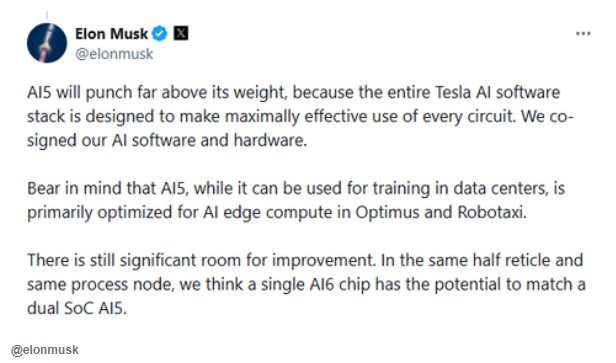
Group 1 - Elon Musk announced that SpaceX AI and Tesla (TSLA.US) will continue to make large-scale purchases of NVIDIA (NVDA.US) chips [1] - Tesla is developing its fifth-generation AI chip aimed at achieving full autonomous driving, which will power its autonomous driving system [1] - The AI5 chip is primarily optimized for AI edge computing support for the Optimus humanoid robot and Robotaxi autonomous vehicles, despite its capability for data center model training [1] Group 2 - Musk indicated that there is significant optimization potential for the AI5 chip, with expectations that the performance of a single AI6 chip could reach the level of a dual-core AI5 system under the same design and manufacturing process [1] - Tesla plans to widely roll out an updated version of its full self-driving (supervised version) software in the coming weeks [1] - SpaceX acquired xAI through an all-stock transaction, occurring ahead of a potential large-scale IPO later this year, marking the first time Musk referred to the merged entity as "SpaceX AI" [2]
马斯克自称英伟达和黄仁勋“铁粉”:将继续大规模订购英伟达芯片
Sou Hu Cai Jing· 2026-03-19 03:45
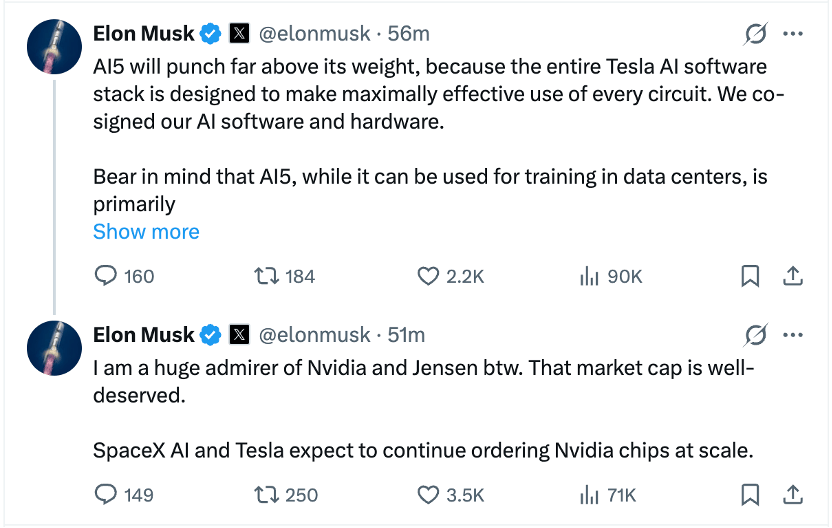
Core Viewpoint - Tesla CEO Elon Musk confirmed that the company will continue to rely heavily on Nvidia's computing chips for the long term, emphasizing the importance of collaboration between AI software and hardware design to maximize circuit efficiency [1] Group 1: Tesla and Nvidia Relationship - Musk stated that both SpaceX and Tesla are expected to continue large-scale orders of Nvidia chips, highlighting a strong partnership between the companies [1] - Musk expressed admiration for Nvidia and its CEO Jensen Huang, affirming the company's market value as "well-deserved" [1] Group 2: AI Industry Context - The GTC conference has evolved into a critical release window for the AI industry, with Nvidia showcasing its latest GPU architecture and solutions, reinforcing its position as an "AI infrastructure platform" [2] - Major tech companies, including Microsoft, Amazon, and Meta, are increasing capital expenditures on AI infrastructure, sustaining high demand for high-performance GPUs [2] Group 3: Tesla's Chip Strategy - Musk reiterated Tesla's strategy of parallel development of in-house and externally sourced chips, aiming for greater control over the entire production process [2] - Tesla's wafer factory, Terafab, is set to start operations within seven days to ensure the production of AI chips [2]
700多亿的商业航天,投不投?
投中网· 2026-03-19 03:44
Core Viewpoint - The article discusses the ongoing boom in China's commercial space industry, highlighting the significant policy support and investment opportunities, while also addressing the challenges and uncertainties faced by companies in this sector [4][5][23]. Group 1: Industry Overview - The commercial space sector in China is experiencing rapid growth, with a focus on developing a trillion-yuan industry cluster by 2025, particularly in areas like Haidian District, which aims to become a global hub for commercial space [4][19]. - The establishment of the Commercial Space Administration and the release of the "Action Plan for Promoting High-Quality and Safe Development of Commercial Space" mark a shift from policy encouragement to systematic advancement [4][18]. - Major cities like Beijing, Guangzhou, and Shanghai are implementing supportive policies to foster the commercial space industry, with Haidian District expected to contribute over 350 billion yuan to the industry by 2024 [4][19]. Group 2: Investment Landscape - The capital market is responding positively to the commercial space sector, with companies like Blue Arrow Aerospace gaining traction and the Shanghai Stock Exchange optimizing listing standards for space companies [4][5]. - Investment strategies are diversifying, with some investors focusing on established companies while others are exploring high-value components within the supply chain [15][16]. - The valuation of leading companies in the sector has surged, with one rocket company reportedly reaching a valuation of over 70 billion yuan, reflecting the intense interest from investors [9][14]. Group 3: Challenges and Opportunities - Despite the growth, the industry faces challenges such as technological hurdles in rocket recovery, supply chain improvements, and balancing manufacturing costs with stability [5][10]. - The commercial viability of satellite companies remains uncertain, with a need for clearer paths to monetization and application expansion [10][12]. - The article emphasizes the importance of patience from investors, as the commercial space sector requires long-term commitment and understanding of the technological complexities involved [21][22]. Group 4: Future Outlook - The future of China's commercial space industry is seen as promising, with potential developments in areas like space mining, space solar power, and space tourism becoming more tangible [5][23]. - The article suggests that while China may be following in the footsteps of SpaceX, there is a need for local innovation and exploration of unique opportunities within the domestic context [23]. - The integration of AI and satellite data, as well as advancements in space computing, are expected to drive further growth and application in the commercial space sector [19][20].

马斯克称SpaceX AI和特斯拉将继续大规模订购英伟达芯片
Xin Lang Cai Jing· 2026-03-19 02:45
Group 1 - Elon Musk announced that SpaceX AI and Tesla are expected to continue large-scale orders of Nvidia chips [1][3] - SpaceX acquired xAI through an all-stock transaction, preparing for a potential large IPO later this year, marking the first time Musk referred to the merged entity as SpaceX AI [1][3] - Tesla is designing its fifth-generation AI chips to power its autonomous driving ambitions, which will support the full self-driving software [1][3] Group 2 - The AI5 chips are optimized primarily for humanoid robots like Optimus and AI edge computing for Robotaxi, although they can also be used for training in data centers [1][3] - Tesla is expected to widely release an update for its full self-driving (supervised) software in the coming weeks [4] - The Terafab project for manufacturing AI chips by Tesla is set to launch within seven days [2][5]
湘财证券晨会纪要-20260319
Xiangcai Securities· 2026-03-19 01:08
Industry Overview - The aerospace industry is witnessing significant advancements, particularly with the introduction of innovative products like the rolled flexible solar wing showcased by the Shanghai Aerospace Technology Research Institute at the Commercial Aerospace Conference in March 2026, highlighting China's capabilities in commercial space technology [2][5] - The rolled flexible solar wing is designed to overcome limitations of traditional rigid or semi-rigid solar wings, achieving breakthroughs in power-to-weight ratio and storage volume, thus enhancing satellite performance and operational lifespan [3][5] Product Highlights - The rolled flexible solar wing is a next-generation lightweight, high-storage, and high-efficiency space energy system, which can be compactly stored during launch and smoothly deployed in orbit, significantly reducing its weight and increasing power output per unit weight [3][5] - This innovation is expected to meet the growing demand for high-power large satellite platforms and commercial space applications, providing promising energy solutions for the future [5] Investment Insights - The competitive landscape in the commercial aerospace sector is intensifying, with companies like SpaceX leading in reusable rockets and low-orbit constellations, prompting domestic players to accelerate their technological advancements [6] - Domestic initiatives, such as the successful first flights of Long March 12 and Zhuque 3 rockets, indicate a shift from technology validation to large-scale commercial operations, supported by national policies and capital investments [6] - The report recommends focusing on core targets within the aerospace electronics industry chain, maintaining an "overweight" rating for the defense and military industry [6]