宁波银行

Search documents
宁波银行首度开展中期分红,近20亿元“红包”回馈投资者
Mei Ri Jing Ji Xin Wen· 2025-12-17 12:07
Core Viewpoint - Ningbo Bank has successfully distributed its first interim cash dividend, amounting to 1.5 billion yuan, reflecting its commitment to shareholder returns and strong financial performance since its listing in 2007 [1] Group 1: Dividend Distribution - The bank distributed a cash dividend of 3 yuan per 10 shares, totaling 1.981 billion yuan based on a total share capital of 6.604 billion shares [1] - This marks the first interim dividend for Ningbo Bank, aligning with its shareholder return plan for 2025-2027 [1] - Cumulatively, the bank has distributed approximately 37.8 billion yuan in cash dividends since its IPO, surpassing the total funds raised through various equity financing methods [1] Group 2: Profit Resilience - Despite industry-wide profit pressures, Ningbo Bank has maintained a solid profit level, supported by a diversified profit structure [2] - The bank has developed nine profit centers, including corporate banking, retail banking, wealth management, and investment banking, enhancing its competitive edge [2] - The bank's net commission income increased by 29.3% year-on-year to 4.85 billion yuan in the first three quarters, driven by wealth distribution and asset management [2] Group 3: Financial Performance - In the first three quarters, Ningbo Bank reported a net profit of 22.445 billion yuan, a year-on-year increase of 8.39%, and operating income of 54.976 billion yuan, up 8.32% [3] - The bank's asset total reached 3.58 trillion yuan by the end of September, a 14.5% increase from the beginning of the year [4] Group 4: Asset Quality - Ningbo Bank has maintained a non-performing loan ratio of 0.76%, remaining stable since the beginning of the year, with a provision coverage ratio of 375.92% [5] - The bank has kept its non-performing loan ratio below 1% for 18 consecutive years, ensuring a strong foundation for sustainable development [5] Group 5: Strategic Focus - The bank emphasizes a differentiated operational strategy, focusing on regional development and supporting the real economy, which has led to significant growth in its asset scale [4] - Ningbo Bank aims to enhance its competitive advantage through a multi-faceted approach to growth and stringent risk management practices [6]

关于黄金交易,多家银行调整
新华网财经· 2025-12-17 11:33
Core Viewpoint - The tightening of personal precious metals trading business by banks acting as agents for the Shanghai Gold Exchange is aimed at managing market risks, complying with regulatory pressures, and fulfilling investor suitability obligations, leading to a more concentrated and mature market structure in precious metals investment [2][5][9]. Group 1: Bank Adjustments - Several banks, including Industrial and Commercial Bank of China (ICBC), have announced adjustments to their personal precious metals trading business, actively clearing inactive "three-no" clients (no positions, no inventory, no debts) [4]. - ICBC's announcement indicates that from December 19, 2025, it will transfer the balances of these clients' margin accounts to their linked settlement accounts and terminate related business functions [4]. - Other banks such as Agricultural Bank of China and China Postal Savings Bank have also made similar announcements regarding the termination of agreements with inactive clients [4]. Group 2: Market Implications - Experts believe that the banks' actions will lead to a reduction in speculative trading and a reassessment of risk-return characteristics of gold investments by individual investors [7][8]. - The tightening of bank channels may result in a decrease in trading volume and liquidity in the short term, but it is expected to guide funds towards more transparent and compliant markets in the long term [8][9]. - The exit of individual investors is likely to concentrate market participants among institutional clients, leading to more rational trading behavior and potentially reducing market volatility [9]. Group 3: Business Transformation - The retail precious metals business of banks is undergoing a transformation from trading channels to asset allocation services, moving away from high-risk, high-leverage trading towards more stable financial products like gold ETFs [11][12]. - This shift indicates that banks are focusing on providing asset allocation services and standardized financial products rather than merely facilitating trading and selling physical gold [12]. - The future development of bank precious metals business is expected to remain significant, with opportunities in promoting lower-risk investment products that meet residents' demand for gold as a hedge and asset allocation [12].


多家银行清理“休眠账户”
Sou Hu Cai Jing· 2025-12-17 10:12
Core Viewpoint - The adjustment by Industrial and Commercial Bank of China (ICBC) to close "three-no" customer gold trading functions reflects a tightening trend in the gold trading business among major banks due to market risk volatility, tax compliance pressures, and changes in investor demand structure [1][2]. Group 1: ICBC's Adjustments - ICBC announced the closure of gold trading functions for customers with no positions, no inventory, and no debts but still holding funds in their accounts, effective December 19 [1]. - Customers are required to withdraw their funds, and the bank will terminate related business agreements, while existing positions will not be affected [1]. - This move aims to enhance account management efficiency and reduce the risk of idle customer funds, aligning with regulatory requirements for fund safety and transparency [2]. Group 2: Industry-Wide Trends - Other banks, including Everbright Bank, China Construction Bank, and Postal Savings Bank, have also taken similar actions to tighten personal gold trading services [2]. - Postal Savings Bank announced the cessation of related services, requiring customers to close positions by October 31, while Citic Bank and Ningbo Bank have also initiated account clean-ups for inactive customers [2]. - The tightening of these services is attributed to the high risk and volatility in the gold market, as well as the low entry barriers for leveraged products, making it difficult for banks to verify customer investment capabilities [2]. Group 3: Brand Gold Sales Exit - Following the implementation of new gold tax regulations, Hengfeng Bank announced it will cease brand gold sales starting December 22, marking the first bank to exit this business since the new policy [3]. - The new tax regulations have increased operational complexity and risk for banks, prompting some to withdraw from brand gold sales due to compliance pressures [3]. - Despite significant price increases in precious metals this year, the volatility has led to a decline in brand gold sales, with expectations that more banks may follow suit in exiting this market segment [3].

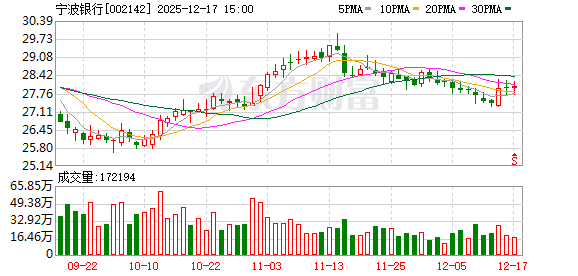
年初至今股价涨幅超20%的宁波银行正式实施分红,每10股派发现金红利3元
Zheng Quan Shi Bao· 2025-12-17 07:48
Core Viewpoint - Ningbo Bank has announced a cash dividend distribution, joining the trend of A-share listed banks increasing their dividend payouts, with a total expected payout exceeding 260 billion yuan across more than 20 banks [1][2] Group 1: Dividend Distribution - Ningbo Bank will distribute a cash dividend of 3 yuan per 10 shares to shareholders registered by December 16, based on a total share capital of 6.6036 billion shares [1] - The trend of increased dividend payouts is supported by regulatory encouragement for banks to enhance dividend frequency and amounts, attracting more dividend-sensitive investments [1] Group 2: Financial Performance - As of September 30, 2025, Ningbo Bank's total assets reached 3.578396 trillion yuan, marking a 14.5% increase from the beginning of the year [2] - The bank's loan and deposit growth rates are both above 10%, with total loans and advances at 1.716823 trillion yuan (up 16.31%) and total deposits at 2.047804 trillion yuan (up 11.52%) [2] - The bank maintains a low non-performing loan ratio of 0.76% and a provision coverage ratio of 375.92%, indicating strong asset quality and risk mitigation capabilities [2] Group 3: Market Performance - Ningbo Bank's stock price has increased over 20% year-to-date, with a current price-to-earnings ratio of 6.38 and a price-to-book ratio of 0.85, alongside a dividend yield of approximately 3.2% [1] - The bank's net interest margin stands at 1.76%, outperforming the industry average of 1.42% and the city commercial bank average of 1.37%, showcasing its competitive edge in profitability [2]
宁波银行实施2025年中期分红 每10股派发现金红利3元
Zheng Quan Ri Bao· 2025-12-17 07:45
Core Viewpoint - Ningbo Bank has announced its first-ever mid-year dividend distribution plan, reflecting a commitment to returning value to shareholders through cash dividends [2] Group 1: Dividend Distribution - The bank will distribute a cash dividend of 3 RMB per 10 shares to all ordinary shareholders, based on a total share capital of 660,359.08 million shares [2] - The total cash dividend payout amounts to 1.981 billion RMB [2] - This marks the first implementation of a mid-year dividend distribution by Ningbo Bank [2]
宁波银行(002142) - 2025年12月17日投资者关系活动记录表
2025-12-17 07:20
Group 1: Loan Growth and Financial Services - The company has focused on supporting key sectors such as private small and micro enterprises, manufacturing, import-export businesses, and consumer services, leading to steady loan growth [2] - Future loan growth is expected to be maintained due to ongoing policy support aimed at expanding domestic demand and promoting consumption [2] Group 2: Refinancing and Internal Growth - The company emphasizes a balanced approach between dividends and internal capital growth, ensuring a solid capital foundation for sustainable development [2] - Internal capital is projected to create greater value for the company, with a commitment to enhancing performance and providing returns to shareholders [2] Group 3: Asset Quality Outlook - The company acknowledges new challenges in asset quality management due to economic fluctuations and external conditions [2] - A focus on risk management and a robust credit risk monitoring system is in place to maintain asset quality at a favorable level within the industry [2] Group 4: Compliance and Disclosure - The company ensured that all communications during the investor relations activity adhered to disclosure regulations, with no significant undisclosed information leaked [2]
19.81亿真金白银回馈!宁波银行首推中期分红,每10股派3元12月17日到账
Jin Rong Jie Zi Xun· 2025-12-17 07:05
Core Viewpoint - Ningbo Bank has announced its first-ever mid-term dividend plan since its listing in 2007, distributing a cash dividend of 3 yuan per 10 shares, marking a significant step in returning value to shareholders [1][3]. Dividend Plan Details - The total dividend payout amounts to 1.981 billion yuan, with the record date set for December 16, 2025, and the dividend payment date on December 17, 2025 [2][3]. - Different tax arrangements apply to various types of shareholders, with specific amounts for Hong Kong investors and domestic investors based on their holding periods [2]. Financial Performance - As of September 2025, Ningbo Bank reported total assets of 3.58 trillion yuan, a 14.50% increase from the beginning of the year, with deposits and loans also showing significant growth [4]. - The bank achieved an operating income of 54.976 billion yuan and a net profit of 22.445 billion yuan, both reflecting year-on-year growth of over 8% [4]. Risk Management and Stability - The bank maintains a low non-performing loan ratio of 0.76%, having kept it below 1% for 18 consecutive years, indicating strong asset quality [4]. - The diversified equity structure and stable management team contribute to the bank's strategic resilience and competitive advantage in profitability [4]. Market Significance - The mid-term dividend reflects the company's commitment to shareholder returns amid regulatory encouragement for increased dividends among listed companies [3][5]. - This initiative positions Ningbo Bank as a benchmark for shareholder returns within the city commercial bank sector, enhancing its investment appeal [3][5].
又一消金公司,计划大规模增资
Zheng Quan Shi Bao· 2025-12-17 04:33
Core Viewpoint - Changyin 58 Consumer Finance plans to raise capital up to 1.55 billion yuan to enhance its capital strength and risk resistance capabilities, with the final amount subject to regulatory approval [1][2][3]. Group 1: Capital Increase Details - Changyin 58's registered capital will increase from 1.124 billion yuan to 1.945 billion yuan after the capital increase and share transfer [1][3]. - The shareholding of Changsha Bank will rise from 56.66% to 80.82%, while Beijing Wanglin and Tongcheng Holdings will see their shares decrease to 15.27% and 3.91%, respectively [3]. - The capital increase is priced at 1.8877 yuan per share, with Tongcheng Holdings planning to transfer 114 million shares to Changsha Bank for approximately 215 million yuan [2][3]. Group 2: Historical Context and Regulatory Changes - Changyin 58 was established in early 2017 with an initial registered capital of 300 million yuan, with Changsha Bank holding 51% [2]. - The company underwent a capital increase in 2019, raising its capital to 900 million yuan while maintaining the same shareholding structure [2]. - The revised "Consumer Finance Company Management Measures" will raise the minimum registered capital requirement from 300 million yuan to 1 billion yuan, effective March 2024 [2]. Group 3: Financial Performance - As of the end of last year, Changyin 58 had total assets of approximately 29.62 billion yuan, with a projected revenue of about 3 billion yuan and a net profit of 34 million yuan, reflecting a year-on-year decline of 7.6% and 95%, respectively [3]. - By the end of September this year, the company's asset scale expanded to over 34.6 billion yuan, with a net profit of 21 million yuan for the first three quarters [3]. Group 4: Industry Trends - At least seven other consumer finance companies have completed capital increases this year, indicating a trend towards strengthening capital bases across the industry [4][5][6]. - The regulatory environment is pushing companies to enhance their capital strength to meet new requirements, as seen in the recent issuance of the "Consumer Finance Company Regulatory Rating Measures" [7].

多家银行调整代理上金所贵金属业务,重点“清理”无持仓不动户
Jing Ji Guan Cha Wang· 2025-12-17 04:31
Core Viewpoint - The tightening of personal precious metals trading by banks acting as agents for the Shanghai Gold Exchange is aimed at managing market risks, complying with regulatory pressures, and fulfilling investor suitability obligations, leading to a more concentrated and mature market structure focused on institutional clients [1][3]. Group 1: Bank Adjustments - Several banks, including Industrial and Commercial Bank of China (ICBC), have announced adjustments to their personal precious metals trading business, actively clearing inactive "three-no" clients (no positions, no inventory, no debts) [2][3]. - ICBC's announcement states that from December 19, 2025, it will transfer the balances of these clients' margin accounts to their linked settlement accounts and terminate related business functions [2][3]. - Other banks such as Agricultural Bank of China and China Postal Savings Bank have also made similar announcements regarding the termination of agreements with inactive clients [2]. Group 2: Market Implications - Experts believe that the exit of personal investors from bank channels may lead to a decrease in trading volume and a return of margin funds, while also pushing investors towards futures companies, brokerages, or physical gold platforms, accelerating the differentiation and specialization of precious metals investment channels [4][5]. - The adjustments are expected to help investors reassess the risk-return characteristics of gold investments, promoting a shift from short-term speculation to long-term asset allocation [4][5]. Group 3: Transformation of Banking Precious Metals Business - The retail side of banking precious metals business is transitioning from a trading channel to asset allocation services, moving away from high-risk, high-leverage products towards more stable financial products like gold ETFs [5]. - This shift indicates a transformation in the retail precious metals business model from providing trading channels and physical sales to offering asset allocation services and standardized financial products [5]. - Future growth opportunities for banks in the precious metals sector include promoting lower-risk investment products such as accumulated gold and physical gold bar sales, catering to residents' demand for hedging and asset allocation [5].




又一消金公司,计划大规模增资
证券时报· 2025-12-17 04:14
Core Viewpoint - Changyin 58 Consumer Finance plans to raise capital up to 1.55 billion yuan to enhance its capital strength and risk resistance, with the registered capital increasing from 1.124 billion yuan to 1.945 billion yuan after the capital increase and share transfer [1][4]. Group 1: Capital Increase Details - Changsha Bank announced a plan to invest up to 1.55 billion yuan in Changyin 58, with the final amount subject to regulatory approval [1][4]. - The capital increase will be priced at 1.8877 yuan per share, and after the completion, Changsha Bank's shareholding will rise from 56.66% to 80.82% [1][4]. - The remaining shareholders, including Tongcheng Holdings and Beijing Wanglin, will not participate in this round of capital increase [1][4]. Group 2: Historical Context - Changyin 58 was established in early 2017 with an initial registered capital of 300 million yuan, with Changsha Bank holding 51% [3]. - The company underwent a capital increase in 2019, raising its capital to 900 million yuan while maintaining the same shareholding structure [3]. - Following the release of the revised "Management Measures for Consumer Finance Companies," which raised the capital threshold to 1 billion yuan, Changyin 58 was the first to disclose a capital increase plan, raising its capital to 1.124 billion yuan in October 2024 [3]. Group 3: Financial Performance - As of the end of last year, Changyin 58 had total assets of approximately 29.62 billion yuan, with a revenue of about 3 billion yuan and a net profit of 34 million yuan, reflecting a year-on-year decline of 7.6% and 95% respectively [4]. - By the end of September this year, the company's asset scale expanded to over 34.6 billion yuan, with a net profit of 21 million yuan for the first three quarters [4]. Group 4: Industry Trends - In addition to Changyin 58, at least seven other consumer finance companies have completed capital increases this year, indicating a trend in the industry towards strengthening capital bases [6][8]. - The revised regulations and the new regulatory rating measures emphasize the importance of capital management, which will influence the operational scope of consumer finance companies [9].