
康方生物

Search documents
风险还是机遇?AH医药集体杀跌!药明康德重挫,医疗ETF下穿3根均线!创新药反攻未果,520880溢价飙逾1%
Xin Lang Ji Jin· 2025-10-10 12:54
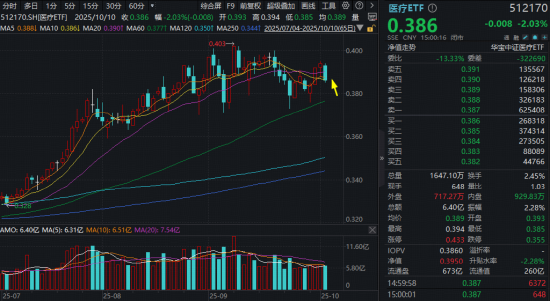
Market Overview - A-shares and Hong Kong stocks experienced synchronized fluctuations, with the Shanghai Composite Index falling below 3900 points and the ChiNext Index dropping by 4.55% [1] - The AH pharmaceutical sector declined across the board, with major players like WuXi AppTec leading the drop at 7.2% [1] - The largest medical ETF (512170) saw a decrease of 2.03%, halting its three-day upward trend, with a total trading volume of 640 million yuan [1] Pharmaceutical Sector Performance - The A-share pharmaceutical sector showed relative resilience, primarily due to traditional Chinese medicine stocks performing well, with companies like China Resources Sanjiu and Jilin Aodong rising over 2.5% [3] - Innovative drug stocks faced more declines than gains, with BeiGene (BGNE) leading the drop at 6.2% [3] - The only drug ETF in the market (562050) fell by 1.07%, indicating increased buying interest as evidenced by 2.23 million yuan of funds entering on dips [3] Innovation Drug Sector Insights - The innovative drug sector, previously a strong performer, has entered a phase of adjustment since September, but investor interest remains high [5] - The Hong Kong Innovation Drug ETF (520880) has attracted over 675 million yuan in the last 20 days, indicating strong buying momentum despite recent declines [5] - Analysts suggest that the short-term adjustment is due to profit-taking after significant gains and a lack of catalysts, but the long-term outlook remains positive [7] Future Catalysts and Strategies - Upcoming academic conferences, such as ESMO and ASH, are expected to reignite interest in the innovative drug sector [8] - The fourth quarter will see the implementation of various policies, including adjustments to medical insurance directories, which may accelerate support for domestic innovations [8] - Investment strategies focus on identifying companies with strong Q3 performance and exploring opportunities in the innovative drug sector for potential rebounds [8] ETF Performance and Characteristics - The Hong Kong Innovation Drug ETF (520880) is fully invested in innovative drug development companies, while the drug ETF (562050) balances innovative and traditional Chinese medicine stocks [9] - The medical ETF (512170) includes medical devices and services, with a significant portion allocated to CXO [9] - As of September 30, 2025, the medical ETF has a scale of 26.4 billion yuan, making it the largest in the pharmaceutical category [10]


维立志博康小强:不卷PD-1,领跑肿瘤免疫治疗2.0 | 进击的创新药企
经济观察报· 2025-10-10 12:25
Core Viewpoint - The article discusses the innovative strategies and advancements of Weilizhibo, a Chinese biopharmaceutical company focused on cancer immunotherapy, particularly in developing next-generation therapies that address limitations of existing PD-(L)1 treatments [4][5][6]. Group 1: Company Overview - Weilizhibo has 14 candidate innovative drugs, with 4 in the top three of global clinical progress, aiming to become first-in-class drugs [6][7]. - The company was founded by Kang Xiaoqiang and Lai Shoupeng in 2012, focusing on cancer immunotherapy after extensive research in the U.S. [8][9]. Group 2: Market Context - The global market for innovative drugs is rapidly evolving, with significant investment interest, particularly in the field of cancer immunotherapy [4]. - The PD-(L)1 inhibitors have shown a response rate of only about 20%, indicating a substantial unmet need in cancer treatment [6][10]. Group 3: Strategic Focus - Weilizhibo aims to address cancers that do not respond to PD-(L)1 therapies, focusing on alternative immune checkpoint inhibitors like LAG-3 and 4-1BB [10][11]. - The company has developed three core technology platforms: IO2.0, TCE, and ADC, which are expected to define the future of oncology [11][12]. Group 4: Clinical Progress - The PD-L1/4-1BB dual antibody (LBL-024) is currently in Phase III clinical trials and has shown promising results, with an objective response rate of 75% in a recent study [12][19]. - Weilizhibo's GPRC5D/CD3 dual antibody has completed Phase II trials and received orphan drug designation from the FDA, indicating its potential in treating multiple myeloma [19][20]. Group 5: Financial Strategy - Weilizhibo has successfully completed multiple funding rounds, raising a total of 1.084 billion yuan, with a significant increase in valuation from 40 million yuan in 2015 to 3.1 billion yuan in 2024 [15][16]. - The company strategically increased its IPO fundraising target to 189 million USD due to favorable market conditions, resulting in a successful listing on the Hong Kong Stock Exchange [16][17]. Group 6: Future Outlook - The company plans to expand its indications from rare cancers to larger cancer types, with a goal of submitting a biological license application by Q3 2026 [20][21]. - Weilizhibo intends to adopt a light-asset strategy for commercialization, collaborating with CDMOs for production while considering establishing its own facilities in the future [21][22].

维立志博康小强:不卷PD-1,领跑肿瘤免疫治疗2.0 | 进击的创新药企
Jing Ji Guan Cha Wang· 2025-10-10 08:58
Core Insights - The article discusses the rise of innovative drug companies in China, particularly in the field of cancer immunotherapy, as they shift from following trends to pioneering original research and development [2] Company Overview - Leads Biolabs, a Chinese company focused on tumor immunotherapy, is currently in clinical stages and aims to address diseases that existing PD-(L)1 therapies cannot treat [3][5] - The company has 14 candidate innovative drugs, with 4 in the top three of global clinical progress, potentially becoming first-in-class drugs [5] Market Context - The PD-(L)1 target has become highly competitive, with 20 approved monoclonal antibodies in China, yet the response rate for PD-(L)1 monotherapy is only about 20%, leaving a significant portion of patients without effective treatment [4][10] - The global sales of the PD-1 drug "K" reached approximately $32.056 billion in 2024, highlighting the lucrative nature of immunotherapy [3] Strategic Focus - The company has chosen to focus on LAG-3 and other targets instead of PD-(L)1, aiming to develop unique therapies that can address the limitations of existing treatments [10][11] - The company has established three core technology platforms: IO2.0 (4-1BB), TCE (CD3), and ADC (antibody-drug conjugates), which are expected to define the future of oncology [10][16] Clinical Development - The PD-L1/4-1BB dual antibody (code LBL-024) is currently in Phase III clinical trials in China, showing promising results with a 75% objective response rate and a 92.3% disease control rate in a recent study [11][12] - The company plans to submit a biological product license application to the Chinese regulatory authority in Q3 2026, with conditional approval expected by Q2 2027 [17] Financing and IPO - Leads Biolabs has completed 8 rounds of financing, raising a total of 1.084 billion yuan, with a significant increase in valuation from 40 million yuan in 2015 to 3.1 billion yuan in 2024 [13][14] - The company went public in July 2025, initially aiming to raise $100 million but increasing the target to $189 million due to market conditions, achieving a record subscription rate on its first trading day [15] Future Outlook - The company aims to expand its indications from rare cancers to larger cancer types, with plans to target 8 indications this year and 10 next year [17] - The commercialization strategy involves a light asset approach, collaborating with CDMOs for production while considering establishing its own manufacturing base in the future [18]

医药股延续跌势 诺诚健华跌超11% 荣昌生物跌超10%
Zhi Tong Cai Jing· 2025-10-10 06:37
Core Viewpoint - Pharmaceutical stocks have declined again, with significant drops in various companies' stock prices, indicating a challenging market environment for the sector [1] Group 1: Stock Performance - Nocera Health (09969) fell by 11.37%, trading at HKD 14.73 [1] - Saint Noble Pharmaceuticals-B (02257) decreased by 11.05%, trading at HKD 13.36 [1] - Rongchang Biopharmaceutical (09995) dropped by 10.4%, trading at HKD 95.15 [1] - Gilead Sciences-B (01672) declined by 8.57%, trading at HKD 9.6 [1] - Viatris (01873) fell by 8.14%, trading at HKD 2.82 [1] Group 2: Investment Trends - According to CMB International, domestic investors have increased their holdings in pharmaceutical stocks through the Hong Kong Stock Connect since September, while foreign investment has slightly decreased since mid-year [1] - The overall trend of increasing investment in innovative drugs remains unchanged for both domestic and foreign investors [1] Group 3: Future Outlook - The ESMO conference is scheduled for mid to late October, with a recommendation to focus on companies like CanSino Biologics, Kelun-Biotech, Rongchang Biopharmaceutical, and Hengrui Medicine (600276) that are expected to release significant data [1] - The pharmaceutical sector in Hong Kong has shown relatively flat performance in September, but with the increase in industry catalysts (various academic conferences and favorable policies), the market is expected to rebound in October [1] Group 4: Market Analysis - Dongguan Securities reports that the pharmaceutical and biotechnology sector has consistently underperformed compared to the CSI 300 index, with some previously high-performing innovative drug companies experiencing corrections [1] - The medical research outsourcing sector has been strengthening due to improved expectations of U.S. interest rate cuts and better financing data, entering a performance vacuum period [1] - Future investment opportunities are suggested in innovative drugs and sectors with expected business development catalysts [1]

港股异动 | 医药股延续跌势 诺诚健华(09969)跌超11% 荣昌生物(09995)跌超10%
智通财经网· 2025-10-10 06:37
Core Viewpoint - The pharmaceutical sector is experiencing a decline, with significant drops in stock prices for various companies, while there is an increasing trend in domestic investment through the Hong Kong Stock Connect, indicating a mixed sentiment in the market [1]. Group 1: Stock Performance - Notable declines in pharmaceutical stocks include: - Innovent Biologics (09969) down 11.37% to HKD 14.73 - Sanofi (02257) down 11.05% to HKD 13.36 - Rongchang Biopharmaceutical (09995) down 10.4% to HKD 95.15 - Galenica (01672) down 8.57% to HKD 9.6 - Viatris (01873) down 8.14% to HKD 2.82 [1]. Group 2: Investment Trends - According to CICC, since September, the proportion of domestic investors holding pharmaceutical stocks through the Hong Kong Stock Connect has been increasing, while foreign investment has slightly decreased since mid-year [1]. - Despite the decline, the overall trend of increasing investment in innovative drugs remains unchanged [1]. Group 3: Future Outlook - The upcoming ESMO conference in mid-October is highlighted as a key event, with recommendations to focus on companies like CanSino Biologics, Kelun-Biotech, Rongchang Biopharmaceutical, and Heng Rui Medicine, which are expected to release significant data [1]. - Dongguan Securities reports that the pharmaceutical and biotechnology sector has underperformed compared to the CSI 300 index, with some previously high-performing innovative drug companies experiencing corrections [1]. - The medical research outsourcing sector is showing strength due to improved financing data and expectations of catalysts in innovative drugs, suggesting potential investment opportunities [1].
港股生物医药股继续回调,诺诚健华跌超11%,荣昌生物跌超10%,药明合联、药明生物跌超5%,药明康德跌超4%
Sou Hu Cai Jing· 2025-10-10 06:24
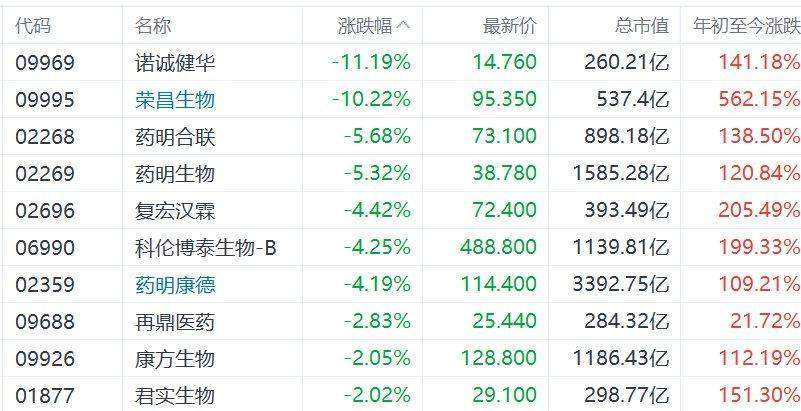
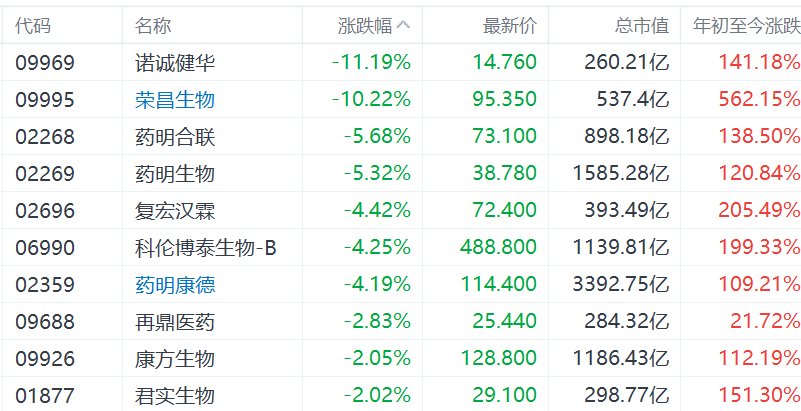
Market Performance - The Hong Kong stock market continued its decline, with notable drops in several biotech companies [1] - Innovent Biologics (09969) fell by 11.19%, closing at 14.760, with a market capitalization of 26.021 billion and a year-to-date increase of 141.18% [2] - Rongchang Biologics (09995) decreased by 10.22%, with a latest price of 95.350 and a total market value of 53.74 billion, reflecting a year-to-date increase of 562.15% [2] - WuXi AppTec (02268) and WuXi Biologics (02269) experienced declines of 5.68% and 5.32%, respectively, with market caps of 89.818 billion and 1585.28 billion [2] - Other companies such as Fuhong Hanlin (02696) and Kelun-Biotech (06990) also saw declines of over 4% [1][2] Company Highlights - Innovent Biologics has shown a significant year-to-date performance increase of 141.18% despite the recent drop [2] - Rongchang Biologics has the highest year-to-date increase among the listed companies at 562.15% [2] - WuXi Biologics and WuXi AppTec have maintained strong year-to-date increases of 120.84% and 138.50%, respectively [2] - Fuhong Hanlin and Kelun-Biotech also reported substantial year-to-date increases of 205.49% and 199.33% [2]
港股生物医药股继续回调,荣昌生物跌超10%
Ge Long Hui A P P· 2025-10-10 06:11
Core Viewpoint - The Hong Kong biopharmaceutical stocks continued to decline, with significant drops in several key companies, indicating a bearish trend in the sector [1]. Group 1: Stock Performance - Innovent Biologics (09969) experienced a decline of 11.19%, with a latest price of 14.760 and a total market capitalization of 26.021 billion, despite a year-to-date increase of 141.18% [2]. - Rongchang Biologics (09995) fell by 10.22%, with a latest price of 95.350 and a market cap of 53.747 billion, showing a remarkable year-to-date increase of 562.15% [2]. - WuXi AppTec (02268) saw a decrease of 5.68%, with a latest price of 73.100 and a market cap of 89.818 billion, maintaining a year-to-date increase of 138.50% [2]. - WuXi Biologics (02269) dropped by 5.32%, with a latest price of 38.780 and a market cap of 158.528 billion, reflecting a year-to-date increase of 120.84% [2]. - Fuhong Hanlin (02696) declined by 4.42%, with a latest price of 72.400 and a market cap of 39.349 billion, showing a year-to-date increase of 205.49% [2]. - Kelun-Biotech (06990) decreased by 4.25%, with a latest price of 488.800 and a market cap of 113.981 billion, with a year-to-date increase of 199.33% [2]. - WuXi AppTec (02359) fell by 4.19%, with a latest price of 114.400 and a market cap of 339.275 billion, reflecting a year-to-date increase of 109.21% [2]. - Gendicine (09688) saw a decrease of 2.83%, with a latest price of 25.440 and a market cap of 28.432 billion, with a year-to-date increase of 21.72% [2]. - CanSino Biologics (09926) declined by 2.05%, with a latest price of 128.800 and a market cap of 118.643 billion, reflecting a year-to-date increase of 112.19% [2]. - Junshi Biosciences (01877) fell by 2.02%, with a latest price of 29.100 and a market cap of 29.877 billion, showing a year-to-date increase of 151.30% [2].
交银国际:外资继续布局中国医药高性价比标的 第四季关注催化剂等
智通财经网· 2025-10-10 03:15
Core Viewpoint - Since September, domestic investors have increased their holdings in pharmaceutical stocks through the Hong Kong Stock Connect, while foreign investment has slightly declined since mid-year. However, the overall trend of increasing investment in innovative drugs remains unchanged [1] Group 1: Investment Trends - Domestic investors are focusing on innovative drug stocks, while foreign investors are also increasing their positions in high-value innovative drug targets and service-related stocks, including CXO companies and "AI + healthcare" concepts [1] - The upcoming ESMO conference in mid to late October is expected to be a catalyst for the industry, with recommendations to focus on companies like CanSino Biologics (09926), Kelun-Biotech (06990), Rongchang Biologics (09995), and Hansoh Pharmaceutical (01276) that are expected to release significant data [1] Group 2: Recommended Sectors - The report suggests a focus on innovative drugs, highlighting companies such as 3SBio (01530) and Eucure Biopharma-B (06996) which have rich short-term catalysts and whose valuations do not yet reflect the value of their core products. Companies like Ascletis Pharma (02096), Hutchison China MediTech (000113), and Legend Biotech are considered significantly undervalued with clear long-term growth logic [1] - In the CXO sector, leading companies benefiting from high downstream demand and marginal recovery in financing, such as WuXi AppTec (02268), are recommended for attention [1]

交银国际每日晨报-20251010
BOCOM International· 2025-10-10 03:04
Core Insights - The report highlights that foreign capital continues to invest in high-cost performance targets within the pharmaceutical sector, suggesting a focus on catalysts and undervalued quality innovation opportunities in Q4 [1][2] - The Hang Seng Healthcare Index increased by 3.1% this week, outperforming the broader market, with medical devices, biopharmaceuticals, and prescription drugs showing superior performance [1] - There is a notable increase in domestic capital holdings in pharmaceutical stocks through the Hong Kong Stock Connect since September, while foreign holdings have slightly decreased since mid-year, indicating a sustained interest in innovative drugs [1][2] Market Review - The report indicates that foreign investors have been increasing their positions in high-cost performance innovative drug targets and service-related companies, particularly those benefiting from potential interest rate cuts and "AI + healthcare" concepts [1] - The upcoming Nobel Prize in Physiology or Medicine awarded for research in Treg and peripheral immune tolerance is expected to further stimulate investment interest in related innovative drug companies [2] - The ESMO conference scheduled for mid to late October is highlighted as a key event, with recommendations to focus on companies like Kangfang Biotech, Kelun-Biotech, Rongchang Biopharma, and Hengrui Medicine, which are expected to release significant data [2] Investment Recommendations - The report recommends focusing on specific segments within the pharmaceutical industry, including: 1. Innovative drugs: Companies like 3SBio and Eucure Biopharma are noted for having rich short-term catalysts and valuations that do not yet reflect the value of their core products [2] 2. CXO: Companies benefiting from high downstream demand and marginal recovery in financing, such as WuXi AppTec, are highlighted as key players in this segment [2]
中芯国际A股,突发!
Mei Ri Jing Ji Xin Wen· 2025-10-09 15:05
Core Viewpoint - SMIC, a leading stock on the STAR Market, has encountered a sudden situation where its A-share margin financing ratio has been adjusted to zero by several major brokerages due to its static price-to-earnings (P/E) ratio exceeding 300 times as of September 30, 2023 [1][4]. Group 1: Margin Financing Adjustments - Major brokerages including CITIC Securities, Guotai Junan, and Huatai Securities have set SMIC's A-share margin financing ratio to zero, following the revised rules from the Shanghai and Shenzhen Stock Exchanges [1][3]. - The adjustment is based on the 2023 revised "Implementation Rules for Margin Financing and Securities Lending Transactions," which stipulates that A-shares with a static P/E ratio above 300 or negative values have a margin financing ratio of zero [4][5]. - Prior to this adjustment, SMIC's A-share margin financing ratio was 70% at Guotai Junan [3]. Group 2: Comparison with Hong Kong Market - In contrast to the A-share market, the Hong Kong market allows brokerages to set their own margin financing ratios, leading to a more flexible environment where SMIC's Hong Kong shares currently have a financing ratio of around 50% [1][6]. - The static P/E ratio for SMIC's Hong Kong shares is 175 times, which does not trigger a reduction in the financing ratio under the current rules [8]. - Other stocks with static P/E ratios exceeding 300 in the Hong Kong market, such as Hua Hong Semiconductor, still qualify for margin financing, indicating a disparity in regulatory approaches between the two markets [10][12]. Group 3: Investor Implications - Investors holding SMIC shares will not be forced to liquidate their positions due to the zero financing ratio, but they may face challenges in opening new positions or obtaining additional financing [5][4]. - If investors' maintenance margin ratio falls below 130%, they may be required to deposit additional collateral or liquidate some assets to maintain their positions [4][5].

