苏州银行

Search documents
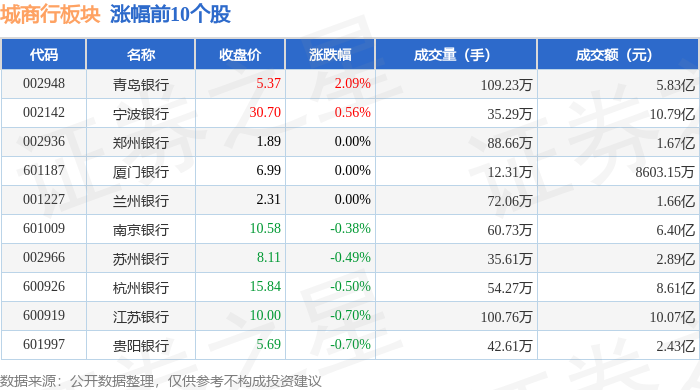
城商行板块2月3日跌0.59%,重庆银行领跌,主力资金净流入1.74亿元
Zheng Xing Xing Ye Ri Bao· 2026-02-03 09:03
Market Overview - The city commercial bank sector experienced a decline of 0.59% on February 3, with Chongqing Bank leading the drop [1] - The Shanghai Composite Index closed at 4067.74, up by 1.29%, while the Shenzhen Component Index closed at 14127.1, up by 2.19% [1] Individual Bank Performance - Qingdao Bank closed at 5.37, with an increase of 2.09% and a trading volume of 1.09 million shares, totaling a transaction value of 583 million yuan [1] - Ningbo Bank closed at 30.70, up by 0.56%, with a trading volume of 352,900 shares and a transaction value of 1.079 billion yuan [1] - Chongqing Bank closed at 10.18, down by 1.83%, with a trading volume of 122,900 shares and a transaction value of 125 million yuan [2] - Chengdu Bank closed at 15.82, down by 1.62%, with a trading volume of 447,000 shares and a transaction value of 710 million yuan [2] Capital Flow Analysis - The city commercial bank sector saw a net inflow of 174 million yuan from institutional investors, while retail investors experienced a net outflow of 322 million yuan [2] - The main capital inflow and outflow for individual banks showed that Hangzhou Bank had a net inflow of 104.1 million yuan from institutional investors, while retail investors had a net outflow of 63.65 million yuan [3] - Chengdu Bank had a net inflow of 75.59 million yuan from institutional investors, with a net outflow of 66.56 million yuan from retail investors [3]


银行业韧性凸显 增长可期
Jin Rong Shi Bao· 2026-02-03 01:49
Core Viewpoint - The performance reports of listed banks for 2025 reveal a resilient banking sector, with significant growth in profitability, particularly among small and medium-sized banks, providing insights for predicting the industry's trajectory in 2026 [1][2]. Group 1: Profitability and Growth - All ten listed banks reported positive growth in net profit, with nine achieving increases in both operating income and net profit [2]. - City commercial banks led the profitability growth, with Qingdao Bank showing a 21.66% increase in net profit, while Hangzhou Bank, Ningbo Bank, and Nanjing Bank reported growth rates of 12.05%, 8.13%, and 8.08% respectively [2]. - National joint-stock banks exhibited steady growth, with Shanghai Pudong Development Bank leading at 10.52% net profit growth, followed by CITIC Bank, China Merchants Bank, and Industrial Bank with growth rates of 2.98%, 1.21%, and 0.34% respectively [2]. Group 2: Revenue Structure Optimization - Revenue structure optimization was a key driver for many banks' performance, with Ningbo Bank's net fee and commission income reaching 6.085 billion yuan, a 30.72% year-on-year increase [3]. - Shanghai Pudong Development Bank improved its asset-liability management and reduced funding costs, stabilizing its net interest margin [3]. - Asset expansion was notable, with China Merchants Bank surpassing 13 trillion yuan in total assets, and several small and medium-sized banks showing significant growth rates in total assets, such as Qingdao Bank at 18.12% [3]. Group 3: Credit Growth and Asset Quality - Accelerated credit issuance was identified as a core driver for asset expansion among small banks, with strong demand in quality regions supporting growth [4]. - Asset quality remained stable, with five banks reporting a decrease in non-performing loan ratios, and overall fluctuations were kept within single-digit basis points [5][6]. - Notably, CITIC Bank and China Merchants Bank saw their non-performing loan ratios decrease by 1 basis point to 1.15% and 0.94% respectively, while the provisioning coverage ratios for several banks remained well above regulatory requirements [6]. Group 4: Future Outlook and Strategic Focus - Analysts predict a positive outlook for the banking sector in 2026, emphasizing the importance of loan growth, particularly in corporate lending, and the stability of asset quality [8]. - Major state-owned banks are focusing on developing differentiated strategies and enhancing operational efficiency as part of their 2026 goals [9][10]. - National joint-stock banks and local small and medium-sized banks aim to optimize their business structures and diversify income sources to improve profitability stability [10].
湘财证券晨会纪要-20260203
Xiangcai Securities· 2026-02-03 00:55
Industry Overview - The banking sector shows signs of recovery in corporate loan growth, with a year-on-year increase of 8.9% in corporate loans by the end of Q4 2025, reflecting a 0.7 percentage point rise from the previous quarter [2] - Infrastructure and service industries are experiencing a rebound in medium to long-term loans, with industrial medium to long-term loans growing by 8.4%, which is 2.2 percentage points higher than the overall loan growth [3] - The growth in loans for infrastructure-related industries reached 6.9%, while service industry loans increased by 7.8%, indicating a positive trend in these sectors [3] Consumer Loans - Household loans showed a modest year-on-year growth of 0.5% by the end of Q4 2025, with operational loans contributing significantly at a 4.0% increase [4] - Consumer loans, excluding personal housing loans, also saw a slight increase of 0.7%, suggesting a stable but weak growth in retail lending [4] Investment Recommendations - With fiscal expansion and the effectiveness of policy tools, corporate loan issuance is expected to improve, leading to a potential "New Year" boost in bank credit [5] - The report highlights the significant value of high dividend yields in bank stocks, suggesting that under a balanced market style, there is potential for valuation recovery [5] - Recommended banks include major state-owned banks and those with strong operational flexibility, such as Industrial and Commercial Bank of China, Bank of China, and others [5]
机构扎堆调研上市银行 信贷投放、净息差等为“最关注”
Xin Lang Cai Jing· 2026-02-02 22:57
Core Viewpoint - The article highlights the ongoing institutional research on listed banks in January, focusing on credit issuance, net interest margin, asset quality trends, and bond investment strategies during the peak marketing season [1][2][7]. Group 1: Institutional Research and Credit Issuance - A total of 373 institutions conducted research on 11 A-share listed banks, with 49 research instances recorded by January 31 [1][7]. - The banks under review include Nanjing Bank, Ningbo Bank, Shanghai Bank, and others, with Nanjing Bank being the most favored, receiving 76 institutional inquiries [2][8]. - Institutions are particularly focused on credit issuance during the marketing peak, with many banks reporting better performance compared to the same period in 2025 [2][8]. - Key areas for credit issuance include manufacturing, infrastructure construction, and green low-carbon transformation projects [3][9]. Group 2: Net Interest Margin Stability - Net interest margin (NIM) is a critical indicator of banking performance, with banks focusing on stabilizing NIM through asset and liability management [4][11]. - Shanghai Bank anticipates a slight decline in NIM due to the expected decrease in loan market quotation rates (LPR) and competitive pressures on deposit pricing [11][12]. - Qilu Bank is optimizing its asset portfolio and enhancing low-cost deposit acquisition to stabilize NIM [11][12]. Group 3: Bond Investment Strategies - The bond market has been volatile since 2025, affecting the bond investment returns of regional small and medium-sized banks [6][12]. - Shanghai Bank expects bond rates to remain in a fluctuating range in 2026, with limited potential for a trend reversal [6][13]. - Hu Nong Bank plans to focus on bond investment for asset allocation while employing risk management strategies, including the use of derivatives [6][13]. Group 4: Asset Quality Management - Banks are implementing measures to maintain stable asset quality, including improving the quality of new loans and increasing efforts to manage non-performing loans [6][13].




机构扎堆调研上市银行信贷投放、净息差等为“最关注”
Zheng Quan Ri Bao· 2026-02-02 16:43
Group 1 - In January, 11 A-share listed banks were surveyed by 373 institutions, with a total of 49 survey instances, focusing on credit issuance, net interest margin, asset quality trends, and bond investment strategies during the peak marketing season [1] - The surveyed banks include Nanjing Bank, Ningbo Bank, Shanghai Bank, Hangzhou Bank, Suzhou Bank, Qingdao Bank, Qilu Bank, Xiamen Bank, Hu Nong Bank, Qing Nong Bank, and Zijin Bank, with six banks experiencing stock price increases, led by Qingdao Bank with over 16% growth [2] - Nanjing Bank was the most favored by institutions, receiving 76 surveys, while Shanghai Bank received 75 surveys, indicating strong interest in their credit issuance during the marketing peak [2] Group 2 - The focus of the credit issuance during the peak marketing season is on corporate credit, with banks reporting better performance compared to the same period in 2025, emphasizing manufacturing, infrastructure, and green transformation projects [2][3] - Shanghai Bank anticipates a continued decline in the Loan Prime Rate (LPR) in 2026, which may lead to a slight decrease in net interest margin due to competitive market factors [4] - Qilu Bank aims to stabilize its net interest margin by optimizing asset management and expanding low-cost deposits while managing liabilities effectively [4] Group 3 - The overall pressure on net interest margin for listed banks is expected to ease in 2026, with a narrowing decline anticipated, supported by improvements in funding costs [5] - Shanghai Bank predicts that bond yields will continue to fluctuate within a range in 2026, with low likelihood of a trend reversal [5] - Hu Nong Bank plans to focus on bond investments primarily for allocation, while also employing advanced technologies for trading and risk management [6]
苏州银行(002966) - 2026年2月2日投资者关系活动记录表
2026-02-02 10:08
Group 1: Credit and Deposit Performance - As of the end of September 2025, the personal deposit balance of the group reached CNY 2,560.34 billion, an increase of CNY 326.21 billion, representing a growth rate of 14.60% compared to the beginning of the year [1] - The bank has achieved a good start in credit issuance for 2026, with proactive preparations for the peak season to ensure efficient project approval and implementation [1] Group 2: Asset Quality Management - The bank is committed to maintaining a stable asset quality throughout the year by continuously improving its comprehensive risk management system, optimizing credit policies, and enhancing monitoring and inspection frequency [2] - The bank aims to prevent and mitigate risks in a timely manner to ensure that asset quality remains stable [2] Group 3: Investor Relations and Communication - During the investor relations activity, the company engaged in thorough communication with investors, adhering strictly to regulations and ensuring no undisclosed significant information was leaked [2]
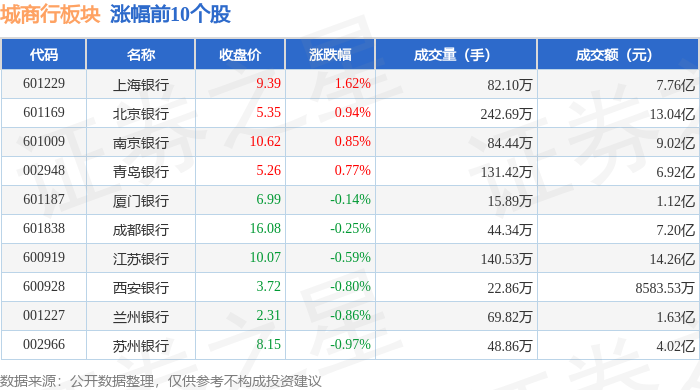
城商行板块2月2日跌0.3%,齐鲁银行领跌,主力资金净流入1792.74万元
Zheng Xing Xing Ye Ri Bao· 2026-02-02 09:15
Market Overview - On February 2, the city commercial bank sector declined by 0.3% compared to the previous trading day, with Qilu Bank leading the decline [1] - The Shanghai Composite Index closed at 4015.75, down 2.48%, while the Shenzhen Component Index closed at 13824.35, down 2.69% [1] Individual Bank Performance - Shanghai Bank (601229) closed at 66.6, up 1.62% with a trading volume of 821,000 shares and a transaction value of 776 million [1] - Beijing Bank (601169) closed at 5.35, up 0.94% with a trading volume of 2.4269 million shares and a transaction value of 1.304 billion [1] - Nanjing Bank (6001009) closed at 10.62, up 0.85% with a trading volume of 844,400 shares and a transaction value of 902 million [1] - Qilu Bank (601665) closed at 5.73, down 1.55% with a trading volume of 715,600 shares and a transaction value of 415 million [2] - Hangzhou Bank (600926) closed at 15.92, down 1.49% with a trading volume of 521,800 shares and a transaction value of 840 million [2] Capital Flow Analysis - The city commercial bank sector saw a net inflow of 17.93 million from institutional investors, while retail investors experienced a net outflow of 157.95 million [2] - Major banks like Shanghai Bank and Jiangsu Bank had significant net inflows from institutional investors, with Shanghai Bank receiving 71.52 million, accounting for 9.22% of its total [3] - Conversely, retail investors showed a notable outflow from several banks, including Beijing Bank, which saw a retail net outflow of 64.17 million, representing 4.92% [3]


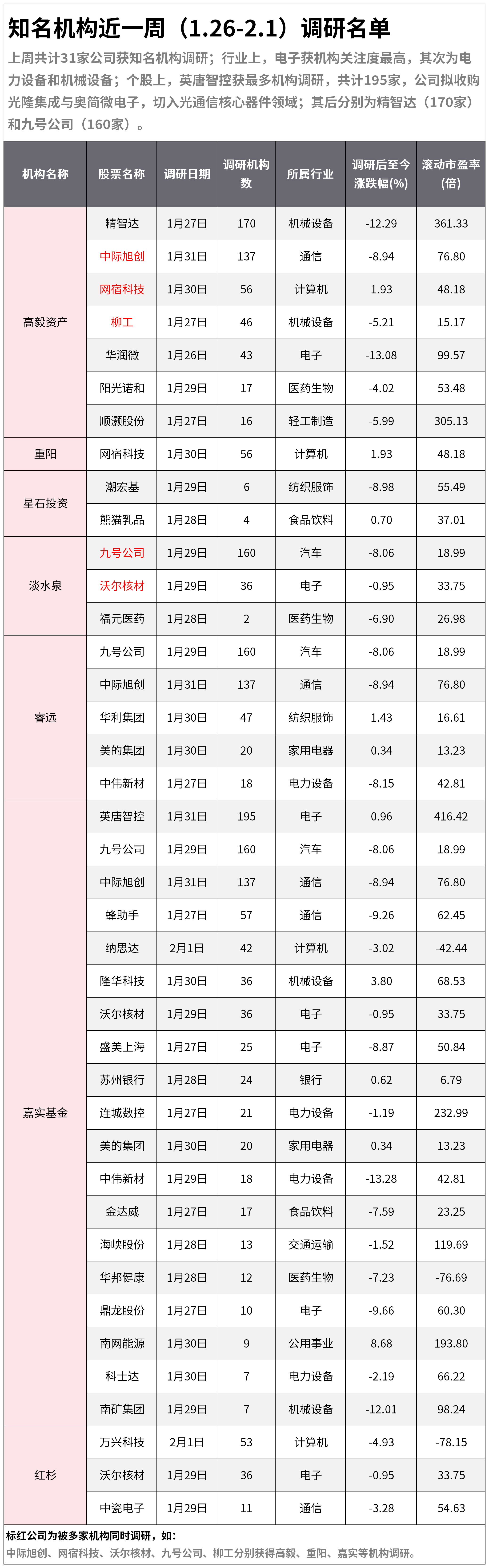
知名机构近一周(1.26-2.1)调研名单:机构扎堆这只芯片设计小龙头
Xuan Gu Bao· 2026-02-02 08:36
Group 1 - A total of 31 companies were investigated by well-known institutions in the past week (January 26 - February 2) [1] - The industries with significant attention included power equipment and machinery [1] - Notable companies receiving the most attention included Ying Tang Zhi Kong, Guanglong Integrated, and Ao Jian Microelectronics, which are involved in core optical communication components [1] Group 2 - The top companies by the number of institutional investigations included: - Jingzhida and Zhongji Xuchuang with 170 and 137 investigations respectively [2] - Wangsu Technology with 56 investigations [2] - Liu Gong with 46 investigations [2] - China Resources Microelectronics with 43 investigations [2] - Other companies of interest included: - Sunshine Nuohe with 17 investigations [3] - Shunhao Co. with 16 investigations [3] - Panda Dairy with 4 investigations [3] - Ninebot Company with 160 investigations on multiple occasions [3][4] - Additional companies receiving attention included: - Midea Group with 20 investigations [5] - Jin Da Wei with 17 investigations [5] - Huaneng Energy with 9 investigations [5]


银行“年终奖理财”卷疯,有人2万元定投黄金
Xin Lang Cai Jing· 2026-02-02 08:12
来源:时代财经APP 岁末更替之际,职场人期盼的2025年年终奖陆续到账,年终奖理财市场持续升温。 时代财经梳理发现,国有大行、股份行、城商行及理财子公司等金融机构,近期纷纷加码推出年终奖专 属产品与服务。其中,交银理财的 "新薪宝" 系列 1 元起购,部分产品成立以来年化达 4.91%;中信银 行深圳分行推 PR1-PR2 级产品,近三月年化最高 2.13%,叠加三重礼至高享 860.6 元权益;浦发银行马 年贺岁存单 1 万起投,3 年期年利率 1.75%;苏州银行自营及代销产品覆盖1.68%-12.32%不同收益区 间。 与此同时,低利率环境下,居民理财更趋理性,稳健优先、分层配置成主流,对确定性收益的追求愈发 凸显。 普益标准研究员付翘楚向时代财经表示,近期银行年终奖理财营销策略有两大变化:一是整合存款、理 财、基金等全品类金融产品,提供覆盖多场景的一站式综合资产配置方案;二是聚焦专业服务,不简单 罗列产品,而是基于客户风险偏好与资金用途,提供专属配置策略与投资逻辑。 机构争相布局:从"单品比拼"到"场景化配资产"转型 面对集中释放的年终奖理财需求,各类金融机构精准发力,不再局限于单一产品推销,而是聚 ...

机器学习因子选股月报(2026年2月)
Southwest Securities· 2026-01-30 07:20
Investment Rating - The report does not explicitly state an investment rating for the industry or specific companies [3]. Core Insights - The top five sectors with the highest excess returns for long positions in January 2026 (excluding comprehensive) are Defense and Military, Communication, Agriculture, Home Appliances, and Electric Equipment & New Energy, with excess returns of 11.41%, 8.40%, 7.85%, 6.01%, and 4.98% respectively [2]. - Over the past year, the sectors with the highest average monthly excess returns (excluding comprehensive) are Real Estate, Home Appliances, Retail, Construction, and Defense and Military, with excess returns of 2.17%, 2.09%, 1.69%, 1.69%, and 1.58% respectively [2]. - The GAN_GRU factor has shown a mean Information Coefficient (IC) of 0.1107 and an annualized excess return of 22.36% from January 2019 to January 2026 [41]. - As of January 28, 2026, the latest IC for the GAN_GRU factor is 0.0003, with a one-year mean IC of 0.0553 [41]. - The top five sectors based on the recent IC performance of the GAN_GRU factor are Defense and Military, Construction, Real Estate, Banking, and Communication, with IC values of 0.3498, 0.2478, 0.2165, 0.1993, and 0.1976 respectively [41]. - The long position combination based on the GAN_GRU factor has shown the highest excess returns in the sectors of Defense and Military, Communication, Agriculture, Home Appliances, and Electric Equipment & New Energy [45]. Summary by Sections GAN_GRU Model Overview - The GAN_GRU model utilizes Generative Adversarial Networks (GAN) for processing time-series features and GRU for encoding these features into stock selection factors [4][13]. GAN_GRU Factor Performance - The GAN_GRU factor has demonstrated significant performance metrics, including a mean IC of 0.1107 and an annualized excess return of 22.36% [41]. - The recent IC rankings for various sectors indicate strong performance in Defense and Military, Construction, and Real Estate [41][45]. Long Position Combinations - The report lists the top ten stocks selected based on the GAN_GRU factor, including companies like Xinhua Insurance, Guanghong Technology, and Guangdong Expressway [50].