
平安银行

Search documents
股份制银行板块11月20日涨0.81%,民生银行领涨,主力资金净流入10.74亿元
Zheng Xing Xing Ye Ri Bao· 2025-11-20 09:04
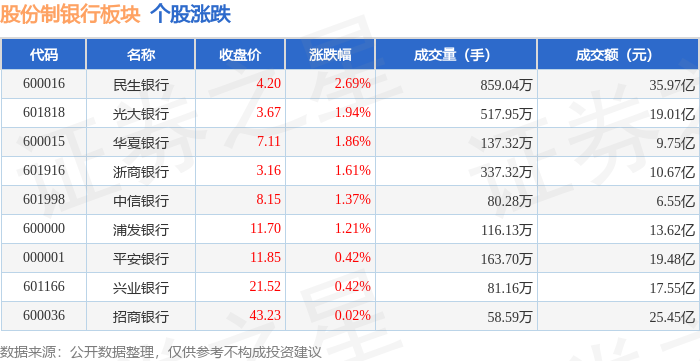
Core Insights - The banking sector saw a rise of 0.81% on November 20, with Minsheng Bank leading the gains [1] - The Shanghai Composite Index closed at 3931.05, down 0.4%, while the Shenzhen Component Index closed at 12980.82, down 0.76% [1] Banking Sector Performance - Minsheng Bank's stock price increased by 2.69% to 4.20, with a trading volume of 8.59 million shares and a transaction value of 3.597 billion [1] - Other notable banks included: - Everbright Bank: closed at 3.67, up 1.94%, with a transaction value of 1.901 billion [1] - Huaxia Bank: closed at 7.11, up 1.86%, with a transaction value of 975 million [1] - Zhejiang Commercial Bank: closed at 3.16, up 1.61%, with a transaction value of 1.067 billion [1] - CITIC Bank: closed at 8.15, up 1.37%, with a transaction value of 655 million [1] Capital Flow Analysis - The banking sector experienced a net inflow of 1.074 billion from main funds, while retail investors saw a net outflow of 451 million [1] - Main fund inflows for specific banks included: - Minsheng Bank: 3.03 billion, with a net outflow from retail investors of 1.10 billion [2] - China Merchants Bank: 2.55 billion, with a net outflow from retail investors of 1.12 billion [2] - Everbright Bank: 1.955 billion from main funds, but a net outflow of 775.33 million from retail investors [2]





黄金税收新规半月观察:金饰价格普遍上涨,金条涨幅不一,银行等渠道金条未明显涨价
Mei Ri Jing Ji Xin Wen· 2025-11-20 08:58
Core Insights - The new tax regulations on gold have led to significant price changes in the gold jewelry market, with an average increase of approximately 60 CNY per gram for gold jewelry, while gold bar prices have varied [1][2][6] - The new regulations are expected to reshape the gold industry chain, shortening the gold bar supply chain and reducing opportunities for illegal tax arbitrage [1][19][22] Price Changes - Gold jewelry prices have increased by about 60 CNY per gram post-regulation, with consumers showing a more cautious buying attitude [2][4] - Gold bar prices have shown a mixed response, with non-member gold stores reporting an average increase of around 60 CNY per gram, while member stores like China Gold and Cai Bai have maintained relatively stable prices [6][11][7] Sales Channel Dynamics - Direct sales brands have an advantage in gold bar pricing, with some brands like Chow Tai Fook experiencing significant price hikes due to their reliance on franchise models [7][9] - Most bank channels have not seen significant price increases for gold bars, as they continue to benefit from previous tax incentives, potentially leading to increased gold bar sales as consumers seek to avoid higher jewelry prices [11][12] Industry Chain Restructuring - The new regulations are likely to shorten the gold bar industry chain, encouraging transactions to shift from off-market to on-market [19][22] - The regulations aim to reduce opportunities for fraudulent invoicing and tax evasion, thereby tightening compliance within the industry [19][21] Future Trends - The increase in costs due to the new tax structure may push the gold jewelry industry to focus more on craftsmanship and design innovation rather than price competition [22][23] - The market may see a shift towards a "buy gold bars and convert to jewelry" model as consumers look to mitigate the tax burden associated with direct jewelry purchases [11][12]

九大基金销售平台对比,谁更胜一筹?
2 1 Shi Ji Jing Ji Bao Dao· 2025-11-20 06:57
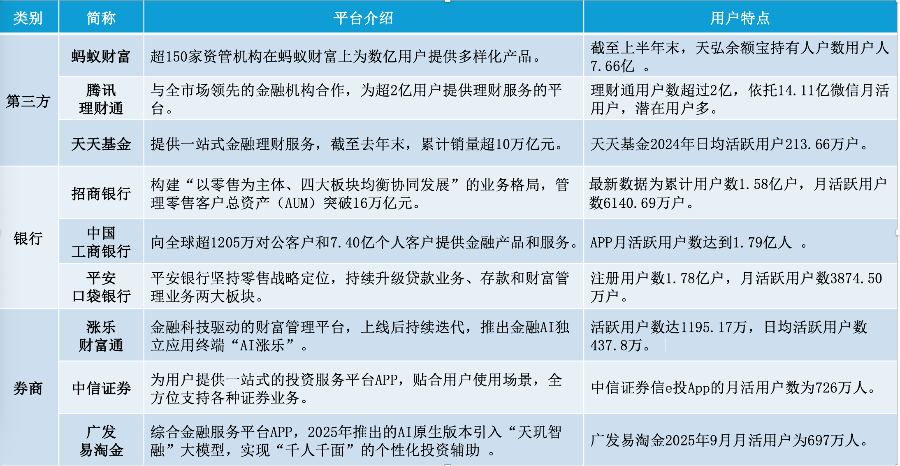
Core Viewpoint - The investment landscape is shifting from "single product selection" to "platform selection," emphasizing the efficiency of asset allocation and long-term wealth preservation for investors seeking certainty [1] Regulatory Environment - The China Securities Regulatory Commission's 2025 action plan aims to establish a classification evaluation mechanism for fund sales institutions and reduce subscription and service fees, promoting a transition from a "fast" to a "deep cultivation" approach in the industry [1] Platform Strategy - Major distribution platforms are adjusting their strategies to focus on long-term returns and user experience rather than short-term gains, leading to diversified competition that includes advisory services, digital tools, and content ecosystems [1] Comparative Analysis of Fund Sales Platforms - The analysis includes nine representative fund sales institutions categorized into three core groups: third-party platforms (Ant Wealth, Tencent Licai Tong, and Tiantian Fund), bank-affiliated platforms (China Merchants Bank, Industrial and Commercial Bank of China, and Ping An Bank), and brokerage platforms (CITIC Securities, Huatai Securities, and GF Securities) [1] User Demand Analysis - The KANO model is utilized to analyze user needs across fund sales apps, categorizing them into five levels: basic, expected, attractive, indifferent, and reverse needs, highlighting the non-linear relationship between product performance and user satisfaction [2] Third-Party Platforms - Ant Wealth excels in attractive features, while Tencent Licai Tong offers limited advisory services. Tiantian Fund has the most comprehensive product offerings, catering to experienced investors [4] - Ant Wealth provides robust educational and community features, while Tiantian Fund allows users to filter funds based on specific criteria. Tencent Licai Tong lags in the richness of professional tools [4] Bank Platforms - China Merchants Bank stands out in expected needs by offering asset allocation reports, while Industrial and Commercial Bank of China relies on its offline network but shows slower innovation in response to younger, online investors [5] - Ping An Bank utilizes an intelligent risk assessment system to recommend products, addressing various user needs effectively [5] Brokerage Platforms - Huatai Securities' Zhangle Wealth integrates research capabilities to offer in-depth market analysis and fund evaluation, while GF Securities' Yitaojin leads in video content and real-time updates, enhancing user engagement [6] - CITIC Securities' Xintou provides personalized advisory services for high-net-worth clients, indicating a shift towards professional service-based revenue models [6]
九大基金销售平台对比,谁更胜一筹?|基金销售平台体验榜①
2 1 Shi Ji Jing Ji Bao Dao· 2025-11-20 06:49
Core Insights - The investment landscape is shifting from "single product selection" to "platform selection," emphasizing the importance of asset allocation efficiency and long-term wealth preservation [1] - Regulatory changes are reshaping the industry, with the China Securities Regulatory Commission's 2025 action plan promoting a transition from a "fast" to a "deep cultivation" approach in public fund development [1] - Major distribution platforms are adjusting their strategies to focus on long-term returns and user experience rather than short-term gains, leading to a more diversified competitive landscape [1] Group 1: Platform Positioning and User Satisfaction - The KANO model is utilized to analyze user needs in fund sales apps, categorizing them into five levels: basic, expected, attractive, indifferent, and reverse needs [2] - Ant Financial's wealth management platform excels in attractive features, while Tencent's wealth management service offers limited advisory services [3][4] - Among third-party platforms, Ant Financial meets basic user expectations for "anytime, anywhere investment," while Tiantian Fund offers the most comprehensive product range [4] Group 2: Bank Platforms - Bank platforms excel in basic and expected needs, leveraging strong offline networks and comprehensive financial services, but are relatively conservative in innovation [5] - China Merchants Bank stands out in expected needs by providing asset allocation reports, while Industrial and Commercial Bank of China (ICBC) relies on a combination of online and offline services [5] - Ping An Bank utilizes intelligent risk assessment systems to recommend products, catering to different user segments with tailored services [5] Group 3: Brokerage Platforms - Brokerage platforms like Huatai Securities' Zhangle Wealth and GF Securities' Easy to Invest leverage deep market understanding and research capabilities, targeting stock investors and professional clients [6] - Zhangle Wealth integrates professional research to offer in-depth market analysis, while Easy to Invest excels in live video content and short video updates, enhancing user engagement [6] - The future challenge for brokerages lies in transitioning from a fee-based sales model to a service-oriented advisory model, which will determine their competitiveness in attracting the next generation of investors [6]
两大关键变化正发生:平安银行重构上市公司客群服务新范式
券商中国· 2025-11-20 06:47
Core Insights - Domestic commercial banks are facing multiple challenges, including narrowing net interest margins, asset quality pressure, and intensified homogeneous competition [1] Group 1: Industry Challenges - The deepening of interest rate marketization and accelerated financial disintermediation are weakening the growth momentum of traditional corporate banking [2] - The need for transformation in business models is urgent for joint-stock banks to find new growth curves [2] Group 2: Company Strategy - Ping An Bank is actively responding to industry challenges by restructuring its full-cycle service system for listed companies, transitioning from a traditional credit provider to a comprehensive financial service provider [2] - As of June, the number of new listed company clients increased by 6% year-to-date, with related deposit and loan balances both growing by 11% [2][4] Group 3: Organizational Innovation - Ping An Bank has established a cross-departmental coordination mechanism to break down barriers and create a collaborative system [5] - The number of corporate clients reached 909,100, a 6.5% increase from the previous year, with corporate loan balances at 1.68252 trillion yuan, up 4.7% [4] Group 4: Service Model Extension - The service model for listed companies has extended from core enterprises to their entire industrial chain and from mid-to-late stage enterprises to early-stage startups [7] - Ping An Bank has developed a comprehensive financial product matrix tailored to different stages of enterprise growth [8] Group 5: Comprehensive Service Ecosystem - The bank recognizes that listed companies require more than just loans, particularly new economy enterprises, which often face operational and payment settlement challenges [9] - In wealth management, Ping An Bank has designed financial products that meet the needs of over 2,200 listed companies, optimizing capital structure and providing employee equity incentive solutions [10] - The "Enterprise + Entrepreneur" dual service model integrates corporate finance with personal wealth management, creating a seamless service loop [10]
银行ETF指数(512730)涨超1.6%,银行估值仍处于历史偏低水平
Xin Lang Cai Jing· 2025-11-20 03:43
Group 1 - The core viewpoint indicates a strong performance in the banking sector, with the China Securities Bank Index rising by 1.73% and individual stocks like Bank of China and Construction Bank showing significant gains [1] - The banking sector is experiencing a defensive style resurgence, with the total market capitalization of A-shares surpassing 2.25 trillion [1] - Current credit growth is slowing down, and social financing growth is also retreating from high levels, although policies are in place to support demand recovery [1] Group 2 - The banking sector's retail risk has increased but remains manageable, supported by substantial provisioning and stable dividend policies [1] - The advantages of banks in areas such as gold markets, wealth management, and investment banking contribute to differentiated valuations within the sector [1] - The valuation of banks is still at historically low levels, and there is potential for medium to long-term capital allocation, making increased investment in the banking sector a favorable choice [1] Group 3 - The Bank ETF Index closely tracks the China Securities Bank Index and serves as an analytical tool for investors [2] - As of October 31, 2025, the top ten weighted stocks in the China Securities Bank Index account for 64.87% of the index, highlighting the concentration of investment in major banks [2]





光大保德信安和债券型证券投资基金分红公告
Zhong Guo Zheng Quan Bao - Zhong Zheng Wang· 2025-11-20 02:10
1.公告基本信息 ■ 2.与分红相关的其他信息 ■ (4)权益登记日当天,注册登记人不接受投资者申请办理转托管、非交易过户等特殊业务。 (5)根据《光大保德信安和债券型证券投资基金基金合同》的规定,红利分配时所发生的银行转账或 其他手续费用由投资者自行承担,若红利分配金额小于银行转账或其他手续费用,则自动转为红利再投 资。因此,当投资者的红利分配金额小于最低现金红利发放限额10.00元(不含10.00元)时,注册登记 机构则将投资者的现金红利按2025年11月24日除权后的基金份额净值自动转为基金份额。 (6)光大保德信基金管理有限公司网站:www.epf.com.cn。 (7)光大保德信基金管理有限公司客户服务热线:4008-202-888。 (8)本基金代销机构 中国民生银行股份有限公司、交通银行股份有限公司、晋商银行股份有限公司、宁波银行股份有限公 司、平安银行股份有限公司、兴业银行股份有限公司、招商银行股份有限公司、中国光大银行股份有限 公司、中国建设银行股份有限公司、光大证券股份有限公司、国金证券股份有限公司、中信证券股份有 限公司、东方财富证券股份有限公司、国泰海通证券股份有限公司、国投证券股份有 ...
成交价低至六折 银行“直供房”密集挂牌
Zheng Quan Shi Bao· 2025-11-19 23:32
Core Insights - The article discusses the increasing trend of banks directly selling properties, referred to as "direct supply housing," as a means to dispose of non-performing assets and recover funds quickly [1][3][4]. Group 1: Overview of Direct Supply Housing - "Direct supply housing" refers to properties that banks acquire through debt recovery processes after borrowers default on loans, allowing banks to sell these properties directly on the market [1][3]. - The number of "direct supply housing" listings has significantly increased, with various types of properties, including commercial shops and residential units, being auctioned across multiple provinces in China [2][4]. Group 2: Market Dynamics and Implications - Properties listed as "direct supply housing" often have starting prices significantly lower than market value, with many properties being sold at discounts of up to 60% [1][2]. - Despite the low prices of "direct supply housing," their impact on the overall second-hand housing market is considered limited, as they represent a small segment and primarily consist of non-residential properties [4][5]. Group 3: Non-Performing Asset Management - The rise of "direct supply housing" is seen as a response to the need for banks to shorten the asset disposal cycle and recover funds more efficiently, especially as many properties have previously failed to sell at auction [4][6]. - The increase in non-performing loans, particularly in retail sectors such as personal consumption and credit card debts, highlights the challenges faced by banks, especially smaller financial institutions, in managing these assets [6].
成交价低至六折 银行“直供房”密集挂牌 不良处置提速
Zheng Quan Shi Bao· 2025-11-19 23:16
Core Viewpoint - The increase in "direct supply housing" from banks is a strategy for disposing of non-performing assets and quickly recovering funds, with expectations for further growth in this area [1][4][6]. Group 1: Overview of "Direct Supply Housing" - "Direct supply housing" refers to properties obtained by banks through debt recovery processes after borrowers default on loans, allowing banks to sell these properties directly to the market [1][3]. - The trend of banks listing "direct supply housing" in bulk is evident, with over a hundred properties currently available for auction across various regions, including commercial shops, residential units, and factories [2][4]. - Properties listed as "direct supply housing" often have starting prices significantly below market value, with many properties marked as "below market average" [2][4]. Group 2: Market Impact and Trends - The auctioning of "direct supply housing" is primarily a response to the need for banks to shorten the asset disposal cycle and recover funds more quickly, especially after previous judicial auctions resulted in unsold properties [4][6]. - Despite the increasing attention on "direct supply housing," its impact on the broader second-hand housing market is limited, as these properties represent a small segment and are primarily non-residential [4][5]. - The current trend shows a rise in non-performing loan transfers among banks, indicating a growing concern over retail loan default rates, particularly in personal loans and credit card debts [6]. Group 3: Characteristics and Advantages - Compared to regular judicial auction properties, "direct supply housing" has clearer ownership and fewer hidden disputes, leading to faster auction and transfer processes [5]. - The emergence of "direct supply housing" highlights the challenges faced by commercial banks, especially smaller institutions, in managing non-performing assets effectively [6].
成交价低至六折银行“直供房”密集挂牌 不良处置提速
Zheng Quan Shi Bao· 2025-11-19 18:01
Core Viewpoint - The increase in "direct supply housing" from banks is a response to the need for banks to dispose of non-performing assets and recover funds quickly, with a notable rise in the number of properties being auctioned directly by banks [1][4][6]. Group 1: Overview of "Direct Supply Housing" - "Direct supply housing" refers to properties that banks acquire through debt recovery processes after borrowers default on loans, allowing banks to sell these properties directly to the market [1][3]. - The trend of banks listing "direct supply housing" is growing, with over a hundred properties currently available for auction across various regions, including commercial shops, residential units, and industrial properties [2][4]. - Properties listed as "direct supply housing" often have starting prices significantly below market value, with many properties marked as "below market average" [2][4]. Group 2: Market Impact and Trends - The auctioning of "direct supply housing" is primarily a strategy to shorten the asset disposal cycle and recover funds more rapidly, as many of these properties have previously failed to sell at judicial auctions [4][6]. - Despite concerns that the sale of "direct supply housing" at discounted prices could impact the second-hand housing market, analysts suggest that its influence is limited due to its small market share and the nature of the properties involved [4][5]. - The overall stability of the real estate market is expected to remain intact, as "direct supply housing" constitutes a niche segment that does not significantly affect broader housing prices [4][5]. Group 3: Non-Performing Asset Management - The acceleration of non-performing asset transfers among banks indicates a rising trend in retail loan defaults, particularly in personal loans and credit card debts [6]. - The emergence of "direct supply housing" highlights the challenges faced by commercial banks, especially smaller institutions, in managing non-performing assets effectively [6]. - Experts recommend that banks adopt diverse strategies for asset recovery, including cash collection, write-offs, and securitization of non-performing assets, while also suggesting that local governments provide support through tax incentives and debt restructuring [6].