
南京银行

Search documents
五家银行跻身绿色信贷“万亿俱乐部” 绿色债券存量规模近2万亿
2 1 Shi Ji Jing Ji Bao Dao· 2025-11-05 23:42
Core Insights - Green finance has transitioned from an optional choice to a mandatory requirement for the banking industry, serving as a new engine for strategic transformation and a blue ocean market for future growth [1] - The balance of green financing at Industrial Bank has reached nearly 2.5 trillion yuan, with green loans exceeding 1 trillion yuan and a non-performing loan rate of only 0.57% [1] - The People's Bank of China and other departments have issued a unified policy framework for green finance, effective from October 1, 2025, to standardize various financial products [2] Group 1: Green Credit Growth - As of the end of 2024, the total balance of green credit among 42 A-share listed banks exceeded 27 trillion yuan, reflecting a year-on-year growth of approximately 20% [3] - State-owned banks dominate the green credit market, with the six major state-owned banks accounting for over 21 trillion yuan, representing 77.6% of the total [3] - Industrial Bank's green loan balance has risen to 1.08 trillion yuan, joining the "trillion club" [3] Group 2: Performance and Sector Focus - The average growth rate of green credit for A-share listed banks in 2024 was 20.6%, a slowdown from approximately 28% in 2023, yet leading institutions maintained strong growth [4] - The focus of green credit issuance is concentrated in four key areas: clean energy, green transportation, energy conservation and environmental protection, and green buildings [4] - The Yangtze River Delta, Guangdong-Hong Kong-Macau Greater Bay Area, and Chengdu-Chongqing Economic Circle are identified as core regions for green credit [4] Group 3: Product Innovation - A-share listed banks are deepening innovation in green financial products, creating a multi-dimensional product system that includes loans, bonds, asset securitization, insurance, and carbon finance [5] - Sustainable Development Linked Loans (SLL), carbon emission rights pledge financing, and environmental rights collateral loans are gaining traction [5] - Industrial Bank has launched the first green loan with biodiversity protection insurance, while Bohai Bank introduced a green loan linked to data center energy efficiency [6] Group 4: Broader Financial Tools - The issuance of green bonds has expanded, with the cumulative issuance of labeled green bonds in 2024 surpassing 4 trillion yuan [6] - Banks are actively participating in green wealth management and fund products, enhancing investor engagement through innovative offerings [6] - Carbon finance tools are transitioning from pilot programs to broader applications, with various banks introducing carbon emission rights pledge financing products [6] Group 5: Future Directions - The banking industry is expected to continue innovating green financial products to support sustainable economic development, moving beyond traditional green credit [7] - The development of ESG-linked loans and financing models using carbon emission rights as collateral will be explored [7] - These innovations will not only assist in achieving national carbon reduction goals but also cultivate new growth momentum for banks [7]





股票回购增持贷款业务落地一年 试点银行有望扩围
Zhong Guo Zheng Quan Bao· 2025-11-05 23:21
Core Viewpoint - The scope of institutions participating in stock repurchase and increase loan business is expected to expand to city commercial banks, which were previously limited to 21 national financial institutions [1] Group 1: Institutional Participation - Beijing Bank and Shanghai Bank have signed loan commitment letters with several listed companies regarding stock repurchase and increase loans [1] - Other banks such as Ningbo Bank, Jiangsu Bank, and Nanjing Bank are also expected to qualify for this loan business [1]





股票回购增持贷款业务落地一年 试点银行有望扩围 上市公司态度分化
Zhong Guo Zheng Quan Bao· 2025-11-05 21:19
Core Viewpoint - The scope of institutions participating in stock repurchase and increase loan business is expected to expand to city commercial banks, which were previously limited to 21 national financial institutions [1][3]. Group 1: Loan Qualification Expansion - Beijing Bank and Shanghai Bank have signed loan commitment letters with several listed companies for stock repurchase and increase loans [1][2]. - Other city commercial banks such as Ningbo Bank, Jiangsu Bank, and Nanjing Bank are also expected to gain eligibility for this loan business [1][2]. - The policy aims to broaden credit channels and enhance customer loyalty while providing comprehensive financial services [1][4]. Group 2: Recent Developments - Zhijiang Biological announced plans to repurchase shares with funding from both its own resources and stock repurchase special loan funds, having obtained a loan commitment from Beijing Bank [2]. - Baoming Technology and Conglin Technology have also secured loan commitment letters from Shanghai Bank for their stock repurchase plans [3][2]. Group 3: Market Dynamics - The stock repurchase and increase loan business is attracting banks to actively position themselves, with qualified banks competing for quality clients and unqualified banks seeking to apply for such qualifications [4][5]. - The business is seen as a way for city commercial banks to provide efficient financing channels for local listed companies, enhancing regional capital market vitality [4]. Group 4: Loan Characteristics and Challenges - The initial total quota for re-loans from the People's Bank of China is set at 300 billion yuan, with an interest rate of 1.75% [7]. - The actual lending scale is often constrained by the total re-loan quota, and banks typically set limits on the amount of special loans issued to individual companies [7]. - Many companies have expressed a preference for longer repayment periods, as shorter terms could significantly impact annual profits due to the nature of repurchase funding [8].
险资三季度加码银行股 国有大行成布局重点
Zhong Guo Zheng Quan Bao· 2025-11-05 20:08
Core Viewpoint - Insurance capital is increasingly investing in the banking sector, particularly in state-owned banks, due to the high dividend yields that align with their investment needs [1][2][3] Group 1: Insurance Capital Increases in State-Owned Banks - Insurance capital has significantly increased its holdings in major state-owned banks, with Postal Savings Bank and China Construction Bank being the primary targets for investment [1] - Ping An Life has increased its stake in Postal Savings Bank by 2.189 billion shares, making it the second-largest shareholder [1] - New China Life Insurance has also increased its holdings in China Construction Bank by 8.8 million shares, becoming its fifth-largest shareholder [1] Group 2: Entry of Insurance Capital in Other Major Banks - For the first time, insurance capital appears in the top ten shareholders of Industrial and Commercial Bank of China and Agricultural Bank of China, with China Life Insurance and Ping An Life becoming significant shareholders [2] - Insurance capital has also been active in the Hong Kong market, frequently increasing stakes in H-shares of state-owned banks [2] Group 3: Attractive Features of Banking Stocks - The six major banks have shown stable profit growth, with a total net profit of 1.07 trillion yuan in the first three quarters, alongside improved asset quality [2] - The low valuation and high dividend yield of banking stocks align well with the asset allocation needs of insurance capital, making them a core investment area [3] Group 4: Future Outlook for Insurance Capital Investment - Industry experts predict that insurance capital will increase its market presence and allocation in banking stocks due to favorable policy environments [3] - The implementation of new accounting standards in early 2026 will likely enhance the demand for stable, low-volatility stocks, further solidifying the preference for banking stocks among insurance capital [4]


股票回购增持贷款业务落地一年试点银行有望扩围 上市公司态度分化
Zhong Guo Zheng Quan Bao· 2025-11-05 20:08
Core Viewpoint - The expansion of stock repurchase financing to include city commercial banks is expected, with several banks already signing loan commitment letters with listed companies [1][2]. Group 1: Loan Participation and Expansion - The stock repurchase financing program, previously limited to 21 national financial institutions, is now likely to include city commercial banks such as Beijing Bank, Shanghai Bank, Ningbo Bank, Jiangsu Bank, and Nanjing Bank [1][2]. - The People's Bank of China has included Beijing Bank in the list of banks eligible for stock repurchase financing, indicating a significant policy shift [1]. Group 2: Market Response and Company Actions - Companies like Zhijiang Biology and Baoming Technology have announced plans to utilize stock repurchase loans, with specific amounts ranging from 60 million to 120 million yuan and 700,000 yuan respectively [1][2]. - The stock repurchase financing has been positively received by companies, providing a flexible financial tool to address timing mismatches in capital availability [5][6]. Group 3: Bank Perspective and Strategy - Banks view stock repurchase loans as a way to enhance relationships with high-quality listed companies and improve customer retention [4]. - The program allows banks to apply for refinancing from the People's Bank of China, with an initial refinancing quota of 300 billion yuan at an interest rate of 1.75% [4]. Group 4: Challenges and Considerations - Some companies remain cautious about utilizing stock repurchase loans due to perceived high interest rates and a lack of suitable repurchase windows [5][6]. - The interest rates for these loans typically range from 1.75% to 2.25%, and the limitations on loan recipients may deter some companies from participating [6].
外资险企再添新军,法巴天星保险获批开业
Mei Ri Jing Ji Xin Wen· 2025-11-05 14:49
Core Viewpoint - 法巴天星保险 has received its operating license from the Beijing Financial Regulatory Bureau, marking the entry of another foreign-backed innovative property insurance institution into the Chinese market [1][3]. Company Overview - 法巴天星保险 is positioned as the 91st property insurance institution in China, with a unique shareholder structure that includes international insurance giants, Chinese technology companies, and European automotive finance leaders [2]. - The company is backed by a diverse group of shareholders, including the French Paris Insurance Group, Volkswagen Financial Services, and Sichuan Yinmi Technology Co., a Xiaomi Group member [2]. Regulatory Milestones - The regulatory approval for 法巴天星保险 was granted on October 17, 2025, with the license issued on October 24, 2025 [1][3]. - The company’s business scope includes various types of insurance such as motor vehicle insurance, property insurance, liability insurance, and health/accident insurance [3]. Management Team - The proposed chairman, OOI See See, has extensive experience in the insurance industry, having held significant positions within the French Paris Insurance Group and other organizations [3]. Market Impact - The entry of 法巴天星保险 is expected to drive the integration of foreign capital and digitalization in the insurance sector, reflecting regulatory encouragement for multinational insurance groups to participate in the Chinese market [4]. - The company may serve as a new model for "auto insurance + technology scene insurance," leveraging its unique shareholder structure to explore innovative insurance solutions [5]. - The establishment of 法巴天星保险 is anticipated to promote structural optimization within the industry, encouraging existing companies to reform their product design and digital services [5]. Strategic Positioning - 法巴天星保险's establishment is significant for the broader strategy of the French Paris Bank in China, completing its layout in both life and property insurance sectors [6]. - The bank has been actively expanding its financial services in China, including various financial licenses and partnerships, indicating a strong commitment to the Chinese market [9][10].
工商银行股价创历史新高,机构热议年末“估值切换”行情
2 1 Shi Ji Jing Ji Bao Dao· 2025-11-05 12:09
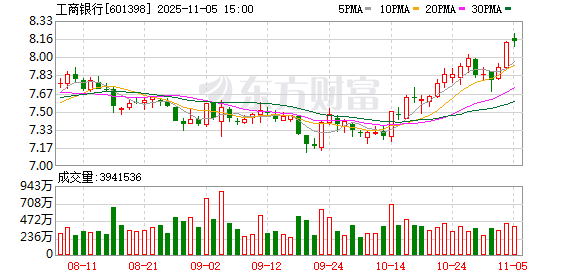
Group 1 - Industrial and Commercial Bank of China (ICBC) reached a historical high of 8.21 yuan on November 5, 2023, alongside other banks like Shanghai Pudong Development Bank and Ningbo Bank showing significant gains [2] - Year-to-date performance of the banking sector is underwhelming, with a gain of 12.99% compared to the All A Index's 25.81% [2] - Large-cap stocks have a weighted return of 15.26%, significantly lagging behind small-cap stocks which achieved a return of 61.46% [2] Group 2 - Historical trends suggest a "valuation switch" may occur towards the end of the year, with expectations for a rotation in market styles [4] - Market strategies indicate that from April to October, the focus is on current fundamentals, while from November to the following March, the emphasis shifts to future expectations [4] - November is identified as a critical time for market movements, where the correlation with current fundamentals weakens, indicating a potential for "anti-fundamental" and "forward-looking" trading strategies [4]

外资A股最新持仓曝光
Di Yi Cai Jing· 2025-11-05 11:55
Group 1 - The A-share market has significantly rebounded since the third quarter, with active trading and foreign capital continuing to buy aggressively [2][3] - Major industry leaders such as Kweichow Moutai, Ping An of China, and Wuliangye have attracted over 80 foreign institutional investors each, indicating strong foreign interest [2][3] - As of the end of September, the top three foreign-held A-shares by market value are CATL, Kweichow Moutai, and Midea Group, with values of 265.66 billion, 88.14 billion, and 71.65 billion respectively [2][3] Group 2 - Foreign investment is particularly focused on industry leaders, "Chinese state-owned enterprises," and bank stocks, with major banks holding significant foreign shares [3][4] - As of September 30, 2023, 68 foreign institutions held shares in China Shipbuilding, a 40% increase from the end of June [4][5] - The number of foreign investors in several A-share companies has increased, including Kweichow Moutai, BYD, and Yangtze Power [4] Group 3 - Foreign investors have shown a preference for certain stocks, with UBS significantly increasing its stake in RuiNeng Technology, becoming the third-largest shareholder [5][6] - UBS held 1.1464 million shares of RuiNeng Technology as of September 30, representing a 130.2% increase from the previous quarter [6] - Other major foreign investors in RuiNeng Technology include Goldman Sachs, JPMorgan, and Merrill Lynch, all newly entering the top ten shareholders [5][6] Group 4 - The overall outlook for the A-share market remains positive, with expectations of continued recovery in earnings and strong inflows of capital [9][10] - UBS forecasts a 6% year-on-year growth in total A-share earnings by 2025, driven by sectors like technology and non-financial industries [9][10] - Goldman Sachs predicts a 30% increase in major stock indices by the end of 2027, indicating a potential long-term bull market for A-shares [10][11]




外资A股最新持仓曝光
第一财经· 2025-11-05 11:45
Core Viewpoint - The A-share market has shown significant recovery since the third quarter, with active trading and continued foreign investment, particularly in industry leaders and state-owned enterprises [3][5][14]. Group 1: Foreign Investment Trends - As of the end of September, major industry leaders such as Kweichow Moutai, China Ping An, and Wuliangye attracted over 80 foreign institutional investors each [6][5]. - The top three foreign-held A-shares by market value are CATL (265.66 billion), Kweichow Moutai (88.14 billion), and Midea Group (71.65 billion) [6][5]. - Foreign investment in "Chinese state-owned enterprises" has increased, with China Shipbuilding attracting 68 foreign investors, a rise of over 40% from the end of the first half [7][5]. Group 2: Sector Preferences - Foreign investors favor industry leaders, state-owned enterprises, and bank stocks, with seven of the top ten foreign-held A-shares being banks [6][5]. - Notable bank stocks include Nanjing Bank (2.36 billion shares held by 32 foreign investors) and Ningbo Bank (1.60 billion shares held by 42 foreign investors) [6][5]. Group 3: Individual Stock Movements - UBS significantly increased its stake in RuiNeng Technology, becoming the third-largest shareholder, while Goldman Sachs, JPMorgan, and Merrill Lynch entered the top ten shareholders [9][10]. - RuiNeng Technology's stock price has surged over 40% since mid-October, despite a 32.73% decline in net profit year-on-year [12][10]. Group 4: Market Outlook - UBS analysts remain optimistic about the medium-term outlook for the A-share market, citing a 12% year-on-year profit growth for all A-shares in the third quarter [15][14]. - Goldman Sachs predicts a 30% increase in major stock indices by the end of 2027, indicating a potential long-term bull market for A-shares [16][14].






华尔街大行抱团买入,外资A股最新持仓曝光
第一财经网· 2025-11-05 11:41
Group 1 - Foreign capital favors industry leaders, "Chinese state-owned enterprises," and bank stocks, with significant investments noted in companies like Kweichow Moutai, Ping An, and Wuliangye, each attracting over 80 foreign institutional investors [1][2] - As of the end of September, the top three foreign-held A-shares by market value are CATL, Kweichow Moutai, and Midea Group, with values of 265.66 billion, 88.14 billion, and 71.65 billion respectively [1][2] - The number of foreign investors holding shares in China Shipbuilding increased by over 40% from the end of June to 68 by the end of September [3] Group 2 - Bank stocks are particularly favored by foreign investors, with seven out of the top ten A-shares held by foreign capital being banks, including Nanjing Bank and Ningbo Bank, which have 2.36 billion and 1.60 billion shares held respectively [2] - A total of 42 A-shares have foreign holdings exceeding 10 billion yuan, indicating strong interest in industry leaders [2] Group 3 - UBS significantly increased its stake in RuiNeng Technology, becoming the third-largest shareholder by holding 1.1464 million shares, a 130.2% increase from the previous quarter [4][5] - Other major foreign investors in RuiNeng Technology include Goldman Sachs, JPMorgan, and Merrill Lynch, who entered the top ten shareholders for the first time [4][5] Group 4 - UBS and other foreign institutions have shown a pattern of increasing their stakes in various A-shares, indicating a trend of foreign capital "clustering" around specific stocks [4][8] - The overall market outlook remains positive, with UBS forecasting a 6% growth in A-share earnings by 2025, driven by sectors like technology and non-financial industries [9][10]