
沪农商行

Search documents
银行业6月金融数据点评:低基数+季末冲量,信贷扭转走弱态势
Huachuang Securities· 2025-07-15 04:13
Investment Rating - The industry investment rating is "Recommended," indicating an expected increase in the industry index by more than 5% over the next 3-6 months compared to the benchmark index [25]. Core Insights - The report highlights a significant increase in social financing scale, with June's new social financing reaching 4.2 trillion yuan, a year-on-year increase of 900.8 billion yuan, and a social financing stock growth rate of 8.9%, up 0.2 percentage points from the previous month [2][6]. - New RMB loans in June amounted to 2.24 trillion yuan, an increase of 110 billion yuan year-on-year, primarily driven by strong short-term loans, especially from enterprises [6][7]. - The report emphasizes the importance of the banking sector's configuration opportunities, suggesting that overall positions in banks are likely to increase due to medium to long-term capital inflows and public fund reforms [6][7]. Summary by Sections Financial Data Overview - In June, the new social financing scale was 4.2 trillion yuan, with a year-on-year increase of 900.8 billion yuan, and the social financing stock growth rate reached 8.9% [2][6]. - New RMB loans totaled 2.24 trillion yuan in June, with a year-on-year increase of 110 billion yuan, indicating a recovery in short-term loans [6][7]. Credit and Financing Trends - The report notes that credit has reversed its weakening trend from the second quarter, supported mainly by short-term loans to enterprises and improvements in household short-term loans [6][7]. - The increase in M1 growth rate to 4.6% in June and M2 growth rate rising to 8.3% reflects enhanced liquidity in the market [6][7]. Investment Recommendations - The report suggests focusing on the banking sector for investment, highlighting the ongoing mid-term investment value of major banks and the potential for absolute returns from banks with high dividend yields and strong asset quality [6][7]. - Specific banks to watch include state-owned large banks and stable joint-stock banks like China Merchants Bank and CITIC Bank, as well as regional banks with high provisioning coverage [6][7].
【Fintech 周报】多地监管:警惕稳定币沦为集资诈骗工具;“养老贷”被叫停;比特币首破12万美元
Tai Mei Ti A P P· 2025-07-14 07:09
Regulatory Dynamics - Multiple regions have issued warnings about stablecoins being used as tools for illegal fundraising and fraud, highlighting the risks associated with this emerging concept [2] - The Beijing Internet Finance Industry Association pointed out that some illegal entities are misleading the public by promoting "virtual currencies" and "digital assets" with promises of high returns [2] - The Shenzhen Financial Supervision Office also warned that these illegal institutions lack the necessary licenses to publicly solicit deposits, leading to various criminal activities [2] Insurance Industry Regulations - The Ministry of Finance released new long-term assessment regulations for state-owned commercial insurance companies, aiming to reduce short-term profit pressures and encourage long-term investments [3] - The regulations are part of a broader initiative to guide state-owned insurance companies towards stable operations and enhance their role in market stability [3] Consumer Protection in Online Lending - The National Financial Supervision Administration has identified three common deceptive practices in online lending, including misleading concepts, false promises, and hidden costs [4][5] Banking Sector Developments - A total of 2,881 bank branches have been closed in the first half of 2025, surpassing the total closures for the entire previous year, with rural commercial banks accounting for the majority [9] - A-shares listed banks have announced a cumulative dividend of over 630 billion yuan for 2024, an increase of 20 billion yuan compared to the previous year, indicating strong performance in the banking sector [8] Payment Institutions - Thirteen non-bank payment institutions have received long-term payment business licenses from the People's Bank of China, indicating regulatory approval for their operations [7] Small Loan Industry - The small loan industry is undergoing a significant cleanup, with over 350 companies being shut down or having their licenses revoked in 2025, reflecting a trend towards industry consolidation [10] Foreign Exchange Reserves - As of June 2025, China's foreign exchange reserves reached 3.3174 trillion USD, marking an increase of 32.2 billion USD from the previous month [11][12] Cryptocurrency Market - Bitcoin's price has surpassed 120,000 USD for the first time, indicating a bullish trend in the cryptocurrency market, with other cryptocurrencies also experiencing significant gains [12] Corporate Actions - Jiangsu Bank's executives have collectively purchased shares worth approximately 24.28 million yuan, reflecting confidence in the bank's future performance [12] - The appointment of a new CEO at OCBC Bank marks a significant leadership change, with the transition planned for January 2026 [13]



银行业周报(2025.07.07-2025.07.13):险资长周期考核强化,增厚银行股红利价值-20250714
Yin He Zheng Quan· 2025-07-14 07:07
Investment Rating - The report maintains a "Recommended" rating for the banking sector, highlighting its value for long-term investment [5][29]. Core Insights - The recent adjustments in insurance fund management are expected to enhance the dividend value of bank stocks, promoting long-term and stable investments [5][8]. - The banking sector's performance has been relatively weak compared to the broader market, with a decline of 1% in the banking sector against a 0.82% increase in the CSI 300 index [5][9]. - As of July 11, 2025, the banking sector's price-to-book (PB) ratio stands at 0.70, with a dividend yield of 5.54%, indicating attractive valuation levels [5][20]. Summary by Sections Latest Research Insights - The Ministry of Finance issued a notice on July 11, 2025, to guide insurance funds towards long-term stable investments, adjusting performance evaluation metrics for state-owned commercial insurance companies [7][8]. - The new evaluation method emphasizes a combination of annual and multi-year performance indicators, aiming to enhance the stability and growth of insurance capital [7][8]. Weekly Market Performance - The banking sector saw a 1% decline, while the CSI 300 index rose by 0.82%. Notably, state-owned banks increased by 1.31%, while city commercial banks and joint-stock banks experienced declines of 2.69% and 1.53%, respectively [5][9]. - Individual bank performances varied, with Xiamen Bank leading with an 8.73% increase, while several banks like Shanghai Bank and Jiangsu Bank faced notable declines [9][16]. Valuation and Company Analysis - As of July 11, 2025, the banking sector's PB ratio is 0.75, reflecting a 45.73% discount compared to the overall A-share market [20][25]. - The report lists key banks with their respective valuations, indicating a general decline in revenue and net profit for Q1 2025 compared to the previous year [25][28]. Investment Recommendations - The report suggests that the enhanced evaluation of insurance funds will lead to increased allocation towards equity assets, benefiting the banking sector [5][29]. - Specific banks recommended for investment include Industrial and Commercial Bank of China, Agricultural Bank of China, Postal Savings Bank of China, and others, indicating a positive outlook for their performance [5][29].




“科技板”用好“稳定器” 金融基础设施协同推进信用风险缓释工具创新
Xin Hua Cai Jing· 2025-07-14 04:43
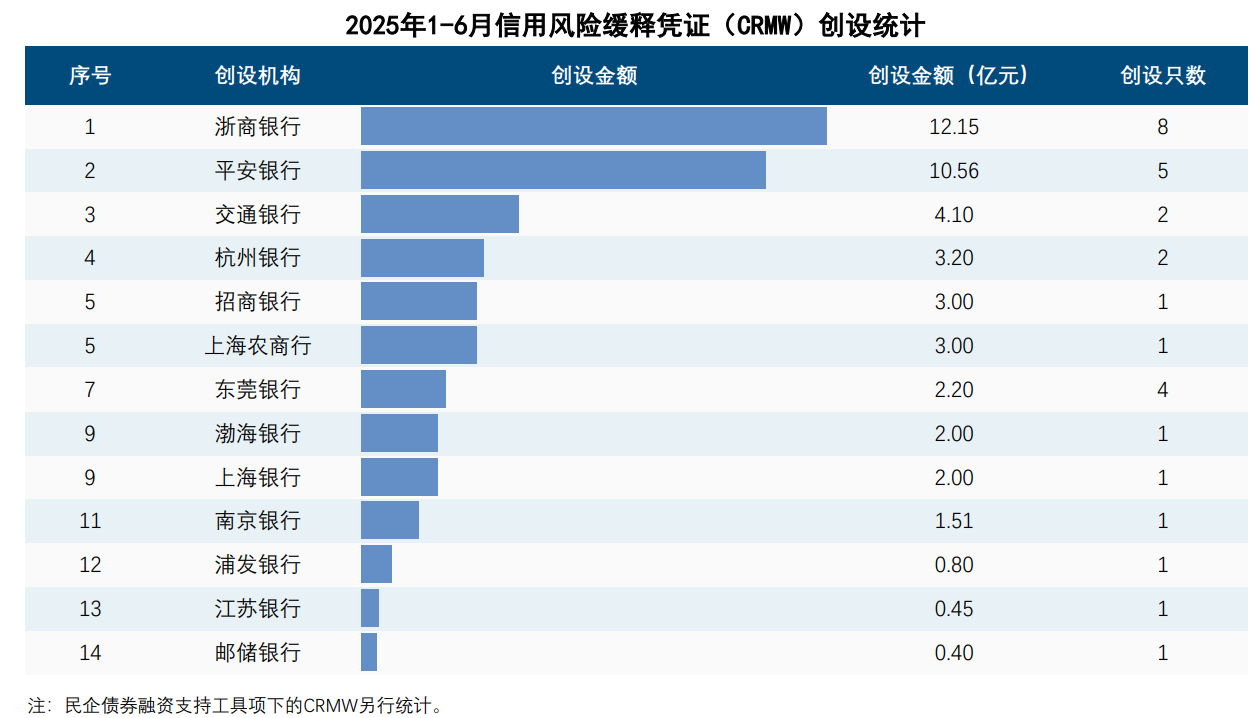
Core Viewpoint - The development of credit risk mitigation tools (CRM) in China's financial market infrastructure is enhancing the innovation and effectiveness of credit derivatives, particularly benefiting the financing needs of technology enterprises [1][2][7]. Group 1: Credit Risk Mitigation Tools and Technology Board - The integration of CRM tools with the "Technology Board" is helping to increase debt financing scale and reduce costs, addressing the financing difficulties faced by private enterprises [2][10]. - Since the launch of the "Technology Board," credit risk mitigation certificates (CRMW) have supported the issuance of technology innovation bonds, with a total of 6 registrations amounting to 395 million yuan, facilitating the issuance of 1.25 billion yuan in technology innovation bonds [1][7]. Group 2: Market Infrastructure and Business Models - The CRMW creation and bond issuance model has created approximately 150 billion yuan in support for over 340 billion yuan in bond issuances since its introduction in 2018 [3][6]. - Major banks such as Zheshang Bank, Ping An Bank, and Bank of Communications have been leading in CRMW creation, with amounts of 1.215 billion yuan, 1.056 billion yuan, and 410 million yuan respectively in the first half of 2025 [4][3]. Group 3: Regulatory and Operational Enhancements - Recent revisions to the CRM business guidelines have streamlined processes and improved operational efficiency, allowing for a more comprehensive regulatory framework for CRM activities [6][7]. - The Shanghai Clearing House has enhanced its services for CRM, enabling online processing for credit events and early termination of CRMW, significantly improving operational convenience [6][7]. Group 4: Broader Economic Impact - CRM tools are increasingly recognized as effective financing aids, helping to mitigate credit risks in the bond market and ensuring smooth financing for the real economy [10][11]. - Local financial institutions are expected to play a crucial role in the creation of CRMW, leveraging their regional knowledge to provide credit risk protection for local enterprises [10][11].
银行股燃爆红利基金!增配逻辑猛抬头,公募低配或渐成历史
券商中国· 2025-07-14 04:36
Core Viewpoint - The banking sector is becoming a popular choice for public funds due to favorable changes in funding, policy, sentiment, and fundamentals, with the China Securities Banking Index rising 16.54% this year, marking a ten-year high [1][7]. Group 1: Fund Dynamics and Market Sentiment - The collective rise of dividend assets, represented by bank stocks, reflects a growing value investment atmosphere in the market, with major banks reaching historical highs [2][3]. - The demand for dividend-themed funds has surged, leading to a rapid increase in the launch of various dividend funds by public funds, indicating strong institutional interest [2][9]. - The shift in public fund allocations towards bank stocks is driven by the need for stable returns amid global uncertainties and the increasing appeal of low-valuation, high-dividend assets [8][9]. Group 2: Performance and Investment Strategies - Bank stocks have outperformed expectations, with Chengdu Bank's stock price increasing by 98% since January 2024, contributing significantly to the performance of many funds [3][4]. - The long-standing 工银金融地产基金 has seen substantial returns over the past three years, highlighting the resurgence of traditional funds focusing on bank stocks [3][4]. - Fund managers are increasingly adjusting their portfolios to include more bank stocks, reflecting a strategic shift towards undervalued assets [5][6]. Group 3: Regulatory and Market Conditions - Recent regulatory changes have prompted public funds to reassess their allocations, with a noted underweight in bank stocks compared to major indices [4][9]. - The ongoing asset shortage and low interest rates are driving insurance companies to invest in dividend assets, further supporting the banking sector's appeal [9][10]. - The introduction of policies encouraging insurance funds to invest a significant portion of new premiums in A-shares is expected to inject substantial long-term capital into the market [9][10].

国有商业保险公司长周期考核机制更新,平安上证红利低波动指数A净值近1年涨幅同类第一
Xin Lang Cai Jing· 2025-07-14 04:05
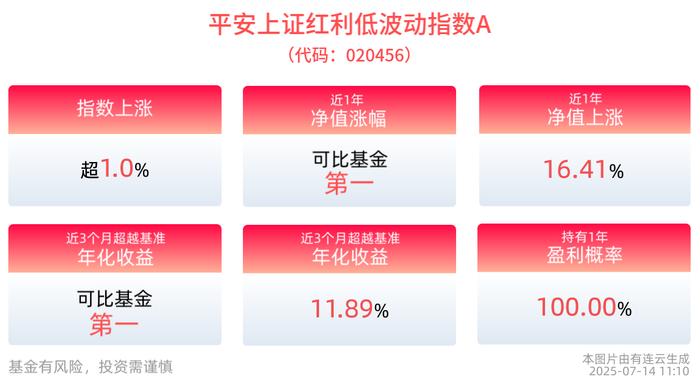
Core Viewpoint - The article highlights the strong performance of the Ping An SSE Dividend Low Volatility Index A (020456), which has shown significant returns and a solid investment strategy focused on low volatility and high dividend-paying stocks [3][4][5]. Group 1: Index Performance - As of July 11, 2025, the Ping An SSE Dividend Low Volatility Index A has a net asset value of 1.15 yuan, with a cumulative increase of 16.41% over the past year [3]. - The index has achieved a maximum monthly return of 11.16% since its inception, with the longest consecutive monthly gain being 2 months and a maximum gain of 7.40% [3]. - The average monthly return is 3.98%, with a weekly profit percentage of 58.73% and a monthly profit probability of 60.43% [3]. - The historical one-year holding profit probability stands at 100% [3]. Group 2: Fund Management and Fees - The management fee rate for the Ping An SSE Dividend Low Volatility Index A is 0.50%, and the custody fee rate is 0.10%, totaling a fee rate of 0.60% [4]. - The fund was established on April 23, 2024, and aims to minimize tracking deviation and error from the SSE Dividend Low Volatility Index [4]. Group 3: Investment Strategy - The Ping An SSE Dividend Low Volatility Index selects 50 securities based on liquidity, continuous dividend payments, moderate dividend payout ratios, positive growth in earnings per share, and high dividend yields with low volatility [5]. - As of March 31, 2025, the top ten holdings of the index fund include COSCO Shipping Holdings, Chengdu Bank, and Yageo, with the top ten stocks accounting for 27.50% of the total weight [5][7].
上海农商银行:“质量贷”构建质量增信融资生态
Xin Hua Cai Jing· 2025-07-14 02:44
Group 1 - The "Quality Loan" is a specialized financial service scheme launched by Shanghai Rural Commercial Bank in collaboration with various market supervision authorities, aimed at enterprises with quality honors or certifications [1][4] - The scheme incorporates non-financial indicators such as corporate quality credit, brand value, and quality standards into the financial credit evaluation system, allowing for a maximum credit limit of up to 500 million yuan [1] - The bank has implemented the "Quality Loan" in 14 branches since its launch in 2023, introducing several regional sub-schemes tailored to local enterprises [1][2] Group 2 - Shanghai YWS Technology Co., Ltd. received the "Hongkou District Quality Award" and benefited from the "Quality Standard Loan" to alleviate funding pressures for continuous R&D [2] - The bank aims to transform quality "soft power" into "hard support" for high-quality development of the real economy by promoting a financing ecosystem that covers quality honors, standard innovation, and brand certification [2] - By June 2025, the bank had disbursed over 2.5 billion yuan in quality financing, ranking among the top in the city, with outreach to over 2,000 quality-honored enterprises [4]
广东17家银行跻身世界银行千强榜
Nan Fang Du Shi Bao· 2025-07-13 23:07
Core Viewpoint - The "2025 World Bank 1000 Strong" ranking by the British magazine "The Banker" highlights the performance of Chinese banks, with 143 banks from mainland China making the list, including 17 from Guangdong province, showcasing the region's financial strength and competitiveness [2][4][6]. Group 1: Rankings of Major Banks - The top four banks in the ranking are Industrial and Commercial Bank of China (1st), China Construction Bank (2nd), Agricultural Bank of China (3rd), and Bank of China (4th) [2][4]. - China Merchants Bank improved its ranking to 8th, while Bank of Communications ranked 9th, with both banks being part of the top ten [4][5]. - Among the 12 national joint-stock banks, the largest improvement was seen in Hengfeng Bank, which moved up from 121st to 118th [4][5]. Group 2: Performance of Guangdong Banks - Guangdong has 17 banks on the list, accounting for 11.89% of the total, with notable improvements in rankings for over half of these banks [6][8]. - Guangdong Huaxing Bank made the most significant leap, advancing 40 places to 336th, while WeBank improved by 28 places to 227th [6][7]. - However, some banks in Guangdong experienced declines, with Zhuhai Huaren Bank dropping 20 places to 358th [7]. Group 3: Financial Growth in Guangdong - In 2024, Guangdong's financial industry added value reached 12.4 trillion yuan, representing 8.8% of the province's GDP, with total assets of financial institutions exceeding 47 trillion yuan [8][9]. - As of May 2025, the balance of loans in Guangdong was 29.5 trillion yuan, a year-on-year increase of 4.7%, while deposits reached 37.4 trillion yuan, growing by 4.3% [8][9]. - The province is focusing on high-quality development, with initiatives aimed at enhancing financing accessibility and expanding credit in key sectors [9].






银行股再度刷屏 基金增配逻辑持续演绎
Zheng Quan Shi Bao· 2025-07-13 17:29
Core Viewpoint - The banking sector is becoming a popular choice for public funds as they shift towards dividend-themed funds amid a backdrop of significant market activity and low allocation in this sector [1][2]. Group 1: Dividend Strategy and Market Performance - The banking stocks, particularly the four major state-owned banks, have seen significant price increases, with some reaching historical highs due to the effectiveness of low valuation and high dividend strategies [2]. - Chengdu Bank, heavily weighted in over 100 funds, has experienced a cumulative increase of 98% from January 2024 to July 11, 2025, outperforming many tech stocks and attracting attention from top fund managers [2]. Group 2: Fund Allocation and Research Activities - Public funds have a current allocation of approximately 3.49% in the banking sector, which is underweight by 9.99 percentage points compared to the CSI 300 index and 6.99 percentage points compared to the CSI 800 index [3]. - Recent fund research activities have focused on banks that were previously underweighted, indicating a potential shift in investment strategy [3][4]. Group 3: Institutional Investment Trends - Insurance companies and large institutional investors are increasingly turning to dividend assets like banking stocks due to rising demand for stable returns amid global uncertainties [5][6]. - The banking sector's current price-to-book ratio is 0.72, below the global average, and its dividend yield is significantly higher than government bond yields, making it attractive for long-term investors [6]. Group 4: Future Outlook - The combination of low interest rates, accounting changes, and policy guidance is expected to further enhance the appeal of dividend strategies, with insurance funds likely to become a significant source of new capital in the stock market [6].

上市银行年度分红进行时 银行股投资吸引力持续凸显
Zheng Quan Ri Bao Wang· 2025-07-13 12:51
Core Viewpoint - A-share listed banks are actively distributing dividends, reflecting strong operational performance and compliance with regulatory requirements for cash dividends [1][2] Group 1: Dividend Distribution - As of July 13, 35 out of 42 A-share listed banks have completed their 2024 annual dividend distributions, including major state-owned banks and several joint-stock and city commercial banks [1] - The trend of high dividend payouts is driven by the implementation of new policies aimed at enhancing cash dividends and improving predictability in dividend distributions [1][2] Group 2: Dividend Yield - Approximately half of the A-share listed banks have a dividend yield exceeding 4%, with six banks, including China Merchants Bank and Postal Savings Bank, surpassing 7% [2] - The high dividend yield is attributed to the banks' stable long-term operations and a lower risk appetite among investors who prioritize steady returns [2] Group 3: Market Performance - The banking sector has seen a cumulative increase of 19.34% year-to-date, driven by the appeal of high dividend yields and increased cash dividend distributions [2] - Several banks are planning mid-term dividend proposals for 2025, further enhancing their investment attractiveness [2] Group 4: Future Outlook - The current market environment is expected to support a steady upward trend in bank stocks, bolstered by strong operational performance and high dividend levels [3] - The defensive nature of bank stocks, combined with favorable macroeconomic policies, suggests continued investment value despite external challenges [3]

