翰森制药

Search documents
翰森制药2025H1业绩:创新国际化驱动 总收入74.34亿元,溢利大涨15.0%达31.35亿元
Zhong Guo Jing Ji Wang· 2025-08-19 06:57
Core Viewpoint - Hansoh Pharmaceutical reported a strong performance in the first half of 2025, with significant revenue growth driven by innovative drugs and collaboration products Financial Performance - In the first half of 2025, Hansoh Pharmaceutical's revenue was approximately RMB 7.434 billion, a year-on-year increase of about 14.3% [1] - The profit was approximately RMB 3.135 billion, reflecting a year-on-year growth of about 15.0% [1] - Basic earnings per share were approximately RMB 0.53, up by about 14.8% year-on-year [1] - The interim dividend declared was HKD 0.2316 per share [1] Product Sales - Sales revenue from innovative drugs and collaboration products reached RMB 6.145 billion, a year-on-year increase of 22.1%, accounting for 82.7% of total revenue [1] - The anti-tumor product Amelot, representing innovative drugs, generated approximately RMB 4.531 billion in revenue, making up about 60.9% of total revenue [2] - Amelot has been approved for four indications and is expanding its application to early and mid-stage NSCLC [2] Research and Development - R&D expenditure was approximately RMB 1.441 billion, a year-on-year increase of 20.4%, representing about 19.4% of total revenue [1] - The company is advancing over 70 innovative drug clinical trials across more than 40 candidate drugs [1] - Notable candidates entering Phase III clinical trials include B7-H3 targeted ADC (HS-20093) and B7-H4 targeted ADC (HS-20089) [1] Collaborations and Licensing - Hansoh Pharmaceutical has engaged in significant licensing agreements, including a global exclusive license with MSD for HS-10535, receiving an upfront payment of USD 112 million [3] - In June 2025, the company granted Regeneron exclusive overseas rights for HS-20094, receiving an upfront payment of USD 80 million and potential milestone payments of up to USD 1.93 billion [3] - The company has also made progress in ADC research, with HS-20093 and HS-20089 being recognized as breakthrough therapy drugs in China [4] Cash Flow and Financial Stability - The net cash inflow from operating activities was RMB 3.605 billion [4] - The company held cash and bank deposits of RMB 27.104 billion, indicating a strong financial position to support ongoing R&D investments [4]

翰森制药(03692):2025 年中期业绩点评:BD创新引领业绩攀升,研发推进驱动未来增长
Minsheng Securities· 2025-08-19 06:44
Investment Rating - The report maintains a "Recommended" rating for the company [4] Core Insights - The company achieved a revenue of 7.434 billion RMB in the first half of 2025, representing a year-on-year growth of 14.3%, and a net profit of 3.135 billion RMB, up 15.0% year-on-year [1] - The company's collaboration revenue reached 1.657 billion RMB in the first half of 2025, with an expected total collaboration revenue exceeding 2 billion RMB for the year [1][4] - Sales of innovative drugs and collaboration products amounted to 6.145 billion RMB, a year-on-year increase of 22.1%, accounting for 82.7% of total revenue [2] - The company has over 40 candidate innovative drugs in its pipeline and is conducting more than 70 clinical trials, with significant advancements in various therapeutic areas [3] Summary by Sections Revenue and Profit Growth - The company reported a revenue of 7.434 billion RMB for the first half of 2025, a 14.3% increase year-on-year, and a net profit of 3.135 billion RMB, reflecting a 15.0% growth [1] Collaboration and Licensing - The collaboration revenue for the first half of 2025 was 1.657 billion RMB, an 18.1% increase year-on-year, with expectations of exceeding 2 billion RMB for the full year [1] - Key collaborations include a 112 million USD upfront payment from MSD and an 80 million USD upfront payment from Regeneron [1] Innovative Drug Sales - Sales from innovative drugs and collaboration products reached 6.145 billion RMB, with a 22.1% year-on-year growth, driven by new indications for existing products [2] - The oncology segment generated 4.531 billion RMB, while other therapeutic areas also contributed significantly to revenue [2] Research and Development - R&D expenses for the first half of 2025 were 1.441 billion RMB, a 20.4% increase year-on-year, constituting 19.4% of total revenue [3] - The company has over 40 innovative drug candidates and is advancing multiple drugs into late-stage clinical trials [3] Financial Forecast - The company is projected to achieve revenues of 14.685 billion RMB, 15.801 billion RMB, and 18.471 billion RMB for 2025, 2026, and 2027 respectively, with corresponding net profits of 5.237 billion RMB, 5.434 billion RMB, and 6.417 billion RMB [5]
牛市主线,创新药还当得起吗?创新药ETF沪港深(159622)倒车接人
Sou Hu Cai Jing· 2025-08-19 06:40
Core Viewpoint - The recent decline in the innovative drug ETF (159622) is seen as a short-term correction, with expectations of continued growth driven by liquidity and upcoming catalysts such as potential interest rate cuts by the Federal Reserve [1][2][3] Group 1: Market Performance - The innovative drug ETF experienced a decline of over 1.5%, with significant stock performance divergence among its components, including gains from companies like Ganli Pharmaceutical (+7%) and Enhua Pharmaceutical (+5%) [1] - The overall market sentiment remains bullish, with a strong rotation and inflow of capital into innovative drug ETFs during corrections [1] Group 2: Catalysts for Growth - The innovative drug sector is expected to benefit from a liquidity-driven market, particularly with anticipated interest rate cuts from the Federal Reserve, which would lower financing costs for drug companies [1][2] - The sector has seen over $2.5 billion in upfront payments for external licensing agreements in the first half of the year, indicating strong ongoing interest and potential for future growth [2] Group 3: Policy Support - Recent updates from the National Healthcare Security Administration regarding the 2025 national medical insurance drug list and commercial insurance innovative drug list show strong support for innovative drugs, including CAR-T therapies and other cancer treatments [3] Group 4: Future Outlook - The upcoming global pharmaceutical conferences and the expected release of key clinical data are anticipated to provide further momentum for the innovative drug sector [5] - The potential for continued high levels of external licensing agreements and the expiration of patents for significant drugs by 2030 suggest a robust pipeline for Chinese innovative drugs [2][5]
翰森制药_业绩回顾_上半年合作收入超预期;2025 年销售指引更积极;买入-Hansoh Pharma (3692.HK)_ Earnings Review_ 1H beats on collaboration income; More positive sales guidance for 2025; Buy
2025-08-19 05:42
Summary of Hansoh Pharma Earnings Review Company Overview - **Company**: Hansoh Pharma (3692.HK) - **Industry**: Pharmaceuticals, specifically focusing on innovative drugs and collaborations Key Financial Highlights - **1H Sales**: Rmb7.4 billion, representing a **14.3% year-over-year increase** compared to the expected Rmb6.5 billion [1] - **Product Sales Growth**: Grew by **13.2% year-over-year**, driven by innovative drugs, particularly Ameile, which saw a **21% year-over-year increase** [1] - **Collaboration Income**: Exceeded expectations with Rmb853 million from Merck GLP-1 deal and Rmb804 million milestone payment from GSK [1] - **Earnings**: Rmb3.1 billion, up **15% year-over-year**, surpassing the expected Rmb2.1 billion [1] - **Core Earnings Growth**: Increased by **13% year-over-year**, slower than product sales due to a **20% year-over-year rise in R&D expenses** [1] Future Guidance - **Sales Guidance for 2025**: Management has raised the product sales growth forecast to **high-double-digit growth**, up from previous double-digit growth expectations [1] - **Ameile Sales Target**: Expected to achieve over Rmb8 billion by 2030, with a target of Rmb10 billion+ in 2025, driven by new indications and extended product life cycle strategies [2] Pipeline Developments - **Key Pipeline Assets**: - **HS-20093 (B7H3 ADC)**: Two phase 3 trials initiated in China for SCLC and osteosarcoma, with plans for pivotal stage advancement in 2025 [3] - **HS-20089 (B7H4 ADC)**: Pivotal study for ovarian cancer initiated in China, with global phase 3 trials expected by 2026 [3] - **HS-10535 (oral GLP-1)**: Global phase 1 studies to start by Merck in 2025 [3] - **HS-20094 (GLP-1/GIP)**: Moving to phase 3 stage by Regeneron in 2026 [3] Strategic Focus - **Collaboration Strategy**: Continues to be a key global expansion strategy, with efforts to self-run global phase 1 studies for selected oncology and immunology assets [8] - **Earnings Estimates Revision**: Earnings estimates for 2025, 2026, and 2027 have been revised up by **10.4%**, **8.9%**, and **6.3%** respectively, reflecting higher collaboration income and innovative drug sales [8] Valuation and Risks - **Price Target**: Increased to HK$39.93 from HK$34.83, based on a sum-of-the-parts (SOTP) valuation [9] - **Risks Identified**: - Generics sales may fall below expectations post VBP - Slower ramp-up of novel drugs - R&D risks in the innovative drug pipeline - Below-expected collaboration income from global expansion [10] Conclusion Hansoh Pharma shows strong financial performance in the first half of the year, with positive sales guidance and a robust pipeline of innovative drugs. The company's strategic focus on collaborations and self-running studies positions it well for future growth, despite identified risks in the generics market and R&D.
减持创新药,补换AI医疗!部分基金动向曝光
证券时报· 2025-08-19 05:03
Core Viewpoint - The public fund's strategy of "first doing drugs, then doing medicine" is enhancing the net value of pharmaceutical theme funds and creating switching opportunities in the market [1][4]. Group 1: Market Dynamics - In June and July, innovative drug theme funds began to double in value, accelerating the demand for portfolio adjustments among public funds, which in turn boosted interest in AI healthcare [1][3]. - By the end of June, many healthcare and technology theme funds reduced or completely sold off their positions in innovative drugs, reallocating those funds to AI healthcare stocks [1][3]. - As of August, AI healthcare stocks gained significant traction in the market, with several prominent fund managers predicting that AI healthcare would attract funds previously directed towards innovative drugs [1][10]. Group 2: Fund Performance - As of August 17, medical theme funds achieved a maximum return of nearly 150% in just eight months, primarily driven by the "drug" segment [3]. - Funds like Huatai-PineBridge and E Fund focused heavily on drug stocks, which contributed to their substantial returns, with some funds doubling their value within the year [3][4]. - The shift in focus from innovative drugs to AI healthcare is evident, with funds like Silver华 and 华夏 increasing their positions in AI healthcare stocks significantly by the end of June [6][8]. Group 3: Investment Strategy - Fund managers emphasize the importance of timing in the investment strategy, advocating for a sequential approach of "first doing drugs, then doing medicine" to maximize returns [4][10]. - The current phase of innovative drugs is characterized by a concentration of results and clear performance indicators, while AI healthcare is still in the early stages of product validation and commercialization [4][10]. - Fund managers are increasingly liquidating their positions in innovative drug stocks to switch to AI healthcare stocks, indicating a strategic pivot in their investment focus [8][10]. Group 4: Future Outlook - There is a growing expectation for AI healthcare to experience a rebound in the latter half of the year, with funds beginning to recognize its potential [9][10]. - Fund managers believe that AI healthcare could become a key investment theme by 2025, driven by collaborations between internet giants, pharmaceutical companies, and leading hospitals [10].


翰森创新药收入占比超八成,中国头部药企加速全球化创新突围
2 1 Shi Ji Jing Ji Bao Dao· 2025-08-19 04:48
Core Viewpoint - The mid-term performance announcement of Hansoh Pharmaceutical highlights the company's clear innovation transformation and internationalization strategy, showcasing significant growth in revenue and profit driven by innovative drugs and collaborative products [1][2]. Financial Performance - In the first half of 2025, Hansoh Pharmaceutical reported revenue of approximately RMB 7.434 billion, a year-on-year increase of about 14.3%, and a profit of approximately RMB 3.135 billion, up 15.0% year-on-year [1]. - Basic earnings per share reached approximately RMB 0.53, reflecting a year-on-year growth of 14.8% [1]. Revenue Composition - Sales revenue from innovative drugs and collaborative products amounted to approximately RMB 6.145 billion, representing a year-on-year increase of 22.1% and accounting for about 82.7% of total revenue [1][2]. - The revenue breakdown for the first half of 2025 includes approximately RMB 4.531 billion from oncology, RMB 735 million from anti-infection, RMB 768 million from central nervous system, and RMB 1.400 billion from metabolic and other diseases, with respective contributions of 60.9%, 9.9%, 10.4%, and 18.8% to total revenue [2]. R&D Investment - R&D expenditure for the first half of 2025 was RMB 1.441 billion, a year-on-year increase of 20.4%, constituting 19.4% of total revenue [3]. Strategic Collaborations - Hansoh has adopted a dual-track approach of "introduction and output" in its innovation strategy, signing various collaboration agreements to enhance its product pipeline and reduce risks associated with single R&D projects [3][4]. - Notable collaborations include a partnership with Merck for a BD licensing fee of USD 112 million and exclusive licensing agreements with Regeneron and other companies for innovative drug development [1][3][5]. Industry Trends - The proportion of innovative drug revenue at 82.7% is significantly higher than the industry average of 50%-70%, indicating a successful strategic shift from "generic-innovative combination" to "innovation-driven" [2][6]. - The Chinese innovative drug sector has seen over 50 BD outbound transactions with a total disclosed cooperation amount of USD 48.448 billion, marking a historic high and reflecting the industry's maturation [6][7]. Future Outlook - The trend towards deeper collaboration within the industry is evident, with companies moving from single transactions to ecosystem co-construction, enhancing R&D efficiency and market value [7]. - The shift from financial investment to strategic binding in partnerships is expected to create long-term value and reduce risks associated with new product introductions [7].
频频斩获海外大单!医药行业"仿转创"迎来收获季
Zheng Quan Shi Bao· 2025-08-19 04:21
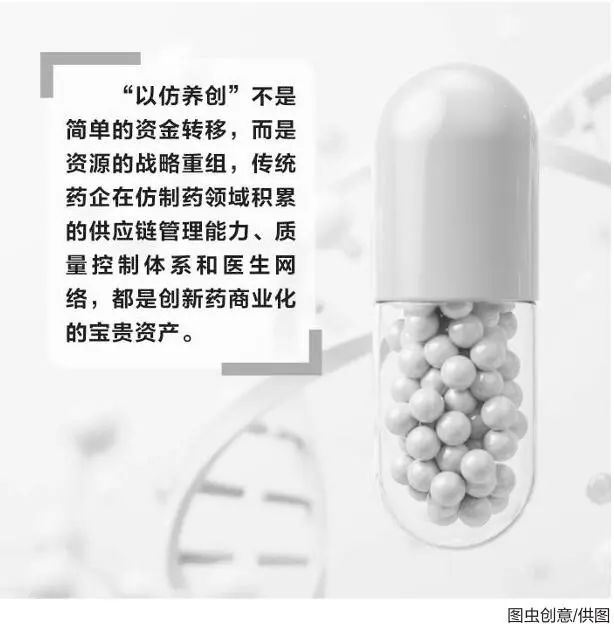
Core Viewpoint - Chinese innovative pharmaceutical companies, primarily rooted in generic drugs, are successfully transitioning to innovative drug development, showcasing resilience and adaptability in a competitive global market [1][2][3] Industry Development - The Chinese pharmaceutical industry was historically focused on generic drugs, with significant reforms in 2015 reducing new drug approval times from an average of 3 years to 60 days, facilitating the rise of innovative drugs [2][3] - The consensus in the industry around 2020 indicated the end of high-profit margins for generic drugs, prompting a necessary shift towards high-level innovation [2][3] - Companies like Hengrui Medicine transitioned from 90% revenue from generics in 2018 to over 50% from innovative drugs by 2024, with innovative drug sales reaching 14 billion yuan, a 30.6% year-on-year increase [2] Case Studies - Aosaikang, once a leader in digestive generics, saw a decline in revenue from 33.66 billion yuan in 2019 to 2.7 billion yuan in 2024 due to procurement reforms, but successfully pivoted to innovative drugs, achieving its first Class 1 innovative drug approval in January 2025 [5][6] - Shandong Innovative Drug Development Co. shifted its focus from generics to innovation, leveraging stable cash flow from generics to support high-investment innovative drug research [5][6] Challenges in Transition - The transition from generics to innovative drugs is fraught with challenges, including high costs and long development times, with the industry facing a "three tens" rule: 10 years of development, 10 billion USD in costs, and a success rate below 10% [7][8] - Companies like Jiahe Biopharma faced setbacks, such as the rejection of their PD-1 drug application, resulting in significant losses from years of investment [7][8] - The cultural shift required for innovation, moving from a "follow-the-recipe" approach in generics to "creating new recipes" in innovation, poses significant organizational challenges [8][9] Strategic Insights - The synergy between generic and innovative drug development is crucial, with traditional companies leveraging their experience in supply chain management and quality control to enhance the commercialization of innovative drugs [6][7] - The industry requires a diverse range of smaller, specialized companies to foster innovation through trial and error, which is essential for breakthroughs in a high-risk environment [9]


频频斩获海外大单!医药行业“仿转创”迎来收获季
证券时报· 2025-08-19 03:37
Core Viewpoint - The article discusses the transformation of Chinese pharmaceutical companies from generic drug production to innovative drug development, highlighting the challenges and successes of this transition in the context of the global pharmaceutical market [3][4][6][13]. Industry Overview - The Chinese pharmaceutical industry has historically focused on generic drugs, with significant reforms initiated in 2015 that reduced new drug approval times from an average of 3 years to 60 days, facilitating the rise of innovative drugs [6]. - The introduction of drug procurement policies since 2018 has led to a significant decrease in the average procurement prices of generic drugs, prompting a shift from high-profit generic drugs to a focus on high-level innovation [6][13]. Company Case Studies - **Hengrui Medicine**: In 2018, nearly 90% of its revenue came from generic drugs, but by 2024, innovative drug sales reached 14 billion yuan, accounting for over half of total sales, with a year-on-year growth of 30.60% [6][13]. - **Aosaikang**: Once a leader in generic digestive drugs, its revenue from this segment fell to 270 million yuan by 2024, down from 3.366 billion yuan in 2019. However, the company has successfully pivoted to innovative drugs, achieving its first Class 1 innovative drug approval in January 2025 [8][10]. - **Shijiazhuang Pharmaceutical Group and Hansoh Pharmaceutical**: Both companies, originally focused on generics, have also made significant strides in the innovative drug sector, reflecting a broader trend among traditional pharmaceutical companies [6][13]. Strategic Insights - The transition from generics to innovation is not straightforward; companies must overcome significant challenges, including high costs and low success rates associated with innovative drug development [14][15]. - The concept of "using generics to support innovation" is emphasized, where profits from generics are reinvested into innovative drug research and development [11][12]. - The industry recognizes the importance of strategic resource reallocation, leveraging existing supply chain management and clinical networks to enhance the commercialization of innovative drugs [11][12]. Challenges in Transition - The article notes that the path to innovation is fraught with difficulties, including the high financial burden of R&D and the need for a cultural shift within organizations to embrace risk-taking and innovation [14][15]. - The success rate for innovative drug development is low, with estimates suggesting it takes about 10 years and costs around 1 billion USD to bring a new drug to market, with a success rate of less than 10% [14][15].

恒指跌93點,滬指升31點,標普500跌1點
宝通证券· 2025-08-19 02:34
Market Overview - The Hang Seng Index (HSI) closed at 25,176 points, down 93 points or 0.4% after reaching a high of 25,466 points earlier in the day[1] - The total market turnover was HKD 312.78 billion, the highest level since July 31[1] - Northbound trading totaled HKD 181.83 billion, while southbound funds saw a net inflow of HKD 1.39 billion, a significant drop of 96% from last Friday's net inflow of HKD 35.88 billion[1] A-Shares Performance - The Shanghai Composite Index rose 31 points or 0.9% to close at 3,728 points, with a peak of 3,745 points, marking a nearly ten-year high[2] - The Shenzhen Component Index increased by 200 points or 1.7%, closing at 11,835 points, with a turnover of CNY 1.63 trillion[2] - The ChiNext Index gained 71 points or 2.8%, closing at 2,606 points, with a turnover of CNY 829.6 billion[2] Corporate Earnings Highlights - Wu Jinzi, the founder of WuXi AppTec (02268.HK), reported a revenue of CNY 2.701 billion for the six months ending June, a year-on-year increase of 62.2%[3] - The net profit for WuXi AppTec was CNY 746 million, up 52.7%, with earnings per share of CNY 0.62[3] - Genscript Biotech (01672.HK) announced a placement of 52.4 million shares at HKD 16.45, a discount of approximately 9.9% from the closing price[4] - Hansoh Pharmaceutical (03692.HK) reported a revenue of CNY 7.434 billion, a year-on-year increase of 14.3%, with a net profit of CNY 3.134 billion, up 15%[4] - Li Auto (09863.HK) achieved a revenue of CNY 24.25 billion, a year-on-year increase of 174.1%, turning a profit of CNY 33.03 million compared to a loss of CNY 2.212 billion in the previous year[5]

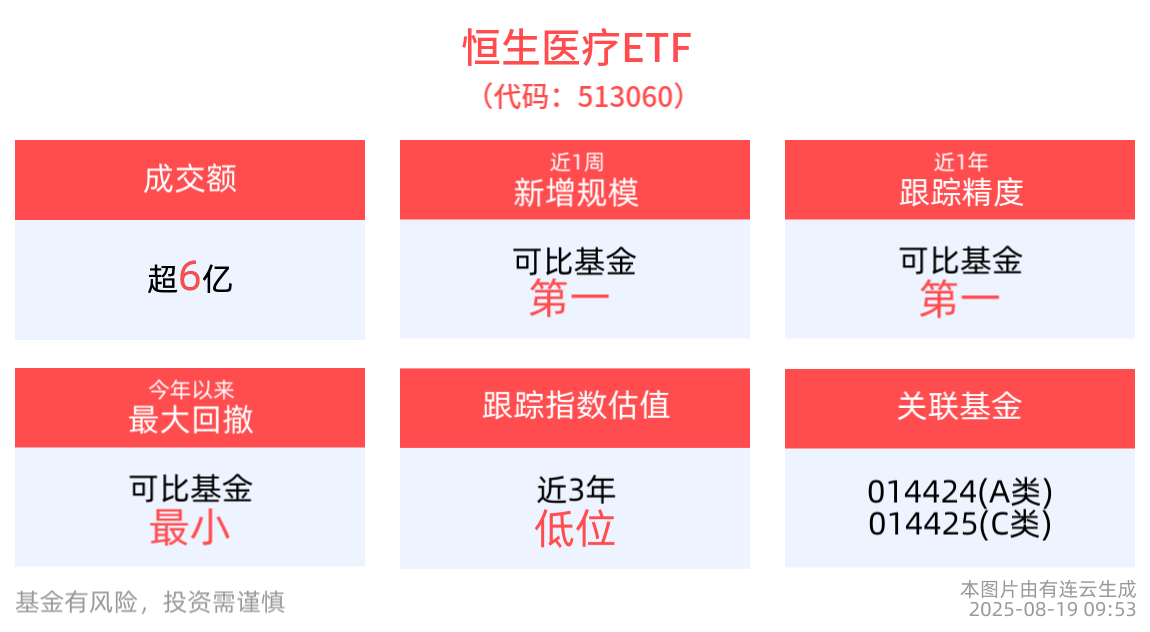
创新药产业多点突破,减肥药概念股受关注,恒生医疗ETF(513060)近1周规模增长5.51亿元,港股创新药精选ETF(520690)冲击5连涨
Xin Lang Cai Jing· 2025-08-19 02:24
Core Viewpoint - The healthcare sector in Hong Kong is experiencing mixed performance, with specific pharmaceutical stocks showing significant gains, while ETFs tracking these sectors have shown varied results in terms of liquidity and performance metrics [3][5][6]. Group 1: Market Performance - As of August 19, 2025, the Hang Seng Healthcare Index (HSHCI) increased by 0.19%, with notable gains from Federated Pharmaceutical (up 7.87%) and Hansoh Pharmaceutical (up 5.61%) [3]. - The Hang Seng Healthcare ETF (513060) saw a decline of 0.27%, with a recent price of 0.74 HKD, but had a 9.50% increase over the past week [3]. - The Hang Seng Hong Kong Stock Connect Innovative Drug Selection Index (HSSCPB) decreased by 0.08%, with Federated Pharmaceutical leading gains [5]. Group 2: Stock Movements - A-share weight loss drug concept stocks surged, particularly Hanyu Pharmaceutical (up over 14%) and Jinkai Biotechnology (up over 12%), following FDA's accelerated approval of Novo Nordisk's Wegovy for specific liver conditions [6]. - The performance of various pharmaceutical stocks is mixed, with some like China Biopharmaceutical declining by 3.03% [5]. Group 3: ETF Insights - The Hang Seng Healthcare ETF recorded a turnover of 8.65% and a transaction volume of 687 million HKD, with an average daily transaction of 2.596 billion HKD over the past month [3]. - The Hong Kong Stock Connect Innovative Drug Selection ETF (520690) increased by 0.19%, achieving a recent price of 1.05 HKD, and has seen a 9.13% rise over the past week [5]. - The Hang Seng Healthcare ETF's net asset value increased by 60.88% over the past two years, ranking it in the top 10% among QDII equity funds [12]. Group 4: Institutional Analysis - The policy framework is evolving with a dual-track system for basic medical insurance and commercial insurance for innovative drugs, indicating a more favorable environment for genuine innovation [8]. - The sentiment in the market is driven by the expansion of GLP-1 indications and the internationalization of Chinese innovative drugs, although there is increasing differentiation among stocks [8]. Group 5: Valuation Metrics - The Hang Seng Healthcare ETF's latest price-to-earnings ratio (PE-TTM) is 31.82, indicating it is at a historical low compared to the past three years [16]. - The Hong Kong Stock Connect Innovative Drug Selection ETF has a maximum drawdown of 5.45% since inception, with a tracking error of 0.112%, showcasing its precision in tracking the index [21][23].