
四川发展(控股)有限责任公司

Search documents
四川发展航空产业投资集团注册资本增至40亿元
Zheng Quan Ri Bao Wang· 2026-01-08 05:42
本报讯(记者袁传玺)天眼查工商信息显示,近日,四川发展航空产业投资集团有限公司发生工商变更, 注册资本由30亿元增至40亿元。股东信息显示,该公司由四川发展(控股)有限责任公司全资持股。 ...
四川发展航空产业投资集团增资至40亿,增幅约33%
Zhong Guo Neng Yuan Wang· 2026-01-07 09:31
Core Insights - Sichuan Development Aviation Industry Investment Group Co., Ltd. has increased its registered capital from 3 billion RMB to 4 billion RMB, representing an increase of approximately 33% [1] Company Overview - Sichuan Development Aviation Industry Investment Group Co., Ltd. was established in June 2021 and is legally represented by Xiong Huiran [1] - The company's business scope includes investment activities using its own funds and asset management services funded by its own capital [1] - The company is wholly owned by Sichuan Development (Holding) Co., Ltd. [1]
成都产投、四川发展等成立蓉光科技公司
Zheng Quan Shi Bao Wang· 2025-12-17 07:35
人民财讯12月17日电,企查查APP显示,近日,四川天府蓉光科技有限责任公司成立,法定代表人为刘 念良,注册资本为9.8亿元,经营范围包含:科技中介服务;以自有资金从事投资活动等。企查查股权 穿透显示,该公司由成都产业投资集团有限公司、四川发展(控股)有限责任公司旗下四川省科技创新投 资集团有限责任公司等共同持股。 ...
信用周报20251214:2025年信用债市场违约特征总结-20251215
Western Securities· 2025-12-15 07:56
1. Report Industry Investment Rating No relevant content provided. 2. Core Viewpoints of the Report - In 2025, the number and scale of credit bond defaults decreased significantly, and the credit environment improved. The number of defaulted bonds was 16, with a total default amount of 15.084 billion yuan, a year-on-year decrease of 54 bonds and 77.145 billion yuan respectively [1][11]. - All first - time defaulting entities in 2025 were non - state - owned enterprises, and the number of defaults in the real estate industry decreased. Looking ahead to 2026, real estate may still be the main risk point in the credit bond market, and local risks of some weak - qualified small and medium - sized financial institutions should be vigilant, but the probability of a systemic impact on the market is low [1][13]. - The default rate dropped to a historically low level. In 2025, the marginal default rate was 0.22%, the second - lowest since 2014 [1][22]. - Last week, after an important meeting released a signal of monetary easing, credit bond yields turned downward in the second half of the week but the repair momentum was weak. Looking forward, due to the impact of wealth management funds returning to the balance sheet at the end of the quarter, incremental funds may be limited, and there is insufficient impetus to compress credit spreads. It is recommended to focus on the coupon strategy [2]. 3. Summary According to the Directory 3.1 2025 Credit Bond Market Default Feature Summary - **Default Quantity and Scale Decreased Significantly, Credit Environment Improved**: In 2025, the number and amount of defaulted credit bonds continued the downward trend of the previous year. There were 16 defaulted bonds with a total amount of 15.084 billion yuan, a year - on - year decrease of 54 bonds and 77.145 billion yuan respectively. From 2014 - 2025, substantial defaults were the main type in the credit bond market (73.4%), and in 2025, there were 11 substantial defaults and 5 extensions [11]. - **First - time Defaulting Entities were All Non - state - owned Enterprises, Real Estate Industry Default Quantity Decreased**: The 16 first - time defaulted bonds in 2025 came from 12 non - state - owned enterprise issuers, covering 6 industries such as real estate and non - bank finance. Historically, non - state - owned enterprises had significantly more defaults than state - owned enterprises. The real estate industry was still the main risk point in 2026, and local risks of some small and medium - sized financial institutions should be watched out for [13][17]. - **Default Rate Dropped to a Historically Low Level**: In 2025, the marginal default rate was 0.22%, the second - lowest since 2014. The overall recovery rate from 2014 to 2025 was 13.76%, with state - owned enterprises having a higher recovery rate of 27.12% than non - state - owned enterprises at 10.28% [22]. 3.2 Credit Bond Yield Overview - Last week, after an important meeting released a signal of monetary easing, credit bond yields turned downward in the second half of the week but the repair momentum was weak. Overall, credit bond yields showed mixed trends, with financial bonds performing better than non - financial credit bonds, and the 3 - year non - financial credit bonds performing better [27]. - Wealth management scale and the proportion of broken - net products decreased. The average yield of wealth management products had been declining for 6 consecutive weeks since early November. Looking forward, due to the impact of wealth management funds returning to the balance sheet at the end of the quarter, incremental funds may be limited, and there is insufficient impetus to compress credit spreads. It is recommended to focus on the coupon strategy. Institutions with stable liability ends can moderately participate in 3 - year medium - and high - grade bank secondary and perpetual bonds and securities firm subordinated bonds with relatively high spreads [29][36]. 3.3 Primary Market - **Issuance Volume**: Last week, the issuance scale of credit bonds increased both month - on - month and year - on - year, while the net financing scale decreased month - on - month and increased year - on - year. The net financing scale of urban investment bonds and financial bonds decreased month - on - month, while that of industrial bonds increased [37]. - **Issuance Cost**: The average issuance interest rate of credit bonds increased slightly. The average issuance interest rate of urban investment bonds increased month - on - month, while that of industrial and financial bonds decreased [45]. - **Issuance Term**: The average issuance term of credit bonds decreased month - on - month. The issuance terms of industrial and financial bonds decreased, while that of urban investment bonds increased [47]. - **Cancellation of Issuance**: The number and scale of cancelled credit bond issuances decreased last week [53]. 3.4 Secondary Market - **Trading Volume**: Except for the trading volume of securities firm subordinated bonds, the trading volume of other types of credit bonds rebounded last week, with the trading volume of bank secondary capital bonds increasing by over 13 billion yuan. The trading terms of different types of bonds showed different trends in terms of remaining maturity and implied rating [57][58]. - **Trading Liquidity**: The turnover rates of urban investment bonds, industrial bonds, and financial bonds increased last week. The turnover rates of different terms of each type of bond also showed different trends [59]. - **Spread Tracking**: Last week, most urban investment bond spreads widened, with the 10 - year AA + grade urban investment bond spreads widening the most. Most industrial bond spreads also widened, with the real estate industry having the largest spread widening for both AAA and AA grades. Most bank secondary and perpetual bond spreads narrowed, while the spreads of securities firm subordinated bonds widened across the board, and most insurance subordinated bond spreads narrowed [65][73][76]. 3.5 Weekly Hot Bonds Overview Based on qeubee's bond liquidity scoring, the top 20 urban investment bonds, industrial bonds, and financial bonds in terms of liquidity scores were selected for investors' reference [80]. 3.6 Credit Rating Adjustment Review Last week, 3 bonds had their debt ratings downgraded, and there were no upgrades [84].
【时政】五粮液入股四川航空
Sou Hu Cai Jing· 2025-12-02 18:28
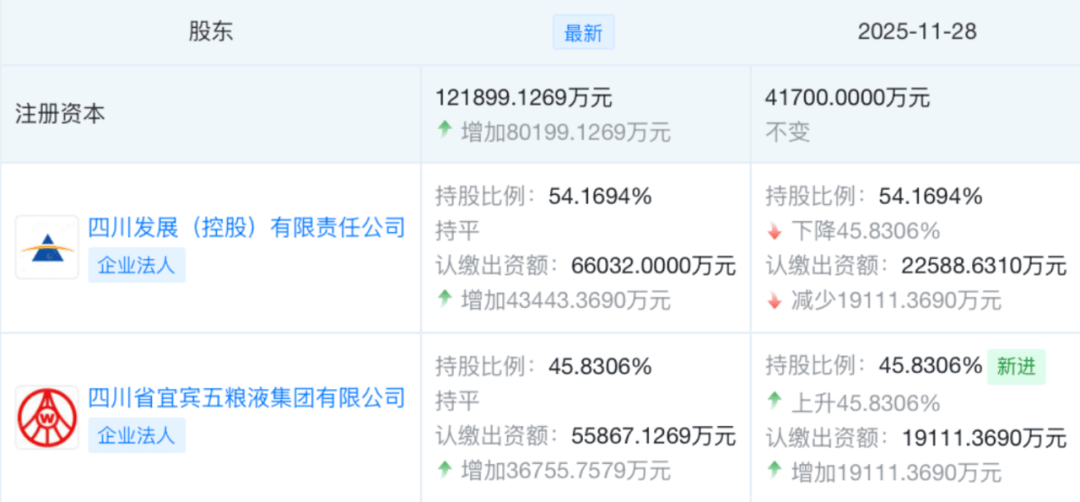
Core Viewpoint - Wuliangye Group has become a shareholder in Sichuan Airlines Group, increasing its registered capital significantly, which marks a strategic partnership aimed at enhancing collaboration in various industries [2][4]. Group 1: Shareholding Changes - Sichuan Airlines Group's registered capital increased from 417 million yuan to approximately 1.219 billion yuan, with Wuliangye Group holding a 45.83% stake [2][3]. - The shareholding structure now consists of Sichuan Development holding 54.17% and Wuliangye Group holding 45.83%, indicating a significant shift in ownership dynamics [4]. Group 2: Previous Investments - This is not Wuliangye's first investment in Sichuan Airlines; a previous agreement in December 2022 involved an injection of around 5 billion yuan to alleviate operational pressures for Sichuan Airlines [4]. - The partnership aims to strengthen collaboration in various sectors, as highlighted by the statements from both companies' executives during the recent shareholders' meeting [4][6]. Group 3: Company Background - Sichuan Airlines Group, established in 1988, has evolved into a comprehensive aviation investment group, focusing on air transport and related industries, with over 20,000 employees [7]. - Wuliangye Group has diversified its investments into various sectors, including aviation, energy storage, and new energy vehicles, indicating a strategic shift towards transformation [7].


五粮液集团入股四川航空集团
Zheng Quan Shi Bao Wang· 2025-12-02 07:24
Group 1 - Sichuan Airlines Group Co., Ltd. has undergone a business change, adding Sichuan Yibin Wuliangye Group Co., Ltd. as a shareholder [1] - The registered capital of Sichuan Airlines has increased from 417 million to 1.219 billion yuan [1] - The company was established in 1988 and is currently co-owned by Sichuan Development (Holding) Co., Ltd. and Sichuan Yibin Wuliangye Group Co., Ltd. [1] Group 2 - The business scope of Sichuan Airlines includes general aviation services, civil aircraft maintenance, and real estate development [1]
五粮液集团入股川航完成工商变更 2022年曾为其注资50亿
Sou Hu Cai Jing· 2025-12-02 06:15
Core Insights - Sichuan Airlines Group has undergone a significant change in its corporate structure, with the addition of Sichuan Yibin Wuliangye Group as a shareholder, increasing its registered capital from 417 million RMB to approximately 1.219 billion RMB [1] - The strategic investment from Wuliangye Group has led to an increase in Sichuan Airlines' asset scale to 73.8 billion RMB, with annual passenger transport exceeding 30 million [2] - The completion of the capital increase and share expansion is considered a milestone in the development history of Sichuan Airlines Group, marking a critical strategic leap [3] Group 1 - Sichuan Airlines Group was established in June 1988 and is involved in general aviation services, civil aircraft maintenance, and real estate development [1] - The capital injection of approximately 5 billion RMB was fully in place by the end of 2022, addressing urgent financial needs for Sichuan Airlines Group [1] - The strategic partnership aims to enhance cooperation in various sectors, including cargo conversion and aircraft leasing [3] Group 2 - The first shareholders' meeting of Sichuan Airlines Group in 2025 was attended by key executives from Wuliangye Group, indicating ongoing collaboration [3] - Wuliangye Group's leadership expressed commitment to supporting the development of Sichuan Airlines Group and fostering cooperation in related industries [3] - Sichuan Development, the controlling entity of Sichuan Airlines, plans to deepen strategic cooperation across multiple areas [3]
盟升电子与川发引领资本达成战略合作 加速拓展航空航天业务
Zheng Quan Shi Bao Wang· 2025-10-18 11:21
Core Viewpoint - The strategic cooperation agreement between Alliance Electronics and Sichuan Development Leading Capital aims to leverage both parties' strengths to promote high-quality development in the aerospace and satellite industries [1][3]. Group 1: Strategic Cooperation Agreement - The agreement includes four main areas: industrial resource cooperation, capital operation cooperation, technological innovation cooperation, and talent exchange cooperation [1][2]. - In industrial resource cooperation, Sichuan Development Leading Capital will coordinate quality enterprises within its system to enhance business collaboration with Alliance Electronics in various fields such as communication navigation, low-altitude economy, satellite internet, and high-end manufacturing [1][2]. Group 2: Capital Operation Cooperation - The capital operation cooperation will focus on utilizing Sichuan Development Leading Capital's advantages to explore multi-dimensional capital operations in satellite communication, navigation, and low-altitude economy, including major industrial project investments and mergers and acquisitions [2][5]. Group 3: Technological Innovation Cooperation - Both parties plan to jointly promote the research and breakthrough of common technologies, enhance technological cooperation in their respective fields, and address core challenges in technology [2][3]. Group 4: Talent Exchange Cooperation - The agreement emphasizes strengthening talent exchange through joint training programs, sharing expert resources, and promoting deep collaboration in technical and management innovation [2][3]. Group 5: Share Acquisition - Sichuan Development Leading Capital will acquire 10.5 million shares of Alliance Electronics, representing 6.25% of the total share capital, at a price of 30.90 yuan per share, totaling 324 million yuan [5].

中国国新等在四川新设控股公司 注册资本20亿元
Zheng Quan Shi Bao Wang· 2025-09-26 03:56
Group 1 - The establishment of Guoxin Holdings (Sichuan) Co., Ltd. has been recently reported, with a registered capital of 2 billion yuan [1] - The company's business scope includes asset management services, venture capital (limited to investments in unlisted companies), and financing consulting services [1] - Guoxin Holdings is jointly owned by China Guoxin Holdings Co., Ltd. and Sichuan Development (Holding) Co., Ltd. [1]
从四川国企半年报,看“压舱石”的分量有多重
Zhong Guo Xin Wen Wang· 2025-08-18 02:53
Core Insights - Sichuan state-owned enterprises reported total assets of 2.97 trillion yuan, operating revenue of 306.2 billion yuan, and tax payments of 13.7 billion yuan, with year-on-year growth of 9.8%, 0.7%, and 3.3% respectively, alongside an investment completion of 122.5 billion yuan in the first half of the year [1] Group 1: Operational Performance - The production line of Sichuan Development's short-flow vanadium electrolyte preparation plant has reached full capacity, with over 10,000 cubic meters sold and more than 20,000 cubic meters in intended orders [1][2] - The successful launch of the vanadium electrolyte project is attributed to industry opportunities, technological accumulation, and collaborative resources, with a stable supply of raw materials and financial backing from state-owned shareholders [2] - Key operational indicators for Sichuan state-owned enterprises have stabilized and rebounded, with significant market expansion and improved management efficiency [2] Group 2: Investment and Infrastructure Development - In the first half of the year, Sichuan state-owned enterprises completed investments of 122.5 billion yuan, focusing on transportation and energy sectors, which directly boosted asset scale [2][3] - Major infrastructure projects include the completion of the Cangba Expressway and the commissioning of new power generation units, adding over 1 million kilowatts of installed capacity [2][3] - The Leshan to Xichang Expressway project is nearing completion, with significant progress made on key engineering tasks [3] Group 3: Strategic Investments and Innovations - Sichuan Development has made strategic investments in aerospace and technology sectors, becoming a major shareholder in several companies focused on advanced manufacturing and aerospace electronics [4] - The state-owned enterprises have seen a 55.2% and 73% year-on-year increase in investments in key and emerging industries, respectively, with these sectors now accounting for 53% of total assets [4] Group 4: Reform and Efficiency Improvements - The ongoing deepening of state-owned enterprise reforms in Sichuan has led to significant restructuring and professional integration in the energy sector [5] - The provincial government emphasizes the importance of maintaining strategic focus and enhancing development confidence amid new challenges [6] Group 5: Emergency Preparedness and Resource Management - Sichuan's water management company has implemented measures to enhance flood prevention and resource management, optimizing water storage and ensuring safety during critical periods [7] - The company has increased water storage by 230 million cubic meters compared to the same period last year, demonstrating effective resource management strategies [7]