
晶泰控股-P

Search documents
质量跃迁、结构优化与创新生态构建:医药制造行业技术要素对信用质量的影响分析(下篇)
新世纪评级· 2025-04-07 03:40
Investment Rating - The report does not explicitly state an investment rating for the high-end medical device industry Core Insights - The high-end medical device market is experiencing stable growth, with a global market size of $345.4 billion in 2023, reflecting a year-on-year increase of 6.64% [2] - In China, the high-end medical device market reached ¥414.45 billion in 2023, growing by 24.9% year-on-year, with a CAGR of 27.8% from 2015 to 2023 [4] - The report highlights the importance of technological innovation and domestic production capabilities in reducing reliance on imports and enhancing market competitiveness [11][14] Summary by Sections High-End Medical Devices - High-end medical devices are characterized by high technical content, significant R&D investment, and complex manufacturing processes, playing a crucial role in precision diagnosis and treatment [1] - The global high-end medical equipment market is primarily concentrated in the US, Europe, and China, which together account for approximately 86% of the market share in 2023 [2] Market Growth and Segmentation - The treatment equipment segment holds the largest market share at 28.67%, followed closely by diagnostic testing equipment at 27.91% in the global market [2] - In China, treatment equipment also leads with a 27.47% market share, followed by diagnostic testing equipment at 26.56% [4] Domestic Innovation and Policy Support - The Chinese government has been actively promoting the development of high-end medical devices to reduce dependence on imports, with a significant increase in the number of approved innovative medical devices [11] - In 2024, the National Medical Products Administration approved 65 innovative medical devices, marking a 6.6% increase from the previous year [12] R&D Investment and Technological Advancements - R&D investment in the high-end medical device sector has been increasing, with companies like Mindray Medical and MicroPort Medical leading in R&D spending [19] - The report notes that the cost structure of high-end medical devices is heavily concentrated on core components and R&D, with core components accounting for 40%-60% of total costs [23] Market Dynamics and Internationalization - The report indicates that the high-end medical device industry is undergoing a transformation driven by domestic substitution and international expansion, with Chinese companies increasingly entering global markets [29][30] - In 2023, China's high-end medical device exports grew by 28%, with significant contributions from imaging equipment [30] Future Trends - The aging population is driving demand for chronic disease management and home medical devices, pushing the industry towards smart and precise development [36] - The integration of AI and robotics in high-end medical devices is expected to enhance diagnostic efficiency and patient outcomes, reshaping traditional healthcare delivery models [38]
集采政策持续推进,恒生医疗ETF(513060)涨近1%,乐普生物-B、翰森制药涨超4%
Sou Hu Cai Jing· 2025-03-31 01:51
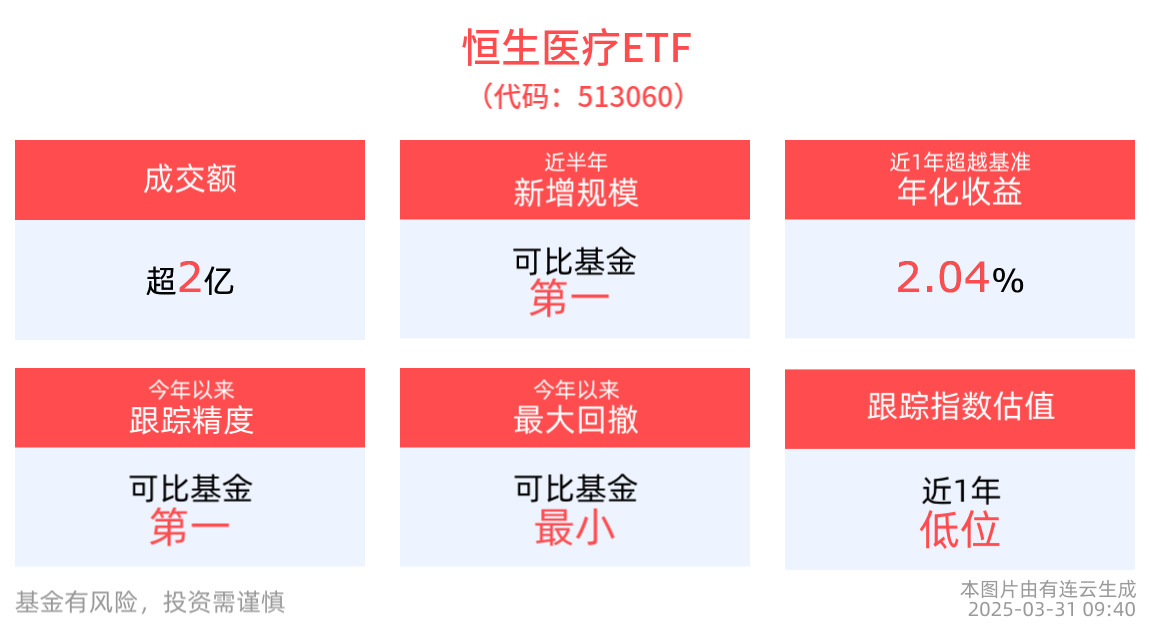
Core Viewpoint - The recent draft proposal from the National Healthcare Security Administration aims to optimize drug procurement policies, which may reshape investor confidence in the pharmaceutical sector and benefit quality generic drug companies [3][4]. Group 1: Market Performance - As of March 31, 2025, the Hang Seng Healthcare Index (HSHCI) increased by 0.02%, with notable gains from companies such as Lepu Biopharma-B (up 4.72%) and Hansoh Pharmaceutical (up 4.66%) [1]. - The Hang Seng Healthcare ETF (513060) rose by 0.84%, with a latest price of 0.48 HKD and a trading volume of 230 million HKD, ranking in the top third among comparable ETFs [1]. Group 2: Policy Changes - The draft proposal includes six main areas of optimization: procurement variety and bidder standards, bidding rules, quantity rules, implementation measures, quality assessment, and information transparency [3]. - The adjustments aim to eliminate the previous low-price bidding rule, prevent malicious low bidding by companies, and ensure stable supply through a "stockout" mechanism [3]. Group 3: Investment Insights - The recent draft is expected to restore investor confidence in hospital medication, potentially benefiting quality generic drug companies and those with significant market space [4]. - The Hang Seng Healthcare ETF has seen a growth of 270 million HKD in scale over the past six months, with a financing buy-in amount of 420 million HKD and a financing balance of 576 million HKD [4]. Group 4: Performance Metrics - Since its inception, the Hang Seng Healthcare ETF has achieved a maximum monthly return of 28.34% and an average monthly return of 7.00% [4]. - As of March 28, 2025, the ETF's maximum drawdown this year was 6.06%, the smallest among comparable funds, with a management fee of 0.50% and a custody fee of 0.15% [5]. - The ETF's tracking error was 0.032%, the highest tracking precision among comparable funds, and its latest price-to-earnings ratio (PE-TTM) was 25.15, indicating a valuation below 97.83% of the past year [5]. Group 5: Top Holdings - The top ten weighted stocks in the Hang Seng Healthcare Index account for 55.69% of the index, including WuXi Biologics (02269) and BeiGene (06160) [5].

港股科技龙头止跌反弹,香港科技ETF(513560)涨超1%,实时换手率突破67%
Jie Mian Xin Wen· 2025-03-26 07:17
Group 1 - The Hong Kong technology sector is experiencing a rebound, with the Hong Kong Technology ETF (513560) rising over 1% and a trading turnover rate exceeding 67% [1] - The CSI Hong Kong Stock Connect Technology Index (931573) has increased by 1.19%, with notable gains from companies such as 3SBio (01530) up 11.50% and Li Auto (09863) up 5.37% [1] - The Hong Kong Technology ETF has shown a strong performance over the past year, with a 77.10% increase and a year-to-date rise of 31.42% [1] Group 2 - DeepSeek, a Chinese AI startup, has launched a new version of its model, DeepSeek-V3, which has 685 billion parameters and has significantly improved its capabilities in coding, mathematics, and reasoning [2] - The "catfish effect" from DeepSeek is expected to drive a wave of AI model applications across various industries, particularly in sectors with high digitalization [2] - China's manufacturing sector, especially in discrete manufacturing and process industries, is well-positioned for rapid AI application due to its high level of digitalization [2] Group 3 - Huatai Securities anticipates potential market volatility in April due to tariff issues and economic data releases, but remains optimistic about the long-term growth of AI technology [3] - The report suggests a "barbell strategy" for investment, focusing on Hong Kong internet and tech hardware stocks, new consumption sectors benefiting from stimulus policies, innovative pharmaceuticals related to AI, and stable dividend stocks [3] - The Hong Kong Technology ETF closely tracks the CSI Hong Kong Stock Connect Technology Index, which includes major tech companies like Xiaomi, Alibaba, and Tencent, representing 72.15% of the top ten holdings [3]


医药行业动态点评:2025政府工作报告发布,促进三医协同发展和治理
Guosen International· 2025-03-10 08:46
Investment Rating - The report suggests a positive outlook for the pharmaceutical industry, emphasizing the importance of innovation and public hospital reforms [2][3]. Core Insights - The 2025 government work report highlights the need to strengthen basic healthcare services and improve social security policies, indicating a supportive environment for the pharmaceutical sector [1][3]. - Key measures include the establishment of an innovation drug catalog, optimization of drug procurement policies, and a focus on public hospital reforms aimed at enhancing service quality [2][3]. - Increased fiscal support for healthcare, particularly in elderly medicine and innovation, aligns with the upcoming implementation of the Class B medical insurance catalog and the expansion of commercial insurance coverage [3]. Summary by Sections Government Initiatives - The government aims to enhance basic healthcare services and deepen public hospital reforms, with a focus on quality improvement [3]. - There will be further relaxation of foreign investment market access and expansion of pilot programs in the healthcare sector [3]. Financial Support - The per capita financial subsidy for resident medical insurance will increase from 670 yuan to 700 yuan, benefiting 320 million people [3]. - The per capita financial subsidy for basic public health services will rise to 99 yuan [3]. Investment Opportunities - The report identifies potential investment opportunities in the following sectors: - Innovative pharmaceuticals: Kelun-Botai Biological (6990.HK), BeiGene (6160.HK/688235.SH/ONC.US) [3]. - Traditional Chinese medicine: Gushengtang (2273.HK) [4]. - AI in healthcare: Jingtai Holdings-P (2228.HK), MicroPort Scientific-B (2252.HK) [4].