
高端医疗器械

Search documents
张瑜:十大增量信息——“十五五”规划纲要学习心得
一瑜中的· 2026-03-16 07:35
Economic Goals - The outline states that by 2035, the per capita GDP is expected to double compared to 2020, reaching a level comparable to that of medium-developed countries, with an average annual growth rate of 4.17% over the next decade [3][16]. Major Goals - The "15th Five-Year Plan" outlines 20 major goals, including maintaining GDP growth within a reasonable range, increasing the proportion of nursing beds in elderly care institutions, and improving the enrollment rate of children under three years old [4][17]. Major Projects - A total of 109 major projects will be implemented during the "15th Five-Year Plan," focusing on enhancing industrial capabilities, fostering new industries, and advancing cutting-edge technology [5][19]. Integration of Technology and Industry - The outline emphasizes the deep integration of technological innovation and industrial innovation, including the establishment of a corporate R&D reserve fund and support for high-quality tech companies to go public [6][22]. Digital China Development - The outline includes significant new content on advancing digital China, emphasizing the strengthening of computing power facilities and promoting the iteration and innovation of models and algorithms [7][24][25]. Family-Friendly Society - A new chapter focuses on building a family-friendly society, highlighting the importance of policies that support childbirth and childcare, including flexible work arrangements for parents of young children [8][27]. Infrastructure Development - The plan prioritizes new infrastructure, renewable energy, and urban renewal, with specific targets for the construction and renovation of urban utility networks [9][29][30]. Emerging Industries - The outline mentions various emerging industries, including new energy, advanced manufacturing, and biotechnology, with a focus on building industry clusters that leverage regional strengths [10][32].

申万宏源策略十五五规划解读:新增“新型基础设施建设+新产业赛道”十五五将带来哪些投资机会
Shenwan Hongyuan Securities· 2026-03-15 08:44
Core Insights - The report outlines the investment opportunities arising from the "New Infrastructure Construction + New Industry Tracks" as part of the 14th Five-Year Plan, emphasizing a shift towards green and low-carbon development [1][2] - The 14th Five-Year Plan maintains a five-part framework, with a focus on economic development, innovation, social welfare, security, and green low-carbon initiatives, addressing current development pain points [1][3] - The report highlights the introduction of new independent chapters in the 14th Five-Year Plan, clarifying policy direction and enhancing strategic priorities, particularly in modern industry and digitalization [1][2] Investment Opportunities - The new infrastructure construction focuses on five key areas: integrated computing networks, satellite internet, information communication networks, data infrastructure, and low-altitude infrastructure [1][3] - The new industry tracks include ten core areas such as integrated circuits, embodied intelligence, biomanufacturing, new batteries, commercial aerospace, domestic large aircraft, low-altitude equipment, green hydrogen, brain-computer interfaces, and high-end medical devices [1][3] - Specific tasks for each track are outlined, such as enhancing advanced manufacturing capabilities in integrated circuits and accelerating the development of key technologies in biomanufacturing [1][3][7] Policy Adjustments - The report notes a significant shift in policy focus from energy consumption control to direct carbon emission management, with new measures for carbon footprint accounting and product carbon emission limits [2][3] - The financial sector is transitioning from supply-side reforms to a "Financial Power Strategy," emphasizing the need for deeper investment and financing reforms to support the real economy [2][3] - The report emphasizes the importance of high-level opening-up strategies, with a focus on expanding service industry openness and promoting the internationalization of the Renminbi [3][2] Traditional Infrastructure - The traditional infrastructure section retains focus on transportation, energy, and water networks, with specific policy adjustments to enhance the national comprehensive transportation network and new energy systems [1][3] - Key projects include the construction of major clean energy bases and the expansion of natural gas pipelines to support energy transition goals [1][3][8] Technological Advancements - The report highlights the need for breakthroughs in high-end materials, basic components, software, and industrial machinery to strengthen the industrial supply chain [4][7] - Emphasis is placed on advancing artificial intelligence, quantum technology, and biotechnology as part of the frontier technology initiatives [12][14]
2026年医药产业政策展望:“两会”绘蓝图,“十五五”新征途
GUOTAI HAITONG SECURITIES· 2026-03-12 14:23
Investment Rating - The report does not explicitly state an investment rating for the pharmaceutical industry but emphasizes strong policy support and innovation as key drivers for growth in the sector. Core Insights - The 2026 National "Two Sessions" coincides with the beginning of the "14th Five-Year Plan," highlighting the pharmaceutical industry as a core area for policy support and innovation, with approximately 14 major projects directly related to health and medicine [3][8] - The government aims to enhance the support for innovative drugs and medical devices, with a focus on creating new application scenarios and optimizing the medical insurance structure [3][5][16] - The report outlines a clear direction for the pharmaceutical industry, emphasizing the importance of innovation, quality, and the rejection of low-level competition [24][26] Summary by Sections 1. Focus on "Two Sessions": Strong Policy Design for Innovation and Public Welfare - The strategic position of the healthcare sector is reinforced, with policies aimed at improving the medical insurance system and promoting high-quality development of innovative drugs and medical devices [5][6] - The per capita financial subsidy for resident medical insurance will increase by 24 yuan, indicating a commitment to enhancing healthcare funding [5] 2. Implementation and Strengthening: Comprehensive Support for Innovation 2.1. Medical Insurance Scenario Cultivation and Opening Up - The report highlights the importance of cultivating new application scenarios in the medical insurance field, which will create vast opportunities for industry development [14][15] - The implementation of the medical insurance imaging cloud project is expected to significantly boost related industries [15] 2.2. Specific Work in Medical Insurance for 2026 - The focus on optimizing the structure of medical insurance services is emphasized, with measures to enhance the efficiency of drug approval and procurement processes [16] 2.3. Continuous Increase in Support for Innovative Drugs - The 2025 medical insurance directory added 114 new drugs, including 50 innovative drugs, reflecting a strong commitment to supporting true innovation [18][24] - The introduction of the "three exclusions" policy for commercial insurance aims to facilitate the entry of innovative drugs into the market [26][27] 3. Standardization and Optimization: Continuous Promotion of Industrial Structure Upgrading - The report discusses the ongoing optimization of drug procurement rules, which aim to maintain clinical quality while minimizing disruptions to the pharmaceutical industry [3][4] - The DRG/DIP payment reform is highlighted as a key area for development, with a focus on improving payment methods and supporting the clinical use of new drugs [4][18] 4. Strengthening Medical Insurance Supervision and AI Empowerment - The report outlines plans for enhanced supervision of medical insurance funds, including the use of AI and data technology to improve regulatory processes [5][6] - A three-year action plan for improving the efficiency of medical insurance fund clearing is set to be implemented [5][6] 5. Deepening Reforms in the Medical Field - Continuous efforts to improve the governance of medical services and enhance the capabilities of public hospitals are emphasized [6][11] - The report stresses the importance of grassroots medical construction and the need for a more equitable distribution of healthcare resources [6][11]
2026年两会医药产业政策专题:擘画健康中国新蓝图
GUOTAI HAITONG SECURITIES· 2026-03-09 02:40
Policy Direction - The government work report emphasizes strong innovation and benefits for people's livelihoods, highlighting the strategic position of the healthcare sector in the national development plan[6] - The "14 major projects" related to the pharmaceutical industry are included in the 15th Five-Year Plan, with approximately 14 directly involving healthcare and pharmaceutical sectors[9] Industry Focus - The pharmaceutical industry is identified as a new pillar industry, with a focus on biomedicine and brain-computer interfaces, which are included in the national policy support system[7] - The report outlines a commitment to enhancing the quality of innovative drugs and medical devices, aiming for high-quality development in these areas[6] Healthcare System Improvements - The report proposes a 24 CNY increase in per capita financial subsidies for resident health insurance, aiming to improve the multi-tiered healthcare security system[6] - It emphasizes the need for public hospital reforms with a focus on public welfare and the optimization of medical procurement and pricing governance[7] Innovation and Digital Transformation - Industry representatives suggest focusing on digital transformation, innovative drug development, and the modernization of traditional Chinese medicine as key areas for future growth[14] - Recommendations include establishing a data asset management system and enhancing the role of AI in healthcare, particularly in disease prevention and management[14] Risk Considerations - There is uncertainty regarding the specific implementation timelines and progress of the proposed policies, which may be influenced by both domestic and international macroeconomic conditions[18]
两会速览︱“十五五”109项重大工程项目 涉及能源有哪些?
中关村储能产业技术联盟· 2026-03-06 08:41
Core Viewpoint - The article emphasizes the importance of enhancing industrial foundational capabilities and competitiveness, focusing on the development of new energy systems and technologies to drive green and low-carbon transitions [6][7][9]. Industrial Foundation and Competitiveness Enhancement - Significant technological equipment is highlighted as a key area for development, including high-end new materials, basic components, and industrial software [10]. - New industries and tracks are being cultivated, particularly in new battery technologies and green hydrogen [6][12]. Cutting-edge Technology Research - The article discusses advancements in artificial intelligence and controllable nuclear fusion as critical areas for technological breakthroughs [6][13]. Modern Infrastructure System Construction - The construction of a modern infrastructure system is essential, with a focus on major hydropower and integrated wind-solar bases, as well as offshore wind power and coastal nuclear power [9][16]. Green and Low-Carbon Transition - The transition towards carbon peak and carbon neutrality is a priority, with initiatives aimed at energy conservation and carbon reduction in key industries [7][25]. - The development of zero-carbon parks and transportation corridors is also emphasized, alongside the promotion of a circular economy to assist in carbon reduction [9][25]. Safety Assurance in Key Areas - Enhancing safety assurance capabilities in critical sectors is crucial, including food security and oil and gas exploration and development [8][29].
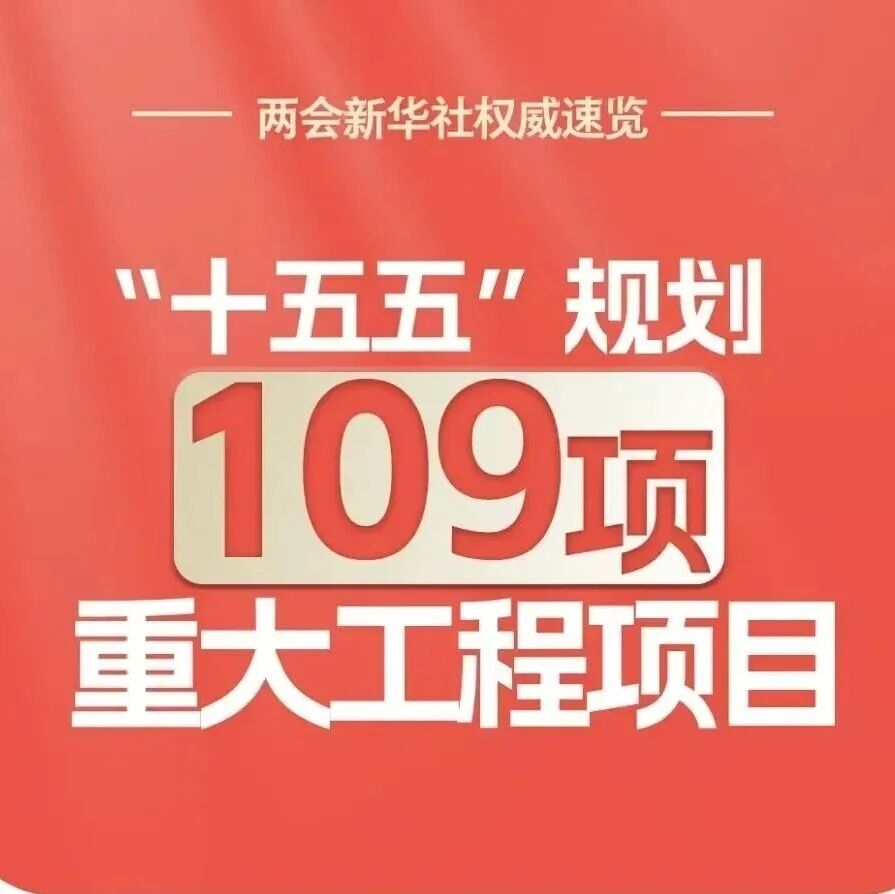
速览!“十五五”109项重大工程项目
券商中国· 2026-03-06 06:20
Core Viewpoint - The "14th Five-Year Plan" outlines 109 major engineering projects that serve as key drivers for the implementation of the plan, reflecting the superiority of the socialist system in China and aiming to achieve the set goals and tasks [3]. Group 1: Industrial Development - The plan emphasizes enhancing industrial foundational capabilities and competitiveness, focusing on high-end new materials, basic components, industrial software, and advanced instruments [5][8]. - New industries and sectors are to be cultivated, including integrated circuits, bio-manufacturing, and commercial aerospace [8][9]. Group 2: Infrastructure Development - A modern infrastructure system is to be constructed, including a comprehensive national transportation network, high-speed rail, and modern airport systems [11][12]. - The plan includes the development of new energy systems and major hydropower bases, as well as improvements in water supply and irrigation systems [12][13]. Group 3: Urban and Rural Integration - Major projects will focus on modernizing agriculture and rural areas, enhancing living conditions, and improving urban infrastructure [16][17]. Group 4: Social Welfare and Cultural Development - The plan aims to improve public health capabilities, enhance educational resources, and promote cultural prosperity [21][22]. - It includes initiatives for better healthcare services, elderly care, and support for vulnerable groups [22][23]. Group 5: Environmental Protection and Carbon Neutrality - The plan addresses carbon peak and carbon neutrality goals, emphasizing energy efficiency and pollution control [24][26]. - It includes measures for ecological protection and restoration, focusing on key ecological areas and waste management [27]. Group 6: Security and Safety - Enhancements in safety and security capabilities in key sectors, including food and energy security, are outlined [28].
“十五五”109项重大工程项目,能源工程项目有哪些?
中国能源报· 2026-03-06 00:58
Group 1 - The article discusses the significance of major engineering projects as a key implementation tool for the "14th Five-Year Plan" and highlights their role in bolstering China's economic structure [2][3] - It outlines six areas with a total of 109 major engineering projects aimed at achieving the goals of the "14th Five-Year Plan" [3] - The projects are seen as a testament to the superiority of the socialist system with Chinese characteristics [2] Group 2 - The focus on enhancing industrial foundational capabilities includes high-end new materials, basic components, and industrial software [7] - New industries and tracks being cultivated include integrated circuits, bio-manufacturing, and commercial aerospace [8] - The development of advanced medical devices and artificial intelligence is also emphasized as part of the technological advancement strategy [9] Group 3 - The construction of a modern infrastructure system is highlighted, including the national comprehensive transportation network and various energy systems [12][14] - Key projects include the development of high-speed railways, modern airports, and renewable energy bases [15][16] Group 4 - The article emphasizes the importance of promoting urban-rural integration through agricultural modernization and rural living condition improvements [18][19] - It also discusses urban renewal and infrastructure upgrades to enhance commuting efficiency in metropolitan areas [19] Group 5 - The article outlines initiatives for improving public health and education, including the enhancement of medical services and the expansion of quality educational resources [25][26] - It highlights the importance of social welfare services, particularly for vulnerable groups such as children and the elderly [27] Group 6 - The article addresses the transition to a green and low-carbon economy, focusing on energy efficiency and pollution reduction in key industries [28][30] - It discusses the importance of ecological protection and restoration efforts across various regions [32] Group 7 - The article mentions the enhancement of safety assurance capabilities in critical sectors, including food security and energy resource management [34][36]

真金白银! 最高5000万! 黑龙江生物制造政策,支持生物医药、生物化工、生物农业
合成生物学与绿色生物制造· 2026-02-26 12:54
Core Viewpoint - The article discusses the recent policies released by the Heilongjiang Provincial Government to support the high-quality development of the biomanufacturing industry, focusing on enhancing technological innovation, promoting industrial expansion and quality improvement, supporting key areas, and increasing resource guarantees [2]. Group 1: Enhancing Technological Innovation - Support for the construction of innovation platforms in biomanufacturing, including collaboration with universities and research institutions [3]. - Financial support for key technology research projects in biomanufacturing, with provincial funding for approved projects [3]. - Encouragement for enterprises to increase R&D investment, with subsidies for qualifying investments over 500,000 yuan [3]. - Support for the establishment of pilot testing platforms, with potential subsidies based on performance evaluations [3]. - Promotion of technology transfer activities, providing funding for contracts over 1 million yuan [3]. Group 2: Promoting Industrial Expansion and Quality Improvement - Financial support for new biomanufacturing projects with fixed asset investments over 20 million yuan, offering up to 50 million yuan in subsidies [4]. - Assistance for equipment upgrades in biomanufacturing enterprises to enhance production efficiency [4]. - Support for digital transformation using AI and big data, with subsidies for recognized digital workshops and smart factories [4]. - Encouragement for leading biomanufacturing enterprises to form innovation alliances to enhance collaboration and market expansion [4]. Group 3: Supporting Key Areas of Development - Financial incentives for new drug and high-end medical device development, with support based on clinical trial phases [5]. - Encouragement for the development of new food products, with rewards for approved new food materials [5]. - Support for the development of high-value biochemicals, with financial rewards for significant sales achievements [5]. Group 4: Increasing Resource Guarantees - Support for the construction of biomanufacturing parks and infrastructure, with potential bond funding [6]. - Assurance of key resource guarantees for biomanufacturing projects, including energy and land use [6]. - Strengthening financial support for biomanufacturing enterprises, including assistance for listing and innovative financing products [6]. - Enhancement of intellectual property protection for biomanufacturing innovations [7]. Group 5: Strengthening Talent Development - Encouragement for universities to develop relevant programs and facilitate talent acquisition in biomanufacturing [7]. - Support for research personnel to engage in innovation and technology transfer activities [7].

内蒙古广东商会会长王鹏翔:广货已成为“高品质”与“智能化”代名词
Xin Lang Cai Jing· 2026-02-16 00:28
Group 1 - The "Guangdong goods going north" trend has deepened, evolving from basic commodity circulation to industrial collaboration and shared concepts between Guangdong and Inner Mongolia [1] - Guangdong's products have transitioned from representing "novelty" to being synonymous with "high quality" and "intelligent" offerings, reshaping consumption and production in Inner Mongolia [1] - Over 2,000 Guangdong enterprises have invested in Inner Mongolia, with actual investments exceeding several hundred billion yuan, making them a significant force in foreign investment in the region [1] Group 2 - Guangdong enterprises have contributed to Inner Mongolia through three main aspects: bringing talent and technology, financial investment exceeding 100 billion yuan, and creating over 50,000 local jobs, primarily in technical positions [2] - Recommendations for future cooperation include enhancing the "flying economy" model, promoting talent mobility between the two regions, and integrating digital industries with Inner Mongolia's computing resources [3]
关于印发《黑龙江省支持生物制造产业高质量发展若干政策措施》的通知
Xin Lang Cai Jing· 2026-02-15 01:02
Core Viewpoint - The Heilongjiang Provincial Government has issued a set of policy measures to support the high-quality development of the biomanufacturing industry, aiming to enhance technological innovation, promote industrial expansion, and ensure resource allocation to create competitive advantages and seize future development opportunities [2][7]. Group 1: Enhancing Technological Innovation - Support for the construction of innovation platforms in biomanufacturing through collaboration between enterprises and research institutions, with financial rewards for approved national and provincial platforms [3][8]. - Encouragement for tackling core technological challenges in biomanufacturing, with provincial financial support for approved key research projects [3][8]. - Incentives for enterprises to increase R&D investment, with subsidies for qualifying expenditures exceeding 500,000 yuan, matched by provincial and municipal funding [3][8]. - Support for the establishment of pilot testing and verification platforms, with potential subsidies of up to 1 million yuan based on performance evaluations [3][8]. - Promotion of technology transfer activities, providing funding for contracts exceeding 1 million yuan for technology purchases from research institutions [3][8]. Group 2: Promoting Industrial Expansion and Quality Improvement - Financial support for new biomanufacturing projects in key sectors, with subsidies of up to 5 million yuan for fixed asset investments of 20 million yuan or more [4][9]. - Assistance for equipment upgrades in biomanufacturing enterprises to enhance production efficiency and reduce costs [4][9]. - Support for digital transformation using AI, big data, and IoT technologies, with subsidies for recognized digital workshops and smart factories [4][9]. Group 3: Supporting Key Sector Development - Focus on strengthening the biopharmaceutical sector with financial support for clinical trials and production of new drugs and high-end medical devices, with potential rewards of up to 1.5 million yuan [4][9]. - Encouragement for the development of new food products, with one-time rewards for approved new food materials and additives [4][9]. - Promotion of biochemicals with high added value, providing rewards for significant sales achievements in new products [4][9]. Group 4: Resource Allocation and Financial Support - Support for the construction of biomanufacturing parks and infrastructure, with potential bond funding for qualifying projects [5][10]. - Inclusion of biomanufacturing enterprises in key resource allocation for utilities, ensuring priority in energy supply [5][10]. - Financial services support for biomanufacturing enterprises to facilitate listing and access to capital markets, including innovative loan products [5][10]. Group 5: Intellectual Property and Talent Development - Strengthening intellectual property protection for biomanufacturing innovations, with services to expedite patent applications [10][11]. - Encouragement for educational institutions to develop relevant programs and attract high-level talent to the biomanufacturing sector [10][11]. Implementation Timeline - The policy measures are effective from the date of issuance until December 31, 2028, with provisions for adjustments based on national and provincial policy changes [10].
