
Ares Management

Search documents
近5亿美元资产94折抛售!AI吓坏美国私募信贷基金
Hua Er Jie Jian Wen· 2026-02-25 08:35
私募信贷市场的紧张情绪正在从"担忧"走向"定价"。在投资者对AI相关风险、流动性与贷款标准的质 疑升温之际,美国New Mountain旗下基金选择以折价出售近5亿美元资产,反映出行业压力进一步加 大。 据彭博报道,New Mountain周二表示,其一只私募信贷基金以"每1美元资产仅售0.94美元"的价格,出 售了4.77亿美元资产,旨在提高组合分散度,降低PIK收入(实物支付利息)以增强财务灵活性。 同时,公司将股息从每股0.32美元下调至0.25美元,原因是降息与信用利差收窄带来的收益端挤压。 公司表示,自2025年第三季度末以来已回购3000万美元股票,并预计今年将继续回购,首席执行官John Kline称此举"凸显对NMFC长期价值的信心"。 这笔处置发生在私募信贷风险讨论显著升温之时。一周前,Blue Owl关闭旗下某只基金的赎回窗口,并 开始出售部分直接放贷投资以向投资者返还资金,引发其市值缩水24亿美元,并拖累Ares Management、黑石等私募信贷相关公司股价走弱。 市场警报密集。Saba Capital创始人Boaz Weinstein称,私募信贷正处于崩溃的早期阶段,行业担忧集中 ...
SaaS Markets Have Crashed in 2026. But Is Private Credit the Even Bigger Risk?
SaaStr· 2026-02-20 15:10
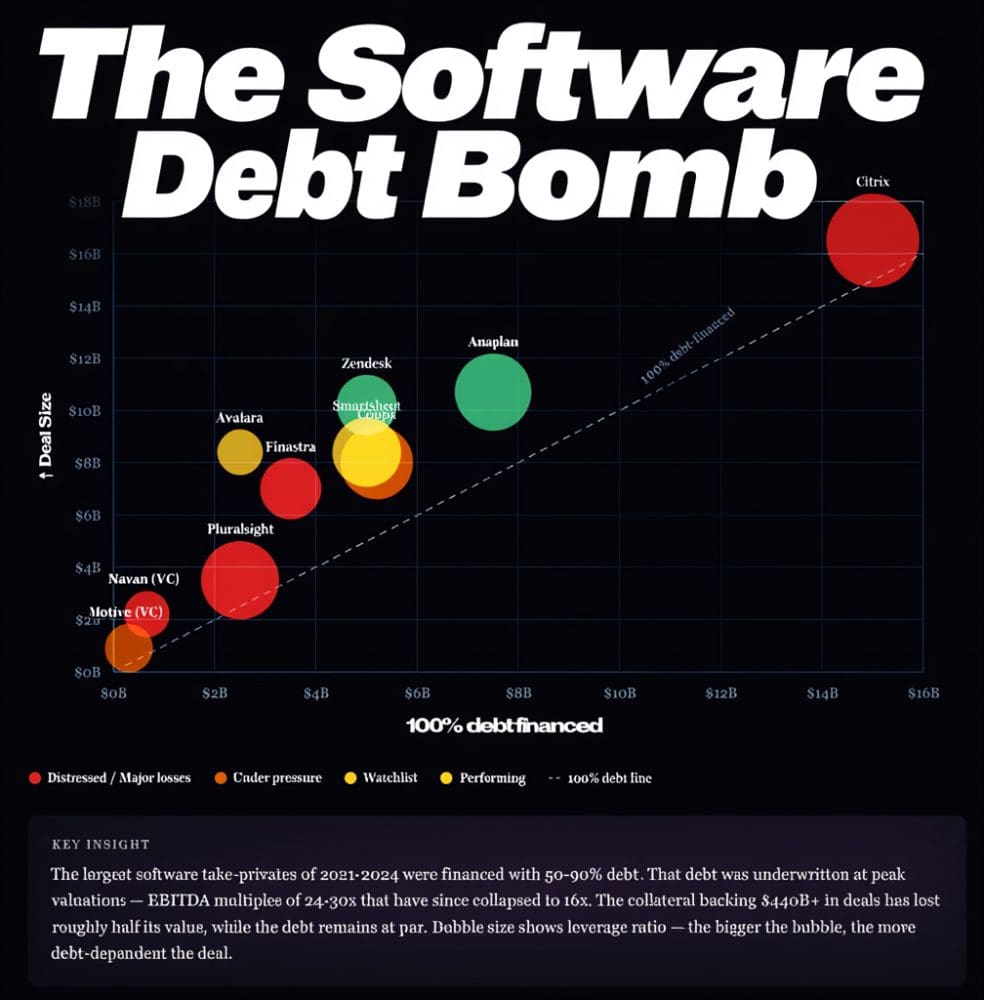
SaaS Markets Have Crashed in 2026. But Is Private Credit the Even Bigger Risk? We all know software stocks have entered a bear market in 2026. But the debt side of software might end up being a much bigger deal.IGV is down 23%+ year-to-date. $285 billion in market cap wiped out in a single day. Software P/S ratios compressed from 9x to 6x — levels we haven’t seen since the mid-2010s. But it’s more than just stocks going down.It puts huge stress on private credit’s $600-750 billion exposure to software comp ...


多重利空压顶,美股三大指数集体下跌
财联社· 2026-02-20 00:19
Market Overview - On February 19, U.S. stock markets opened lower and closed down, with all three major indices declining [1][2] - The Dow Jones Industrial Average fell by 0.54% to 49,395.16 points, the S&P 500 decreased by 0.28% to 6,861.89 points, and the Nasdaq Composite dropped by 0.31% to 22,682.73 points [2][3] Asset Management Sector - Blue Owl Capital announced the sale of $1.4 billion in loan assets from three private debt funds, raising concerns among investors about potential losses in the private loan sector [4] - Following this news, several asset management companies experienced significant stock declines: Blue Owl Capital down 5.93%, Blackstone down 5.37%, Apollo Global Management down 5.21%, Ares Management down 3.08%, and Brookfield down 2.68% [4] Software Industry - The software sector also showed weakness, with notable declines in stocks such as Cadence Design Systems down 2.76%, SAP down 2.41%, Intuit down 2.06%, and ServiceNow down 1.33% [4] - Concerns about artificial intelligence potentially disrupting the software industry were highlighted, with Mistral AI's CEO stating that over 50% of enterprise software could be replaced by this technology [4] Energy Sector - Energy stocks mostly rose amid ongoing tensions between the U.S. and Iran, with ConocoPhillips up 0.97% and Chevron up 0.49% [5] Retail Sector - Walmart's stock fell by 1.38% after the company provided a fiscal year profit guidance that fell short of market expectations, overshadowing its better-than-expected fourth-quarter results [5] Technology Stocks - Major tech stocks had mixed performances: Nvidia down 0.04%, Apple down 1.43%, Alphabet down 0.13%, Microsoft down 0.29%, Amazon up 0.03%, Meta up 0.24%, and Tesla up 0.12% [6][7] Chinese Stocks - The LiFeng Chinese stock index fell by 0.54%, and the Nasdaq Golden Dragon China Index decreased by 0.35% [8] - Popular Chinese stocks mostly declined, with Bawang Tea down 2.5%, Trip.com down 2.28%, Alibaba down 0.96%, and Pinduoduo down 0.94% [8] Company News - Amazon surpassed Walmart to become the highest-grossing company globally, reporting $717 billion in sales for the fiscal year ending December, compared to Walmart's $713.2 billion [9] - AMD announced it will support a $300 million loan to Crusoe, backed by chip products [10] - Hims & Hers Health is acquiring Australian digital health company Eucalyptus for up to $1.15 billion, which boosted its stock by approximately 7% in pre-market trading [11] - Yorkville America Equities LLC announced plans to acquire the Point Bridge America First ETF, focusing on investments aligned with former President Trump's "America First" ideology [12] - BE Semiconductor Industries reported fourth-quarter revenue of €166.4 million, exceeding analyst expectations, and projected a revenue growth of 5%-15% for the first quarter [13]


X @Bloomberg
Bloomberg· 2026-02-19 19:46
RT Bloomberg Live (@BloombergLive)How does private credit reach its next phase of growth? Michael Arougheti of @ares_management joins #BloombergInvest to discuss democratizing private market investments and bringing them to retail investors with @daniburgz.Live 3/3 at 11:05 AM ET!https://t.co/eeTrczeDUG https://t.co/DI2HytBpSJ ...
X @Bloomberg
Bloomberg· 2026-02-10 17:42
Secondaries firm Coller Capital closed a deal to extend the life of an Ares Management private credit portfolio, amassing more than $1.3 billion in total commitments https://t.co/cy19Y2lZ3D ...
X @Bloomberg
Bloomberg· 2026-02-10 17:14
Ares Management CEO Michael Arougheti downplayed the idea of trouble in the private credit market and fears of AI disruption, two factors that hammered shares of alternative asset managers recently https://t.co/SIrQx2FqvX ...
AI冲击波从软件业蔓延至债市:最大债主Ares、KKR股价重挫,违约率恐飙至13%
Hua Er Jie Jian Wen· 2026-02-09 06:21
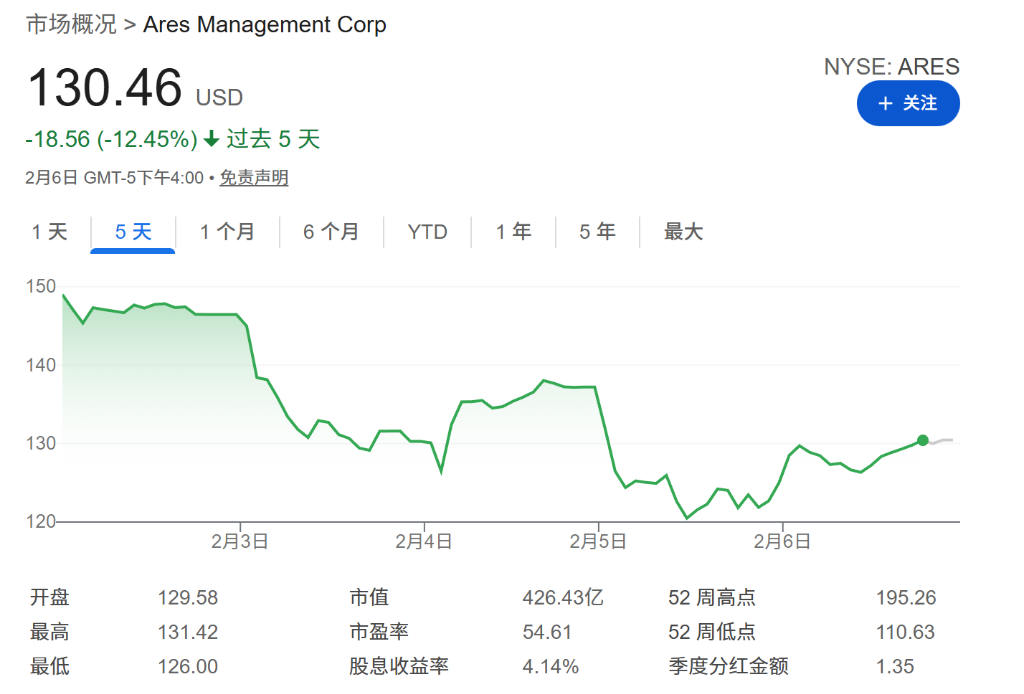
Core Insights - The disruptive wave of artificial intelligence (AI) technology is spreading from the software industry into the financial markets, creating unprecedented uncertainty in the private credit bond market, which is valued at approximately $3 trillion [1][12] - The release of a new AI tool by Anthropic has triggered a sell-off in software data supplier stocks, leading to significant declines in asset management companies heavily invested in private credit bonds [1][8] Group 1: Market Impact - The stock prices of major asset management firms with substantial private credit bond operations have experienced sharp declines, with Ares Management down over 12%, KKR down nearly 10%, Blue Owl Capital down over 8%, and TPG down about 7%, while the S&P 500 index only slightly decreased by approximately 0.1% during the same period [1][3] - Investors are increasingly uneasy about their exposure to the private credit bond market, particularly due to the software industry's significant concentration in this sector, which amplifies any disturbances [8][9] Group 2: Credit Quality Concerns - UBS has issued a stern warning that if the disruptive effects of AI accelerate beyond the adaptability of borrowing companies, the default rate in the U.S. private credit bond market could soar to 13% under aggressive scenarios, significantly higher than their estimates for leveraged loans (8%) and high-yield bonds (4%) [8][9] - The private credit bond market's heavy reliance on the software industry raises concerns about the quality of these assets, as any downturn in the software sector could lead to significant issues within investment portfolios [9][10] Group 3: Structural Risks - The structure of loans, particularly Payment-in-Kind (PIK) loans, exacerbates potential risks, as these loans allow borrowers to defer cash interest payments, which can become problematic if the borrower's financial situation deteriorates [10] - Moody's Analytics warns that the opacity of the private credit bond market complicates comprehensive risk assessment, highlighting the rapid growth of AI-related lending, rising leverage, and lack of transparency as significant warning signs [10][11] Group 4: Systemic Concerns - The market reassessment triggered by AI occurs against a backdrop of existing scrutiny of the private credit bond industry, which has long been criticized for high leverage and valuation opacity [12] - The private credit bond market, which has favored corporate software companies since 2020, must now prepare for the disruptive impacts driven by AI technology, prompting investors to reevaluate financing transactions that involve opaque, illiquid loans, especially those exposed to technological change risks [12]

Private credit worries resurface in $3 trillion market as AI pressures software firms
CNBC· 2026-02-09 04:41
Core Viewpoint - The private credit markets are experiencing increased uncertainty due to the emergence of AI-driven tools that may disrupt traditional software business models, particularly affecting software companies that are significant borrowers in the private lending space [1][2]. Group 1: Impact of AI on Software Companies - AI tools developed by Anthropic are designed to perform complex tasks that many software companies currently charge for, raising concerns about the potential weakening of traditional software business models [2]. - The software sector, which has been a favored area for private credit lenders since 2020, is now facing pressure as AI adoption could accelerate faster than companies can adapt [5][7]. - Software companies account for approximately 17% of loans held by U.S. business development companies, making them a significant focus for private credit lenders [6]. Group 2: Market Reactions and Financial Implications - Shares of major asset managers with substantial private credit franchises have declined significantly, with Ares Management falling over 12%, Blue Owl Capital losing over 8%, and KKR declining almost 10% [3]. - UBS Group has warned that default rates in U.S. private credit could rise to 13% in an aggressive disruption scenario, which is notably higher than the projected stress for leveraged loans and high-yield bonds [7]. - The private credit industry, valued at $3 trillion, is facing concerns over leverage, opaque valuations, and the risk of isolated problems becoming systemic issues [9]. Group 3: Credit Risk and Future Outlook - The potential for credit risk varies among software and services sector borrowers, depending on their position relative to AI advancements [10]. - Payment-in-kind (PIK) loans, which allow borrowers to defer interest payments, are prevalent among software companies, posing risks if their financial situations deteriorate [11]. - Experts indicate that while the private credit industry may currently absorb losses, ongoing credit growth could lead to significant credit problems in the future [13].


Steward Adds South Florida Team From Raymond James
Yahoo Finance· 2026-02-05 14:11
Core Insights - Steward Partners has expanded its advisory team by adding the Silcox & Avonda Wealth Management team from Raymond James & Associates, managing $716 million in client assets [1][2] - The addition of this team is part of Steward's broader growth strategy, which included adding 11 new advisor teams in 2025, representing nearly $4 billion in client assets [4] Company Overview - Steward Partners is an employee-owned hybrid partnership with nearly $50 billion in client assets and operates a broker/dealer called Steward Partners Investment Solutions [1][5] - The firm has 628 partners, 301 advisors, and 80 offices across the U.S. [5] Team Details - The Silcox & Avonda team, led by Peter Silcox and Peter Avonda, will serve as executive managing directors and portfolio managers at Steward [3] - The team includes Melissa Larson, Joseph Jones IV, and five client administrative managers, enhancing Steward's advisory capabilities [3] Growth Strategy - Steward transitioned from a 1099 independent contractor model to a W-2 integration framework for future hires approximately three years ago [4] - The firm raised $475 million in capital from Ares Management, which will support its growth initiatives [5]
US software stocks hit by Anthropic wake-up call on AI disruption
Yahoo Finance· 2026-02-04 15:42
Core Viewpoint - U.S. software stocks are experiencing a significant decline due to fears of disruption from artificial intelligence, with analysts warning of potential volatility as the sector assesses the existential threat posed by AI [1][5]. Group 1: Market Performance - The S&P 500 software and services index has dropped nearly 13% over five consecutive sessions and is down 26% from its peak in October, while the S&P 500 reached an all-time high recently [5]. - Nasdaq-listed Thomson Reuters saw a decline of about 2% following a record 16% drop, driven by concerns that AI could threaten its core legal division [7]. - Other companies such as Salesforce, CrowdStrike, Adobe, and Intuit experienced declines ranging from 2% to 6.6% [7]. Group 2: Industry Disruption Concerns - The push of AI into various industries, including finance, law, and coding, has raised fears of disruption, particularly for startups like OpenAI and Anthropic, which are under pressure to validate their high valuations [2][3]. - Analysts express skepticism about the success of AI startups, citing their lack of specialized data crucial for businesses in these industries [3]. - Concerns exist that the expectation for companies to develop bespoke products to replace existing enterprise software may be unrealistic [4]. Group 3: Broader Impact - The volatility in the software sector is affecting private credit firms that lend to software companies, with notable declines in firms like Blue Owl Capital (down 9.8%), Ares Management (down 10.2%), and KKR (down 9.7%) [6]. - Analysts suggest that during volatile periods, market reactions can be hasty, indicating that further volatility is likely [6].
