Thomson Reuters

Search documents
Thomson Reuters Announces New US$600 Million Share Repurchase Program and US$605 Million Return of Capital and Share Consolidation Transactions
Prnewswire· 2026-02-25 12:00
Thomson Reuters Announces New US$600 Million Share Repurchase Program and US$605 Million Return of Capital and Share Consolidation Transactions [Accessibility Statement] Skip NavigationUp to US$600 million of shares to be repurchased pursuant to amended normal course issuer bidUS$605 million return of capital and share consolidation expected to be completed in MayTORONTO, Feb. 25, 2026 /PRNewswire/ -- Thomson Reuters (TSX/Nasdaq: TRI) today announced that it plans to repurchase up to US$600 million of its c ...



Axon Enterprise beats fourth-quarter profit estimates, shares rise
Reuters· 2026-02-24 22:00
Skip to main content Exclusive news, data and analytics for financial market professionalsLearn more aboutRefinitiv Axon Enterprise beats fourth-quarter profit estimates, shares rise February 24, 202610:00 PM UTCUpdated ago By Reuters Feb 24 (Reuters) - Taser-maker Axon Enterprise (AXON.O), opens new tab beat Wall Street estimates for fourth-quarter profit on Tuesday, driven by strong demand for its security devices and software products. Shares of the Arizona-based company were up 15% in extended trading. ...


Thomson Reuters shares rally after CoCounsel AI tool draws 1 million users
Reuters· 2026-02-24 21:40
Core Insights - Thomson Reuters shares surged over 11% following the announcement that its AI tool, CoCounsel, has attracted one million users, alleviating concerns about competition from other AI technologies [1] - This stock increase marked the largest percentage gain for Thomson Reuters since 2009, despite the company still being down more than 30% for the year [1] - The legal AI market is evolving, with Thomson Reuters emphasizing the importance of substance over hype in its AI strategy, which is supported by proprietary intellectual property and extensive legal archives [1] Company Developments - CoCounsel was launched after Thomson Reuters acquired AI legal startup Casetext for $650 million in 2023, positioning it as a core AI engine for automating legal tasks [1] - The Legal Professionals division is the largest revenue contributor for Thomson Reuters, accounting for approximately one-third of total sales [1] - The company’s executives highlighted that its legal offerings are differentiated from general-purpose AI startups due to its unique intellectual property, which includes extensive legal documents that are largely undigitized and unpublished [1] Market Context - The announcement of CoCounsel's user base followed a significant selloff in the software and services sector, triggered by concerns over AI technologies potentially reducing revenue streams [1] - The market reaction to the launch of Anthropic's AI tool, which integrates its Claude AI model into legal workflows, had previously caused an $830 billion global selloff over six trading days [1]

Home Depot Earnings Preview: Q4 Sales Seen Lower as Housing Market Stays Frozen
Investing· 2026-02-24 06:53
Market Analysis by covering: Home Depot Inc. Read 's Market Analysis on Investing.com ...


FiscalNote (NYSE:NOTE) Update / briefing Transcript
2026-02-18 17:02
FiscalNote Update Summary Company Overview - **Company**: FiscalNote (NYSE: NOTE) - **Industry**: Political prediction markets and data analytics Key Points and Arguments Market Opportunity - The way information is consumed and acted upon is rapidly changing, presenting new market opportunities for FiscalNote [3][4] - FiscalNote has a strong foundation with thousands of policy professionals relying on its data and analysis, which is difficult to replicate [3] - The expansion into political prediction markets is seen as a natural evolution of FiscalNote's existing capabilities [4] Growth in Prediction Markets - Global trading volume in prediction markets surged, with U.S. volumes hitting over $44 billion in 2025, representing a 400% year-over-year growth [8] - Political markets accounted for approximately $7.2 billion in 2025, with expectations for continued growth [8] - The market is still early and underdeveloped, making it an attractive entry point for FiscalNote [5] Regulatory Environment - The CFTC's withdrawal of the ban on political and sports event contracts has enabled significant market growth [10][22] - Regulatory clarity is expected to improve, which will support the development of prediction markets [22] Competitive Advantage - FiscalNote's deep knowledge and experience in political prediction markets position it uniquely to capitalize on this growth [17] - The combination of FiscalNote's domain expertise and 365 Prediction's iGaming experience is expected to create a differentiated product [18] Product Development and Innovation - FiscalNote plans to launch products that address existing market concerns, such as credibility and ethical considerations [23][24] - The company aims to create a subscription service for tips on political outcomes, leveraging its AI capabilities [32] - Plans to explore fantasy leagues around political outcomes as a way to engage users without waiting for regulatory changes [33] Ethical Considerations - There are concerns about the perception of betting on political outcomes; FiscalNote aims to position prediction markets as tools for advocacy and awareness [25][26] - Existing relationships with advocacy organizations will be leveraged to create a more constructive market environment [26][27] Strategic Partnerships - Partnerships, particularly with 365 Prediction, are crucial for leveraging existing market infrastructure and capabilities [6][17] - The collaboration is expected to enhance market design and integrity, which are essential for successful market making [20][21] Future Outlook - FiscalNote is not pivoting away from its core business but is extending its capabilities into new markets [35] - The company is focused on leveraging its existing strengths to explore new opportunities in prediction markets and beyond [35] Additional Important Content - The discussion highlighted the historical context of prediction markets, originating from academic experiments to improve outcome predictions [12][14] - The integration of prediction market data into professional workflows is growing, indicating a shift towards institutional relevance [5] - The potential for prediction markets to hedge policy and regulatory risks was noted as a significant opportunity [5]

My Thoughts on this Software, Data Companies Repricing
Investment Moats· 2026-02-18 00:01
Core Insights - The recent release of Anthropic's Claude Cowork and Claude Opus 4.6 has triggered a "repricing mode" across various sectors, leading to significant market volatility [1][4] - Companies that were previously valued highly are now facing skepticism regarding their future cash flows and competitive advantages, resulting in a reassessment of their valuations [5][10] - The market is questioning the sustainability of high margins and economic moats for many firms, particularly in the software and data sectors, as they transition towards more commoditized offerings [5][18] Market Dynamics - The market's reaction to new information often leads to either over-optimism or excessive pessimism, complicating investment decisions [2][3] - Companies like ZoomInfo, Fastly, and Teledoc have seen their valuations decline significantly compared to their peaks in 2020, raising concerns about their long-term viability [3][4] - The shift in market dynamics suggests that previously high-growth companies may need to adapt their business models to remain competitive [5][12] Valuation Considerations - High valuations based on future cash flows are now under scrutiny, as the market reassesses the ability of these companies to maintain their operating margins [5][10] - The transition from high-margin, asset-light models to more asset-heavy structures could negatively impact key financial metrics such as ROIC, ROA, and ROE [10][22] - Historical data indicates that companies undergoing significant asset growth often experience stock price declines, suggesting a need for caution in investment strategies [10][24] Sector Performance - A list of software and data companies has shown significant year-to-date declines, with some experiencing drawdowns of over 30% [21][22] - The performance of these companies contrasts sharply with their perceived economic moats just a few years ago, indicating a shift in investor sentiment [21][22] - The current market environment may favor asset-heavy companies that are less affected by the recent volatility and uncertainty [22][23] Long-term Trends - The article highlights the importance of recognizing that market trends can last longer or shorter than anticipated, emphasizing the need for adaptive investment strategies [24] - Valuation remains a critical factor in long-term investment success, with fewer companies demonstrating consistent quality over time [24][25] - The evolving landscape suggests that investors may need to reassess their portfolios to account for changing market dynamics and emerging opportunities [18][19]

1 Artificial Intelligence (AI) Stock Investors Are Buying on the Dip
The Motley Fool· 2026-02-15 04:54
Core Viewpoint - The release of Anthropic's Claude Cowork tools has negatively impacted the stock market, particularly affecting software companies and AI competitors, but some investors see this as a buying opportunity for Alphabet shares [1][2]. Group 1: Market Impact - Anthropic's Claude Cowork, featuring industry-specific plugins, caused a significant market reaction, leading to declines in stocks of software companies like Salesforce, Intuit, and Atlassian, which are down 27.9%, 33%, and 41.6% year-to-date, respectively [4]. - Alphabet's shares dropped over 6% following the announcement of Claude Cowork, reflecting investor anxiety despite Alphabet not being directly impacted by the specific software offerings [5]. Group 2: Alphabet's Position - Alphabet, with a market cap of $3.7 trillion, has a strong presence in the AI sector, recently launching its own LLM, Gemini 3, which has shown improvements over competitors like OpenAI's ChatGPT [7]. - The rollout of Gemini 3 has resulted in a significant increase in paid subscribers, indicating potential customer shifts from ChatGPT to Gemini, raising concerns that Claude Cowork could attract these subscribers away from Alphabet [7]. Group 3: Investment Opportunities - Notable investors, including Warren Buffett, have taken positions in Alphabet, suggesting confidence in the company's long-term prospects despite recent stock price declines [10]. - Cathie Wood's Ark Invest purchased $21.6 million in Alphabet shares, indicating a strategic move to capitalize on the current dip in stock price [11].


From software to real estate, US sectors gripped by AI scare trade
BusinessLine· 2026-02-13 18:10
Market Overview - Wall Street is experiencing significant disruption concerns due to AI, leading to a sell-off in various sectors, particularly software companies, which has resulted in sharp losses in U.S. stocks this week [1][2]. Software Sector - The S&P 500 Software & Services index has lost approximately $2 trillion in value since its peak in October, with half of this loss occurring in the past two weeks due to fears that AI could disrupt traditional subscription and enterprise tools [2]. - Notable declines in the Nasdaq 100 include Atlassian down 47%, Intuit down 40%, and Workday down 33% [4]. - The U.S. software sector is facing its worst drawdown in over three years, impacting alternative asset managers with exposure to software-related loans, with firms like Ares, Blackstone, and KKR seeing declines between 13% and 24% this year [5]. Financial Brokerage, Data Analytics & Legal Services - The financial industry, especially brokerages and data analytics firms, has been negatively affected after Altruist introduced AI-enabled tax planning features, raising fears about the viability of their business models [6]. - Shares of brokers such as LPL Financial and Charles Schwab fell over 7%, while S&P Global's shares dropped more than 25% in February, marking its worst month since 2009 [7]. Real Estate Services - Commercial real estate and investment managers have suffered as investors shift away from high-fee, labor-intensive business models perceived as vulnerable to AI disruption, with CBRE Group and Jones Lang LaSalle each dropping about 12% [8]. Insurance Sector - Insurance stocks have experienced a significant decline, with the S&P 500 insurance index falling 3.9% on a single day, its largest drop since mid-October, following the release of an AI-powered comparison tool by Insurify [10]. - Shares of Willis Towers Watson have decreased by 15% this week, while Aon and Arthur J. Gallagher fell by 9% and 15%, respectively [11]. Trucking & Logistics - The trucking and logistics sector saw unexpected declines, with stocks like Landstar System and C.H. Robinson dropping sharply after Algorhythm Holdings reported a significant increase in freight volumes without a corresponding rise in operational headcount [13].


AI冲击下,软件业走向“僵尸化”?
智通财经网· 2026-02-11 08:45
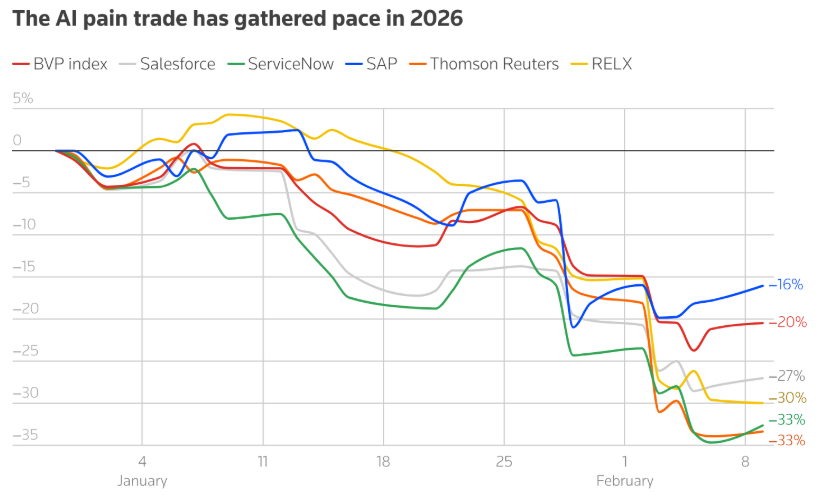
Group 1 - The core viewpoint is that artificial intelligence will impact existing software, data, and professional services companies, but it will not completely destroy them. Investors seem to share this perspective, as indicated by a Breakingviews analysis comparing valuation drops with recent analyst forecasts [1] - The BVP Nasdaq Emerging Cloud Index, a benchmark for software stocks, has declined by 20% year-to-date, raising concerns that AI chatbots like Claude from Anthropic could serve as flexible alternatives to existing company products [1] - Companies such as RELX and Thomson Reuters have seen their stock prices drop by approximately one-third since the end of 2025 due to this panic [1] Group 2 - ServiceNow's enterprise value is estimated at $105 billion, with free cash flow projected to grow from $5.8 billion this year to $10.3 billion by 2029. The implied value of recent cash flows, discounted at a 10% rate, is $27 billion [4] - After subtracting this amount from the enterprise value, ServiceNow's business value from 2030 onwards is approximately $78 billion, which translates to $114 billion in 2030 dollars using a 10% discount rate [5] - The long-term growth rate required to achieve this figure is only 0.9%, significantly lower than the previous year's growth rate of 5.7% [5] Group 3 - A study of 76 stocks, including BVP index components and some European software companies, shows a median long-term growth rate of 0.9%. About 60% of these companies are expected to grow from 2030, but only one-third will exceed a growth rate of 2% [6] - Companies like Monday.com, RingCentral, and Wix.com are exceptions that reflect expectations of significant declines in free cash flow starting in 2030 [6] Group 4 - Analysts caution that the analysis may be overly simplistic, as sell-side brokers might not have adjusted their forecasts for 2029, and a uniform 10% discount rate may not be appropriate across different industries [8] - The analysis suggests that AI is more likely to "zombify" existing companies rather than quickly eliminate them, raising questions about how CEOs should respond to this reality [8] - Stocks like SAP are trading close to what is termed "liquidation value," indicating a scenario where management accepts decline and cuts all growth-related spending to maximize cash extraction [8] Group 5 - Currently, no major data or software companies are pursuing a liquidation strategy, as many, like ServiceNow, continue to show strong growth. However, the market signals that many companies may soon stagnate or even face rapid decline [9] - If investors are pricing these companies as if they are zombie firms, it raises concerns about whether these companies will operate in a manner similar to actual zombie enterprises [9]

超级碗广告大战:Anthropic攻击OpenAI,Sam Altman怒斥"不诚实",软件股崩盘进行时
3 6 Ke· 2026-02-11 02:11
Core Insights - The market is undergoing a significant shift as AI agents are perceived not just as tools to assist human work but as potential replacements for traditional software, leading to a massive loss of nearly $1 trillion in tech stock market value within a week [1][2][32] - The release of a legal document review plugin by Anthropic triggered a sell-off in legal software stocks, indicating a broader recognition that AI could replace existing software solutions [1][2][32] Market Reaction - Major legal information companies experienced drastic stock declines: Wolters Kluwer down 13%, RELX down 15.8%, LegalZoom down 18%, and Thomson Reuters down 19% [2] - The software sector's forward 12-month P/E ratio dropped from 33.1 to 23.2, a 30% contraction, nearing the lows of the 2022 bear market [2][32] AI Agent Revolution - The AI agent revolution is just beginning, with implications for the software industry that could lead to the obsolescence of traditional software solutions [3] Super Bowl Advertising Battle - Anthropic launched a Super Bowl ad contrasting its ad-free AI assistant Claude with competitors that incorporate ads, targeting enterprise decision-makers rather than general consumers [5][6] - OpenAI's CEO Sam Altman responded aggressively to Anthropic's claims, framing the debate as a philosophical conflict over the future of AI [6][8][28] Market Share Dynamics - ChatGPT's market share plummeted from 69% in January 2025 to 45.3% in January 2026, while Gemini's share rose from 14.7% to 25.1%, and Grok's from 1.6% to 15.2% [8][28] Software Industry Disruption - The traditional view that AI would enhance software is being challenged; instead, AI is seen as a force that could eliminate the need for existing software [11][12] - The four levels of disruption include: 1. Functionality replacement, where AI can create user interfaces and databases tailored to individual needs [11][12] 2. Process reengineering, where AI can automate task management, rendering tools like Asana obsolete [12][14] 3. Pricing collapse, as AI reduces the cost of services, leading to renegotiation of software pricing [15][16] 4. Valuation compression, with software companies facing reduced future cash flow expectations [16] High-Risk Software Types - High-risk categories include: 1. Interface-driven software like monday.com and Asana, which lack unique data or algorithms [19][20] 2. Vertical industry information intermediaries, such as legal databases, which may be rendered unnecessary by AI's capabilities [20][21] 3. RPA tools that rely on manual configuration, which AI can automate without pre-programmed workflows [21][22] Value Capture in AI Era - Potential beneficiaries of the AI shift include foundational model companies (OpenAI, Anthropic), cloud infrastructure providers (AWS, Azure), chip manufacturers (Nvidia), and AI-native development studios [23][24][26] - The AI revolution may not yield clear winners, as traditional software companies face erosion of revenue and profits while foundational model companies engage in intense competition [27][28] Philosophical Divide - The advertising battle between Anthropic and OpenAI highlights a deeper philosophical divide regarding the future of AI: rapid commercialization versus responsible deployment [28][30] - The outcome of this conflict could significantly impact the software industry, with potential for both rapid disruption and the establishment of protective barriers for existing companies [30][31]