中小银行资本补充

Search documents
不到3个月,超80家中小银行融资“补血”
经济观察报· 2026-03-18 12:50
Core Viewpoint - The current "capital replenishment" trend among small and medium-sized banks in China is driven by narrowing net interest margins, intensified market competition, and the need for these institutions to enhance quality while reducing quantity through mergers and acquisitions [2][10]. Group 1: Capital Replenishment Trend - Since the beginning of 2026, over 80 small and medium-sized banks have initiated capital replenishment due to pressure on capital adequacy ratios [2]. - Various capital replenishment tools are being utilized, including targeted placements, convertible bond conversions, and perpetual bonds [2][6]. - The capital adequacy ratios of some banks, such as Chengdu Bank and Hubei Bank, are below industry averages, necessitating capital increases to enhance their financial strength [5][6]. Group 2: Regulatory and Market Influences - Regulatory guidance is pushing small and medium-sized banks to return to their core operations, which requires sufficient capital support [9][10]. - The average capital adequacy ratios for city commercial banks and rural commercial banks are below the banking industry's average, indicating a pressing need for capital replenishment [6]. Group 3: Mergers and Acquisitions - Mergers and acquisitions are occurring alongside capital replenishment, as banks face operational and management pressures during the restructuring process [10][11]. - The acquisition of weaker institutions is seen as a way to optimize the banking structure and reduce high-risk entities [10][11]. Group 4: Long-term Capital Supplementation Mechanisms - There are discussions on establishing long-term mechanisms for capital replenishment, including allowing local governments to issue special bonds to support small and medium-sized banks [13][14]. - Various models for local government involvement in capital replenishment have been proposed, including indirect equity participation and market-driven collaboration with private enterprises [14][15].


从风险识别到价值挖掘:中小银行二永债投资策略分析
Shenwan Hongyuan Securities· 2026-03-16 06:15
Group 1 - The report highlights that in the context of reduced net supply of perpetual bonds and weakened capital replenishment demands from state-owned banks, small and medium-sized banks have a strong need for capital replenishment, leading to a significant increase in their share of net supply [3][10] - The analysis indicates that the historical cases of non-redemption of perpetual bonds are concentrated in specific regions and involve weaker banks, particularly rural commercial banks, which account for 76.4% of such cases since 2018 [3][40] - A quantitative scoring framework has been developed to assess the redemption capability of small and medium-sized banks' perpetual bonds, showing a strong correlation between the scoring results and implied ratings from the China Bond market [3][10] Group 2 - The report notes that the market structure of perpetual bonds is changing, with small and medium-sized banks becoming the main suppliers, as their net supply is expected to exceed 1.4 trillion yuan annually during 2024-2025, accounting for over 25% of the total net supply [3][15] - The overall redemption pressure for perpetual bonds is manageable in the short term, but structural risks are highlighted, particularly for small and medium-sized banks facing concentrated redemption pressures in Q4 2026 [3][25] - The report emphasizes that the current yield spreads for weaker quality perpetual bonds are at historical lows, suggesting potential investment opportunities in specific categories of these bonds [4][10] Group 3 - The investment strategy suggests focusing on three main opportunities: moderately sinking into the short to medium-term bonds with implied AA/AA- ratings, identifying merger and acquisition opportunities, and targeting entities receiving special bond injections [4][10] - The report indicates that the redemption risk for small and medium-sized banks is significant, particularly for those with implied ratings of AA- and below, as some may face capital adequacy issues post-redemption [3][26] - Historical data shows a decrease in non-redemption cases, with only two instances in 2025, reflecting an overall manageable risk environment despite individual vulnerabilities [3][40]
专访湖南省副省长王俊寿:风险化解进入存量出清,金融创新赋能“三车两员”
第一财经· 2026-03-12 11:17
Core Viewpoint - The shift in the government's work report from "actively preventing" financial risks to "steadily resolving" them indicates a transition to a focus on "clearing existing risks and curbing new ones," signaling a systemic restructuring of financial governance [2][11]. Group 1: Financial Risk Management - The key task of mitigating risks in small and medium financial institutions is crucial for preventing and resolving financial sector risks [4]. - The approach to financial risk control has evolved from merely managing risks to actively eliminating them, with a focus on comprehensive risk resolution [11][12]. - The government aims to enhance capital supplementation for small banks, establishing a long-term mechanism to improve their resilience and service capabilities [12]. Group 2: Support for New Employment Groups - The "three vehicles and two workers" group faces three main challenges in financial services: inadequate insurance coverage, low financing accessibility, and insufficient service convenience [5][6][7]. - Financial institutions are encouraged to develop tailored products for this group, such as specialized insurance and flexible credit options that align with their income patterns [8]. - A collaborative mechanism is needed to break down data barriers and implement policy support, ensuring financial services meet the specific needs of these new employment groups [8]. Group 3: Support for Physical Stores and SMEs - To support physical stores, a differentiated, community-oriented, and integrated online-offline approach is essential [9]. - Financial institutions should innovate credit products based on operational data, reduce financing costs, and enhance service efficiency to meet the unique needs of small and micro enterprises [10]. - A collaborative mechanism involving government guidance, financial support, and platform empowerment is crucial for the sustainable development of physical stores [10].

中小银行资本“嗷嗷待补”,代表委员建言专项债“自审自发”
第一财经· 2026-03-11 13:38
Core Viewpoint - The article discusses the urgent need for capital replenishment in small and medium-sized banks in China, highlighting the government's initiatives and suggestions from representatives during the National People's Congress to address this issue [4][5][7]. Group 1: Capital Replenishment Challenges - Small and medium-sized banks are facing significant pressure in capital replenishment, whether through internal or external methods, making it difficult to maintain adequate capital levels [5]. - As of the end of Q4 2025, the capital adequacy ratios for various types of banks were reported as follows: large commercial banks at 18.16%, joint-stock banks at 13.58%, city commercial banks at 12.39%, and rural commercial banks at 13.18% [5]. - Some city commercial banks and rural commercial banks are nearing regulatory capital thresholds, indicating an urgent need for capital support [5]. Group 2: Government Initiatives - The government plans to issue 300 billion yuan in special treasury bonds to support the capital replenishment of state-owned large commercial banks [4]. - A successful case of using special bonds to support small banks was seen in Jilin Province, which issued 26 billion yuan to help improve the capital adequacy and risk resistance of Jilin Rural Commercial Bank [6]. - From 2020 to 2022, 550 billion yuan in new local government special bonds were issued specifically for the purpose of replenishing the capital of small and medium-sized banks [6]. Group 3: Recommendations from Representatives - Representatives during the National People's Congress suggested the regular issuance of special bonds at the provincial level to assist small and medium-sized banks in establishing a long-term capital replenishment mechanism [7][8]. - The "self-examination and self-issuance" model for special bonds is proposed to streamline the process of capital replenishment for small banks, allowing for quicker access to necessary funds [9]. - The article emphasizes the importance of establishing a stable external capital replenishment channel and optimizing the governance structure of banks to better serve local economies [8][9]. Group 4: Risk Management and Oversight - It is crucial to implement a regular regulatory and behavioral constraint mechanism after the capital replenishment through special treasury bonds and local government bonds to prevent new risks from undermining the capital [10]. - Recommendations include strict monitoring of the use of funds from special bonds, ensuring they are used specifically for capital replenishment and not diverted to other areas [10]. - Banks are encouraged to regularly disclose key information such as capital adequacy ratios and non-performing loan rates to enhance market oversight and ensure that capital is effectively utilized to support the real economy [10].

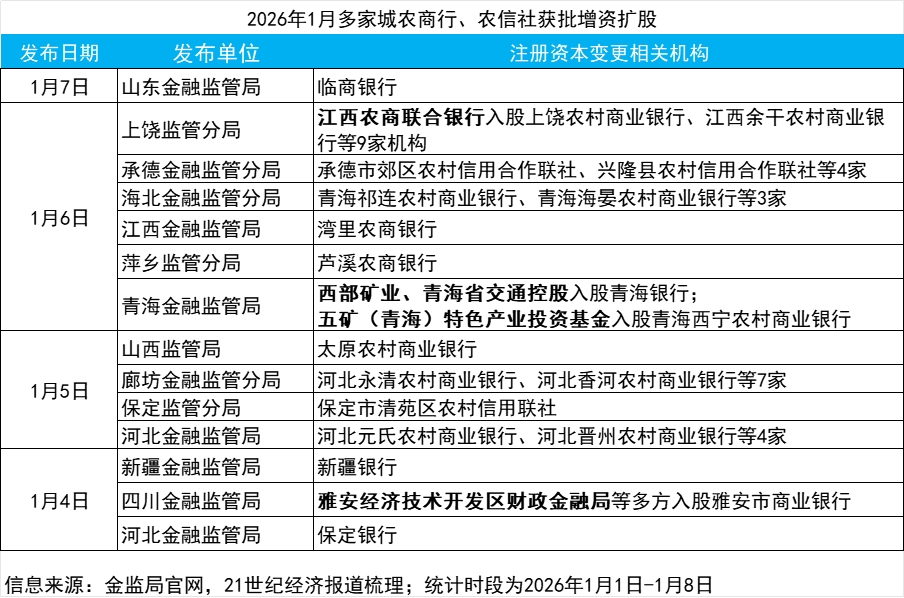
开年地方银行密集增资 多元新股东现身
2 1 Shi Ji Jing Ji Bao Dao· 2026-01-08 11:31
Core Viewpoint - The local small and medium-sized banks in China are accelerating their capital increase efforts at the beginning of 2026, with multiple banks receiving regulatory approval for capital increase plans, indicating a trend of strengthening their financial positions and enhancing risk resilience [1][2]. Group 1: Capital Increase Approvals - In the first week of January 2026, a significant number of local city and rural commercial banks received approvals for capital increases, with 37 banks approved for changes in registered capital from January 1 to January 8 [2][3]. - Notable capital increases include Qinghai Bank raising its registered capital by 648 million yuan to 3.205 billion yuan, and Xinjiang Bank increasing its capital from 7.906 billion yuan to 12.223 billion yuan [2][3]. - The trend is particularly active in regions such as Hebei, Jiangxi, Qinghai, Shandong, Sichuan, and Xinjiang, with some regulatory bodies approving multiple banks' capital changes in a single day [3]. Group 2: Diverse Shareholder Participation - The composition of investors in local small and medium-sized banks is becoming more diversified, with not only regional institutions but also local government financial entities and large state-owned enterprises participating in capital increases [4]. - For instance, Qinghai Bank's capital increase involved investments from Western Mining Group and Qinghai Transportation Holding Group, highlighting the integration of industrial capital with local finance [4]. Group 3: Capital Strengthening Measures - In addition to capital increases, banks are also actively issuing secondary capital bonds and perpetual bonds as important means to strengthen their capital base, reflecting a trend towards diversified capital replenishment channels [6]. - In December 2025, banks issued a total of 382.91 billion yuan in perpetual bonds, with an average interest rate of 2.27%, indicating a significant increase in issuance compared to the previous year [6]. Group 4: Signals to the Industry - The increased activity in capital increases and bond issuance sends three positive signals to the industry: accelerated risk resolution processes, proactive capital replenishment due to regulatory pressures, and the broadening of market-based financing channels [7]. - The structure of capital tools is continuously optimizing, with perpetual bonds becoming a mainstream choice for capital replenishment, thus reducing financing costs for banks [7].
积极补充资本 中小银行股权结构持续优化
Zheng Quan Ri Bao· 2025-12-10 16:10
Core Insights - Since December, regional city commercial banks and rural commercial banks have accelerated capital replenishment through external shareholders and targeted placements, with local state-owned assets becoming the main force in filling capital gaps and optimizing equity structures [1][2] Group 1: Capital Replenishment Trends - The pace of capital increase and expansion among small and medium-sized banks has intensified, with several banks announcing significant capital increases, such as Suzhou Bank increasing its capital by 10 billion yuan and Long'an Bank planning to raise up to 26.11 billion shares [2][3] - The core drivers for the capital replenishment include increased credit issuance and capital consumption due to risk management, leading to a sustained high demand for capital in the future [1][4] Group 2: Regulatory Environment and Challenges - Many regional banks have received regulatory approval for their capital increase plans, indicating a supportive regulatory environment for capital replenishment [3] - However, small and medium-sized banks face challenges such as weak internal capital accumulation capabilities, regulatory rating restrictions, and low investor confidence, which hinder their ability to issue capital instruments [4][5] Group 3: Future Outlook - Experts predict that the demand for capital replenishment among small and medium-sized banks will remain high, with a clear trend of structural differentiation emerging within the industry [4][5] - The ease of future capital replenishment will be closely linked to the banks' operational quality and regional development environments, with well-governed banks likely to attract more market and policy support [5]
中小银行加快充实“家底”抵御风险
Jin Rong Shi Bao· 2025-08-08 07:59
Group 1 - The core viewpoint of the articles highlights the frequent capital replenishment actions taken by small and medium-sized banks in response to capital pressure, with many banks receiving regulatory approval for capital increase plans [1][2] - Various local banks, including Zhangjiakou Bank, Zhejiang Chouzhou Commercial Bank, Baoding Bank, and Shangrao Bank, have been actively increasing their registered capital through methods such as targeted fundraising and capital expansion [1] - Local state-owned enterprises have emerged as the main supporters in the capital increase actions of small and medium-sized banks, indicating a trend of local government backing [1][2] Group 2 - As of July 16, Shangrao Bank completed the issuance of 1.244 billion shares, raising a total of 3.867 billion yuan, with the state-owned shareholding ratio expected to increase from 54.16% to approximately 67% by the end of 2024 [2] - Qingdao Bank announced that its parent company, Qingdao Guoxin Group, plans to increase its stake in the bank, reflecting confidence in the long-term investment value of the bank's shares [2] - The capital adequacy ratios of city commercial banks and rural commercial banks are notably lower than the overall banking sector, with urgent needs for capital injection to meet regulatory requirements [3] Group 3 - Experts suggest that shareholder increases and state-owned capital injections can provide immediate relief for banks, while also emphasizing the need for long-term structural solutions to capital replenishment challenges [3] - Recommendations include lowering the requirements for capital replenishment tools and simplifying approval processes to enhance the feasibility of capital increases for small and medium-sized banks [4]
威海银行拟发行股份募资不超30亿元 用于补充核心一级资本
Zheng Quan Ri Bao· 2025-08-01 15:49
Group 1 - Weihai Bank plans to raise up to 3 billion yuan through a private placement of domestic shares and H-shares to improve its capital adequacy ratio and support business growth [1] - The bank's major shareholders, Shandong High-speed Group and Shandong High-speed Co., Ltd., intend to participate in the capital increase, with Shandong High-speed planning to subscribe for up to approximately 106 million shares, totaling around 348 million yuan [1] - As of the end of 2024, Weihai Bank's core Tier 1 capital adequacy ratio is 9.31%, showing a slight increase from 2023 but a decrease from 2020 [2] Group 2 - The trend of local state-owned capital actively participating in the capital increase of regional small and medium-sized banks indicates confidence in the banks' development prospects [3] - The capital replenishment is crucial for small and medium-sized banks to ensure business growth and manage rising risks, especially in the context of narrowing net interest margins and pressure on bank profitability [2]
中小银行多举措提升资本补充能力
Zhong Guo Zheng Quan Bao· 2025-07-29 21:07
Group 1 - Jilin Province issued 26 billion yuan in special bonds to support the development of small and medium-sized banks, specifically to invest in Jilin Rural Commercial Bank, enhancing its capital adequacy and risk resistance [1][2] - The total amount of special bonds injected into Jilin Rural Commercial Bank will reach 34.6 billion yuan, including 8.6 billion yuan used in 2021 and the newly approved 26 billion yuan in 2023 [1] - The issuance of special bonds for small and medium-sized banks is part of a broader policy allowing local governments to support capital replenishment for these banks, with 550 billion yuan in new local government special bonds issued from 2020 to 2022 for this purpose [1][2] Group 2 - The issuance of special bonds signals a commitment to risk management, with previous recipients of such bonds showing significant improvements in capital adequacy ratios, helping to mitigate financial risks for rural commercial banks and rural credit cooperatives [2] - Jilin Rural Commercial Bank is expected to have a healthy capital structure post-reform, with total equity projected to reach 40 billion yuan, focusing on supporting agriculture and small enterprises while optimizing asset allocation [2] - Various channels are being utilized by small and medium-sized banks to replenish capital, including changes in registered capital and issuance of subordinated bonds, indicating a proactive approach to enhancing their ability to serve the real economy [2]
时隔一年半!吉林省重启260亿元中小银行专项债,全国累计发行已达5080亿元
Sou Hu Cai Jing· 2025-07-23 23:40
Group 1 - The issuance of the first special bond for small and medium-sized banks in Jilin Province, amounting to 26 billion yuan, marks the official restart of such bond issuance after nearly a year and a half [1] - The bond has a 10-year term, a coupon rate of 1.76%, and an AAA credit rating [1] - The funds from this bond will be combined with previously issued special bonds totaling 8.6 billion yuan, resulting in a total of 34.6 billion yuan to be injected into the newly established Jilin Rural Commercial Bank [1] Group 2 - The issuance of special bonds for small and medium-sized banks began in 2020, with a total quota of 550 billion yuan allocated by the Ministry of Finance over the years to address the capital needs of these banks [3] - From 2021 to 2023, the issuance of special bonds peaked, with a total issuance of 440.6 billion yuan, accounting for 87% of the total issuance [3] - As of now, the cumulative issuance of special bonds for small and medium-sized banks has reached 508 billion yuan, leaving approximately 42 billion yuan remaining from the total quota [3] Group 3 - The recent bond issuance is closely related to the reform of the Jilin rural credit system, which aims to establish a provincial-level rural commercial bank with unified legal management [4] - The funds from the newly issued bonds will be transferred to Jilin Financial Holding Group and then injected into the Jilin Rural Commercial Bank to supplement its capital [4] - The expected capital of the Jilin Rural Commercial Bank after the reform will reach 40 billion yuan, including 34.6 billion yuan from Jilin Financial Holding Group [4]