
主体功能区战略

Search documents
发挥比较优势、深化跨行政区合作,不断增强区域发展协调性
第一财经· 2026-03-05 09:15
2026.03. 05 本文字数:2655,阅读时长大约4分钟 作者 | 第一财经 周芳 据新华社,国务院总理李强5日在政府工作报告中介绍今年政府工作任务时提出,推动新型城镇化和 区域协调发展。深入实施区域协调发展战略、区域重大战略、主体功能区战略和新型城镇化战略,构 建优势互补、高质量发展的区域经济布局和国土空间体系。 安徽发展战略研究会副会长林斐解读称,今年政府工作报告对区域协调发展有一个较为鲜明的变化 是,更加强调以功能定位为牵引、以协同机制为支撑,区域发展思路正由过去侧重"板块布局"逐步 转向更加注重"体系协同";更加注重功能定位、分工互补、城市群发展和增长极带动,以及跨区域 协同机制建设,由补短板向优势互补、协同共进的纵深推进。 辽宁大学李安民经济研究院院长姚树洁对第一财经记者表示,我国区域均衡发展是社会主义现代化强 国的重要空间地理布局,需要用"马阵垮阱"理论引导,推动合理高效空间布局,形成全国具有内生 增长动力的地理架构;用"板链拉动"战略手段,促进这一架构的快速形成与稳定。 所谓"马阵垮阱",就是把全国地级及以上城市形容为一匹匹骏马,让经济体量较大、发展能力较 强、人均产出较多的城市(快马)去 ...


发挥战略叠加效应推动区域联动融合
Jing Ji Ri Bao· 2026-01-19 22:20
Core Viewpoint - The article emphasizes the importance of regional coordinated development as an inherent requirement of Chinese modernization, highlighting the need for a strategic approach to optimize regional economic layout and promote balanced development across different regions [1][2]. Group 1: Regional Development Strategies - China has established a regional development strategy system that includes regional coordinated development, major regional strategies, principal function area strategies, and new urbanization strategies, each with its own focus and strengths [2]. - The regional coordinated development strategy aims to address development disparities, focusing on macro balance and promoting collaborative development among the eastern, central, western, and northeastern regions [3]. - Major regional strategies aim to enhance development capabilities through high-quality initiatives such as the Beijing-Tianjin-Hebei coordinated development and the Yangtze River Economic Belt development [3]. - The principal function area strategy clarifies spatial order based on resource and environmental carrying capacity, promoting sustainable development [3]. - The new urbanization strategy focuses on optimizing spatial carriers, emphasizing human-centered development and the coordination of urban and rural areas [3]. Group 2: Challenges and Systemic Issues - Despite significant achievements in regional coordinated development since the 18th National Congress, challenges such as policy fragmentation and conflicts remain evident [4]. - Issues include insufficient policy coordination, high departmental coordination costs, and persistent imbalances in resource allocation, particularly the trend of factors concentrating from west to east and north to south [4]. - The mismatch between population-economic layout and resource-environment carrying capacity continues to pose challenges [4]. Group 3: Enhancing Strategic Implementation - The article advocates for a systematic approach to enhance the effectiveness of regional strategies, emphasizing the need for integrated goals and dynamic coordination at national and provincial levels [6]. - It suggests optimizing policy collaboration and mechanisms to eliminate local policies that hinder free flow of factors and market unity [6]. - The importance of facilitating the circulation of factors and improving spatial governance to enhance the quality of land development is highlighted [7]. Group 4: Building Resilience - The article stresses the need to leverage strategic synergies to enhance regional resilience, focusing on deep collaboration in areas such as industrial cooperation and ecological protection [8]. - It calls for strengthening infrastructure resilience through coordinated planning of major transportation, energy, and information infrastructure [9]. - The establishment of a unified national market is deemed essential for maximizing the benefits of strategic synergies, encouraging inter-regional market interactions and regulatory standard recognition [9].
如何理解细化明确特殊功能区
Xin Lang Cai Jing· 2026-01-03 07:56
Core Viewpoint - The article discusses the implementation of the主体功能区 (Main Functional Area) strategy in China, emphasizing the need to refine the classification of functional areas to enhance land space development and protection, ensuring high-quality development and stability in urbanization, agricultural production, and ecological functions [1][2][3] Group 1: Main Functional Area Strategy - The主体功能区 strategy aims to classify land space based on resource and environmental carrying capacity, existing development density, and potential for development, promoting regional comparative advantages [2] - China has established a "two horizontal and three vertical" urbanization strategy, a "seven zones and twenty-three belts" agricultural development pattern, and a "three regions and four belts" ecological security pattern [2] - Differentiated policies are implemented for urbanization areas, agricultural production areas, and key ecological function areas to enhance economic and population carrying capacity in major cities and urban clusters [2] Group 2: Special Functional Areas - The article highlights the need to identify and define special functional areas based on the existing three main functional categories, allowing for precise spatial control and support policies [2][3] - Special functional areas include border regions, energy resource-rich areas, historical and cultural resource-rich areas, and marine space optimization areas, each with specific spatial boundaries and usage control rules [3] - Differentiated development and protection policies are proposed for these special functional areas, such as supporting urbanization and infrastructure in border areas and promoting renewable energy development in energy-rich regions [3]
学习规划建议每日问答丨如何理解细化明确特殊功能区
Xin Hua She· 2026-01-03 06:03
Core Viewpoint - The article emphasizes the importance of implementing the主体功能区 (Main Functional Area) strategy to enhance the spatial development and protection of land resources in China, focusing on maintaining stability in urbanization areas, major agricultural production areas, and key ecological function areas while identifying special functional areas for targeted policies and evaluation mechanisms [1][2][3]. Group 1: Main Functional Area Strategy - The主体功能区 strategy aims to classify land into different functional areas based on resource and environmental capacity, existing development density, and potential for growth, promoting regional comparative advantages [2]. - China has established a "two horizontal and three vertical" urbanization strategy, a "seven zones and twenty-three belts" agricultural development pattern, and a "three regions and four belts" ecological security pattern [2]. - The strategy involves differentiated policies for urbanization areas, agricultural production areas, and ecological function areas to enhance economic and population carrying capacities [2][3]. Group 2: Special Functional Areas - The article discusses the need to identify and define special functional areas within the three main categories, which require precise spatial control rules and support policies due to their unique resource endowments and location conditions [2][3]. - Examples of special functional areas include border regions, energy resource-rich areas, and historical and cultural resource-rich areas, each with specific development and protection policies [3][4]. - The article highlights the importance of maintaining the overall stability of the主体功能区 structure while optimizing specific areas based on local conditions and national development strategies [3].
学习规划建议每日问答 | 如何理解细化明确特殊功能区
Xin Hua She· 2026-01-03 05:33
Core Viewpoint - The article emphasizes the importance of refining the implementation of the主体功能区 (main functional area) strategy to enhance the spatial development and protection of land resources in China, focusing on maintaining stability in urbanization areas, major agricultural production areas, and key ecological function areas while identifying special functional areas for targeted policies and evaluation mechanisms [1][2][3] Group 1: Main Functional Area Strategy - The主体功能区 strategy aims to classify land into different functional areas based on resource and environmental capacity, existing development density, and potential for development, promoting regional comparative advantages [2] - China has established a "two horizontal and three vertical" urbanization strategy, a "seven zones and twenty-three belts" agricultural development pattern, and a "three zones and four belts" ecological security pattern [2] - The strategy involves differentiated policies for urbanization areas, agricultural production areas, and ecological function areas to enhance economic and population carrying capacities in key regions while ensuring food and ecological security in others [2] Group 2: Implementation and Policy Development - The Central Committee has made several deployments since the 20th National Congress to implement and improve the主体功能区 system, emphasizing the need to optimize land spatial development patterns [3] - The proposal to clarify special functional areas is based on existing classifications, allowing for tailored support policies that leverage regional advantages without major adjustments to the overall functional area structure [3] - Special functional areas will include border regions, energy resource-rich areas, historical and cultural resource-rich areas, and marine space optimization areas, each with specific spatial boundaries and regulatory frameworks [3]
把握推动高质量发展的科学方法论
Jing Ji Ri Bao· 2025-12-01 22:26
Core Viewpoint - The article emphasizes the importance of "high-quality development" as a primary goal for China's 15th Five-Year Plan, highlighting the need for a balanced approach between stability and progress in economic and social development [1][2][5]. Group 1: Stability and Progress - "Stability" is identified as a prerequisite for high-quality development, reflecting a methodology that respects objective laws and emphasizes practical realities [3]. - The current development environment is characterized by complex changes, necessitating a focus on stabilizing employment, businesses, markets, and expectations to ensure economic operations remain within a reasonable range [3][5]. - "Progress" is framed as the goal and direction of high-quality development, requiring transformative changes in quality, efficiency, and momentum to achieve a balance between qualitative improvement and reasonable quantitative growth [4][5]. Group 2: Dynamic Balance - The article stresses the need for a dynamic balance between "stability" and "progress," which serves as a guiding principle for economic work, advocating for effective macroeconomic regulation and policy implementation [5]. - It highlights the importance of maintaining a systematic view to harmonize government and market roles, speed and quality, and development and safety [5]. Group 3: Coordinated Development - The concept of "point" and "surface" coordination is introduced, emphasizing the need for targeted breakthroughs in key areas while ensuring overall systemic advancement [6][7]. - The article suggests that breakthroughs in core issues can lead to broader systemic improvements, particularly in the context of developing a modern industrial system centered on advanced manufacturing [7][8]. Group 4: Internal and External Integration - The article discusses the necessity of integrating internal and external development, advocating for a strong domestic cycle while promoting international cooperation and trade [10][12]. - It notes that domestic consumption is a significant driver of economic growth, with a focus on enhancing consumer demand and optimizing investment structures [11][12]. Group 5: Institutional Support - The article calls for the establishment of a robust institutional framework to support high-quality development, including the construction of a high-level socialist market economy and the removal of barriers to market integration [9][13]. - It emphasizes the importance of creating a conducive business environment to facilitate the efficient allocation of resources and promote innovation [9][13].
构建区域协调发展系统框架
Xin Hua Ri Bao· 2025-11-27 21:11
Core Viewpoint - The article emphasizes the importance of regional coordinated development as an intrinsic requirement of Chinese modernization, aiming to address the issues of unbalanced and insufficient development across different regions of China [1][2]. Group 1: Regional Coordinated Development Strategy - The strategy focuses on "balance and coordination," primarily addressing the development disparities between eastern, central, and western regions, as well as between the north and south [1]. - The proposal aims to promote a new pattern of development in the western region, achieve breakthroughs in the revitalization of the northeast, accelerate the rise of the central region, and advance modernization in the eastern region [1]. Group 2: Major Regional Strategies - The major regional strategies aim to "lead and break through," with national strategies such as the coordinated development of Beijing-Tianjin-Hebei, Yangtze River Delta integration, and the Guangdong-Hong Kong-Macau Greater Bay Area serving as key drivers for high-quality development [1]. - The proposal emphasizes the need to consolidate and enhance the high-quality development roles of these major regions while promoting ecological protection strategies in river basins [1]. Group 3: Main Functional Area Strategy - The main functional area strategy focuses on "positioning and constraints," categorizing urbanization areas, major agricultural production areas, and key ecological function areas based on resource and environmental carrying capacities [2]. - The implementation paths outlined in the proposal aim to provide precise policy support for ecologically fragile and resource-rich areas [2]. Group 4: New Urbanization Strategy - The new urbanization strategy highlights "quality improvement and integration," with a focus on human-centered urbanization [2]. - By the end of 2024, the urban population in China is projected to reach 943.5 million, with an urbanization rate of 67.00%, reflecting a 3.11 percentage point increase since the end of 2020 [2]. Group 5: Synergistic Effects of the Four Strategies - The synergistic effects of the four strategies are manifested in policy coordination, spatial integration, and functional complementarity [2]. - The regional major strategies serve as the engine, the regional coordinated development strategy as the goal, the main functional area strategy as the regulatory baseline, and the new urbanization strategy as the spatial carrier, collectively forming a systematic framework for regional development in China [2].
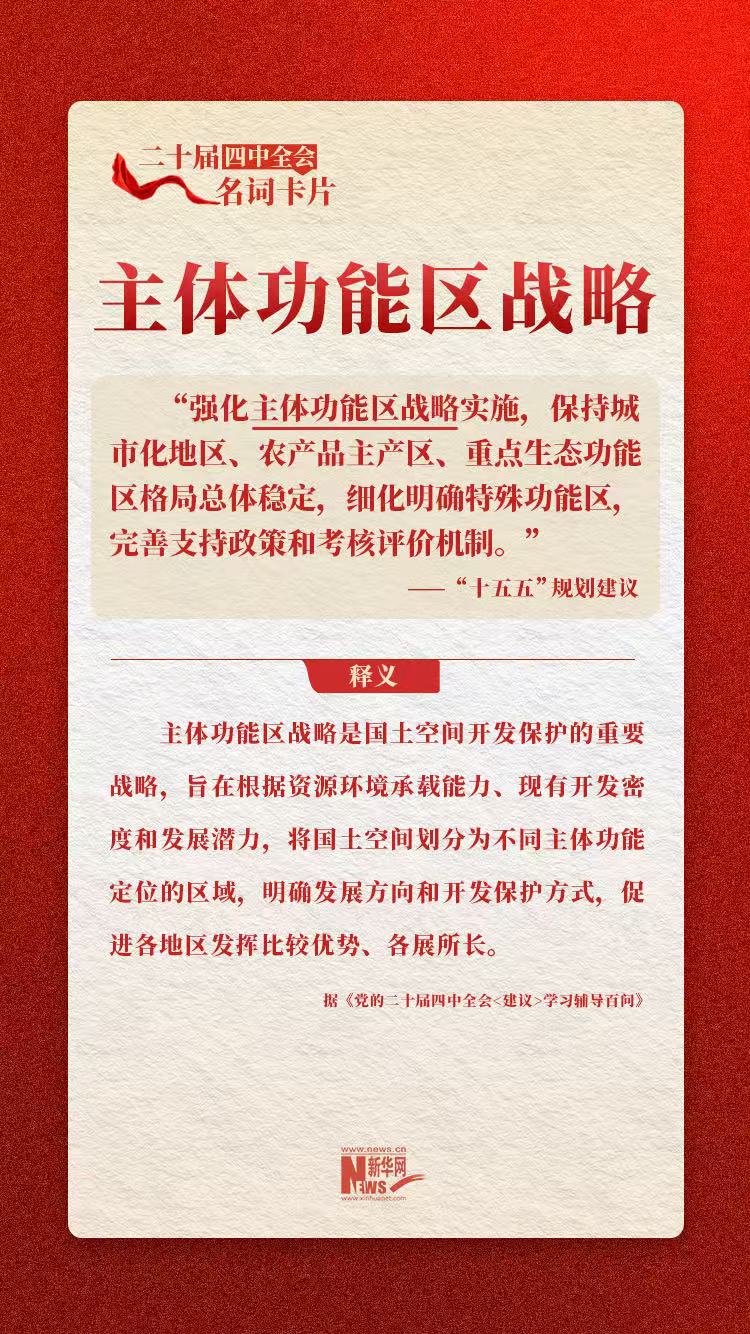
二十届四中全会名词卡片:主体功能区战略
Xin Hua Wang· 2025-11-16 13:09
Core Viewpoint - The article discusses the implementation of the主体功能区战略 (Main Functional Area Strategy) in China, emphasizing the need to maintain stability in urbanization, agricultural production areas, and key ecological function areas while refining special functional areas and improving support policies and evaluation mechanisms [2][9]. Group 1: Current Development Status - China has established a "two horizontal and three vertical" urbanization strategy, a "seven zones and twenty-three belts" agricultural development pattern, and a "three areas and four belts" ecological security pattern [7]. - The provincial-level land space planning identifies the main functional positioning of counties (cities, districts) as the basic unit [7]. Group 2: Deployment of the Strategy - The "National Land Space Planning Outline (2021-2035)" requires the refinement of the classification of main functional areas [8]. - The strategy aims to identify special functional areas based on the three main functional area classifications, tailoring support policies to leverage regional comparative advantages [8]. Group 3: Implementation of the Strategy - The strategy aims to maintain the overall stability of the main functional area pattern, considering natural endowments, resource environmental carrying capacity, and national development layout [9]. - Special functional area types and usage control rules will be clarified, including border areas, energy resource-rich areas, cultural and natural heritage protection, and marine economic development [10]. - Differentiated development and protection policies will be formulated for special functional areas, focusing on urbanization, infrastructure, and industry development in border areas, and promoting renewable energy in energy-rich regions [11][12].
事关区域发展,发挥四大战略叠加效应
21世纪经济报道· 2025-10-25 05:58
Core Viewpoint - The article discusses the outcomes of the Fourth Plenary Session of the 20th Central Committee of the Communist Party of China, emphasizing the importance of optimizing regional economic layout and promoting coordinated regional development through the integration of four major strategies [1][5][7]. Group 1: Four Major Strategies - The article highlights the introduction of the "Four Major Strategies" which include regional coordinated development strategy, major regional strategy, main functional area strategy, and new urbanization strategy, aimed at promoting high-quality regional development [6][7]. - The strategies are designed to address the disparities in per capita GDP, living standards, and public services among different regions, which are essential components of the regional coordinated development strategy [6][7]. - The major regional strategies encompass initiatives like the Beijing-Tianjin-Hebei coordinated development, Guangdong-Hong Kong-Macau Greater Bay Area construction, Yangtze River Delta integration, and others, focusing on enhancing international competitiveness [6][7]. Group 2: Regional Coordination and Development - The article emphasizes the need for enhanced regional coordination and interaction, where regions leverage their comparative advantages and collaborate in areas such as industrial links, innovation transformation, and infrastructure connectivity [2][10]. - It discusses the importance of optimizing the spatial development pattern of the country, moving from merely protecting land to achieving balanced development across regions [10][11]. - The article notes that the new urbanization strategy should focus on improving the quality of urbanization and facilitating the integration of rural populations into urban areas, which is crucial for achieving comprehensive modernization [12]. Group 3: Implementation and Future Directions - The article suggests that the implementation of these strategies requires a focus on regional major strategies and the promotion of inter-regional cooperation to transform development gradients into new spaces for high-quality growth [11][12]. - It highlights the necessity for a more integrated approach to regional development, breaking down silos and ensuring that regional strategies align with national development goals [7][12]. - The article concludes that the coordinated development of regions will provide strong support for the modernization of China, ensuring that development benefits are more equitably distributed among the population [10][12].

发挥“四大战略”叠加效应 增强区域发展协调性丨四中全会解读
2 1 Shi Ji Jing Ji Bao Dao· 2025-10-23 14:47
Core Viewpoint - The Fourth Plenary Session of the 20th Central Committee of the Communist Party of China emphasizes the optimization of regional economic layout and the promotion of coordinated regional development through the integration of four major strategies: regional coordination development strategy, major regional strategy, main functional area strategy, and new urbanization strategy [1][3][10] Group 1: Regional Economic Layout - The session highlights the need to enhance regional development coordination and promote regional linkage development, optimizing the national spatial development pattern [1][8] - The integration of the "Four Strategies" aims to optimize the layout of major productive forces in response to changing domestic and international development conditions [3][4] - The focus is on constructing a high-quality regional economic layout and spatial system that complements advantages [6][10] Group 2: Implementation of Strategies - The report stresses the importance of implementing existing development strategies, including regional coordination development strategy and new urbanization strategy, to better serve the overall modernization goals of China [10] - It calls for a collaborative approach among regions to leverage comparative advantages and enhance interaction in industrial links, innovation transformation, and infrastructure connectivity [2][8] - The emphasis on the "Four Strategies" aims to narrow the development gap between regions in terms of GDP, public services, and living standards [3][4] Group 3: New Urbanization and Spatial Planning - The report indicates a shift from merely optimizing the development and protection of land space to enhancing the overall development pattern of land space [9] - It highlights the ongoing process of human-centered new urbanization, which is closely related to high-quality regional development and rural revitalization [9][10] - The integration of development planning and spatial planning is crucial for achieving better synergy during the 15th Five-Year Plan period [7][10]