住房公积金制度改革

Search documents
事关1.7亿人的钱包,公积金这次为何被单独点名
经济观察报· 2026-03-05 09:45
这是一个关乎上亿人的制度,它的调整,无疑会影响无数家庭 的生活,而改革的最终目的,是让更多人能够更好地解决居住 需求。 作者:张雅楠 封图:图虫创意 2026年3月5日,政府工作报告明确提出"深化住房公积金制度改革"。这一提法在过往10年的政府工作报告中未曾出现。 中国的住房公积金制度始于20世纪90年代。1991年,上海借鉴新加坡经验推出住房公积金制度。1992年,北京等城市相继在房改方案中规定了住房 公积金制度。1994年,中国开始全面推行住房公积金制度。 在政府工作报告中,也曾数度出现住房公积金这一关键词。 1997年,公积金第一次被写入政府工作报告:鼓励企业主动用自己的财力,积极补充公积金和资本金。 2007年—2009年,公积金连续三年进入政府工作报告。当时,房地产市场开始火热,供不应求的矛盾凸显,公积金管理也有待完善。 2007年,政府工作报告要求:强化社会保障基金、住房公积金等社会公共基金的监督管理,严禁侵占挪用。 2008年,政府工作报告提出:完善住房公积金制度。 2009年,政府工作报告提出:选择一些有条件的地区进行试点,把部分住房公积金闲置资金补充用于经济适用住房建设。 公积金最近一次出现 ...


时隔11年政府工作报告再提公积金改革
第一财经· 2026-03-05 07:47
本文字数:2288,阅读时长大约4分钟 作者 | 第一财经 安卓 2026.03. 05 "下调个人住房公积金贷款利率""深化住房公积金制度改革",在今年的政府工作报告上,住房公积 金罕见出现两次。而上一次住房公积金改革被写入政府工作报告还是在2015年。 去年底,中央经济工作会议提出"深化住房公积金制度改革",在近10年的中央经济工作会议公报 中,这也是公积金首次被单独提及。随后,全国住房城乡建设工作会议将公积金制度改革列为稳定房 地产市场、推动房地产高质量发展的重要任务。 2026年初,各地公积金新政密集落地,精准匹配居民刚需与改善型住房需求,降低居民购房压力。 此前曾有机构测算, 公积金改革预计可释放约5151亿元资金,按70%的消费倾向计算,理论上可 拉动3606亿元消费,提升居民消费增速0.7个百分点。 各地公积金新政持续密集落地 我国住房公积金制度起源于1994年,《国务院关于深化城镇住房制度改革的决定》中明确提出建立 住房公积金制度,1999年《住房公积金管理条例》出台,明确住房公积金"用于职工购买、建造、 翻建、大修自住住房,任何单位和个人不得挪作他用"。 如今,住房公积金制度已实施了30余年 ...

时隔十年公积金改革写入政府工作报告,10万亿存量迎盘活契机
21世纪经济报道· 2026-03-05 05:12
记者丨 张敏 编辑丨吴抒颖 张伟贤 3月5日,十四届全国人大四次会议开幕,国务院总理李强作政府工作报告。政府工作报告提出,深化住房公积金制度改革。 十年后,公积金制度改革再度被写入政府工作报告 。 公积金制度改革上次被写入政府工作报告,还是在2015年。但当时的政策语境与现时有所不同。在楼市仍处于调整期,并进入新旧 动能转换阶段的当下,超过10万亿元的存量公积金,有望通过制度改革发挥更大的作用。 改革箭在弦上 近几个月来,监管部门频繁提及公积金,意味着该项制度的改革已箭在弦上。 2025年12月召开的中央经济工作会议指出,深化住房公积金制度改革。在近10年的中央经济工作会议公报中,这是公积金首次被单 独提及。 根据中指研究院的统计,2025年全国各地共出台房地产政策超630条,其中围绕公积金贷款政策优化出台政策约280条,频次为各类 政策最高。今年以来,一些重点城市也在优化公积金政策。 在具体措施上,以提高公积金贷款额度、调整公积金贷款套数认定、优化"商转公"、扩宽提取公积金使用范围(如支付首付、物业 费、装修款、税款等)等为主要优化方向。 多个方向有待破局 公积金制度改革上一次被写入政府工作报告,还是在20 ...

“加强初婚初育家庭住房保障”首次写入政府工作报告
第一财经· 2026-03-05 05:05
2026.03. 05 本文字数:1545,阅读时长大约3分钟 作者 | 第一财经 吴斯旻 今年我国将加强初婚初育家庭住房保障,支持多子女家庭改善性住房需求。 3月5日,十四届全国人大四次会议开幕,国务院总理李强作政府工作报告。房地产业影响投资和消 费,住房问题则事关民生和发展。本次政府工作报告对房地产相关工作着墨颇多,一方面继续将主体 内容放在"加强重点领域风险防范化解和安全能力建设"的大框架下,这意味着今年房地产领域风险 防范仍是住建领域的工作重点;同时明确"统筹防风险和促发展",在新型城镇化发展中提出"高质量 推进城市更新";此外在谈及保障工作时,首次作出上述部署。 "住房是家庭安居和生育养育的重要基础保障。初婚初育和多子女家庭,婚育成本高,生活压力大。 今年政府工作报告之所以将住房需求侧支持政策,聚焦于初婚初育家庭的刚性需求保障和多子女家庭 的改善住房需求,既是积极应对人口发展新形势,构建生育友好型社会的体现,也是促进房地产市场 平稳健康发展的重要举措。而加强住房周边儿童活动、托育、母婴、车位等设施配套建设或改造,也 能更好推动城市更新相关工作,一举数得。"成都市城市建设发展研究院副院长冯波对第一财经 ...

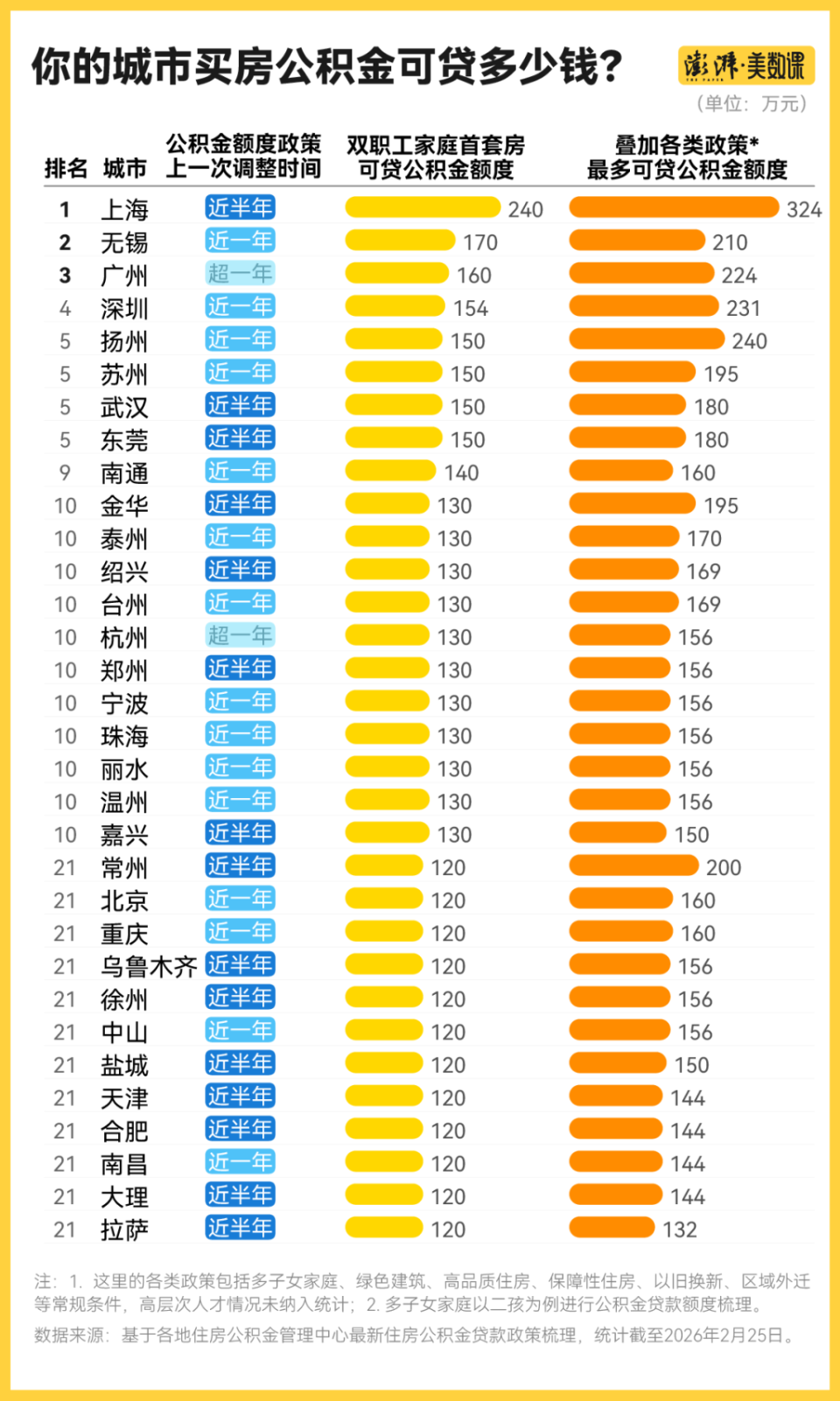
上海公积金贷款家庭额度升至最高324万,各地能贷多少?
Feng Huang Wang· 2026-02-27 02:36
Core Viewpoint - The new policy issued by Shanghai's housing authorities aims to optimize real estate regulations, focusing on purchase restrictions, public housing fund loans, and property taxes to support both rigid and improved housing demands [1] Group 1: Public Housing Fund Loan Adjustments - The maximum public housing fund loan for first-time homebuyers has been increased from 1.6 million yuan to 2.4 million yuan [1] - For families with multiple children and those purchasing qualifying green buildings, the loan limit can be raised by 20% and 15% respectively, with a combined maximum increase of 35%, allowing for a total loan of up to 3.24 million yuan, the highest in the country [1] - This adjustment reflects a significant response to the high housing prices in Shanghai, where the public housing fund loan previously covered only 36% of the price of a typical 90 square meter second-hand apartment, now increased to 53% [5] Group 2: Broader Trends in Public Housing Fund Policies - At least 32 cities across China have raised their public housing fund loan limits for dual-income families to 1.2 million yuan or more, with eight cities reaching 1.5 million yuan [4] - The increase in public housing fund loan limits is part of a broader trend, with approximately 280 policies introduced in 2025 aimed at optimizing public housing fund regulations [4] - The cumulative total of public housing fund deposits reached 32.79 trillion yuan by the end of 2024, with a year-on-year growth of 8.61% [5] Group 3: Implications for Real Estate Market - The adjustments in Shanghai's public housing fund loan policies signal a shift from merely supporting basic housing needs to promoting improved housing conditions, indicating a more systematic approach to real estate policy [8] - Shanghai's experience with the public housing fund system, initiated in 1991, has been influential and is now being adapted to meet current market demands, suggesting a potential for greater impact on domestic demand in the future [8]
松绑!又一地发布公积金贷款新政 最高能贷324万元
Zhong Guo Jing Ying Bao· 2026-02-25 14:35
Core Viewpoint - Shanghai has introduced a comprehensive set of policies to optimize the housing provident fund system, aimed at supporting both rigid and improved housing demand, effective from February 26, 2026 [1][5]. Group 1: Policy Changes - The maximum loan amount for first-time homebuyers using the housing provident fund has been increased from 1.6 million yuan to 2.4 million yuan, significantly reducing the down payment pressure and loan costs for buyers [2][4]. - The new policy allows for a 20% increase in loan limits for families with multiple children purchasing their first or second homes, and a 15% increase for those buying new green buildings, with the potential for a combined increase of up to 35% [2][3]. Group 2: Implications for Housing Market - The adjustments in the housing provident fund policy indicate a shift from merely supporting first-time buyers to also addressing the needs of those seeking to improve their housing situation, aligning with national population policies encouraging childbirth [3][4]. - The changes are expected to have a significant impact on the second-hand housing market, as the majority of buyers in the rigid and improved demand categories tend to purchase second-hand homes [3][4]. Group 3: Broader Context and Future Outlook - The reforms are part of a broader initiative to deepen the housing provident fund system, which has been emphasized in recent central government meetings, highlighting the need for ongoing reform and optimization of housing policies across various cities [5][6]. - The new policies in Shanghai serve as a model for other cities, showcasing a systematic approach to housing market regulation that integrates various policy tools to address both immediate housing needs and long-term urban development goals [6][7].
2026年,公积金确定有大动作,会有着哪2大新变化?
Sou Hu Cai Jing· 2026-02-22 07:50
Core Viewpoint - The housing provident fund system in China, established in 1999, is set for significant reforms aimed at stabilizing the real estate market and boosting domestic consumption, with potential changes in investment rates and the scope of fund usage [4][12]. Group 1: Current Status of the Housing Provident Fund - The housing provident fund system has been in place for 27 years, aiding millions of families in purchasing homes, with a current total of 1.76 billion contributors and a fund balance of 10.9 trillion yuan [4][12]. - The annual interest rate for the provident fund has remained low at 1.5% since 2016, despite decreasing bank deposit rates, leading to reduced earnings for the fund [8][9]. Group 2: Anticipated Reforms - Official announcements indicate that significant reforms to the housing provident fund are expected, focusing on both the interest rate and the range of permissible uses for the funds [4][12]. - There is speculation that the fund's investment scope may expand to include stock market investments, similar to social security funds, to generate higher returns [9][19]. Group 3: Implications for the Real Estate Market - The anticipated reforms are expected to positively impact the real estate market by enhancing consumer confidence and stimulating housing demand [18]. - Recent policy changes in various regions have already begun to allow the use of provident funds for additional expenses, such as property management fees and elevator installations, indicating a trend towards broader fund utilization [17][19]. Group 4: Disparities in Fund Contributions - There are significant disparities in provident fund contributions across different types of employers, which may widen the gap in employee benefits and welfare [10][9]. - The potential for expanded usage of the provident fund could further highlight these disparities, as higher-paying employers may offer more substantial contributions compared to lower-paying ones [10].

廊坊全面放开公积金提取频次限制
Xin Lang Cai Jing· 2026-02-11 22:53
Core Viewpoint - Langfang City has implemented a new housing provident fund withdrawal policy that removes the previous restriction of a 12-month interval between withdrawals, allowing contributors to withdraw funds based on their actual needs, thereby enhancing the efficiency of dormant funds [1][2]. Group 1: Policy Changes - The new policy allows withdrawals under four specific circumstances: when the contributor and their spouse do not own a home in the deposit location and are renting; for purchasing, building, renovating, or major repairing of a self-occupied home; for repaying housing loan principal and interest; and for those included in the local urban residents' minimum living security range [2]. - The withdrawal limits remain as per the original policy, with single employees able to withdraw up to 20,000 yuan annually for renting commercial housing, and couples combined up to 26,000 yuan, while those renting public rental housing can withdraw the full amount of actual rent [2]. Group 2: Impact and Statistics - In the first week of the new policy's implementation, Langfang processed 5,382 withdrawal transactions totaling 110 million yuan, with online and offline transaction volumes increasing by 184.3% compared to the same period last month [1]. - The policy aims to alleviate financial pressure for renters and families repaying loans by simplifying withdrawal constraints and directly addressing the housing consumption pain points of residents [2].
焦点访谈|让住房公积金“活”起来 书写温暖民生答卷
Yang Shi Wang· 2026-02-06 13:40
Core Viewpoint - The reform of the housing provident fund system is essential for promoting stable and healthy development in the real estate market and better supporting housing demand, as emphasized in the Central Economic Work Conference held at the end of 2025 [1] Group 1: Housing Provident Fund System Reform - The housing provident fund system has become a crucial part of China's housing security system, with 176 million contributors and a total balance of 10.9 trillion yuan by the end of 2024 [3] - The reform aims to address the "sleeping" funds in accounts and improve the efficiency of fund usage, which has become a hot topic in society [3] - The necessity of reform is driven by the public's higher expectations for the provident fund's role in supporting housing consumption and the system's misalignment with current economic and social developments [3] Group 2: Expansion of Usage Scenarios - Recent innovations in housing provident fund policies include supporting the installation of elevators in old residential buildings, addressing the needs of elderly residents [5][8] - Many cities have begun to include elevator installation costs in the scope of provident fund withdrawals, allowing family members to withdraw funds on behalf of elderly residents [8][10] - The reform also extends the usage of the provident fund to cover major repairs, renovations, and urban renewal projects, enriching the support for housing consumption [10] Group 3: Inclusion of Flexible Employment Groups - The inclusion of flexible employment groups in the provident fund system is a key focus of the reform, with pilot programs initiated in cities like Shenzhen [12] - A tailored policy framework has been developed to accommodate the unique characteristics of flexible employment, allowing over a million individuals to participate in the system [14] - The reforms have enabled individuals like a former employee turned flexible worker to access provident fund loans, enhancing the system's inclusivity [14] Group 4: Cross-Regional Coordination - The reform emphasizes the importance of cross-regional collaboration for the "inter-city withdrawal and loan" of the housing provident fund, addressing inconsistencies in policy and technical standards across regions [16] - Efforts to streamline processes and enhance data sharing have led to improved efficiency in handling cross-province transactions, allowing for quicker and more accessible services [18][20] - The establishment of collaborative mechanisms among cities has facilitated a "one-stop" service for provident fund withdrawals and loans, reducing the burden on citizens [20]
多地支持住房公积金用于居民房屋改建
第一财经· 2026-02-05 08:27
Core Viewpoint - The article discusses the recent relaxation of restrictions on the use of housing provident funds for urban renewal projects, which is expected to benefit more flexible employment groups. However, there are concerns that the housing provident fund system still faces challenges in effectively mobilizing the over 10 trillion yuan of "sleeping funds" [3][11]. Group 1: Policy Changes and Urban Renewal - Recent policies from various cities have expanded the use of housing provident funds, particularly for urban renewal projects aimed at improving residents' living conditions and asset value [5]. - The Ningxia Zhongwei Housing Provident Fund Management Center announced new policies allowing fund withdrawals for elderly and child-friendly renovations, structural reinforcement, and urban renewal projects, with a maximum withdrawal limit of 100,000 yuan per year [5]. - Hebei Langfang has lifted restrictions on the frequency of housing provident fund withdrawals, allowing residents to withdraw funds for various housing-related purposes without a 12-month waiting period [6]. - The Fujian Provincial Department of Housing and Urban-Rural Development has optimized housing provident fund policies to support urban renewal, allowing withdrawals for personal contributions to renovation projects [6]. - Beijing's urban renewal policy toolbox aims to accelerate housing provident fund loan support for residents' renovation costs, reducing financial burdens [6]. Group 2: Inclusion of Flexible Employment Groups - Shandong Dezhou is piloting the inclusion of flexible employment individuals in the housing provident fund system, providing incentives for residents to open accounts and allowing them to use relocation compensation for fund contributions [7]. - This initiative is expected to generate 15.3 million yuan in housing provident fund loan issuance and stimulate local real estate sales and downstream consumption [7]. Group 3: Overall Trends and Future Outlook - The central government has signaled a commitment to deepening housing provident fund reforms, with a focus on including more flexible and new employment groups [9][10]. - In 2024, the total housing provident fund contributions are projected to reach 36,317.83 billion yuan, a 4.67% increase from the previous year, but the proportion of flexible employment individuals remains low at 1.24% [10]. - The cumulative total of housing provident fund withdrawals reached 218,688.56 billion yuan, with a significant portion used for purchasing and renovating homes, while withdrawals for old community renovations remain minimal [10]. - Experts suggest that relaxing restrictions on housing provident fund loans and expanding its use for urban renewal could activate the dormant funds, but the effectiveness in alleviating housing consumption pressure and enhancing residents' willingness to participate in urban renewal needs further improvement [11].