
公用事业领域反垄断

Search documents
江苏首次集中表彰270名技术技能人才 国务院:到2035年全面建成全国统一电力市场体系
Sou Hu Cai Jing· 2026-02-12 00:16
Equity Market - On February 11, A-shares showed mixed performance with the Shanghai Composite Index up by 0.09% while the Shenzhen Component Index fell by 0.35% and the ChiNext Index dropped by 1.08% [4] - The trading volume in the Shanghai and Shenzhen markets fell below 2 trillion yuan for the first time in 31 trading days, decreasing by 121.3 billion yuan compared to the previous trading day, with over 3,200 stocks declining [4] Domestic Economic Policies - Jiangsu Province announced the recognition of 270 top talents in the technical and skill fields, marking the largest and most comprehensive award ceremony in recent years [6] - In 2025, Jiangsu's total tax revenue is projected to be 30,351.9 billion yuan, with tax revenue of 15,801.6 billion yuan, reflecting a year-on-year growth of 3.8% [6] - The province's policies to support technological innovation and manufacturing development include tax reductions and refunds totaling 331.997 billion yuan [6] Transportation and Infrastructure - On February 11, the China National Railway Group announced plans to add 1,544 passenger trains for the Southern New Year, with over 200 million train tickets sold during the Spring Festival travel period [7] - The State Council issued an opinion on improving the national unified electricity market system, aiming for 70% of electricity consumption to be from market transactions by 2030 [7] Technology and App Market - QuestMobile reported that on February 7, the daily active users (DAU) of the Qianwen app reached 73.52 million, surpassing the DAU of Yuanbao at 18.28 million and approaching Doubao at 78.71 million [8] - The Qianwen app has maintained the top position on the App Store's free chart for six consecutive days [8]


细化垄断行为认定规则
Xin Lang Cai Jing· 2026-02-11 18:46
Core Viewpoint - The State Administration for Market Regulation has issued the "Antitrust Guidelines for the Public Utilities Sector" to prevent and curb monopolistic behaviors in public utilities, ensuring fair market competition and protecting consumer and public interests [1][2]. Group 1: Overview of the Guidelines - The guidelines consist of seven chapters and 50 articles, systematically summarizing enforcement experiences and accurately grasping the characteristics of the public utilities sector and market competition rules [1]. - The guidelines provide clearer and more explicit instructions for antitrust enforcement and compliance for operators in the public utilities sector [1]. Group 2: Specific Provisions - The guidelines specifically address monopolistic behaviors in the public utilities sector, including market definition, recognition of market dominance, antitrust agreements, and abuse of market dominance [2]. - They further detail the manifestations of monopolistic agreements, particularly in industries like bottled liquefied gas, and abusive practices such as restrictive trading, bundling, and imposing unreasonable trading conditions in sectors like water, electricity, gas, and heating [2]. Group 3: Compliance and Oversight - The guidelines encourage public utility operators to strengthen compliance efforts, promote the active role of associations, enhance positive compliance guidance, and maintain open channels for social supervision [2].
公用事业领域反垄断指南出台 细化垄断行为认定规则
Shang Hai Zheng Quan Bao· 2026-02-11 17:54
Core Viewpoint - The State Administration for Market Regulation has issued the "Antitrust Guidelines for the Public Utilities Sector," aimed at clarifying antitrust enforcement and compliance in the public utilities sector to prevent monopolistic behaviors and maintain fair market competition [1][2]. Group 1: Guidelines Overview - The guidelines consist of seven chapters with 50 articles covering general principles, monopolistic agreements, abuse of market dominance, operator concentration, fair competition review, abuse of administrative power to eliminate competition, and applicable legal responsibilities [1]. - The identification of market dominance in the public utilities sector will consider the natural monopoly characteristics and franchise operating models, focusing on the operators' control over physical networks or other critical infrastructure [1][2]. Group 2: Monopolistic Behaviors - The guidelines detail common monopolistic behaviors in industries such as bottled liquefied gas, and the public utilities sectors (water, electricity, gas, heating) that often involve restrictive trading, bundling, and unreasonable trading conditions [2]. - The guidelines emphasize that public utility operators may extend their monopolistic advantages to competitive sectors, which necessitates a systematic approach to enhance the scientific, targeted, and effective nature of antitrust enforcement [2]. Group 3: Compliance and Risk Management - The guidelines encourage public utility operators to strengthen antitrust compliance frameworks, establish effective management systems to identify potential antitrust legal risks, and implement corresponding preventive and remedial measures [3].
事关供水、供电、供气、供热……公用事业领域反垄断指南出台!
Zhong Guo Zheng Quan Bao· 2026-02-11 14:36
Core Viewpoint - The State Council's Anti-Monopoly and Anti-Unfair Competition Commission has issued the "Anti-Monopoly Guidelines for the Public Utility Sector" to prevent and curb monopolistic behaviors, maintain fair market competition, and protect consumer and public interests [1][3]. Background - The public utility sector encompasses essential services such as water supply, electricity, gas, heating, sewage treatment, waste management, and public transportation, which often exhibit natural monopoly characteristics [5]. - Monopolistic behaviors in the public utility sector are prevalent, with operators extending their monopolistic advantages to upstream and downstream competitive sectors, thereby restricting market competition [6]. Purpose of the Guidelines - The guidelines aim to address the unique characteristics and market competition rules of the public utility sector, providing clearer and more specific guidance for anti-monopoly enforcement and compliance for operators [7]. Development Process - The guidelines were developed through a systematic summary of enforcement experiences and extensive consultation with various stakeholders [8]. Main Content - The guidelines consist of seven chapters and 50 articles, detailing specific manifestations and recognition standards of monopolistic behaviors in the public utility sector [9]. - The first eight articles outline the overall principles of anti-monopoly enforcement in the public utility sector, emphasizing the establishment of compliance management systems by operators and industry associations [9]. Specific Provisions - Articles 9 to 14 elaborate on the forms of monopolistic agreements, including horizontal and vertical agreements among operators, and the conditions under which certain agreements may be exempted from prohibition [10]. - Articles 15 to 25 focus on the abuse of market dominance, detailing factors for recognizing operators with market power and specific abusive practices such as unfair pricing and refusal to deal [11][12]. - Articles 26 to 31 discuss the review of operator concentration, highlighting that certain concentrations may require notification even if they do not meet the reporting threshold [15]. - Articles 32 to 39 emphasize the need for fair competition reviews of policies affecting economic activities in the public utility sector and detail behaviors that abuse administrative power to restrict competition [18]. - Articles 40 to 48 clarify the legal responsibilities applicable to operators, industry associations, and individuals who violate anti-monopoly laws [20].

事关水电气热等领域,公用事业领域反垄断指南出台
Xin Lang Cai Jing· 2026-02-11 12:33
Core Viewpoint - The State Council's Anti-Monopoly and Anti-Unfair Competition Commission has implemented the "Anti-Monopoly Guidelines for the Public Utilities Sector" to prevent and curb monopolistic behaviors in public utilities, ensuring fair market competition and protecting consumer and public interests [1] Group 1: Overview of the Guidelines - The guidelines consist of seven chapters and 50 articles, systematically summarizing enforcement experiences and accurately grasping the characteristics of the public utilities sector and market competition rules [1] - The guidelines provide clear and specific directives for anti-monopoly enforcement and compliance for operators in the public utilities sector, enhancing the scientific, targeted, and effective nature of anti-monopoly enforcement [1] Group 2: Characteristics of Public Utilities - Public utilities such as water, electricity, gas, and heating exhibit natural monopoly characteristics, with monopolistic behaviors being increasingly prevalent in recent years [1] - Due to the public, regional, and policy-related nature of public utilities, the types, manifestations, and damages of monopolistic behaviors present certain specificities [1] Group 3: Objectives of the Guidelines - The implementation of the guidelines aims to establish a long-term regulatory mechanism for anti-monopoly in the public utilities sector, promoting sustainable and healthy development of public utilities [1]
事关水电气热等领域,公用事业领域反垄断指南出台
证券时报· 2026-02-11 12:14
Core Viewpoint - The article discusses the issuance of the "Antitrust Guidelines for the Public Utilities Sector" by the State Council, aimed at preventing and curbing monopolistic behaviors in public utilities, ensuring fair market competition, and protecting consumer and public interests [1][4]. Group 1: Background and Purpose - The public utilities sector, which includes water supply, electricity, gas, heating, sewage treatment, waste disposal, and public transportation, often exhibits natural monopolistic characteristics [7]. - Recent years have seen a rise in monopolistic behaviors within this sector, where operators extend their monopolistic advantages to upstream and downstream competitive segments, limiting market competition [2][8]. - The guidelines consist of seven chapters and 50 articles, summarizing enforcement experiences and providing clear rules for identifying monopolistic behaviors in public utilities [2][9]. Group 2: Key Contents of the Guidelines - The guidelines outline the overall principles for antitrust enforcement in the public utilities sector, emphasizing the need for operators and industry associations to establish compliance management systems to prevent risks [12][14]. - Specific provisions include the clarification of the rights and procedures for whistleblowers, and the prohibition of monopolistic behaviors through data algorithms [15][16]. - The guidelines detail the forms of monopolistic agreements and the conditions under which certain agreements may be exempt from prohibition [18][21]. Group 3: Market Dominance and Abuse - The guidelines provide a framework for analyzing the abuse of market dominance, including factors for determining whether a public utility operator holds a dominant market position [22][24]. - They specify considerations for identifying unfair pricing, refusal to deal, and other abusive practices, along with common justifications that may not be accepted as valid [26][27]. - The guidelines also address the review of operator concentrations, particularly in natural monopoly segments, and the potential requirement for operators to report concentrations that may restrict competition [27][28]. Group 4: Legal Responsibilities and Enforcement - The guidelines clarify the legal responsibilities of public utility operators and industry associations in cases of antitrust law violations, including the consequences of aiding in monopolistic agreements [32][34]. - They emphasize the importance of compliance with antitrust regulations and the potential for penalties to be recorded in credit histories, highlighting the collaborative enforcement approach among regulatory bodies [34].
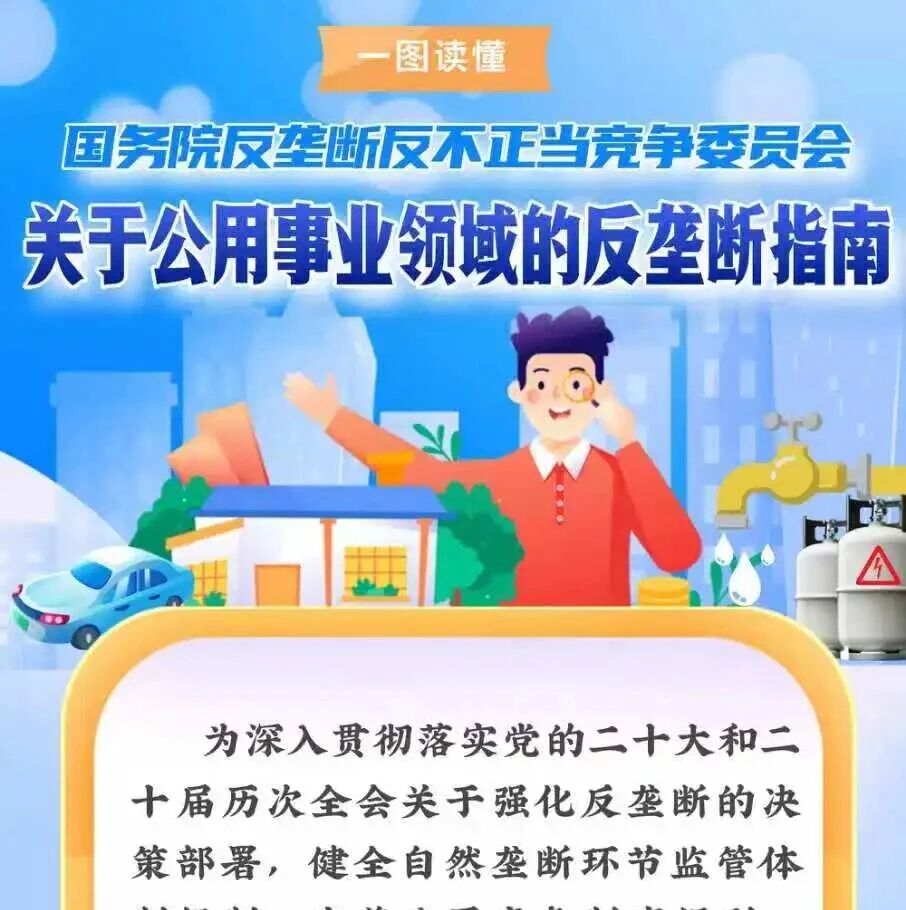
公用事业领域反垄断指南出炉 细化垄断行为认定规则
Xin Hua She· 2026-02-11 11:01
Core Viewpoint - The State Council's Anti-Monopoly and Anti-Unfair Competition Committee has issued guidelines aimed at preventing and curbing monopolistic behaviors in the public utility sector, ensuring fair market competition and protecting consumer and public interests [1][2]. Group 1: Guidelines Overview - The guidelines consist of seven chapters and 50 articles, systematically summarizing enforcement experiences and accurately grasping the characteristics of the public utility sector and market competition rules [1]. - The guidelines provide clearer and more explicit directives for anti-monopoly enforcement and compliance for operators in the public utility sector [1]. Group 2: Specific Provisions - The guidelines specifically address monopolistic behaviors in the public utility sector, including market definition, recognition of market dominance, and identification of monopolistic agreements and abuse of market dominance [2]. - The guidelines further detail the forms of monopolistic agreements and abusive behaviors, particularly in industries like bottled liquefied gas, as well as in water, electricity, gas, and heating sectors [2]. Group 3: Compliance and Industry Support - The guidelines encourage public utility operators to strengthen compliance measures and promote the active role of associations in compliance guidance [2]. - There is an emphasis on maintaining open channels for social supervision to ensure ongoing compliance and accountability within the industry [2].
事关水电气热等领域,公用事业领域反垄断指南出台
中国能源报· 2026-02-11 10:52
Core Viewpoint - The article discusses the release of the "Antitrust Guidelines for Public Utilities" by the State Council Antitrust Committee, aimed at preventing monopolistic behaviors in public utility sectors such as water, electricity, gas, heating, sewage treatment, waste management, and public transportation [1][3]. Group 1: General Principles - The purpose of the guidelines is to prevent and stop monopolistic behaviors in public utilities, guide operators in antitrust compliance, strengthen regulation of natural monopoly sectors, and protect fair market competition and consumer interests [3]. - The guidelines emphasize maintaining fair competition, scientifically regulating the sector, enhancing public welfare, and supporting high-quality development [4][5]. Group 2: Antitrust Compliance - Public utility operators are encouraged to strengthen antitrust compliance management and identify potential legal risks [5]. - Industry associations in the public utility sector should enhance antitrust compliance management and self-discipline to avoid violations of antitrust laws [5]. Group 3: Reporting and New Monopolistic Behaviors - Any individual or organization can report suspected monopolistic behaviors in the public utility sector to antitrust enforcement agencies, which must keep the whistleblower's identity confidential [6]. - Public utility operators are prohibited from using data, algorithms, technological, capital advantages, or platform rules to engage in monopolistic behaviors [6]. Group 4: Market Definition - The guidelines provide a framework for defining relevant markets in the public utility sector, considering factors such as product characteristics, usage costs, and consumer dependency [8][9]. - The geographic market is defined based on the physical network or infrastructure coverage of the public utility operator [7]. Group 5: Monopolistic Agreements - The guidelines outline the criteria for identifying monopolistic agreements, including horizontal and vertical agreements that restrict competition [9][10]. - Public utility operators must not engage in practices that could be deemed as price-fixing, market division, or limiting production [10][11]. Group 6: Abuse of Market Dominance - The guidelines specify the framework for identifying abuse of market dominance, including unfair pricing and refusal to deal [12][13]. - Factors such as market share, dependency of consumers, and barriers to market entry are considered in determining market dominance [14][15]. Group 7: Operator Concentration - Public utility operators can legally concentrate through fair competition and voluntary cooperation, but must report to antitrust authorities if they meet certain thresholds [19][20]. - The guidelines emphasize the need for scrutiny of concentrations that may harm competition, especially in natural monopoly sectors [25][26]. Group 8: Fair Competition Review - Administrative bodies must conduct fair competition reviews for policies affecting public utility operators to ensure equal access to resources and fair market participation [28][29]. - The guidelines prohibit the abuse of administrative power to limit competition in the public utility sector [30][31]. Group 9: Legal Responsibilities - Violations of antitrust laws by public utility operators, industry associations, and administrative bodies will be subject to legal consequences as outlined in the guidelines [39][40]. - The guidelines encourage cooperation with investigations and provide for leniency in penalties for those who actively assist in compliance [45][46].

事关水气电热等民生领域,怎样为公用事业经营画红线
Yang Shi Xin Wen Ke Hu Duan· 2025-08-21 23:39
Core Viewpoint - The State Administration for Market Regulation has released a draft guideline for public utilities aimed at enhancing antitrust enforcement in sectors characterized by natural monopolies, such as water, electricity, gas, and heating services [1][3]. Group 1: Antitrust Guidelines Overview - The draft guideline consists of seven chapters and 45 articles, providing a comprehensive framework for analyzing monopolistic agreements and abuse of market dominance in the public utilities sector [3]. - It addresses horizontal monopolistic agreements, particularly in the bottled gas industry, and outlines specific behaviors and standards for identifying such agreements [3][4]. - The guideline establishes a systematic antitrust regulatory framework that covers preemptive, ongoing, and post-incident measures in the public utilities sector [3][4]. Group 2: Specific Provisions and Implications - The guideline specifies two forms of horizontal monopolistic agreements, including price-fixing through verbal agreements or meetings, and market division through cooperative operations [4]. - It emphasizes that operators cannot justify abusive market dominance behaviors under the pretext of safety unless they can prove such actions are necessary for safety [6]. - The guideline aims to promote self-regulation among public utility operators, encouraging compliance with laws and regulations to enhance fair competition and public welfare [6][7]. Group 3: Coordination and Comprehensive Governance - The guideline highlights the need for coordinated efforts between antitrust enforcement agencies and industry regulators to address systemic monopolistic issues in public utilities [7]. - It mandates that any violations of industry regulations discovered during investigations be reported to the relevant regulatory bodies for further action [7].

事关水气电热等民生领域,怎样为公用事业经营画红线?
Yang Shi Xin Wen Ke Hu Duan· 2025-08-21 22:21
Core Viewpoint - The State Administration for Market Regulation has released a draft of the "Antitrust Guidelines for the Public Utilities Sector" to solicit public opinions, aiming to enhance the scientific, targeted, and effective enforcement of antitrust laws in this sector [1][2]. Summary by Relevant Sections Antitrust Guidelines Overview - The guidelines consist of seven chapters and 45 articles, addressing monopolistic agreements, abuse of market dominance, and the analysis framework for operator concentration, thereby creating a comprehensive antitrust regulatory system for public utilities [2][3]. Specific Provisions - The guidelines specifically address horizontal monopolistic agreements, particularly in the bottled gas industry, and detail the behaviors and standards for identifying such agreements [2][3]. - It also outlines the legal responsibilities of operators and includes provisions for fair competition reviews and the prohibition of administrative power abuse [2]. Unique Characteristics of Public Utilities - Due to the public, regional, and policy nature of public utilities, the types and impacts of monopolistic behaviors exhibit certain peculiarities, which the guidelines aim to address [3]. - The guidelines clarify that operators cannot justify abusive behaviors under the pretext of safety unless they can prove such actions are necessary for safety [3]. Enforcement Principles - The enforcement of antitrust regulations in the public utilities sector is guided by principles of maintaining fair competition, scientific regulation, enhancing public welfare, and supporting high-quality development [4]. - The guidelines emphasize a preventive regulatory role, encouraging operators to comply with laws and self-regulate [4]. Coordination with Other Regulatory Bodies - The guidelines highlight the need for coordination between antitrust enforcement agencies and industry regulatory bodies, suggesting a multi-faceted approach to address systemic monopolistic issues [4].