
分级诊疗制度

Search documents
灯火里的“医”靠:社区医院的别样年味
Chang Jiang Shang Bao· 2026-02-25 05:30
●长江商报记者 王天宇 在这个团圆的时刻,这份"医靠"显得尤为珍贵。大年初三的中午,值班医生正在为患者测量血压,耐心 地询问他过年期间的饮食和作息。"过年高兴归高兴,油腻的、太甜的东西还是要少吃点,药可得按时 吃。" 这种医患间的信赖,并非一日之功。平日里,在负责基本医疗的同时,社区卫生服务中心还承担着辖区 居民的公共卫生服务。家庭医生团队与居民签订服务协议,对妇女、儿童、老年人、慢性病患者、精神 病患者进行上门随访。针对65岁以上老年人,他们下社区开展义诊活动,告知免费健康体检信息。针对 失能老人,医生和护士主动上门,提供更换导尿管、抽血、B超等服务,让失能老人的健康得到保障。 中山社区卫生服务中心的现状,是落实"医疗卫生强基工程"的一个缩影。落实医疗卫生强基工程实施方 案要求,在加强基层医疗卫生机构全科医疗科、中医科、预防保健科等业务及医技科室建设的基础上, 综合考虑辖区居民健康需求、人口老龄化、区域医疗卫生资源布局等因素,重点加强若干临床科室建 设,形成在一定区域范围内具有基层优势和特色的科室。 要实现这一目标,离不开医联体的支撑。上级医院的优势被充分激活,依托医学重点学科、临床重点专 科、中医优势专科 ...
群众家门口就医从有到优
Xin Lang Cai Jing· 2026-02-23 20:40
以提供均等化基本公共卫生服务和同质化基本医疗服务为目标,将家庭医生签约服务作为打通服务群 众"最后一公里"的突破口和重要抓手,严格对照目标任务规范实施国家基本公共卫生服务项目,推动高 血压、糖尿病等慢性病防、治、管全流程融合发展,逐步实现基层医疗卫生服务同质化管理。截至目 前,全省常住人口家庭医生签约服务率达78.41%,重点人群签约服务率达87.25%,基本公共卫生服务 覆盖面和服务质量持续提升。 充分发挥中(藏)医药特色优势,广泛推广应用中(藏)医药适宜技术,积极探索中(藏)医药综合服 务模式,基层医疗卫生机构中(藏)医诊疗量占比达32%以上。通过持续推进社区医院建设,基层医疗 卫生机构科室设置不断优化,门诊常见病、多发病诊疗能力及住院服务水平显著提升。 本报讯 (记者 郭靓) 2月23日,青海省卫生健康委传来消息,青海扎实推进"优质服务基层行"活动, 不断优化医疗卫生资源配置,完善基层医疗卫生服务功能,加大社区医院建设力度,进一步推动分级诊 疗制度落地见效。目前,全省8个市州19个县已建成社区医院30家,其中乡镇卫生院25家,社区卫生服 务中心5家,共覆盖城镇122.2万人口。100%的社区医院能够提供 ...
山东中医药大学附属医院医联体成员单位签约揭牌仪式在泰安市妇幼保健院举办
Qi Lu Wan Bao· 2025-12-01 07:25
Core Points - The signing and unveiling ceremony of the medical alliance between Shandong University of Traditional Chinese Medicine Affiliated Hospital and Tai'an Maternal and Child Health Hospital marks a significant step in integrating quality traditional Chinese medicine resources with maternal and child health services in Tai'an [1][2] - The initiative is part of Tai'an's efforts to deepen healthcare reform, enhance service capabilities, and benefit the local population [1][2] Group 1 - The establishment of a close-knit medical alliance is a continuation of the "Ten Hundred Thousand Project" and aims to provide high-quality healthcare services to women and children in Tai'an [2] - The collaboration will focus on resource sharing, joint training of disciplines and talents, and the development of a new health service model that combines traditional Chinese and Western medicine [2][3] - The unveiling of the medical alliance and the concurrent training program for suitable traditional Chinese medicine techniques demonstrate a commitment to implementing national healthcare reform policies and enhancing the healthcare system [3] Group 2 - The training program featured expert lectures on various traditional Chinese medicine techniques, including treatments for conditions such as lumbar myofascial pain and knee osteoarthritis, showcasing the practical application of these methods [3] - Tai'an Maternal and Child Health Hospital plans to leverage the advantages of Shandong University of Traditional Chinese Medicine Affiliated Hospital to strengthen specialty disciplines and improve the integration of traditional Chinese medicine in maternal and child health services [4] - The collaboration aims to establish a benchmark for integrated maternal and child health services in the region, focusing on comprehensive care throughout the lifecycle of women and children [4]
以医术而非话术留住病人,让分级诊疗落地生根
Nan Fang Du Shi Bao· 2025-11-28 06:51
Core Viewpoint - The phrase "keeping patients is an art" used by a health institution in Anhui has sparked controversy, raising concerns about its implications for patient care and the potential for over-medicalization [1][2] Group 1: Current Challenges in Primary Healthcare - Many primary healthcare institutions face difficulties in retaining patients, often referring cases to higher-level hospitals due to risk aversion and a lack of confidence in handling more complex cases [2] - The financial structure of primary healthcare, heavily reliant on public health funding, diminishes the incentive for doctors to increase patient volume, leading to a reluctance to treat patients [2] - The phenomenon of "easy upward referral and difficult downward referral" complicates the implementation of a tiered healthcare system [2] Group 2: Policy and Structural Responses - Local health departments have established patient visit rate indicators for healthcare institutions below the county level, and insurance policies have been adjusted to increase reimbursement rates for primary care [2] - Despite these measures, the reluctance to retain patients persists in many primary healthcare settings, indicating a need for further encouragement and support for institutions that commit to patient retention [2] Group 3: Importance of Clear Communication and Quality Care - There is a need to correct the flawed promotional language used by healthcare institutions, emphasizing clarity and avoiding ambiguous expressions that could lead to misunderstandings [3] - The primary focus of healthcare institutions should be on improving diagnostic and treatment capabilities rather than on marketing strategies to attract patients [3] - Enhancing the quality of care through better training for general practitioners, improved equipment, and a scientific referral system is essential for the success of tiered healthcare [3]
新世纪期货交易提示(2025-11-28)-20251128
Xin Shi Ji Qi Huo· 2025-11-28 05:31
1. Report Industry Investment Ratings - Iron Ore: Volatile [2] - Coking Coal and Coke: Volatile and Weakening [2] - Rolled Steel and Rebar: Volatile [2] - Glass: Volatile [2] - Shanghai Composite 50 Index Futures/Options: Volatile [3] - CSI 300 Index Futures/Options: Volatile [3] - CSI 500 Index Futures/Options: Rebounding [3] - CSI 1000 Index Futures/Options: Rebounding [3] - 2 - Year Treasury Bonds: Volatile [3] - 5 - Year Treasury Bonds: Volatile [3] - 10 - Year Treasury Bonds: Upward [3] - Gold: Volatile and Bullish [4] - Silver: Volatile and Bullish [4] - Logs: Bottom - Hunting [4] - Pulp: Volatile and Weakening [7] - Offset Paper: Volatile and Weakening [7] - Soybean Oil: Range - bound [6] - Palm Oil: Range - bound [6] - Rapeseed Oil: Range - bound [6] - Soybean Meal: Volatile [6] - Rapeseed Meal: Volatile [6] - Soybean No. 2: Volatile [6] - Soybean No. 1: Volatile [6] - Live Pigs: Volatile and Bullish [8] - Rubber: Volatile [10] - PX: Volatile [10] - PTA: Volatile [10] - MEG: Widely Volatile [10] - PR: Wait - and - See [10] - PF: Wait - and - See [10] 2. Core Views of the Report - The overall market shows a complex situation with different trends in various industries. Some industries are facing supply - demand imbalances, while others are affected by policy, geopolitical, and seasonal factors. The market is generally in a state of volatility, and short - term and long - term influencing factors need to be comprehensively considered for investment decisions [2][3][4] 3. Summary by Relevant Catalogs Black Industry - **Iron Ore**: Global iron ore shipments decreased by 238.0 tons to 3278.4 tons, while 47 - port foreign ore arrivals increased by 569.6 tons to 2939.5 tons. Daily hot metal production decreased by 1.6 tons to 234.68 tons. The demand core lies in the real estate sector, with new construction starts at 2005 levels and weak domestic demand. Port iron ore inventories rose slightly to an 8 - month high. The supply - demand surplus pattern is hard to reverse, and although steel mill profits are squeezed, short - term self - initiated production cuts are unlikely, so iron ore prices will mainly fluctuate at high levels [2] - **Coking Coal and Coke**: Affected by Mongolia's import target and the heating - season supply guarantee meeting, the coking coal and coke futures prices dropped significantly. Although the fourth round of price increases by coking enterprises has been implemented, profit repair is limited, and there are obvious differences in sentiment regarding the fifth round. Pit - mouth coking coal prices are high, and coking plants are under cost pressure and have low production intentions. Supply concerns in the coking coal industry are intensifying, and the supply - demand situation may become loose again, with prices adjusting weakly in the short term [2] - **Rolled Steel and Rebar**: Downstream demand is sluggish, and winter storage replenishment has not started. The core lies in steel demand, with real estate new construction at 2005 levels and weak domestic demand. Steel prices will stop falling depending on the implementation of a more than 5% production cut in Q4 2025 and the intensity of anti - "involution" policies. Currently, steel prices will remain at the bottom and fluctuate, and attention should be paid to the impact of December's macro - policy expectations on winter storage [2] - **Glass**: News of cold repairs in Hubei continued to ferment, which will reduce delivery pressure. Real - estate completion is declining, dragging down demand, and enterprise inventories are increasing. To solve the industry - wide surplus problem, the daily melting volume needs to drop to about 15.4 tons by the end of the year. Attention should be paid to whether macro - factors and production - line cold repairs can bring a turning point for prices to stop falling and stabilize [2][3] Financial - **Stock Index Futures/Options**: The previous trading day saw the CSI 300 index down 0.05%, the SSE 50 index up 0.02%, the CSI 500 index down 0.20%, and the CSI 1000 index up 0.12%. Some sectors had capital inflows or outflows. The State Council held a meeting to discuss relevant work, and the NDRC introduced infrastructure REITs expansion and addressed the development of the embodied - intelligence industry. The market is in short - term adjustment but remains optimistic in the medium term, with the high - tech industry growing [3] - **Treasury Bonds**: The yield of 10 - year treasury bonds was flat, and the central bank conducted 3564 billion yuan of 7 - day reverse repurchase operations, with a net investment of 564 billion yuan. Treasury bond spot rates were consolidating, and the market showed a slight rebound [3] Precious Metals - **Gold and Silver**: In the context of high - interest rates and globalization reconstruction, the pricing mechanism of gold is shifting from being centered on real interest rates to central - bank gold purchases. Gold's de - fiat - currency attribute is prominent, and its sensitivity to US Treasury real interest rates has decreased. Geopolitical risks and Chinese physical - gold demand support prices. The logic driving the current gold - price increase remains unchanged, and the Fed's interest - rate policy and risk - aversion sentiment may be short - term disturbances. Silver shows a similar trend to gold [4] Light Industry - **Logs**: Last week, the average daily port shipment of logs decreased by 0.12 cubic meters to 6.44 cubic meters, and the national average daily outbound volume was stable above 6 cubic meters. In October, the volume of logs shipped from New Zealand to China increased by 2%, while China's coniferous - log imports decreased by 4.67% month - on - month and 7.14% year - on - year. This week's expected arrival volume increased by 48%. Port inventories increased by 8 cubic meters to 303 cubic meters, with high inventory pressure. Spot prices were stable, but the cost support weakened, and log prices are expected to continue to decline [4][7] - **Pulp**: The previous trading day's spot prices were stable. The latest outer - market prices of coniferous pulp decreased by 20 dollars to 680 dollars/ton, and those of broad - leaved pulp increased by 20 dollars to 540 dollars/ton. The cost support for pulp prices weakened. The papermaking industry's profit level was low, and paper mills had high inventory pressure and low acceptance of high - priced pulp. Pulp prices are expected to fluctuate weakly [7] - **Offset Paper**: The previous trading day's spot prices increased slightly in some cases. Supply was stable, and production decreased slightly compared to last week. Publishing tenders were ongoing, but market expectations were cautious. Paper prices were at low profit levels, and the enthusiasm for high - price stockpiling was low. Prices are expected to fluctuate weakly [7] Oils and Fats - **Oils**: US soybean crushing reached a record high, but the US biodiesel policy is uncertain. In October, Malaysian palm oil production and inventory were higher than expected, and from November 1 - 20, production increased by 3.24% month - on - month. However, floods in Southeast Asia may affect palm - oil harvesting and transportation. Malaysian palm - oil exports from November 1 - 25 decreased by 16.4% - 18.8% month - on - month. In China, a large amount of soybeans are arriving, oil - mill operating rates are high, and oil inventories are rising, while demand is weak. Oil prices are expected to continue to move in a range, and attention should be paid to weather in the Brazilian soybean - producing areas and Malaysian palm - oil production and sales [6] - **Meals**: US soybean production, exports, and ending stocks have all been adjusted downward, with a structurally tight supply, but the global soybean supply remains relatively loose. The China - US trade agreement may promote US soybean exports to China, but US soybean prices lack export advantages. Brazilian soybean planting progress has improved, and Argentina is experiencing drought. Domestic oil - mill operating rates are high, and soybean - meal supply is abundant. Although demand from the breeding industry supports feed consumption, feed enterprises are cautious in purchasing. Soybean - meal prices are expected to fluctuate in the short term, and attention should be paid to South American soybean weather and China - US trade progress [6] Agricultural Products - **Live Pigs**: The average trading weight of live pigs varies in different regions, with some areas seeing a decline due to farmers reducing losses or early slaughter, and others seeing an increase due to bullish expectations or passive pressure on inventory. The average settlement price of live pigs by key slaughtering enterprises is 12.34 yuan/kg, down 2.58% from the previous period. Terminal pork demand has recovered, but as the supply of suitable - weight pigs increases, the settlement price may face downward pressure. Slaughtering - enterprise operating rates are slowly rising, and live - pig prices are expected to fluctuate with a bullish bias [8] Soft Commodities - **Rubber**: In Yunnan, raw - material prices are stable, and factory price increases drive up raw - material prices. In Hainan, continuous rain, typhoons, and temperature drops affect rubber tapping, resulting in lower - than - expected glue production. In Thailand, rain has increased, and raw - material prices have risen, while in Vietnam, raw - material supply has gradually recovered. Total inventory is low. The capacity utilization rates of China's semi - steel and full - steel tire sample enterprises decreased, but as maintenance enterprises resume production, capacity will be gradually released. Automobile production and sales in October increased. Natural - rubber inventory is gradually increasing, and prices are expected to fluctuate widely [10] - **PX, PTA, MEG, PR, PF**: PX prices fluctuate due to geopolitical uncertainties and Thanksgiving - holiday - affected trading. PTA's cost side is unstable, and although short - term supply - demand is improving, the industry will weaken seasonally. MEG has long - term inventory - accumulation pressure, and short - term prices will fluctuate. PR and PF lack clear direction, and the market is expected to move sideways [10]
宏观日报:地产下游小幅回暖-20251128
Hua Tai Qi Huo· 2025-11-28 03:14
Report Summary 1) Report Industry Investment Rating No information provided. 2) Core Viewpoints - The downstream real estate sector shows a slight recovery, while the service industry's domestic flight frequency experiences a minor decline [1][3]. - Upstream nickel and egg prices rise, while international crude oil and liquefied natural gas prices fluctuate downward. Mid - stream PX, urea, and PTA prices fall, power plant coal consumption is at a low level, and asphalt construction is in the off - season [3]. 3) Summary by Related Catalogs A. Mid - view Event Overview - **Production Industry**: At the National Development and Reform Commission's November press conference on November 27, the commission responded to market hot - spot issues such as humanoid robots and the expansion of infrastructure REITs project issuance. It aims to prevent high - repetition humanoid robot products from flooding the market and promote the healthy and standardized development of the embodied intelligence industry [1]. - **Service Industry**: Li Qiang chaired an executive meeting of the State Council to deploy the promotion of provincial - level overall planning of basic medical insurance. This is an important measure to improve the universal medical insurance system [1]. B. Industry Data - **Upstream**: - **Non - ferrous Metals**: Nickel prices rise slightly, with the spot price on November 27 at 119,366.7 yuan/ton, a 1.98% year - on - year increase [3][38]. - **Agriculture**: Egg prices recover, with the spot price on November 27 at 6.4 yuan/kg, a 2.74% year - on - year increase [3][38]. - **Energy**: International crude oil and liquefied natural gas prices fluctuate downward. On November 27, the spot price of WTI crude oil is 58.7 dollars/barrel, a 1.33% year - on - year decrease; the spot price of Brent crude oil is 62.5 dollars/barrel, a 1.53% year - on - year decrease; and the spot price of liquefied natural gas is 4,084 yuan/ton, a 2.34% year - on - year decrease [3][38]. - **Mid - stream**: - **Chemical Industry**: PX, urea, and PTA prices fall. On November 27, the spot price of PTA is 4,628.3 yuan/ton, a 0.61% year - on - year decrease; the spot price of polyethylene is 6,980 yuan/ton, a 0.26% year - on - year decrease [3][38]. - **Energy**: Power plant coal consumption is at a low level [3]. - **Infrastructure**: Asphalt construction is in the off - season [3]. - **Downstream**: - **Real Estate**: The sales of commercial housing in first - tier cities rise slightly [3]. - **Service**: The number of domestic flights decreases slightly [3].
群众就近享受优质贴心健康服务,怎么做到的?
Xin Hua She· 2025-11-27 23:51
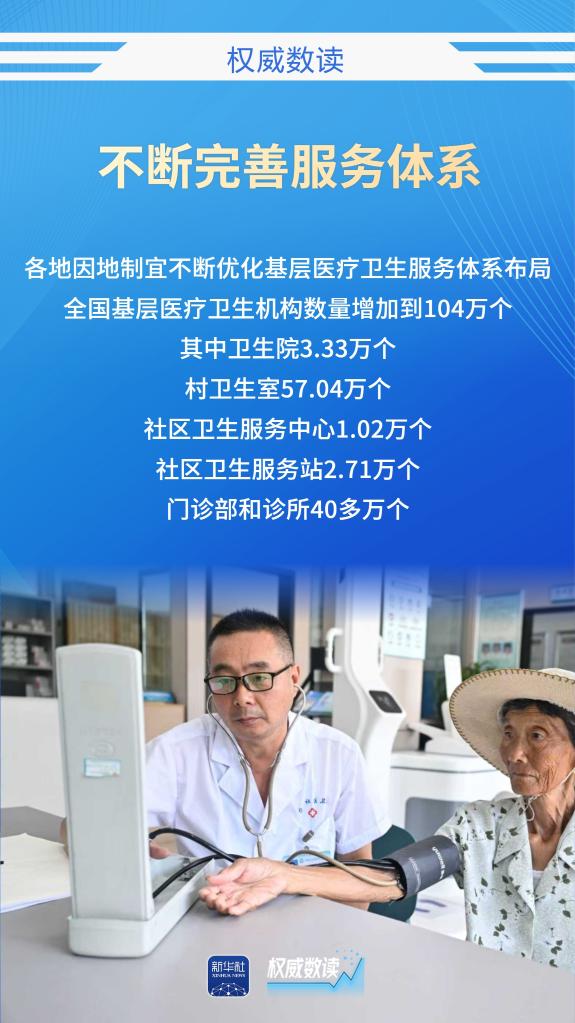
Core Viewpoint - The National Health Commission emphasizes the progress and effectiveness of grassroots medical and health services, aiming to provide convenient and efficient healthcare close to home for the public [1] Group 1: Service System Improvement - The number of grassroots medical and health institutions has increased to 1.04 million, including 33,300 health centers, 570,400 village clinics, 10,200 community health service centers, 27,100 community health service stations, and over 400,000 outpatient departments and clinics [2] - Localities are continuously optimizing the layout of grassroots medical and health service systems according to their specific conditions [2] Group 2: Service Capability Enhancement - As of the end of 2024, there are 2.078 million licensed physicians and assistant physicians in grassroots medical institutions, with over 90% of township health centers and community health service centers meeting basic service capability standards [5] - 93% of grassroots medical institutions can provide pediatric diagnosis and treatment services, and the average number of drug varieties equipped in township health centers and community health service centers has reached around 300 [5] Group 3: Service Model Optimization - 95% of community health service centers and township health centers can provide long-term prescriptions for chronic diseases, and they also offer extended service hours or holiday clinics [7] - 85% of community health service centers and township health centers provide weekend vaccination services, with several provinces like Shanghai, Zhejiang, Jiangsu, and Tianjin implementing family bed services [7] Group 4: Integrated County Medical Community Development - A total of 3,099 tightly-knit county medical communities have been established across 2,199 counties (cities, districts), serving as a key approach to promote a hierarchical medical system [10] - Approximately 18,000 personnel from urban hospitals will be dispatched to support 1,750 counties, and 80% of counties have initially established resource-sharing centers for imaging, electrocardiograms, and testing [10] - Over 97% of administrative villages with village clinics are included in the medical insurance designated coverage [10]

国家卫健委:基层医生四年增加54万
第一财经· 2025-11-27 11:16
Core Viewpoint - The article discusses the significant improvements in grassroots healthcare services in China, particularly addressing the "lack of doctors and medicines" issue, with grassroots medical institutions now accounting for over 50% of the national medical treatment volume since the 14th Five-Year Plan began [3][5]. Summary by Sections Grassroots Healthcare Institutions - Grassroots healthcare institutions, including community health service centers and township hospitals, have seen a consistent treatment volume share of over 50% nationally [3]. - The average number of drug varieties available in township hospitals and community health service centers has reached around 300 [3]. Drug Accessibility and Management - The National Health Commission has been working to expand the types of drugs available at grassroots levels and improve the coordination between grassroots and higher-level medical institutions [3]. - Nearly half of the counties have established centralized pharmacies, with the number of drug varieties in county medical communities generally reaching between 800 and 1200 [4]. Medical Personnel and Training - As of the end of 2024, there are 2.078 million licensed physicians in grassroots healthcare institutions, an increase of 542,000 since 2020 [5]. - The proportion of healthcare personnel with college degrees or higher in township hospitals and community health service centers has risen significantly, from 65% and 81.4% in 2020 to 77.4% and 88.2% in 2024, respectively [5]. Healthcare System Structure - The graded diagnosis and treatment system is a fundamental part of China's healthcare system, with 3,099 tightly-knit county medical communities established, covering a population of 924 million [5]. - The National Health Commission has been promoting the "downward transfer of personnel" to enhance grassroots medical capabilities, including sending urban hospital staff to assist county hospitals [6]. Specialized Services and Initiatives - The National Health Commission has initiated the "Hundred-Thousand-Ten Thousand Project" to improve clinical specialty services in over 10,000 city and county hospitals, enhancing previously weak specialties like oncology and psychiatry [6]. - A three-year action plan for pediatric and mental health services has been launched, with over 93% of grassroots healthcare institutions now able to provide pediatric services, exceeding the initial target [6].

国家卫健委:基层医生四年增加54万
Di Yi Cai Jing· 2025-11-27 10:15
Core Insights - The "lack of doctors and medicines" issue in grassroots healthcare institutions, which account for over 50% of national medical services, has been effectively alleviated [1] - The National Health Commission (NHC) has reported that the proportion of medical services provided by grassroots healthcare institutions has consistently remained above 50% since the start of the 14th Five-Year Plan [1] Summary by Sections Grassroots Healthcare Development - The NHC has expanded the variety of medicines available at grassroots healthcare institutions, with an average of around 300 types of medicines now equipped in township hospitals and community health service centers [1] - A recent policy reform aims to enhance the accessibility of essential medicines for chronic and common diseases by improving the coordination of drug supply between different levels of healthcare [1] County-Level Medical Community - Nearly half of the counties have established centralized pharmacies, with the number of medicines available in county medical communities generally reaching between 800 to 1200 types, significantly improving grassroots medication access [2] - Over 97% of administrative villages with village clinics are now covered by medical insurance, facilitating medication access and reimbursement for rural residents [2] Workforce and Capability Enhancement - As of the end of 2024, there are 2.078 million licensed physicians in grassroots healthcare institutions, an increase of 542,000 since 2020 [2] - The proportion of healthcare personnel with college degrees or higher in township hospitals and community health service centers has risen from 65% and 81.4% in 2020 to 77.4% and 88.2% respectively by 2024 [2] Support and Resource Allocation - The NHC has dispatched approximately 180,000 personnel to support 1,750 counties, with over 70,000 personnel stationed in grassroots facilities for more than six months this year [3] - The "Hundred-Thousand-Ten Thousand Project" aims to enhance clinical specialties in over 10,000 county-level hospitals, improving service capabilities in previously weak specialties such as oncology and psychiatry [3] Pediatric and Mental Health Services - The NHC has initiated a three-year action plan for pediatric and mental health services, with a goal for over 90% of grassroots healthcare institutions to provide pediatric services by the end of this year, which has already been exceeded with 93% now offering such services [3]
2024年县域内基层医疗卫生机构诊疗人次占比63.4%
Zhong Guo Xin Wen Wang· 2025-11-27 09:57
Core Insights - The proportion of outpatient visits at grassroots medical institutions in counties reached 63.4% in 2024, an increase of 0.5 percentage points from the previous year, indicating a growing preference among rural residents for local healthcare services [1] - The National Health Commission (NHC) emphasizes the importance of building county-level medical communities to enhance the tiered diagnosis and treatment system, which aims to improve healthcare accessibility and resource sharing [1] Group 1: Policy and Implementation - The NHC adheres to the policy of "strengthening counties and grassroots," continuously enhancing the service capacity of county medical communities to better meet the demand for convenient healthcare [2] - Key measures include strengthening the capabilities of leading hospitals, with over 10,000 clinical key specialties established in city and county hospitals, significantly improving previously weak specialties such as oncology and psychiatry [2] - The NHC has implemented a tiered support system, with urban hospitals sending approximately 180,000 personnel to support 1,750 county hospitals in 2024, and over 70,000 personnel have been stationed in grassroots facilities for more than six months [2] Group 2: Technological and Resource Development - The NHC promotes the integration of "artificial intelligence" in grassroots healthcare, with 80% of counties having established resource-sharing centers for imaging, ECG, and laboratory tests, leading to over 68 million remote medical imaging diagnoses this year [3] - The establishment of unified drug lists and collaborative medication use across county, township, and village levels has improved access to medications, with nearly half of the counties having set up central pharmacies that stock 800 to 1,200 types of drugs [3] - Over 97% of administrative villages with health stations are now covered by medical insurance, facilitating easier access to medications and reimbursements for rural residents [3]