
半导体设计

Search documents
芯片巨头,加码印度
半导体行业观察· 2026-02-08 03:29
Group 1 - Qualcomm announced a significant breakthrough in chip design in India, completing the 2nm semiconductor design, marking an important milestone in the country's semiconductor ecosystem [2][3] - The achievement highlights Qualcomm's strong global engineering capabilities and collaboration among its R&D centers in Bangalore, Chennai, and Hyderabad, which are among the most advanced engineering teams outside the US [2][4] - Indian officials emphasized that this milestone reflects India's growing importance as a key center for advanced semiconductor development and aligns with the vision of building a globally competitive semiconductor industry [3][4] Group 2 - Texas Instruments (TI) opened a new R&D center in Bangalore, celebrating its 40th anniversary in India, which aims to enhance collaboration in chip design [5][6] - The new center, covering 550,000 square feet, includes advanced testing facilities and multiple integrated circuit design labs, showcasing TI's commitment to semiconductor innovation and talent development in India [5][6] - TI's investment reinforces India's position as an innovative country and highlights the company's long-term commitment to leveraging local talent to strengthen its leadership in semiconductor technology [6]



希荻微预计2025年净利润同比减亏 丰富产品矩阵深化业务布局
Zheng Quan Ri Bao Wang· 2026-01-30 12:14
Core Viewpoint - The company, Hidi Microelectronics Group Co., Ltd., anticipates a net loss of between 102 million to 147 million yuan for the year 2025, which represents a reduction in losses compared to the previous year [1]. Group 1: Financial Performance - The expected net loss for 2025 is projected to decrease by 144 million to 189 million yuan compared to the same period last year, indicating an improvement in financial performance [1]. - The company's revenue is expected to show significant growth due to an increase in demand from end customers in the consumer electronics market [1]. - The gross profit is anticipated to increase compared to the previous year, driven by the expansion of the company's overall business scale and effective integration of the upstream supply chain [1]. Group 2: Product Lines and Market Trends - The audio coil motor driver chip product line, part of the smart visual perception business, has seen a notable increase in revenue due to the gradual realization of self-commissioned production [1]. - The newly added sensor chip product line, introduced in August 2024, is also contributing to revenue growth for 2025 [1]. - The market is gradually recovering, leading to a stabilization in demand and a reduction in inventory impairment risks, resulting in a decrease in the amount of asset impairment provisions compared to the previous year [1]. Group 3: Company Overview - Hidi Microelectronics is a semiconductor and integrated circuit design company, primarily engaged in the research, design, and sales of analog integrated circuits and mixed-signal integrated circuits [2]. - The company's main products serve the consumer electronics and automotive electronics sectors, including DC/DC chips, lithium battery charging management chips, port protection and signal switching chips, power conversion chips, audio coil motor driver chips, and sensor chips [2].

豪威集团,港股上市
半导体芯闻· 2026-01-12 10:23
Core Viewpoint - The article highlights the successful listing of OmniVision Technologies on the Hong Kong Stock Exchange, marking a significant milestone for the company as it enters a dual capital platform phase with a market capitalization exceeding HKD 150 billion [1]. Group 1: Company Overview - OmniVision Technologies is a fabless semiconductor design company with a global R&D center and business network, focusing on sensor solutions, analog solutions, and display solutions for various applications including smartphones, automotive electronics, and IoT [1]. - The company plans to utilize 70% of the raised funds for key technology R&D, 10% for global market penetration and business expansion, 10% for strategic investments or acquisitions, and 10% for working capital and general corporate purposes [1]. Group 2: Business Segments - The core business of OmniVision is the image sensor solutions, particularly CMOS image sensors, where it ranks as the third-largest digital image sensor supplier globally with a market share of 13.7% [2]. - The company is also the third-largest supplier of smartphone CIS and the largest supplier of automotive CIS, holding market shares of 10.5% and 32.9% respectively [2]. - The display solutions include products like LCD-TDDI and OLED DDIC, while the analog solutions encompass PMIC, TVS, and MOSFET products, contributing to a diversified product matrix [2]. Group 3: Financial Performance - OmniVision's revenue has shown consistent growth, with figures of CNY 20 billion, CNY 20.984 billion, and CNY 25.7 billion for the years 2022, 2023, and 2024 respectively, alongside gross profits of CNY 4.741 billion, CNY 4.184 billion, and CNY 7.239 billion [3]. - The gross profit margins for the same years were 23.7%, 19.9%, and 28.2%, indicating an improvement in profitability [3]. - For the first nine months of 2025, the company reported revenue of CNY 21.783 billion, a year-on-year increase of 15.2%, and a net profit of CNY 3.21 billion, reflecting a growth of 35% [3].

市值超1400亿,中国CIS龙头赴港上市
Sou Hu Cai Jing· 2026-01-12 03:48
Core Viewpoint - OmniVision Technologies, a leading semiconductor company, successfully listed on the Hong Kong Stock Exchange, raising approximately HKD 4.8 billion through the issuance of 45.8 million H-shares at HKD 104.80 per share, marking a significant step in its "A+H" strategy [2][8]. Group 1: Listing Details - The company attracted 10 cornerstone investors, including notable firms such as Hillhouse Capital and UBS, with a total subscription amount of HKD 2.174 billion, accounting for 45.28% of the offering [2]. - On its first trading day, OmniVision's stock opened at HKD 108 and reached HKD 111.9, reflecting a 6.77% increase, with a total market capitalization of HKD 140.488 billion [2][3]. Group 2: Company Background - OmniVision, formerly known as Weir Shares, was founded in 2007 by Yu Renrong and has evolved into a major player in the global image sensor market, ranking third in digital image sensor solutions with a market share of 13.7% as of 2024 [4]. - The company has a strong presence in the automotive image sensor market, holding the largest share at 32.9% [4]. Group 3: Business Operations - OmniVision operates three main business lines: image sensor solutions, display solutions, and simulation solutions, catering to high-growth sectors such as smartphones, automotive, medical, and security [5]. - Revenue figures for the company show a growth trajectory, with revenues of RMB 20.04 billion, RMB 20.98 billion, and projected RMB 25.71 billion for 2022, 2023, and 2024 respectively, alongside a notable increase in net profit from RMB 0.951 billion in 2022 to RMB 3.279 billion in 2024 [5][6]. Group 4: Revenue Composition - The majority of OmniVision's revenue comes from semiconductor design sales, with contributions from image sensor solutions consistently above 80% from 2022 to 2025 [6]. - The sales of CIS products represent a significant portion of the image sensor solutions revenue, maintaining a share of over 90% during the same period [6]. Group 5: Future Plans - The funds raised from the IPO will be allocated towards enhancing R&D in key technologies, expanding global market penetration, and pursuing strategic investments and acquisitions to strengthen the company's competitive edge [8]. - The listing is part of OmniVision's strategy to accelerate internationalization and improve its overseas business capabilities, aiming to connect with international capital markets [8].
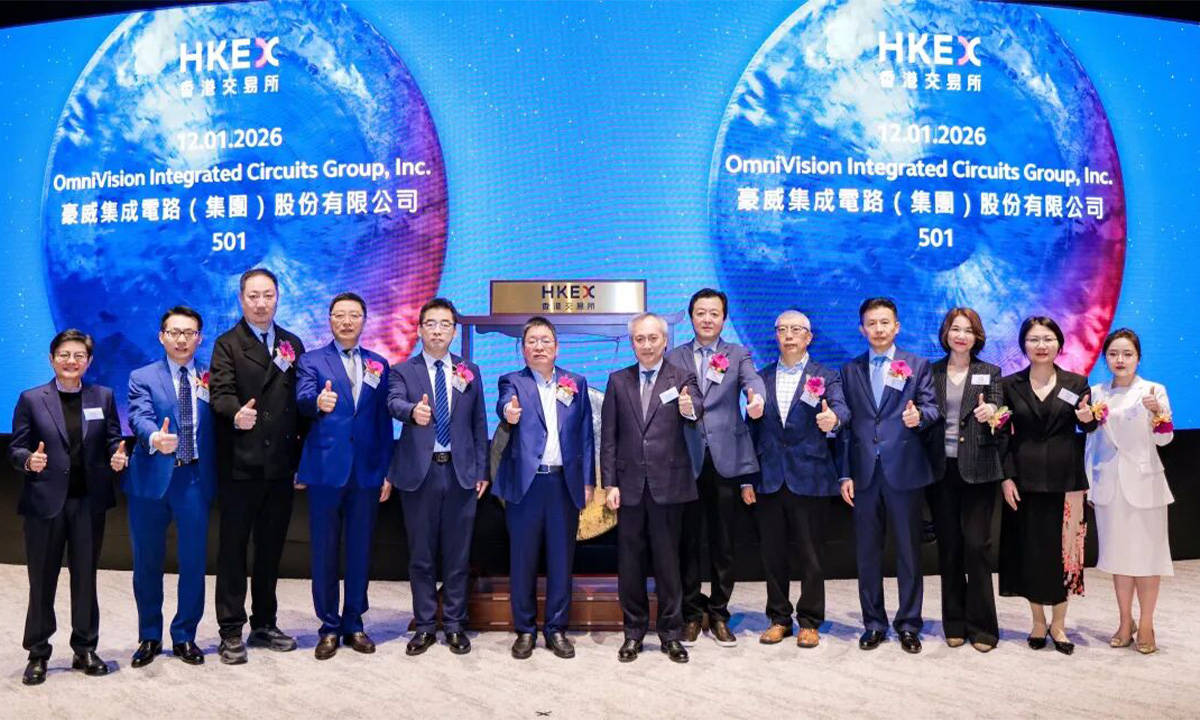
豪威开启招股:获2.79亿美元基石投资 1月12日上市 虞仁荣再敲钟
Sou Hu Cai Jing· 2026-01-01 03:09
Core Viewpoint - OmniVision Technologies, Inc. (referred to as "OmniVision Group") has initiated its IPO process, planning to list on the Hong Kong Stock Exchange on January 12, 2026, with a target of raising approximately HKD 4.693 billion for various strategic investments and operational purposes [3][6]. Group 1: IPO Details - OmniVision Group plans to issue 23.263 million H-shares, with 10% allocated for public offering in Hong Kong and the remaining for international placement. The offering price is set at HKD 104.8 per share, with an entry fee of HKD 10,585.69 for 100 shares [3]. - The cornerstone investors include Wildlife Willow, UBS AM Singapore, and others, collectively subscribing to USD 279.38 million [4]. Group 2: Fund Utilization - The expected net proceeds of HKD 4.693 billion will be allocated as follows: 70% for R&D in key technologies over the next 5 to 10 years, 10% for global market penetration and business expansion, approximately 10% for strategic investments or acquisitions, and about 10% for working capital and general corporate purposes [6]. Group 3: Company Background and Financials - OmniVision Group, previously known as Weir Shares, was renamed in June 2025 after acquiring three major image sensor chip design companies in 2019, establishing a business framework around sensor solutions, display solutions, and analog solutions [8][10]. - The company reported revenues of RMB 20 billion, RMB 20.984 billion, and RMB 25.707 billion for the years 2022, 2023, and 2024, respectively, with gross profits of RMB 4.741 billion, RMB 4.184 billion, and RMB 7.239 billion, indicating a gross margin of 23.7%, 19.9%, and 28.2% [11][12]. - For the first nine months of 2025, OmniVision Group achieved revenues of RMB 21.783 billion, a year-on-year increase of 15.2%, and a net profit of RMB 3.21 billion, up 35% [13]. Group 4: Leadership and Shareholding Structure - The founder of OmniVision Group, Yu Renrong, controls 33.6% of the company's shares. The executive directors include Yu Renrong, Wu Xiaodong, and others [15][21]. - As of September 30, 2025, the shareholding structure includes significant stakes held by various institutional investors, with Yu Renrong's shareholding being 27.4% [21][25].
豪威集团将于1月12日正式登陆港交所 最高募资总额近48亿港元
Zheng Quan Ri Bao Wang· 2025-12-31 09:13
Core Viewpoint - The company, OmniVision Technologies, is launching its IPO on the Hong Kong Stock Exchange to enhance its international strategy and funding capabilities, aiming to raise nearly HKD 4.8 billion for R&D and global market expansion [1][3]. Group 1: IPO Details - OmniVision plans to issue 45.8 million H-shares, with 10% allocated for Hong Kong public offering and 90% for international placement, at a maximum price of HKD 104.80 per share [1]. - The IPO will run from December 31, 2025, to January 7, 2026, with the listing date set for January 12, 2026, under the stock code "0501.HK" [1]. - The cornerstone investors include 10 entities from various sectors, with a total subscription amount of HKD 2.174 billion, accounting for 45.28% of the offering [1]. Group 2: Company Overview - OmniVision is a global fabless semiconductor design company, primarily focused on CMOS image sensors (CIS), and operates in three main business lines: image sensor solutions, display solutions, and analog solutions [2]. - The company is the third-largest digital image sensor supplier globally, with a market share of 13.7% as of 2024 [2]. - In the first three quarters of 2025, OmniVision reported revenue of CNY 21.783 billion, a year-on-year increase of 15.20%, and a net profit of CNY 3.210 billion, up 35.15% [2]. Group 3: Strategic Goals - The funds raised from the IPO will be directed towards R&D investments and global market penetration, supporting the company's expansion in high-growth sectors [3].

【IPO追踪】又一家半导体龙头来了!豪威集团拟净筹47亿港元
Sou Hu Cai Jing· 2025-12-31 08:34
Core Viewpoint - The article discusses the IPO of two leading semiconductor companies from the A-share market, namely Zhaoyi Innovation and OmniVision Technologies, on the Hong Kong Stock Exchange, highlighting their fundraising plans and market positioning. Group 1: IPO Details - OmniVision Technologies plans to issue approximately 45.8 million H-shares globally, with 458,000 shares (about 10%) allocated for public offering in Hong Kong and 41.22 million shares (about 90%) for international offering, along with a 15% over-allotment option [2][3] - The maximum offer price is set at HKD 104.80 per share, potentially raising a net amount of approximately HKD 4.693 billion if the over-allotment option is not exercised [2][3] - The IPO subscription period is from December 31 to January 7, 2026, with shares expected to be listed on January 12, 2026, and the entry fee for one board lot of 100 shares is HKD 10,585.69 [3] Group 2: Fund Allocation - Approximately 70% of the raised funds will be allocated for investment in key technology research and development over the next 5 to 10 years [2][3] - About 10% will be used to enhance global market penetration and business expansion, while another 10% is earmarked for strategic investments and/or acquisitions that can create synergies with existing operations [2][3] - The remaining 10% will be allocated to working capital and general corporate purposes [2][3] Group 3: Company Overview - OmniVision Technologies is a global fabless semiconductor design company providing image sensor solutions, display solutions, and analog solutions for high-growth industries such as smartphones, automotive, medical, security, and emerging markets [4] - The company is the third-largest digital image sensor supplier globally, with a market share of 13.7% as of 2024, and is recognized as the largest supplier of CMOS image sensors (CIS) in China and the largest automotive CIS supplier worldwide [5] Group 4: Financial Performance - The company's revenue for the years 2022 to 2024 and the first half of 2025 is reported as RMB 20.04 billion, RMB 20.98 billion, RMB 25.71 billion, and RMB 13.94 billion respectively, with profits of RMB 0.951 billion, RMB 0.544 billion, RMB 3.279 billion, and RMB 2.020 billion during the same periods [6]
豪威集团于12月31日至1月7日招股,获基石投资认购约2.79亿美元
Zhi Tong Cai Jing· 2025-12-30 23:32
Core Viewpoint - The company, OmniVision Technologies, is set to launch an initial public offering (IPO) of 45.8 million H-shares, with a share price of HKD 104.8, aiming to raise approximately HKD 4.693 billion for strategic investments and business expansion [1][4]. Group 1: Company Overview - OmniVision is a global fabless semiconductor design company, primarily known for its CMOS image sensors (CIS) [1]. - The company operates in three main business lines: image sensor solutions, display solutions, and analog solutions, targeting high-growth industries such as smartphones, automotive, medical, and security [1]. Group 2: Market Position and Financial Performance - According to Frost & Sullivan, OmniVision ranks as the third-largest digital image sensor supplier globally, holding a market share of 13.7% as of 2024 [2]. - Revenue increased from RMB 20 billion in 2022 to RMB 21 billion in 2023, representing a growth of 4.7%, and is projected to grow by 22.5% to RMB 25.7 billion in 2024 [2]. - For the first half of 2025, revenue rose by 15.3% to RMB 13.9 billion compared to RMB 12.1 billion in the same period of 2024 [2]. Group 3: Strategic Investments and Use of Proceeds - The estimated net proceeds of approximately HKD 4.693 billion from the IPO will be allocated as follows: 70% for R&D in key technologies over the next 5-10 years, 10% for enhancing global market penetration and business expansion, 10% for strategic investments and acquisitions, and 10% for working capital and general corporate purposes [4]. Group 4: Cornerstone Investors - The company has entered into cornerstone investment agreements with several investors, including Wildlife Willow Limited and UBS AM Singapore, committing to purchase shares worth approximately USD 279 million [3]. - The participation of cornerstone investors is expected to enhance the company's visibility and reflects confidence in its business prospects [3].
A股市场大跌原因找到了,高盛给出九大理由,历史大底信号再次闪现?
Sou Hu Cai Jing· 2025-11-23 16:19
Market Overview - On November 21, 2025, the A-share market experienced a significant decline, with the Shanghai Composite Index dropping 2.45% and falling below the 3900-point mark, while the Shenzhen Component Index and ChiNext Index fell 3.41% and 4.02%, respectively [1][2] Market Performance - Over 5000 stocks in the market declined, with only around 300 stocks rising. Nearly 2500 stocks saw declines exceeding 3%, and trading volume surged to 1.78 trillion yuan, marking the largest single-day drop since April 7 [2][4] - The technology sector was particularly hard hit, with an average decline of 7.5% among ChiNext constituents, and major stocks like CATL, SMIC, and Industrial Fulian contributing significantly to the index's drop [5][10] Capital Flow - There was a net outflow of 645.1 billion yuan from major funds, the highest in three months, with significant outflows from the semiconductor and power equipment sectors [6][7] - Retail investors also saw a net outflow of 218.5 billion yuan, indicating a synchronized sell-off with institutional investors [7] Sector Analysis - The lithium battery sector faced a collective collapse, with lithium carbonate futures hitting the limit down and spot prices dropping 5% to 178,000 yuan per ton [9] - Defensive sectors like banking and public utilities showed resilience, with blue-chip stocks like Industrial and Construction Bank experiencing slight increases [11] Structural Issues - The extreme concentration of public funds in the technology sector, particularly in AI, semiconductors, and lithium batteries, was identified as a core internal factor for the market crash, with some funds exceeding their industry holding limits [13] - The valuation and performance divergence in the technology sector was highlighted, with average P/E ratios significantly higher than the growth rates of earnings [13] External Influences - The decline in the U.S. stock market, particularly the Nasdaq's drop of 2.15%, was a direct trigger for the A-share market's fall, exacerbated by concerns over the sustainability of AI profits [18][20] - The market's reaction to U.S. economic data, which indicated a higher-than-expected job growth but also a rising unemployment rate, led to a shift in expectations regarding Federal Reserve interest rate cuts [18] Historical Context - Goldman Sachs noted historical parallels with previous market bottoms, suggesting that similar panic events occurred on April 7, 2020, and April 7, 2025, both of which were followed by significant market recoveries [22][26] Investment Opportunities - Despite the overall market decline, certain sectors showed resilience, such as the photolithography sector benefiting from export restrictions and some AI application stocks that performed well [29] - Defensive sectors, including banking and public utilities, attracted capital due to their low valuations and high dividend yields [29]
豪威集团:虞仁荣剩余累计质押股份约为1.72亿股
Mei Ri Jing Ji Xin Wen· 2025-10-28 11:14
Group 1 - The controlling shareholder of Haowei Group, Mr. Yu Renrong, holds approximately 333 million shares, accounting for 27.64% of the total share capital [1] - After the recent pledge release, Mr. Yu has approximately 172 million shares pledged, representing 51.59% of his holdings [1] - The joint action party, Shaoxing Wehao Equity Investment Fund, holds about 74.13 million shares, which is 6.15% of the total share capital, with 15.86 million shares pledged, accounting for 21.39% of their holdings [1] Group 2 - The total shares held by the controlling shareholder and joint action parties amount to approximately 409 million shares, representing 33.87% of the total share capital [1] - Following the pledge release, the total pledged shares by Mr. Yu and his joint action parties are approximately 188 million shares, which is 45.99% of their total holdings and 15.58% of the total share capital [1] - For the first half of 2025, Haowei Group's revenue composition shows that semiconductor design and sales account for 84.12%, while electronic component agency and sales account for 31.84%, with inter-segment offsets at -15.96% [1] Group 3 - As of the latest report, Haowei Group's market capitalization is 164.8 billion yuan [2]