国有资产流失

Search documents
武商集团:市值波动受众多外部因素影响
Zheng Quan Ri Bao Wang· 2026-01-15 12:11
Core Viewpoint - The fluctuation in market value of Wushang Group (000501) is influenced by macroeconomic factors, industry cycles, and market sentiment, which is considered a normal market phenomenon and does not directly reflect the actual value change of state-owned assets [1] Group 1 - The company emphasizes that the loss of state-owned assets typically refers to significant and irreversible reductions due to violations or major negligence, which is not the case here [1] - Even in the face of cyclical profit declines or short-term market value fluctuations, if the company operates steadily and makes compliant decisions, it usually does not involve the issue of state-owned asset loss [1] - As a state-owned listed enterprise, the company prioritizes the safeguarding of state-owned assets as a core responsibility [1] Group 2 - The company's financial statements have been audited by auditing institutions and have received standard unqualified opinions, indicating compliance with legal regulations and state-owned asset supervision requirements [1] - There are no indications of state-owned asset loss within the company's operations [1]

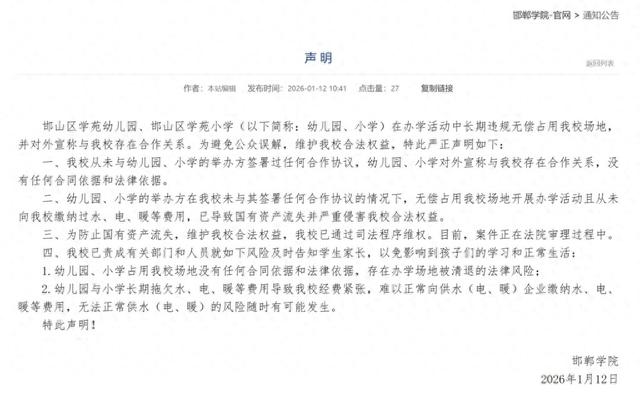
邯郸学院称被民办小学、幼儿园长期占用场地,已致国有资产流失
Xin Lang Cai Jing· 2026-01-12 11:47
1月12日,邯郸学院公开发布声明,称民办的邯山区学苑幼儿园、邯山区学苑小学违规占用场地且拖欠 水、电、暖费用。 三、为防止国有资产流失,维护邯郸学院合法权益,学院已通过司法程序维权。目前,案件正在法院审 理过程中。 四、邯郸学院已责成有关部门和人员就如下风险及时告知学生家长,以免影响到孩子们的学习和正常生 活:幼儿园、小学占用邯郸学院场地没有任何合同依据和法律依据,存在办学场地被清退的法律风险; 幼儿园与小学长期拖欠水、电、暖等费用导致邯郸学院经费紧张,难以正常向供水(电、暖)企业缴纳 水、电、暖等费用,无法正常供水(电、暖)的风险随时有可能发生。 邯郸学院是一所公办全日制普通本科院校,位于河北省邯郸市邯山区学院北路530号。办学历史始于 1905年成立的邯郸县初级师范学堂,1982年升格为邯郸师范专科学校,2004年升格为本科院校并定名为 邯郸学院,2024年挂牌附属小学、初级中学,2025年接收设立附属高级中学,实现大中小学办学功能一 体贯通。 智通财经注意到,上述声明中提到的邯山区学苑幼儿园、邯山区学苑小学均为民办教育机构。2025年12 月23日,邯山区民政局公布的《关于区属社会组织2024年度检查情 ...

低价转让股权引国有资产流失质疑 港股IPO企业芯德半导体回应
Sou Hu Cai Jing· 2026-01-12 09:38
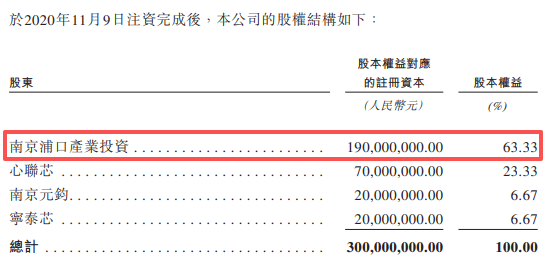
Core Viewpoint - Jiangsu Xinde Semiconductor Technology Co., Ltd. is preparing for an IPO on the Hong Kong Stock Exchange, with concerns raised about the legitimacy of its equity transfers involving state-owned assets [1][12]. Group 1: Company Background - Xinde Semiconductor is a semiconductor packaging and testing solution provider, established in September 2020, focusing on advanced packaging technologies [2][13]. - The company has developed a range of packaging capabilities, including QFN, BGA, LGA, WLP, and 2.5D/3D technologies, and has accumulated significant technical experience in the field [2][13]. Group 2: Shareholding Structure - The largest shareholder group includes Zhang Guodong, Pan Mingdong, Liu Yixian, and two limited partnerships, Ningtai Xin and Ningpu Xin [2]. - In November 2020, Nanjing Pukou Industrial Investment Partnership became the largest shareholder with a 63.33% stake after investing 190 million RMB [3][9]. Group 3: Equity Transfer Issues - There have been multiple instances of equity being transferred at 1 RMB per registered capital, significantly lower than the market price, raising concerns about potential state asset losses [9][10]. - In 2023, Nanjing Pukou Industrial Investment transferred shares at 1 RMB per registered capital while the market price was around 5 RMB, indicating a substantial potential profit loss of up to 675 million RMB if priced at market rates [10][11]. Group 4: Financial Performance - Xinde Semiconductor has reported negative net profits during the reporting period, with figures of -360 million RMB, -359 million RMB, -377 million RMB, and -219 million RMB [17]. - The company's revenue growth rate has been declining, with a reported increase of only 22.1% in the first half of 2025, contrasting sharply with a 343.47% increase in total compensation for four executive directors [18]. Group 5: Future Outlook - The company aims to enhance its customer collaborations, expand production capacity, and improve technology to capture market opportunities, positioning itself for a successful IPO as a means to enhance value and financing channels [17][18].
济南“租客卖房”事件再添疑问:涉事房屋“卖”给政府时或虚增面积百余平
Xin Lang Cai Jing· 2025-12-19 07:27
济南"租客卖房"事件持续发酵。继对"租客何以卖房"的质疑市中区舜耕街道办回应其"只作表面审 查"后,16日"房东"再次发声:其800多平米的房子,被租客"卖"给政府时测出了1000多平米的面 积。"房东"认为,"租客"不仅卖了房子,而且涉事房屋在测绘过程中涉嫌虚增面积100余平方米诈补。 16日,王女士方面再次到舜耕街道办反映相关问题。街道办相关负责人表示,关于测绘面积问题,鲁贤 公司已审查,没有发现问题,测量是第三方公司进行的,如果测绘出了问题,是测绘公司的责任。就房 主认定问题,相关负责人表示,房主认定由鲁贤公司依程序认定,经街道办审核,街道办认为鲁贤公司 的认定没有问题。就虚测面积可能造成国有资产流失问题,街道办负责人表示不是政府拨款,是鲁贤公 司的(款项),是市场行为,不涉及国资流失。 但鲁贤公司对街道办的说法表示否认。同在16日,鲁贤公司郭姓负责人表示,协议、谈条件、委托第三 方测绘、评估、审计,都由舜耕街道办负责,补偿款来源为市中区财政,鲁贤公司按照区里要求和房主 签订协议,舜耕街道办向区财政申请的款项打到鲁贤公司,鲁贤公司根据舜耕街道办的支付指令打款, 让支给谁就支给谁,"如果多测量了面积,肯定 ...
国企太原重工七年财务造假背后:公司系统性溃败?管理层腐败审计机构致同失责
Xin Lang Zheng Quan· 2025-11-05 09:43
Core Viewpoint - Taiyuan Heavy Industry has been involved in financial fraud for over seven years, with underlying issues stemming from external auditors' negligence and internal governance failures [1] Group 1: Financial Fraud Details - The company was fined for financial fraud occurring between 2014-2018 and 2020-2021, with a total penalty of 16.95 million yuan, including lifetime market bans for key executives [1][2] - Fraudulent practices included premature revenue recognition and inflated project income, particularly in the 300MW wind power project in Heilongjiang [2][3] - In 2014, the company overstated revenue by 757 million yuan, representing 8.39% of reported revenue, and inflated profit by 155 million yuan, which was 763.89% of the reported profit [3] Group 2: Company Performance and Debt Issues - The company's revenue growth has been struggling since 2011, with significant declines in core business segments starting in 2014 [5][6] - High debt levels have been a persistent issue, with liabilities exceeding 80% of assets since 2014, peaking over 90% [8][10] - The company has relied heavily on external financing, with interest-bearing debt surpassing 10 billion yuan in recent years, leading to financial costs exceeding profits [10][12] Group 3: Governance and Internal Control Failures - External auditors, specifically Deloitte, failed to detect the fraud over seven years, raising questions about their accountability [13][15] - Internal governance issues are evident, with key executives being aware of the fraudulent activities yet failing to act [16] - Corruption among management, particularly involving the former general manager, has led to significant losses of state assets [17][18]

还原宗馥莉“接班”娃哈哈20个月的精心布局,国民品牌将走向何方?
Guan Cha Zhe Wang· 2025-10-11 05:21
Core Viewpoint - The resignation of Zong Fuli from her positions at Wahaha Group marks a significant shift in the company's leadership amidst ongoing family disputes and brand transitions following the death of founder Zong Qinghou [1][18]. Timeline of Events - February 25, 2024: Zong Qinghou, the founder and chairman of Wahaha Group, passed away [3]. - April 1, 2024: Zong Fuli became the legal representative of several Wahaha-affiliated companies [3]. - July 18, 2024: A resignation letter from Zong Fuli surfaced, indicating conflicts with shareholders [3]. - July 22, 2024: Wahaha publicly stated that Zong Fuli would continue her role [3]. - August 29, 2024: Zong Fuli fully took over Wahaha Group [3]. - September 1, 2024: Changes in the board of directors occurred, with several original executives exiting [3]. - September 10, 2024: Old employees initiated legal action regarding equity recovery from a 2018 employee stockholding meeting [3]. - December 2024: Wahaha announced a tender for maintenance and market deployment of 100,000 smart ice cabinets [3]. - February 12, 2025: Wahaha issued a statement regarding the transfer of 387 "Wahaha" trademarks, citing "historical legacy issues" [4]. - May 2025: Wahaha began expanding production while facing operational halts in 18 production lines [6]. - July 2025: Legal disputes among Zong Fuli and her siblings became public [7]. - August 1, 2025: A Hong Kong court froze overseas trusts, preventing Zong Fuli from misusing trust funds [8]. - September 12, 2025: Zong Fuli officially resigned from her positions at Wahaha Group [11]. - October 10, 2025: Wahaha confirmed Zong Fuli's resignation [1]. Brand Transition - Zong Fuli's resignation is linked to compliance issues with trademark usage, leading her to focus on her own brand "Wah Xiaozong" [1][12]. - An internal notice indicated that Wahaha might start using the new brand "Wah Xiaozong" from 2026 [12]. Family and Legal Issues - The ongoing legal disputes among Zong Fuli and her siblings have brought family conflicts to the forefront, raising concerns about the management of the company and its assets [16][17]. - The involvement of the Hangzhou municipal government in the disputes over Zong Qinghou's estate indicates potential implications for state-owned asset management [17].

宗馥莉辞职了,又有人假装自己胜利
Hu Xiu· 2025-10-11 03:59
Core Viewpoint - The article discusses the psychological issues of some internet users regarding the resignation of a prominent figure, emphasizing the need for a deeper understanding of historical context in discussions about state-owned assets and corporate governance [2][5][30]. Group 1: Company Insights - The resignation of a key figure,宗馥莉, has sparked discussions and speculation online, reflecting a broader trend of public sentiment and reaction to corporate changes [2][5]. - The article argues that the history of companies like Wahaha is often misunderstood, with claims of state asset loss being unfounded when historical context is considered [8][10][24]. - It highlights the importance of understanding the historical background and operational context of companies to avoid misinterpretations and unfounded accusations [16][32]. Group 2: Industry Context - The discussion touches on the broader implications of corporate governance and the relationship between state-owned assets and private enterprises, suggesting a mutual benefit in economic development [26][28]. - The article critiques the lack of historical awareness among some commentators, suggesting that many do not grasp the complexities of corporate history and the evolution of state-owned enterprises [29][31]. - It emphasizes the need for a nuanced approach to analyzing corporate issues, advocating for a thorough investigation into historical practices rather than relying solely on current data [34][36].
国资回归,剑南春即将重新洗牌?
Sou Hu Cai Jing· 2025-09-20 02:14
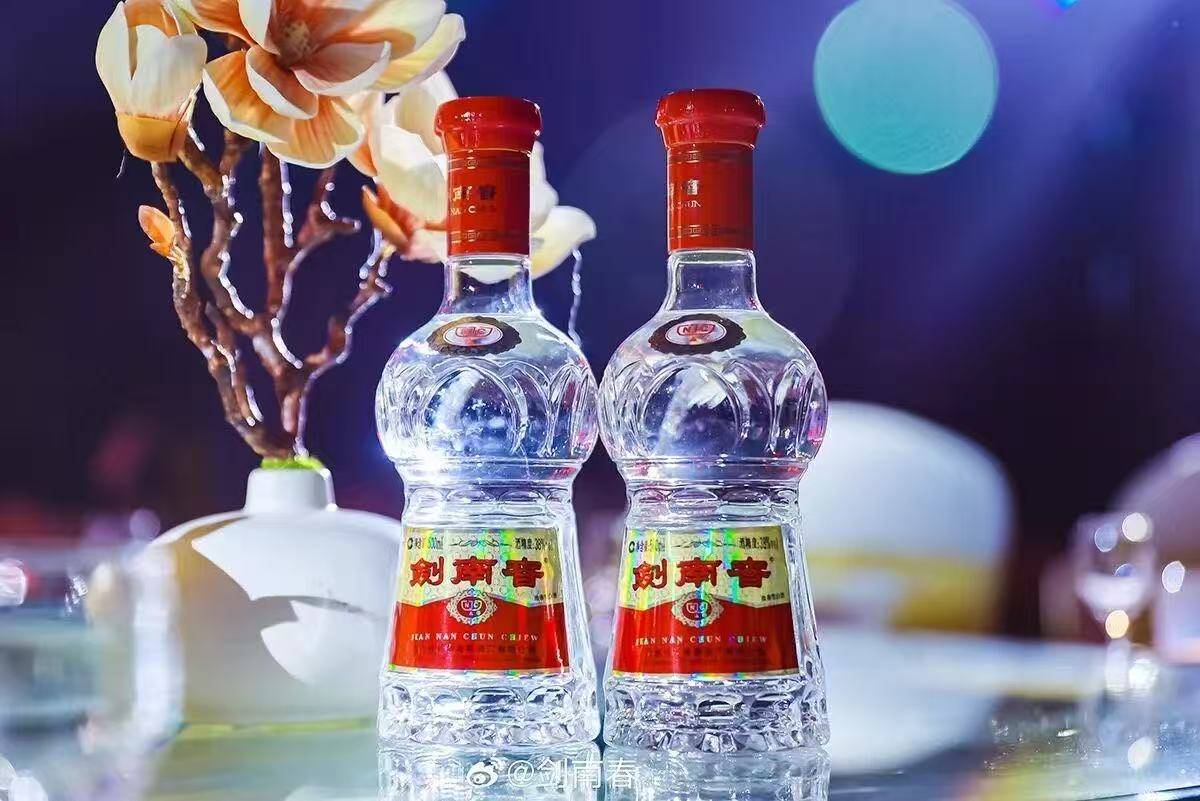
Core Viewpoint - The return of state-owned assets to Jian Nan Chun after 22 years of privatization indicates a significant reshuffling in the company's ownership structure, raising questions about past asset losses during its privatization process [2][4][11] Group 1: Ownership Changes - The Mianzhu State-owned Assets Administration Center acquired a 14.51% stake in Jian Nan Chun Group by contributing 137 million yuan, becoming the second-largest shareholder [2][11] - The registered capital of Jian Nan Chun increased from 808 million yuan to approximately 946 million yuan, confirming the legal status of state-owned assets in the company [2] Group 2: Historical Context - Jian Nan Chun underwent a tumultuous privatization process starting in 2003, which has been scrutinized for potential state asset losses [4][5] - The privatization led to significant internal conflicts, including a notable incident in 2012 where the then-chairman Qiao Tianming was attacked due to employee disputes over privatization rights [4][5] Group 3: Legal and Financial Implications - Qiao Tianming was implicated in a corruption case, leading to his conviction in 2018 for embezzling state assets, which confirmed the loss of state assets during the privatization [4][5] - The company has faced ongoing legal disputes regarding the legitimacy of trademark transfers, which are central to the current state-owned asset involvement [9][11] Group 4: Current Management Dynamics - Following Qiao Tianming's legal troubles, internal power struggles emerged, with Yang Dongyun and Qiao Yuzhu competing for control until Qiao Yuzhu eventually took over management in 2022 [5][7] - Despite the state-owned entity's entry, Qiao Tianming remains the chairman, while Qiao Yuzhu holds actual operational control, indicating a complex management landscape [11]
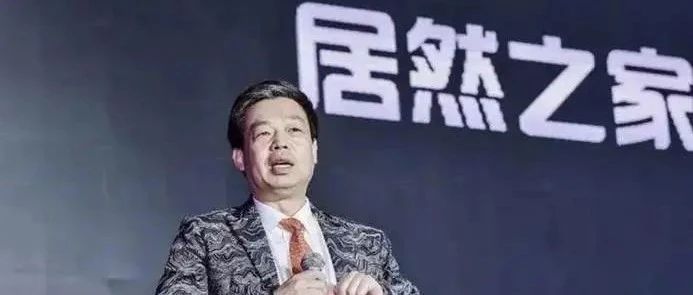
昔日湖北首富汪林朋坠楼身亡背后,一手主导“中国商业史上最离奇的蛇吞象交易”,时任多位湖北高官已先后落马! 汪林朋个人进账50亿元,国有资产流失争议不断
Sou Hu Cai Jing· 2025-07-29 12:25
Core Viewpoint - The tragic death of Wang Linpeng, the actual controller and chairman of Juran Zhijia, raises questions about the circumstances surrounding his demise, particularly in relation to the controversial backdoor listing of the company and the subsequent fall of several high-ranking officials in Hubei [1][4][8]. Company Summary - Wang Linpeng, the founder and actual controller of Juran Zhijia, passed away on July 27, 2025, shortly after being released from a three-month detention investigation [1][5]. - Juran Zhijia's backdoor listing through Wuhan Zhongshang in 2019 was marked by significant controversy, including allegations of state asset loss and rapid dilution of state-owned shares [6][8]. - The backdoor listing transaction was valued at 356.5 billion yuan, with Wuhan Zhongshang's market value at only 15 billion yuan at the time, leading to claims of it being one of the most bizarre transactions in Chinese commercial history [6][7]. - Following the listing, Wang Linpeng's companies cashed out approximately 5.2 billion yuan, with Wang personally benefiting close to 5 billion yuan [7]. Industry Context - The backdoor listing of Juran Zhijia has been scrutinized for its implications on state-owned asset management, particularly as multiple Hubei officials involved in the process have since been investigated and removed from their positions due to corruption allegations [8][10][11]. - The performance of Juran Zhijia post-listing has also been questioned, as the company failed to meet its profit commitments, triggering compensation mechanisms that raised further concerns about potential conflicts of interest [7].

曾言“没想退”,留置风波结束5天后,居然智家董事长汪林朋身故
凤凰网财经· 2025-07-28 13:38
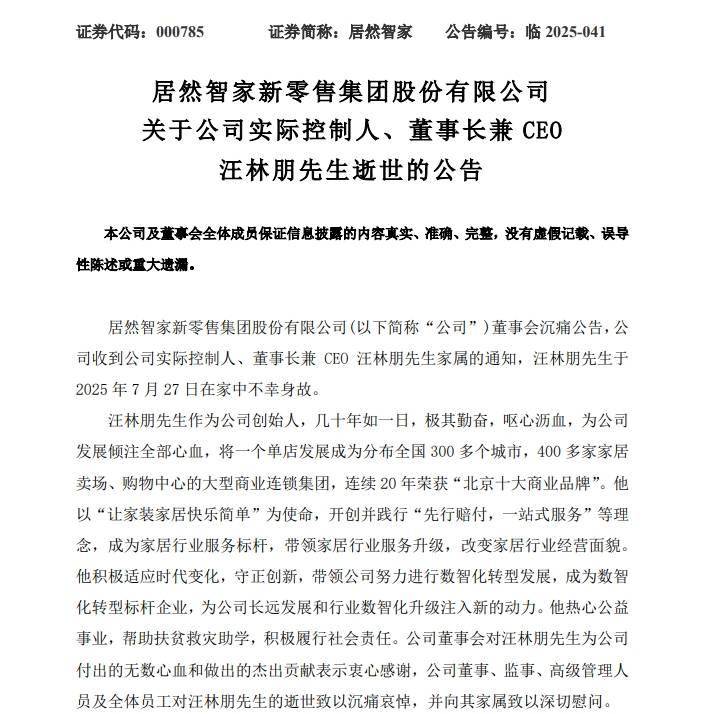
Core Viewpoint - The sudden death of Wang Linpeng, the chairman and CEO of Juran Smart Home, raises questions about the company's future and the circumstances surrounding his recent legal troubles [2][3][4]. Group 1: Legal Issues and Company Impact - Wang Linpeng was placed under a detention notice by the Wuhan Municipal Jianghan District Supervisory Committee on April 17, leading to significant market turmoil for Juran Smart Home [6][7]. - Following the detention, Wang's 100% ownership of Juran Smart Home shares (5.97% of total shares) was judicially frozen, causing the company's stock to plummet [8][10]. - After a brief return to his position, Wang's unexpected death occurred just five days later, further complicating the company's situation [11]. Group 2: Controversies and Financial Performance - Wang Linpeng's leadership has been marked by both significant achievements and controversies, including allegations of state asset loss and profit transfer during the company's reverse merger in 2019 [12][13]. - The reverse merger with Wuhan Zhongshang was valued at 35.65 billion, but it faced criticism for the rapid dilution of state-owned shares [12][13]. - Despite revenue growth from approximately 9 billion to 13 billion, the company's net profit has been declining since 2022, raising concerns among investors [16][17]. Group 3: Shareholder Actions and Market Reactions - In June 2023, Wang and his associates began large-scale share reductions, leading to suspicions about his intentions [16][17]. - Juran Holdings, controlled by Wang, sold shares worth approximately 4.7 billion through multiple transactions, further intensifying investor scrutiny [17]. - The company's stock experienced a significant drop following Wang's death, reflecting investor uncertainty about its leadership and future direction [4][11].