
美国政治极化

Search documents
一场演讲,难掩颓势
Xin Lang Cai Jing· 2026-02-25 23:03
Core Points - The article discusses President Trump's State of the Union address, highlighting his self-promotion in areas such as immigration, economy, and foreign policy, while facing significant media fact-checking and public skepticism [1][2][6] - The speech is characterized as a political spectacle, with intense partisan conflict evident during the event, reflecting the increasing polarization in American politics [3][4] Economic Performance - Trump claimed that inflation has decreased, oil prices have dropped, the stock market is performing well, and employment has increased, asserting that the U.S. is in a "golden age" [1] - However, media fact-checks revealed that the U.S. economic growth is projected to slow to 2.2% by 2025, the highest unemployment rate in January was 4.3%, and no state had an average gas price as low as $2.3 per gallon as claimed [1][6] Public Opinion - A joint poll indicated that approximately 60% of Americans disapprove of Trump's economic policies, suggesting a disconnect between his claims and public sentiment [2] - Trump's approval rating has dropped to 36%, down from 48% a year prior, with nearly 70% of respondents feeling that his administration has not adequately addressed core national issues [6] Political Dynamics - The address was marked by stark contrasts in reactions from Republican and Democratic lawmakers, with Republicans showing enthusiasm while Democrats remained largely unresponsive [3] - Some Democratic lawmakers chose to boycott the address, opting instead to participate in an alternative event highlighting the negative impacts of Trump's policies [3][4] Election Implications - The speech is viewed as an attempt to rally support ahead of the midterm elections, but analysts express doubt about its effectiveness given the rising public dissatisfaction with economic and immigration issues [6] - Experts suggest that the Republican Party may lose its slim majority in the House due to growing public discontent, particularly regarding economic pressures and aggressive immigration policies [6]
特朗普一场演讲,难掩颓势
Xin Lang Cai Jing· 2026-02-25 15:53
Core Points - President Trump's State of the Union address aimed to highlight his achievements in immigration, economy, and foreign policy, but faced significant media fact-checking and criticism [1][3] - The speech, lasting 107 minutes, was the longest on record and was characterized by a stark divide between Republican and Democratic responses [3][6] - Trump's claims about economic improvements and military engagements were contradicted by data showing rising unemployment and ongoing conflicts [3][6][9] Economic Performance - Trump asserted that inflation had decreased, oil prices had dropped, and employment had increased, claiming the U.S. was in a "golden age" [3][6] - However, data indicated that the U.S. economic growth rate is projected to slow to 2.2% by 2025, the lowest since 2020, and the unemployment rate rose to 4.3% year-on-year in January [3][9] - A CNN poll revealed that Trump's approval rating had fallen to 36%, down from 48% a year prior, indicating growing public dissatisfaction with his economic policies [9][11] Political Climate - The address highlighted the increasing polarization in U.S. politics, with the event becoming a platform for partisan attacks rather than a serious political discourse [6][8] - Democratic lawmakers staged protests during the speech, and many chose to attend an alternative event, indicating a significant divide in political engagement [7][8] - Analysts noted that the current political environment poses challenges for the Republican Party, with potential losses in the upcoming midterm elections due to public discontent over economic issues and immigration policies [11]

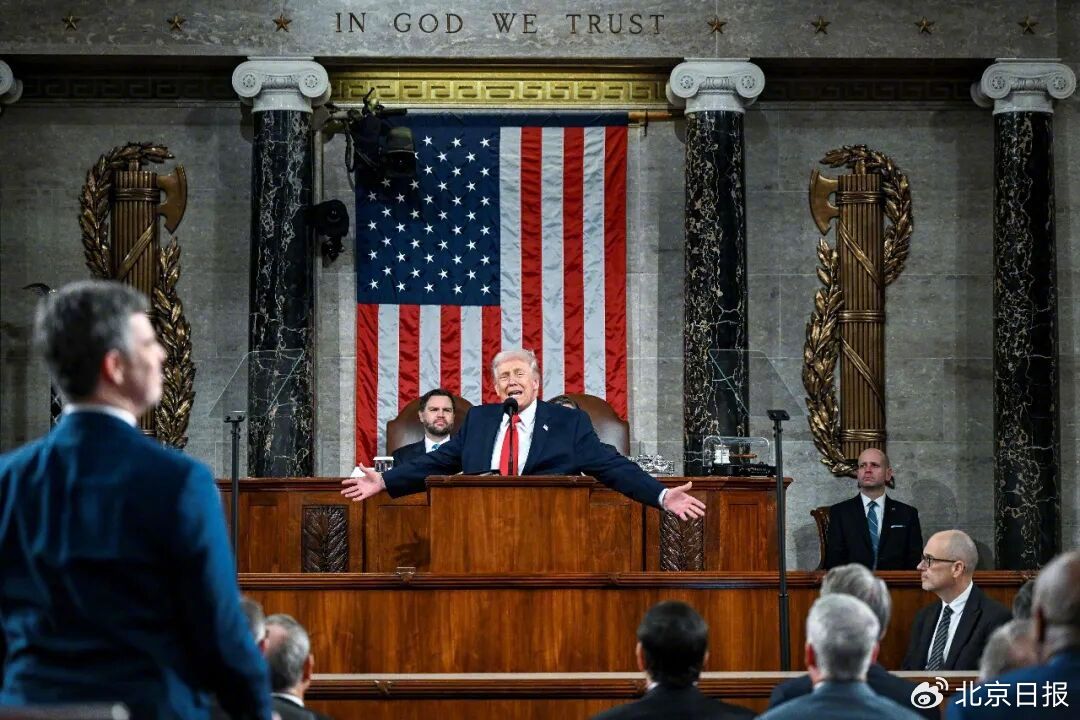
国际观察|一场演讲,难掩颓势
Xin Hua She· 2026-02-25 15:20
Core Viewpoint - The article discusses President Trump's State of the Union address, highlighting his attempts to showcase achievements in immigration, economy, and foreign policy, while facing significant media fact-checking and political opposition [1][2]. Economic Performance - Trump claimed that inflation has decreased, oil prices have dropped, the stock market is performing well, and employment has increased, asserting that the U.S. is in a "golden age" [2]. - However, media fact-checks revealed that the U.S. economic growth rate is projected to slow to 2.2% by 2025, the lowest since 2020, and the unemployment rate rose to 4.3% year-on-year in January [2][3]. - No state in the U.S. has an average gas price as low as the $2.3 per gallon claimed by Trump [2]. Public Opinion and Political Climate - A joint poll indicated that approximately 60% of Americans disapprove of Trump's economic policies, reflecting a lack of public support for his self-promotion [3]. - Trump's address coincided with setbacks in his tariff and immigration policies, suggesting a struggle to regain momentum in his presidency [3][6]. Political Division - The political environment surrounding the address was marked by heightened polarization, with Republicans and Democrats engaging in mutual criticism rather than substantive dialogue [4]. - The event featured dramatic moments, such as protests from Democratic representatives and a stark contrast in reactions from party members [4]. Election Implications - Trump's speech aimed to rally support for the upcoming midterm elections, but his approval rating has dropped to 36%, down from 48% a year prior [6]. - Concerns over economic pressures and dissatisfaction with immigration policies may jeopardize Republican chances in the midterms, with predictions of potential losses in the House of Representatives [6].
特朗普发表史上最长国情咨文演讲,夸夸其谈难掩政策挫败
2 1 Shi Ji Jing Ji Bao Dao· 2026-02-25 14:08
Group 1 - The core message of Trump's State of the Union address highlights a significant gap between his proclaimed economic achievements and the actual sentiments of the American public, reflecting the polarization in U.S. politics and the challenges faced by citizens [1][2] - Trump emphasized that the U.S. is in a "golden age," claiming it is "stronger, better, and richer than ever," while asserting that he has curbed inflation and driven stock prices to new highs [2][3] - Despite claims of economic improvement, a poll indicated that 55% of respondents believe the U.S. is in a worse state than a year ago, showcasing a disconnect between political rhetoric and public perception [3] Group 2 - Trump's key policies on tariffs and immigration are facing setbacks, with a recent Supreme Court ruling limiting his authority to impose large-scale tariffs, which he criticized as "completely wrong" [4][5] - The Department of Homeland Security is experiencing a partial shutdown due to a lack of consensus on funding, exacerbated by violent incidents involving immigration enforcement [4] - The complexities surrounding the potential refund of tariffs already paid by companies could lead to lengthy legal challenges, impacting the overall trade environment [5]
不是“停摆”就是在“停摆”路上,美国政治运作恶性循环
Xin Lang Cai Jing· 2026-02-05 05:51
Group 1 - The U.S. federal government experienced a partial "shutdown" for three days due to funding issues, which was resolved when the House of Representatives passed a funding bill that was later signed by President Trump [1] - The recent shutdown occurred just over two months after the longest shutdown in U.S. history [1] - Key departments affected by the shutdown included the Department of Homeland Security, Department of Defense, Department of Education, Department of Health and Human Services, Department of Housing and Urban Development, Department of Transportation, Department of State, Department of Labor, and Department of the Treasury, which collectively account for over three-quarters of the federal government's discretionary spending [4] Group 2 - The Department of Homeland Security became a focal point of controversy due to its enforcement actions, which have intensified public opposition, particularly following incidents involving the use of lethal force by enforcement personnel [5] - The funding for the Department of Homeland Security was temporarily extended for two weeks to allow for further negotiations between the two parties and the White House regarding improvements in the department's operations [6] - The recurring shutdowns reflect a deeper issue of political polarization and dysfunction within the U.S. political system, with 15 shutdowns occurring since 1980, often stemming from unresolved core disagreements between the two major parties [6][9]
当爱泼斯坦案成为一面照妖镜
Xin Lang Cai Jing· 2025-12-23 22:11
Group 1 - The recent release of documents related to the Epstein case has sparked political outrage, with Democrats accusing the White House of selective disclosure to divert attention, while Republicans view it as overdue justice revealing the corruption of elite figures [1][2] - The release of information appears to disproportionately target Democratic figures, raising concerns about "limited transparency" in political maneuvers, where partial truths are used to achieve specific political goals [1][2] - The involvement of the U.S. judicial system in political disputes has eroded its perceived independence and neutrality, with both parties accusing each other of weaponizing legal investigations for political gain [2][4] Group 2 - Media coverage of the Epstein case is polarized, with different outlets framing the narrative to align with their political biases, further complicating the public's understanding of the facts [3] - The Epstein case has become a tool for political conflict, reflecting a broader crisis of trust in American elite institutions and the rise of populism against established political figures [3][4] - The lack of public trust in government institutions poses significant challenges for effective governance, as political violence and extreme confrontations may become more likely in a highly polarized environment [4]

当不成总统了?美国投票结果出炉,特朗普开始下令
Sou Hu Cai Jing· 2025-12-17 06:15
Group 1 - The political landscape in the U.S. is increasingly chaotic, with significant events such as Trump's hardline stance on Venezuela, ongoing impeachment proceedings, and military leadership changes creating a stormy atmosphere in Washington [1] - The 2024 U.S. presidential election concluded with Trump winning 312 electoral votes against Harris's 226, and a popular vote of 74.64 million for Trump compared to 70.91 million for Harris, highlighting the electoral college's influence [3][5] - Trump's victory speech in Palm Beach and Harris's concession at Howard University marked the end of a prolonged election battle, paving the way for the electoral vote confirmation on December 17, 2024, and the presidential inauguration on January 20, 2025 [5] Group 2 - Trump's campaign focused on issues like judicial weaponization and economic recovery, criticizing Biden's inflation policies while the Democrats emphasized democracy and social equity to attract voters [7] - Following his election, Trump initiated a series of political actions targeting Democratic figures, including revoking security clearances for key individuals such as Hillary Clinton and Kamala Harris, which was seen as a direct attack on political opponents [9][10] - Trump's administration plans to reverse Biden's offshore drilling ban and electric vehicle mandates, and he has proposed increasing NATO defense spending from 2% to 5% of GDP, indicating a shift in policy direction [10] Group 3 - Trump's legal pressure on political adversaries intensified, with calls for investigations into figures like Bill Clinton and financial backers related to the Epstein case, reflecting his aggressive governance style [12] - Hillary Clinton faces significant challenges, including revoked security clearances and congressional subpoenas related to the Epstein case, which could lead to legal repercussions if she fails to comply [14][19] - The ongoing investigations and evidence linking Bill Clinton to Epstein raise questions about the Clinton family's political future, with public scrutiny increasing and Clinton's support declining in polls [21][23] Group 4 - The political purging initiated by Trump may reshape the U.S. political landscape, with potential implications for the 2026 midterm elections and the Republican Party's influence in Congress [27] - The current political climate suggests a decline in policy stability and an increase in societal division, which could affect the U.S.'s international reputation and leadership [29]
上证国际 | 美国政府“停摆”落幕 数据断档余波仍未平
Sou Hu Cai Jing· 2025-11-15 01:08
Core Points - The U.S. government shutdown has ended after 43 days, marking the longest shutdown in U.S. history, following the signing of a temporary funding bill by President Trump [1][2] - The shutdown has left a significant impact on economic data releases, creating uncertainty for the Federal Reserve's upcoming policy decisions [2][3] Economic Data Impact - During the shutdown, the Labor Statistics Bureau's data collection was affected, leading to delays in the release of key economic reports, including the October CPI data [2][3] - The market is currently experiencing a "data blackout" period, which may hinder the Federal Reserve's ability to make informed decisions at its December meeting [2][3] Federal Reserve Policy Uncertainty - The Federal Reserve's decision-making process is complicated by the lack of complete data, increasing uncertainty regarding potential interest rate cuts [3][4] - Market expectations for a 25 basis point rate cut in December have decreased from 70% to approximately 50% [4] Political Landscape and Future Risks - The temporary funding bill only extends government operations until January 30, suggesting a potential for another shutdown in the near future [5][6] - The ongoing political polarization in the U.S. may lead to repeated budgetary crises, impacting economic stability and investor confidence [5][6]
美国政府“停摆”落幕 数据断档余波仍未平
Shang Hai Zheng Quan Bao· 2025-11-14 18:39
Core Points - The U.S. government shutdown has ended after 43 days, marking the longest shutdown in U.S. history, but the economic impact will take time to heal [1] - The release of key economic data, including the October CPI, has been delayed, creating uncertainty for the Federal Reserve's upcoming policy decisions [2][3] - The market's expectation for a rate cut in December has decreased significantly, with the probability of a 25 basis point cut now around 50%, down from 70% [4] Group 1: Economic Data Impact - The shutdown affected the Labor Statistics Bureau's ability to release timely employment and CPI data, leading to a "data blackout" period for the market [2][3] - The Federal Reserve may have to make policy decisions based on incomplete data, increasing uncertainty around its December meeting [3] - Historical patterns suggest that the recovery of economic data post-shutdown does not follow a fixed timeline, adding to the unpredictability [3] Group 2: Political Landscape - The temporary funding bill passed only extends government operations until January 30, indicating a potential for another shutdown in the near future [5] - The ongoing political polarization in the U.S. suggests that future negotiations on key issues like the debt ceiling may lead to further instability [6] - Frequent shutdowns could undermine investor confidence and the credibility of the U.S. dollar, posing long-term risks to the economy [6]
美国联邦政府“停摆”刷新纪录 政治极化加剧经济民生困境
Ren Min Ri Bao· 2025-11-11 00:35
Group 1 - The U.S. federal government shutdown has reached a record 41 days, significantly impacting the economy and public welfare due to political polarization and governance crises [1][2][3] - The Senate has passed a procedural vote for a temporary funding bill, which is expected to provide funding for most federal agencies until January 30, 2026, but still requires House approval [2][3] - The ongoing political deadlock has led to widespread dissatisfaction among the public, with 61% believing the Republican policies prioritize party interests over public needs, and 68% feeling the Democrats place political games above welfare issues [3] Group 2 - The shutdown has directly affected federal employees, with at least 670,000 workers furloughed and 730,000 working without pay, leading to financial instability for many [4][5] - The Supplemental Nutrition Assistance Program (SNAP) has halted benefits for over 40 million low-income individuals, including 12 million children and 3 million seniors, causing significant distress [4][5] - The aviation sector has seen a reduction of 10% in domestic flights at 40 major airports, with potential increases in cancellations and delays as the shutdown continues [5][6] Group 3 - The economic impact of the shutdown is escalating, with estimates suggesting a loss of approximately $7 billion for every four weeks of the shutdown, potentially lowering GDP growth from 2.1% to below 1.5% for the year [6][7] - The tourism industry has already lost about $5 billion in spending, with risks of further losses as the holiday season approaches [7] - Consumer confidence has dropped to its lowest level since June 2022, with 62% of respondents reducing non-essential spending due to the shutdown [7][8] Group 4 - The shutdown has exposed weaknesses in the U.S. economic governance system, leading to decreased trust in U.S. governance capabilities, with foreign investment inflow slowing by 5% [8] - Experts suggest that the budgetary process flaws are the root cause of the recurring shutdowns, which could have long-term implications for the U.S. economy's vitality [8]