
银行股价值重估

Search documents
回望2025,盘点银行业十大关键词
Xin Lang Cai Jing· 2026-01-04 01:17
Core Viewpoint - In 2025, the Chinese banking industry is entering a transformative phase focused on high-quality development, with a clear strategic direction to accelerate the construction of a financial powerhouse and empower new productive forces [1] Policy Level Summary - The government has implemented targeted measures for risk resolution and transformation of local small and medium financial institutions, emphasizing market-oriented and legal approaches [1] - The Financial Regulatory Bureau has intensified efforts to address "involution" competition, guiding the industry to shift from "scale competition" to "value creation" [1] - The Central Economic Work Conference has set priorities for 2026, focusing on the "reduction and quality improvement" of small and medium financial institutions [1] Industry Practice Summary - State-owned banks are experiencing a new wave of capital replenishment supported by special government bonds, enhancing their risk resistance and credit issuance capabilities [2] - The adjustment of deposit interest rates has deepened, entering the "1 era," with high-interest long-term products gradually being phased out [2] - The governance structure of banks has undergone historic reforms, with many banks abolishing supervisory boards and transferring oversight functions to audit committees [2] - The banking sector has seen a significant revaluation of undervalued bank stocks, with a notable increase in stock prices across the board [2] Financial for the People Summary - Policies aimed at improving financial services for the public have been implemented, such as exempting large cash withdrawals from registration, enhancing service efficiency and safeguarding individual financial autonomy [2] - A personal credit repair policy has been introduced to assist individuals with credit damage due to non-malicious overdue situations, facilitating their reintegration into economic activities [2] Key Terms Summary - **Involution Competition Rectification**: The banking industry has reached a consensus on combating "involution," with associations issuing self-regulatory agreements to promote healthy development [3] - **Reduction and Quality Improvement of Small Financial Institutions**: Over 400 financial institutions have exited the market in 2025, with a focus on optimizing structure and enhancing service capabilities [4] - **Bank Stock Value Revaluation**: The banking sector has seen a significant increase in stock prices, with 35 out of 42 A-share listed banks reporting positive growth [5] - **Declining Deposit Rates**: The net interest margin for commercial banks has decreased to 1.42%, leading to a widespread reduction in deposit rates [6][7] - **Exit of Supervisory Boards**: A wave of governance reforms has led to the abolition of supervisory boards in favor of audit committees, enhancing governance efficiency [8][9] - **Core Capital Supplementation for Major Banks**: Major state-owned banks have initiated a new round of capital replenishment, with plans to raise significant funds through stock issuance [10] - **Expansion of AIC**: The issuance of AIC licenses has resumed, allowing more banks to establish financial asset investment companies [11][12] - **Exemption from Registration for Withdrawals Over 50,000**: New regulations will simplify the process for large withdrawals, balancing financial security and service convenience [13] - **Personal Credit Repair Policy Implementation**: A one-time credit repair policy has been introduced to support individuals with overdue credit issues [14][15] - **Deepening the "Five Major Articles"**: The financial sector has made significant progress in implementing the "Five Major Articles" strategy, with a notable increase in loans to key areas [16][17]


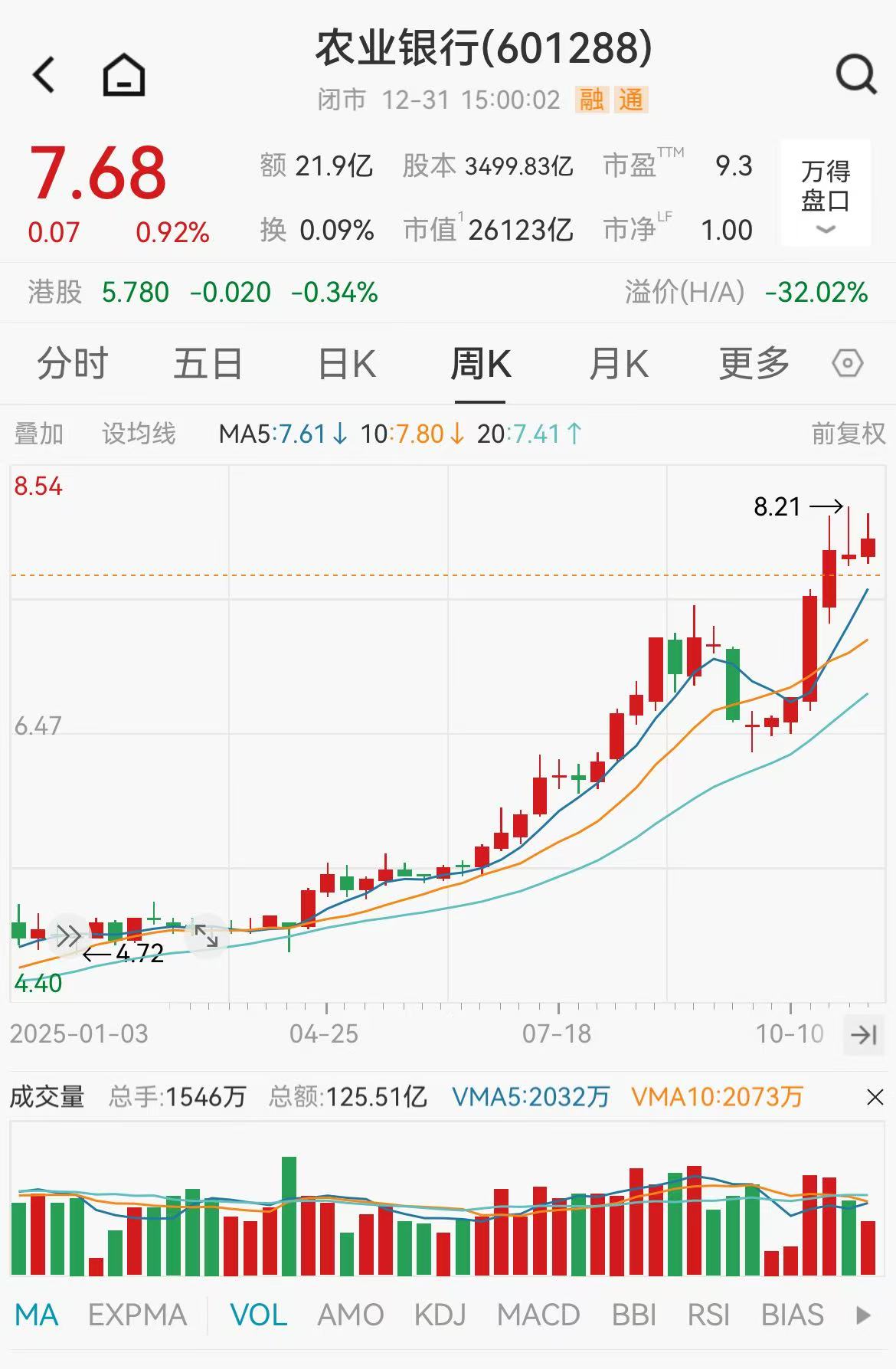
2025年A股银行股超八成上涨:农行涨超50%居榜首,7只银行股下跌
Xin Lang Cai Jing· 2025-12-31 11:57
Core Viewpoint - The A-share banking sector showed a 12.04% increase in 2025, indicating continued attractiveness for asset allocation despite a lower growth rate compared to previous years [5][6][17]. Performance Summary - Among the 42 listed A-share banks, 35 experienced price increases, while 7 saw declines. Agricultural Bank of China (601288.SH) led with a 52.66% increase, followed by Xiamen Bank (601187.SH) at 35.78% [1][10][12]. - Major banks like Shanghai Pudong Development Bank (600000.SH), Chongqing Bank (601963.SH), Industrial and Commercial Bank of China (601398.SH), and Ningbo Bank (002142.SZ) all recorded annual increases exceeding 20% [1][12]. - Conversely, banks such as Huaxia Bank (600015.SH) and Zhengzhou Bank (002936.SZ) faced declines of 9.82% and 7.26%, respectively [4][12]. Market Dynamics - The banking sector's performance in 2025 was characterized by a transition from valuation recovery to value reassessment, with high dividends and low valuations being key attractions [4][8][17]. - The banking index's performance lagged behind major indices like the Shanghai Composite Index and Shenzhen Component Index, which saw increases of 18.41% and 29.87%, respectively [6][7]. Quarterly Performance - The banking sector experienced fluctuations throughout the year, with a 2.95% increase in Q1, a significant 12.44% rise in Q2, an 8.68% decline in Q3, and a recovery of 5.99% in Q4 [7][8]. - The total market capitalization of A-share banks reached 14.65 trillion yuan by the end of 2025, reflecting a robust defensive and allocation value [7][12]. Valuation and Dividend Insights - As of the last trading day of 2025, only Agricultural Bank of China had a price-to-book ratio of 1, while the majority of banks remained in a "broken net" state [15][17]. - The average dividend yield for the banking sector was maintained above 3.75%, with some banks offering yields exceeding 5%, making them attractive in a low-interest-rate environment [16][17]. Future Outlook - Experts predict that the value reassessment trend for banking stocks will continue, albeit at a slower pace, with a focus on structural differentiation [17][18]. - Key factors influencing future performance include the stabilization of net interest margins and the overall macroeconomic environment [18].

券商密集看多银行股
21世纪经济报道· 2025-12-12 01:20
Core Viewpoint - The banking sector is expected to enter a phase of mild recovery in 2026, driven by macroeconomic policy support, stabilization of interest margins, and ongoing alleviation of existing risks [1][4][10]. Group 1: Industry Performance Outlook - Most institutions predict that the overall performance of listed banks will see slight positive growth, moving away from a period of stagnation, with revenue and net profit expected to grow by 0.69% and 0.95% in 2025, and 3.11% and 3.94% in 2026, respectively [4][5]. - Structural differentiation within the banking industry is emphasized, with larger banks and those with strong customer bases and efficient operations expected to outperform smaller banks [4][5]. - Institutions like Zheshang Securities forecast a more optimistic growth rate for net profit at 2.7% and revenue at 2.8% for 2026, highlighting a potential reversal of negative growth trends seen since 2023 [4][10]. Group 2: Interest Margin and Asset Quality - There is a consensus that the net interest margin is likely to stabilize in 2026, supported by improved deposit costs and reduced downward pressure on asset yields [7][8]. - Asset quality is expected to remain stable overall, but with structural pressures, particularly in retail assets and real estate exposure, which will influence individual bank performance [8][9]. Group 3: Investment Strategies - Investment strategies are focused on three main areas: large state-owned banks, regional banks with strong local economic ties, and banks with specific recovery or transformation potential [12][13]. - Large state-owned banks are viewed as defensive choices due to their stable operations and attractive dividends, with recommendations for major banks like ICBC, ABC, CCB, and BOC [12]. - Regional banks, particularly those in economically vibrant areas, are seen as potential sources of excess returns, with specific mentions of banks like Chengdu Bank and Hangzhou Bank [12]. - Banks with convertible bonds or strong retail business foundations are also highlighted as opportunities for potential recovery and valuation enhancement [12].

2026银行股前瞻:业绩企稳结构分化 机构看好“再出发”
2 1 Shi Ji Jing Ji Bao Dao· 2025-12-11 23:35
Core Viewpoint - The performance trajectory and structural differentiation of bank stocks are central topics as 2026 approaches, with expectations of a mild recovery in overall performance driven by macro policy support and easing risks [1][2] Group 1: Industry Performance Outlook - There is a consensus among institutions that the banking sector will see a mild recovery in revenue and net profit due to alleviated pressure from narrowing interest margins and growth in wealth management and other fee-based businesses [2][3] - The growth dynamics of the banking industry are shifting from homogeneous scale expansion to differentiated competition based on customer loyalty, business structure, and operational efficiency [3] - Major banks with established advantages in settlement and wealth management are expected to outperform smaller banks, which may face increased investment pressures [3] Group 2: Interest Margin and Asset Quality - The net interest margin is anticipated to stabilize in 2026, supported by improvements in deposit costs and a reduction in downward pressure on asset yields [4] - While overall asset quality is expected to remain stable, there is a shift in risk focus from the overall sector to specific banks, with those managing retail assets and real estate exposure effectively showing greater resilience [4] Group 3: Investment Strategies - Investment strategies are converging on three main areas: large state-owned banks, regional banks benefiting from local economic vitality, and banks with specific recovery or transformation potential [9][10] - Large state-owned banks are viewed as defensive choices with high allocation value due to their stable operations and attractive dividends [9] - Regional banks with solid asset quality and strong performance certainty, particularly in economically developed areas, are highlighted as targets for excess returns [9][10]


南京银行频获增持,银行股价值拐点已至?
Jing Ji Guan Cha Wang· 2025-10-23 06:40
Core Viewpoint - The recent capital inflow into Nanjing Bank reflects a significant trend of shareholder increases across various banks, indicating a growing confidence in the banking sector's long-term value and stability [2][3][9] Group 1: Shareholder Actions - Nanjing Gaoke Co., Ltd. increased its stake in Nanjing Bank to 9.99% by investing approximately 1.684 billion yuan, marking the second major increase for the bank this year [2][3] - BNP Paribas raised its holdings in Nanjing Bank to 17.02% by acquiring 108 million shares, signaling international capital's endorsement of the bank's fundamentals [3] - Other banks, including Qingdao Bank, Suzhou Bank, Chengdu Bank, and Chongqing Bank, have also seen significant shareholder increases, showcasing a broader trend in the banking sector [2][5][7] Group 2: Capital Composition - The capital influx into Nanjing Bank includes contributions from foreign investors, domestic listed companies, and local state-owned enterprises, indicating a rare alignment of interests among diverse capital sources [3][4] - Local state-owned capital, such as Jiangsu Transportation Holding Co., Ltd., has optimized its shareholding structure by transferring shares to enhance management efficiency [4] Group 3: Market Trends - The trend of shareholder increases in 2025 is characterized by a diverse range of investors, including local state-owned platforms, central state-owned enterprises, foreign QFII, and industrial capital [8] - The banking sector is experiencing a shift in valuation logic, with investors increasingly focusing on structural advantages such as customer base, regional economic resilience, and asset quality stability [9] - The current market environment is transitioning from speculative trading to a focus on stable returns, positioning bank stocks as attractive investments for long-term capital [8][9]


A股市值最高公司“14连阳”背后关键词: 防御性、季节性与差异化
Zhong Guo Zheng Quan Bao· 2025-10-22 22:17
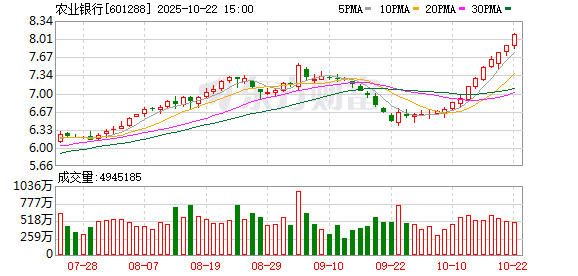
Core Viewpoint - Agricultural Bank of China (ABC) has seen a significant rise in its A-share price, achieving a historical high and a "14 consecutive days of gains" phenomenon, driven by both sector-wide recovery and individual bank characteristics [2][3][8] Group 1: Stock Performance - As of October 22, ABC's A-share price increased by 2.66% to 8.09 yuan per share, with a total market capitalization of 2.75 trillion yuan, making it the highest-valued company in A-shares [2] - Over the past 14 trading days, ABC's stock has risen over 23%, and its year-to-date increase exceeds 58%, leading the A-share banking sector [3] - ABC's price-to-book (PB) ratio has returned to 1.06, surpassing that of China Merchants Bank, with both banks being the only ones among 42 A-share listed banks to exceed a PB of 1 [3] Group 2: Market Factors - The banking sector is experiencing a recovery, characterized by high dividends and strong defensive attributes, attracting funds as market conditions shift [3][8] - Long-term funds have shown a preference for banking stocks, particularly in the context of rising risk aversion among investors [8][10] Group 3: Individual Bank Characteristics - ABC has unique advantages in county-level lending and asset structure, positively impacting its performance metrics such as profit growth, interest margins, and asset quality [2][6] - The bank's county-level loan balance has surpassed 10 trillion yuan, accounting for nearly 41% of its domestic loan portfolio, with a low non-performing loan ratio of 1.2% [7] - ABC's net profit has increased by 2.5% year-on-year, leading among state-owned banks, providing a solid foundation for its stock price [7][8] Group 4: Future Outlook - Analysts predict that the banking sector will enter a favorable investment period, with a 70% probability of generating absolute returns from November to December [8][9] - Factors supporting the banking sector's recovery include approaching dividend distribution, stabilization of interest rates, and ongoing policy support aimed at enhancing liquidity and optimizing asset structures [9][10]
A股市值最高公司“14连阳”背后关键词:防御性、季节性与差异化
Zhong Guo Zheng Quan Bao· 2025-10-22 20:16
Core Viewpoint - Agricultural Bank of China (ABC) has seen a significant rise in its A-share price, reaching a historical high and achieving a "14 consecutive days of gains" milestone, driven by both sector-wide recovery and the bank's unique strengths in county-level lending and asset structure [1][2][3]. Group 1: Stock Performance - As of October 22, ABC's A-share price increased by 2.66% to 8.09 yuan per share, with a total market capitalization of 2.75 trillion yuan, making it the highest-valued company in A-shares [1]. - ABC's stock has experienced a cumulative increase of over 23% in the last 14 trading days and over 58% year-to-date, leading the A-share banking sector [1][2]. - The price-to-book (PB) ratio for ABC has returned to 1.06, indicating a strong valuation compared to other banks, with only ABC and China Merchants Bank having a PB over 1 among 42 A-share listed banks [2]. Group 2: Factors Driving Growth - The overall recovery of the banking sector, characterized by high dividends and strong defensive attributes, has attracted significant capital, particularly from long-term investors [2][6]. - ABC's unique characteristics, such as its advantages in county-level lending and asset quality, have positively impacted its performance metrics, including net interest margin and asset quality [2][3][4]. Group 3: County-Level Financial Services - ABC has a robust county-level financial network, with 56.6% of its branches located in these areas, and county loans exceeding 10 trillion yuan, accounting for nearly 41% of its domestic loan portfolio [4]. - The bank's county-level loans have shown a growth rate of 9.3%, with a low non-performing loan ratio of 1.2%, which is better than the industry average [4][5]. Group 4: Market Outlook - The banking sector is entering a favorable investment period, with expectations of strong performance in the fourth quarter and early next year due to seasonal trends and a shift in investor preferences towards defensive stocks [6][7]. - Analysts predict that the upcoming dividend distribution and a stable interest rate environment will further enhance the attractiveness of bank stocks, including ABC [7].
新主线确立?农业银行逆市新高!百亿银行ETF(512800)顽强7连阳,近7日大举吸金逾48亿元
Xin Lang Ji Jin· 2025-10-19 12:06
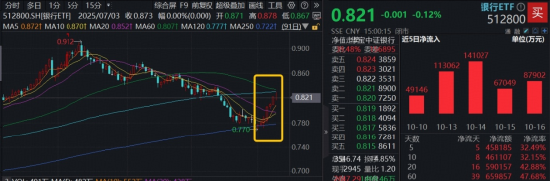
Core Viewpoint - The banking sector demonstrates resilience amid a declining market, with several banks, including Agricultural Bank of China, reaching historical highs, indicating strong investor interest in bank stocks as a safe haven [1][7]. Group 1: Market Performance - Agricultural Bank of China saw an intraday increase of over 2%, closing up 1.74%, while other banks like Xiamen Bank and Qingdao Bank also rose by more than 2% [1]. - The Bank ETF (512800) experienced a brief intraday surge of nearly 1% before closing down 0.12%, maintaining a seven-day upward trend with a total trading volume of 2.922 billion yuan [1][3]. - The Bank ETF has attracted significant capital inflow, with a net inflow of 4.854 billion yuan over the past seven days, bringing its total size close to 20 billion yuan, setting a new historical high [5]. Group 2: Investment Drivers - The banking sector is benefiting from multiple catalysts, including heightened market risk aversion, leading investors to seek stable, high-dividend bank stocks [7]. - Continued government policies aimed at economic stability are fostering expectations of recovery, which directly benefits the banking sector due to its close ties to economic cycles [7]. - Historical trends suggest that the fourth quarter is typically a favorable period for undervalued, high-dividend large-cap stocks, potentially enhancing the appeal of bank stocks [8]. Group 3: Future Outlook - Analysts believe that the banking sector will become a key focus in the current market phase, with defensive asset allocation driving demand for bank stocks [8]. - The stability of bank dividends and the recent price corrections have improved the attractiveness of bank stocks, likely drawing in risk-averse capital [8]. - The Bank ETF (512800) and its associated funds are effective tools for tracking the overall performance of the banking sector, comprising 42 listed banks in A-shares [8].
银行股还能冲吗?价值估值重估转折点或已来到
2 1 Shi Ji Jing Ji Bao Dao· 2025-08-08 00:34
Core Viewpoint - The banking sector has shown strong performance in the stock market, with significant gains in share prices and a favorable outlook for future earnings, despite concerns about potential risks in the industry [1][3][5]. Group 1: Stock Performance - As of early August, the A-share banking sector saw all 42 listed banks' stocks rise, with 15 stocks increasing by over 2% [1]. - The China Securities Banking Index has accumulated a 13.90% increase year-to-date, indicating a robust performance across the sector [1]. - Agricultural Bank of China reached a record high closing price of 6.62 yuan, with a market capitalization of 2.11 trillion yuan [1]. Group 2: Earnings and Risks - Many listed banks reported lower-than-expected earnings in Q1, with declining net interest margins and rising non-performing loan ratios, raising concerns about future dividend capabilities [1][2]. - Analysts suggest that the pressure on net interest margins will persist into Q1 2025, with new non-performing loans primarily arising from retail banking [2]. Group 3: Factors Driving Bank Stocks - Increased demand for safe-haven assets amid economic uncertainty has led to greater institutional investment in bank stocks, which are viewed as defensive [3]. - The banking sector offers a high dividend yield, with a median yield of 4.35% over the past 12 months, making it more attractive compared to low-yielding government bonds [3]. - Strong earnings reports from banks like Ningbo Bank and Hangzhou Bank, with revenue growth of 7.91% and 3.89% respectively, highlight the sector's profitability [3]. Group 4: Shareholder and Management Actions - Several banks have seen significant share purchases by shareholders and executives, which is expected to bolster stock prices [4]. - For instance, Nanjing Bank's major shareholder increased their stake from 8.94% to 9% by purchasing over 750,000 shares [4]. Group 5: Future Outlook - Analysts believe that the current banking stock rally is driven by dividend yield logic, but caution that if yields approach risk-free rates, the attractiveness of bank stocks may diminish [7]. - The overall performance of bank stocks is expected to improve as the year progresses, with potential for earnings growth and stabilization of net interest margins [7][8]. - The market anticipates a rotation between high and low valuation banks, but sustained low price-to-book ratios could hinder this rotation and affect overall sector performance [8].
银行股还能冲吗?价值重估转折点或已来到
2 1 Shi Ji Jing Ji Bao Dao· 2025-08-07 13:00
Core Viewpoint - The banking sector has shown strong performance in August, with significant stock price increases and a positive outlook for future earnings, despite concerns about potential risks and declining net interest margins [1][3][5]. Group 1: Stock Performance - The A-share banking sector saw all 42 stocks rise on August 5, with 15 stocks increasing by over 2% [1]. - Agricultural Bank reached a record closing price of 6.62 yuan, raising its market capitalization to 2.11 trillion yuan [1]. - The China Securities Banking Index has accumulated a 13.90% increase year-to-date as of August 7 [1]. Group 2: Earnings and Risks - Many listed banks reported lower-than-expected earnings in Q1, with declining net interest margins and rising non-performing loan ratios [1][2]. - Analysts express concerns about the sustainability of stock price increases due to potential declines in asset quality and dividend capabilities [1][2]. Group 3: Factors Driving Bank Stocks - Increased demand for defensive assets amid economic uncertainty has made bank stocks attractive [3]. - The banking sector offers a median dividend yield of 4.35%, making it more appealing compared to low-yielding government bonds [3]. - Strong earnings reports from banks like Ningbo Bank and Hangzhou Bank indicate robust profitability, with significant year-on-year revenue growth [3]. Group 4: Shareholder and Management Actions - Several banks' shareholders and executives have been actively buying shares to support stock prices, with notable increases in ownership percentages [4]. - For instance, Nanjing Bank's shareholder increased their stake from 8.94% to 9% by purchasing over 750,000 shares [4]. Group 5: Future Outlook - Analysts suggest that the current banking stock rally is driven by dividend yield logic, which may be challenged if yields approach risk-free rates [7]. - The overall performance of bank stocks is expected to improve as the year progresses, with potential for earnings growth and stabilization of net interest margins [6][7]. - The market anticipates a rotation between high and low valuation banks, but sustained low price-to-book ratios could hinder this dynamic [8].