门店调改

Search documents
永辉超市春节销售额客流实现“双增”
Zheng Quan Ri Bao Wang· 2026-02-26 09:15
Core Insights - Yonghui Supermarket reported significant growth in same-store sales and customer traffic during the Spring Festival holiday, attributed to effective management of consumer demand and continuous optimization of product offerings [1] Group 1: Sales Performance - From the 28th day of the lunar month to the 7th day of the lunar new year, Yonghui Supermarket achieved a year-on-year increase in both same-store sales and customer traffic [1] - The supermarket's key product categories saw remarkable growth, with prepared foods, baked goods, and freshly baked items increasing by over 220%, hot pot products by over 140%, and organic and local vegetables by nearly 200% [2] - The "Quality Yonghui" private label saw a sales increase of over 70% during the Spring Festival period [2] Group 2: Strategic Initiatives - Yonghui Supermarket implemented a "New Yonghui New Year Flavor" theme for its New Year goods festival, introducing a "four-phase" supply strategy to meet consumer needs at different stages [2] - The company transformed its store backrooms into "central kitchens," enabling the sale of freshly prepared meals, which supported the surge in demand for ready-to-eat products [2] Group 3: Regional Performance - In Fuzhou, the revamped Aoti Center store achieved an average daily sales of over 1 million yuan during the Spring Festival [3] - In the Henan market, the Xinmi Zhongqiangguang store experienced a nearly threefold increase in sales compared to the previous year, with customer traffic up over 230% [3] - The Tianjin SM Plaza store in the Bohai Bay region reported average sales exceeding 1.3 million yuan from January to the present [3]

永辉完成北京20家门店调改,第二阶段着重于“细节场景优化”
Bei Ke Cai Jing· 2026-01-31 07:01
Core Viewpoint - Yonghui Supermarket has officially reopened its Beijing Longhu Changying Tianjie store after over a month of renovation, with 20 stores upgraded in the Beijing area, achieving both increased foot traffic and sales in the first 19 stores that reopened [1][2]. Group 1: Store Renovation and Performance - The overall product replacement rate at the Yonghui Longhu Changying Tianjie store exceeds 70%, with a 76% replacement rate for fresh products [1]. - The product structure of the renovated store aligns 80% with that of the brand Pang Donglai, incorporating local Beijing characteristics [1]. - Yonghui's private label "Quality Yonghui" has launched nearly 60 products, with plans to introduce 200 products by 2026 [1]. Group 2: Future Plans and Financial Outlook - Yonghui's Vice President and General Manager of Beijing Region, Gan Wangheng, stated that the company will enter a second phase of renovation focused on optimizing details and responding to diverse local market demands [1]. - The company plans to enhance operations centered around "product scene" and will continue to optimize dimensions such as products, services, and experiences [1]. - As of the end of 2025, Yonghui is expected to have a total of 403 stores, with 315 stores having completed renovations, while facing a projected loss of 2.14 billion yuan for 2025, marking the fifth consecutive year of losses [2]. - Analysts suggest that as store closures and renovations conclude, Yonghui is entering a phase of refined operations, which may improve single-store efficiency and stabilize revenue, enhancing profitability [2].
永辉超市深夜回应北京一调改门店停业:物业方“擅自闭店”的说法与事实严重不符
Xin Lang Cai Jing· 2026-01-27 01:17
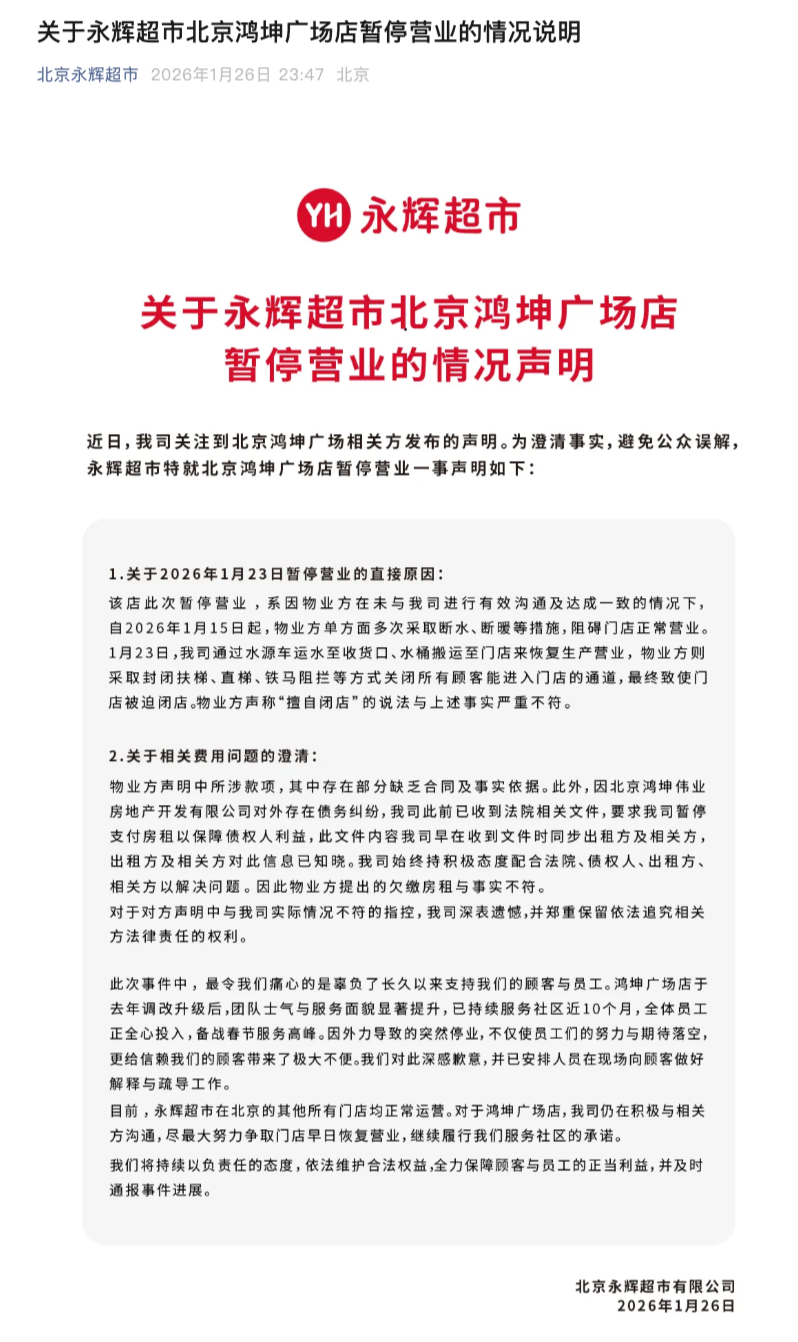
Core Viewpoint - The recent sudden closure of Yonghui Supermarket's Hongkun Plaza store in Beijing has raised concerns, primarily due to disputes with the property management regarding operational conditions and unpaid fees [1][7]. Group 1: Store Closure Details - Yonghui Supermarket announced the closure of its Hongkun Plaza store due to the property management's unilateral actions, including cutting off water and heating since January 15, 2026, without effective communication [1]. - The company attempted to restore operations by transporting water to the store, but the property management obstructed access by blocking entrances [1]. - The property management claimed that Yonghui closed the store without proper communication and has not paid any rent or utility fees since the store's renovation [7]. Group 2: Operational Status and Financial Performance - All other Yonghui Supermarket locations in Beijing are operating normally, and the company is actively working to resolve the issues with the Hongkun Plaza store [4]. - Yonghui Supermarket's recent financial report indicated an expected net loss of 2.14 billion yuan for the year 2025, marking the fifth consecutive year of losses, with the loss amount increasing compared to 2024 [7]. - The company plans to close 381 underperforming stores and significantly restructure 315 stores, which has led to substantial one-time expenses affecting overall performance [7].

永辉超市:预期调改店营收和净利较调改前将保持增长,2026年经营业绩进一步下滑风险较低
Cai Jing Wang· 2026-01-22 04:17
Core Viewpoint - The company is undergoing a significant transformation due to continuous revenue decline caused by store closures and operational adjustments, with a strategic shift planned for the second half of 2024 [1][3]. Group 1: Revenue and Financial Performance - The company's revenue has been consistently declining due to store closures and intensified industry competition, which is deemed objective and reasonable [1]. - In the first nine months of 2025, revenue from closed stores decreased by 5.988 billion, and overall sales revenue dropped by 6.379 billion compared to the previous year, primarily due to store closures [2]. - The company incurred a one-time cost of 840 million from store adjustments in 2025, with a total pre-tax profit impact of 1.174 billion from closed stores [4]. Group 2: Store Adjustments and Transformations - In 2025, the company closed 381 stores and completed adjustments on 275 existing stores, with the majority of these activities concentrated in that year [3]. - By the end of 2025, the company had 403 stores, with 315 having completed adjustments, which are expected to contribute positively to revenue and profit in 2026 [3][4]. - The company plans to close approximately 25 stores and adjust around 50 stores in 2026, significantly reducing the negative impact on operational performance compared to 2025 [3]. Group 3: Upgrade and Renovation Strategy - The selection criteria for upgrading stores include the location's alignment with the target demographic, physical conditions of the store, and the operational capabilities of the team [5][6]. - Among the 216 stores selected for renovation, 154 are located in core business districts, and 149 are situated in standardized shopping centers, indicating a strategic focus on high-traffic areas [6]. - The logistics upgrade project will cover 241 stores, representing 60% of the total stores, with expectations of increased sales and improved cold chain logistics efficiency post-renovation [7].
家家悦2025年净利润预增超50% 门店调改与商品力提升成效显著
Zheng Quan Ri Bao Zhi Sheng· 2026-01-21 11:41
Core Viewpoint - The company, Jiajiayue Group Co., Ltd., anticipates a significant increase in net profit for the year 2025, driven by improvements in store operations and product structure optimization [1] Financial Performance - The expected net profit attributable to shareholders for 2025 is projected to be between 198 million and 228 million yuan, representing a year-on-year growth of 50.06% to 72.79% [1] - The net profit after deducting non-recurring gains and losses is expected to be between 180 million and 210 million yuan, with a year-on-year increase of 55.61% to 81.55% [1] Operational Improvements - The company has enhanced store operation quality and optimized product structure, leading to significant performance improvements in 2025 [1] - Key strategies include strengthening customer orientation, optimizing store positioning, iterating products, and improving service experiences [1] Comparable Store Performance - In 2025, comparable store traffic and sales growth are expected to show continuous improvement, with a projected 8% increase in traffic and a 6% increase in sales in the fourth quarter [1] - Overall, comparable store traffic is anticipated to grow by approximately 2% year-on-year, with a stable and slightly improved gross margin [1] Customer Engagement - The company is shifting from a product-centric approach to a customer-driven model, accelerating product structure adjustments and developing private labels [1] - There is an emphasis on expanding direct sourcing partnerships to create a high-cost performance product mix, which has led to increased customer trust and repurchase rates [1]

九毛九20251216
2025-12-17 02:27
Summary of Jiamaojiu Group Conference Call Company Overview - Jiamaojiu Group has closed 132 underperforming direct-operated stores, currently operating a total of 510 stores, including 22 franchise stores and 33 located in Hong Kong, Macau, and overseas, aiming to optimize store structure [2][3] Key Points and Arguments New Store Model Implementation - The company has launched the 5.0 Fresh Model for its Tai Er brand, focusing on family dining options and upgraded environments and services, with over 160 new model stores opened [2][3] - New model stores have seen a 10% year-on-year increase in revenue and over 15% growth in dine-in revenue [2][5] - The average customer spending has increased by 2-3 RMB due to menu adjustments and improved service, attracting more customers [2][6] Cost Management and Profitability - Despite an increase in workforce by 3-4 employees per new model store, the company has effectively controlled labor costs through training and supply chain optimization [7][9] - The company aims for a gross margin of 64%, with labor costs at 20%-21% and rent below 10%, targeting an operating profit margin of over 18% by 2027 [9][10] - The company is optimistic about future profit recovery, expecting to achieve a stable state for new model stores by 2027 [9][10] Sales Performance and Market Outlook - Same-store sales turned positive starting from the last week of November 2025, with expectations for December to show significant recovery [12] - The new model stores have outperformed traditional stores, particularly in first-tier cities like Beijing and Shanghai, with a 15% increase in dine-in sales compared to a 10% decline in traditional models [15] Future Expansion Plans - The company plans to complete the renovation of over 200 stores by mid-2026, with no specific annual opening targets but focusing on locations with a two-year payback period [13][25] - The company is exploring new brand opportunities, including a new barbecue brand "Zhao Zhao Na Bian," with plans to open its first store in Guangzhou [21] Financial Performance Expectations - The company anticipates a more favorable financial report for 2026, with all unprofitable stores closed by the end of 2025 and a significant reduction in impairment losses [23][24] - The dividend payout ratio is expected to remain at a minimum of 40%, with adjustments based on actual performance [27] Additional Important Insights - The company is focusing on using fresh ingredients sourced directly from suppliers to balance procurement costs and enhance product quality [10] - The transition to a fresh model has not negatively impacted store efficiency; instead, it has improved overall store performance [17] - The company has established central kitchens in Guangzhou, Shanghai, and Chongqing, with further expansions planned [19] This summary encapsulates the key insights from Jiamaojiu Group's conference call, highlighting their strategic adjustments, financial expectations, and market outlook.
公司快评︱前三季营收、净利均降 永辉超市为何还能“三连板”?
Mei Ri Jing Ji Xin Wen· 2025-12-11 03:10
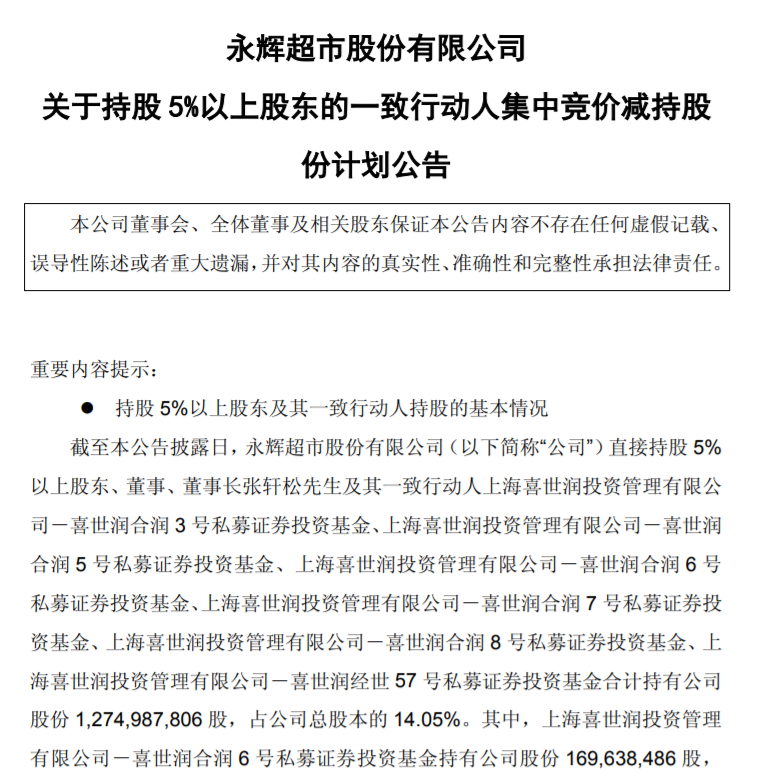
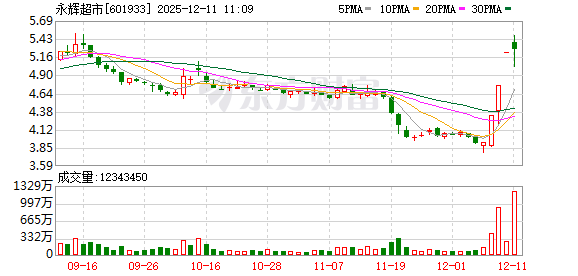
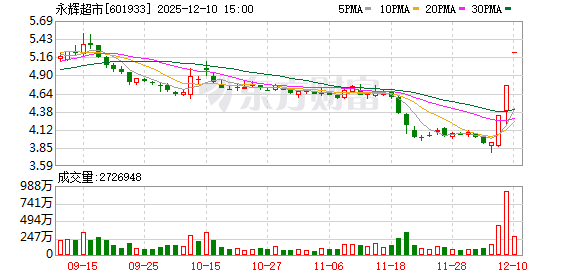
Core Viewpoint - The stock price of Yonghui Supermarket has experienced a strong performance, achieving a three-day limit up, driven by market sentiment and expectations of its transformation efforts, despite facing significant fundamental challenges [2][4]. Group 1: Stock Performance and Market Sentiment - Yonghui Supermarket's stock price reached a limit up on December 10, with a closing price of 5.23 yuan and a market capitalization of 47.5 billion yuan [2]. - The recent stock price increase is attributed to active market sentiment and the retail sector's attention, with Yonghui being a well-known player in the industry [2]. - The company is undergoing store adjustments and a business model transformation, which has led to market expectations that have positively influenced its stock price [2]. Group 2: Financial Performance and Challenges - For the first three quarters of 2025, Yonghui Supermarket reported a revenue of 42.434 billion yuan, a year-on-year decline of 22.21%, and a net loss attributable to shareholders of 710 million yuan, a decrease of 632 million yuan compared to the previous year [2]. - Cumulatively, from 2021 to 2024, the company has incurred a total net loss of 9.501 billion yuan, with over 10.2 billion yuan lost in the last five years [2]. - The company closed 227 unprofitable stores in 2025, indicating significant operational pressures and challenges [2]. Group 3: Transformation Efforts and Uncertainties - As of the end of the third quarter of 2025, 222 stores have completed adjustments, but the transformation process has faced difficulties [3]. - The company is optimizing its product structure and procurement model, which has led to a decline in gross margin, reflecting short-term impacts of the transformation strategy [3]. - There is uncertainty regarding whether the transformation strategy will effectively enhance the company's profitability in the long term [3]. Group 4: Shareholder Actions and Market Reactions - On December 8, Yonghui Supermarket announced that a shareholder with over 5% ownership completed a concentrated auction to reduce their stake by 90.75 million shares, raising approximately 377 million yuan [3]. - This reduction in shareholding has raised concerns about the company's future development and may impact market confidence [3]. - The company issued a risk warning regarding its stock trading, acknowledging the potential for market overheating and advising investors to be cautious [3][4].
永辉超市连续3天涨停 最新公告:存大幅下跌风险!5年亏损超100亿元 上半年关闭亏损门店227家
Mei Ri Jing Ji Xin Wen· 2025-12-10 17:48
Core Viewpoint - Yonghui Supermarket's stock price has experienced significant fluctuations, with a recent surge leading to a market capitalization of 47.5 billion yuan, raising concerns about potential overvaluation and trading risks [1][3]. Group 1: Stock Performance - On December 10, Yonghui Supermarket's stock price hit the daily limit, marking a three-day consecutive increase, closing at 5.23 yuan [1]. - The stock's closing price on December 8 and 9 showed a cumulative deviation of 20% from its previous trading prices, prompting a risk warning from the company [3]. Group 2: Shareholder Actions - On December 8, it was reported that a significant shareholder, Shanghai Xishirun Investment Management Co., Ltd., completed a plan to reduce its holdings by 90.75 million shares, raising approximately 377 million yuan [6]. - Following this reduction, the total shares held by the major shareholder and its concerted parties decreased to 1.184 billion shares, representing 13.05% of the company's total equity [6]. Group 3: Financial Performance - For the first three quarters of 2025, Yonghui Supermarket reported a revenue of 42.434 billion yuan, a year-on-year decline of 22.21%, and a net loss attributable to shareholders of 710 million yuan, worsening by 632 million yuan compared to the previous year [6]. - The company has accumulated losses exceeding 10.2 billion yuan over the past five years, with net profits for 2021-2024 recorded at -3.944 billion yuan, -2.763 billion yuan, -1.329 billion yuan, and -1.465 billion yuan respectively [7]. Group 4: Operational Changes - Yonghui Supermarket has closed 227 unprofitable stores as part of its restructuring efforts, which include adopting the "Pang Donglai model" to enhance operational efficiency [7]. - As of the end of the third quarter of 2025, 222 stores have been transformed under this new operational model, covering various product categories [7].
合百集团20251126
2025-11-26 14:15
Summary of HeBai Group's Conference Call Company Overview - **Company**: HeBai Group - **Date**: October 2025 Key Points Industry Performance - **Real Estate**: Revenue for the first three quarters of 2025 decreased by over 50% [2][5] - **Appliance Business**: Despite stable performance in the first half due to subsidy policies, profits are expected to decline slightly for the year [2][5] - **Agricultural Products**: Revenue increased by 16.8% year-on-year, but net profit declined due to the cultivation period of the Feixi Logistics Park, putting pressure on overall profitability [2][5] - **Supermarket Sales**: In October 2025, supermarket sales grew by 27% to 350 million yuan, while department store sales saw a slight increase of 0.5% after previous declines [2][6] - **Overall Sales**: Appliance sales dropped by 50% year-on-year, while agricultural product sales rose by 13% to 550 million yuan [2][6] Financial Metrics - **Gross Margin**: - Supermarket: Approximately 14%, down 0.5 percentage points year-on-year [14] - Department Store: Approximately 12.5%, down 0.7 percentage points year-on-year [14] - Appliance: 7.4%, slightly up by 0.1 percentage points [14] - **Net Profit**: - Supermarket net profit fell from over 30 million yuan last year to less than 10 million yuan this year [14] - Department store net profit around 12 million yuan, with appliance net profit at approximately 1 million yuan [14] Strategic Initiatives - **Store Adjustments**: Plans to gradually adjust stores from 2026 to 2028, with significant sales and customer flow increases reported in adjusted stores [4][18] - **Private Label Development**: Nearly 500 private label products, with a 90% year-on-year increase in product count, but sales contribution remains below 2% [9][10] - **Supply Chain Optimization**: Direct procurement in Hefei region increased to over 70%, with plans to expand into fresh vegetables and fruits [10][12] Investment and Expansion - **Investment in Emerging Industries**: HeBai Group invested 900 million yuan in the Hefei Guosheng Capital Equity Investment Fund, focusing on semiconductors, new energy, and biomedicine [20][21] - **Store Expansion Plans**: Closed 35 stores this year but plans to open 10 new supermarkets, focusing on stabilizing the central Anhui region [7][13] Market Challenges - **Intense Competition**: The market in Anhui, especially Hefei, is nearing saturation with new entrants, leading to fierce competition in community shopping centers [15] - **Impact of Subsidy Policies**: The shift to a lottery system for appliance subsidies has led to a significant drop in sales since mid-July 2025 [24][25] Future Outlook - **Profit Margin Improvement**: Expected improvements in profit margins through store adjustments and supply chain enhancements [16][18] - **Marketing Strategies for 2026**: Preparing differentiated marketing strategies for the upcoming Spring Festival to maximize consumer opportunities [26] Additional Notes - **New Chairman Appointment**: The appointment of a new chairman is pending, with expectations for a decision by the end of 2025 [22] - **Tax Refund Stores**: Five stores in Anhui are part of the tax refund pilot, with potential for increased transactions if policies are streamlined [11]

永辉“胖改”还没上岸,股东套现13亿,叶国富的设想会落空吗
Xin Lang Cai Jing· 2025-11-24 02:55
Core Viewpoint - Yonghui Supermarket is facing significant financial challenges, including substantial losses and a declining number of stores, while key stakeholders are reducing their holdings in the company [2][8][10]. Group 1: Financial Performance - Yonghui Supermarket reported a revenue of 424.34 billion yuan for the first three quarters of 2025, a year-on-year decrease of 22.21% [8]. - The net loss attributable to shareholders reached approximately 7.1 billion yuan, expanding over eight times compared to the previous year [8]. - Cumulatively, from 2021 to 2024, Yonghui Supermarket has incurred losses exceeding 95 billion yuan, with total losses surpassing 102 billion yuan over the past five years [10][22]. Group 2: Store Closures - As of the end of the third quarter of 2025, Yonghui Supermarket has closed a total of 325 stores, with 102 closures occurring in the third quarter alone [10]. - The number of operational stores has decreased from around 1,000 at the end of 2023 to only 450 by September 30, 2025, indicating a rapid contraction of its retail network [10]. Group 3: Shareholder Actions - On November 11, 2025, Yonghui Supermarket announced that Chairman Zhang Xuansong and his associates plan to reduce their holdings by up to 90.75 million shares, representing 1% of the total share capital, potentially raising about 4.3 billion yuan [3][6]. - This is not the first instance of share reduction by the Zhang family, as Zhang Xuanning previously sold over 90 million shares for more than 3 billion yuan in March 2023 [6][7]. Group 4: Debt and Cash Flow - As of the end of the third quarter of 2025, Yonghui Supermarket's total assets were 316.2 billion yuan, with total liabilities reaching 281.29 billion yuan, resulting in a high debt-to-asset ratio of 88.96% [22]. - The company's cash reserves were reported at only 33.58 billion yuan, the lowest in nearly a decade, indicating that at the current average loss rate of nearly 20 billion yuan per year, the cash flow may not sustain operations for more than two years [23]. Group 5: Future Outlook - Yonghui Supermarket aims to complete the renovation of all stores by 2026, which is seen as a critical point for reversing its financial decline [25]. - However, the high debt levels and insufficient cash flow raise concerns about the feasibility of this turnaround plan [25].