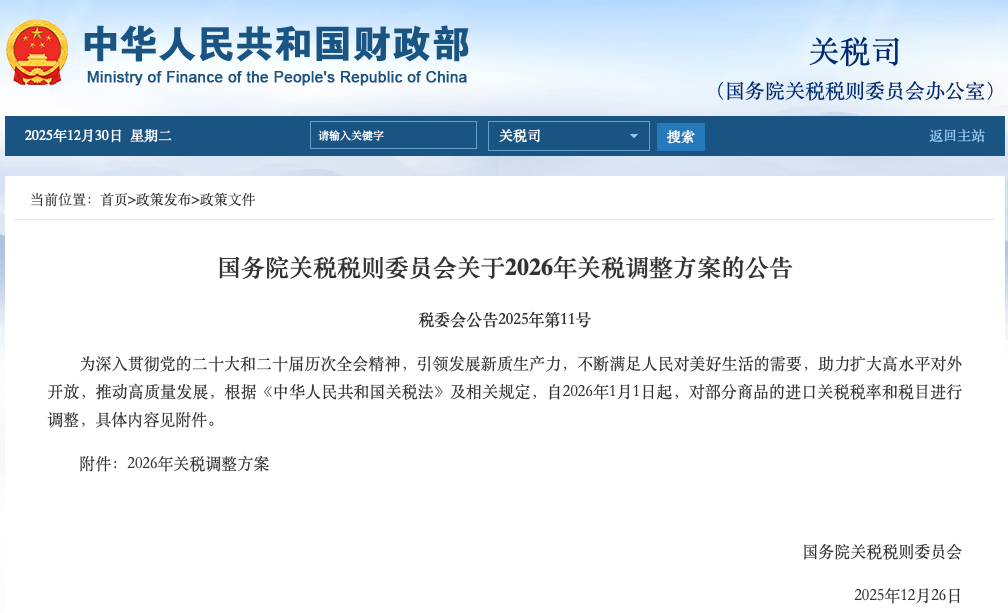
关税调整

Search documents
特朗普推迟上调软体家具、橱柜及浴室柜关税一年
Xin Lang Cai Jing· 2026-01-01 03:41
针对选民对物价水平的不满情绪持续发酵,美国总统唐纳德・特朗普宣布推迟上调软体家具、橱柜及浴 室柜的关税,放缓了加征关税的节奏。 当地时间周三晚间,特朗普在佛罗里达州海湖庄园举办跨年派对之际,白宫发布了这份总统公告的情况 说明书。 根据该文件,原定于周四生效的加征关税政策,现推迟至 2027 年 1 月 1 日实施。 针对选民对物价水平的不满情绪持续发酵,美国总统唐纳德・特朗普宣布推迟上调软体家具、橱柜及浴 室柜的关税,放缓了加征关税的节奏。 当地时间周三晚间,特朗普在佛罗里达州海湖庄园举办跨年派对之际,白宫发布了这份总统公告的情况 说明书。 根据该文件,原定于周四生效的加征关税政策,现推迟至 2027 年 1 月 1 日实施。 白宫方面表示,特朗普在去年 9 月的公告中曾明确,自今年 1 月 1 日起,"部分木质软体家具" 的关税 税率将从 25% 提高至 30%,橱柜及浴室柜的关税税率将从 25% 提高至 50%;而此次周三发布的公告推 迟了这一调税举措,现行 25% 的关税税率保持不变。 情况说明书指出,美国 "正持续与贸易伙伴开展建设性谈判,以解决木制品进口相关的贸易对等性及国 家安全问题",这意味着相 ...
多项新法规,元旦起实施
Zhong Guo Zheng Quan Bao· 2025-12-31 12:27
Group 1 - The China Securities Regulatory Commission has revised the Corporate Governance Guidelines for listed companies, effective from January 1, 2026, to further regulate the behavior of directors, senior management, and controlling shareholders, enhancing corporate governance standards [1] - The People's Bank of China has issued the Interbank Market Brokerage Business Management Measures, effective from January 1, 2026, which prohibits brokerage firms from providing services for financial institutions participating in bond issuance, while emphasizing the need for enhanced internal controls and process management [2] - The People's Bank of China has announced a one-time credit repair policy, effective from January 1, 2026, allowing individuals to have overdue information removed from credit databases if they repay overdue debts by specified deadlines [3] Group 2 - The Financial Regulatory Bureau has revised the Trust Company Management Measures, effective from January 1, 2026, to strengthen the regulatory framework for the trust industry, requiring major shareholders to provide accurate operational and financial information [4] - The Financial Regulatory Bureau has issued the Financial Leasing Company Management Measures, effective from January 1, 2026, focusing on the unique functions of financial leasing companies and outlining specific regulations for various leasing activities [5] - The new Value-Added Tax Law will come into effect on January 1, 2026, marking significant progress in implementing the principle of tax legality in China [6] Group 3 - The Ministry of Commerce and other departments have issued a notice to strengthen the management of used car exports, effective from January 1, 2026, requiring additional documentation for vehicles registered less than 180 days before export [7] - A mandatory national standard for electric vehicle energy consumption will be implemented on January 1, 2026, setting stricter limits on energy consumption compared to previous recommendations [8][9] - The State Council Tariff Commission has announced adjustments to import tariff rates and categories, effective from January 1, 2026, including zero tariff treatment for 43 products from least developed countries [10] Group 4 - The new management measures for oil and gas infrastructure will take effect on January 1, 2026, promoting private sector participation in oil and gas pipeline projects and related infrastructure [11] - The Ministry of Finance and the State Taxation Administration have announced changes to the value-added tax policy for personal housing sales, effective from January 1, 2026, imposing a 3% tax on properties sold within two years of purchase [12] - The national medical insurance drug list will be updated on January 1, 2026, adding 114 new drugs, including 50 innovative drugs, significantly improving coverage for critical health areas [13] Group 5 - The National Development and Reform Commission, along with other ministries, has issued a notice to improve kindergarten fee policies, effective from January 1, 2026, allowing various types of fees while implementing government-guided pricing for public and non-profit kindergartens [14] - A subsidy program for the purchase of new household appliances and smart products will begin on January 1, 2026, offering a 15% subsidy on eligible products, with specific caps on the amount per item [15]
海关总署发布关于执行2026年关税调整方案及有关事宜的公告
Di Yi Cai Jing· 2025-12-31 10:33
海关总署发布关于执行2026年关税调整方案及有关事宜的公告。 企业在上述进出口环节税收政策项下进出口有关商品时,应按照本公告相应附件所列商品编号进行申 报,政策适用范围以《2026年关税调整方案》、相关进口环节增值税和消费税政策规定为准。 对于非全税目适用信息技术产品最惠国税率的商品,其10位海关商品编号继续按照海关总署公告2024年 第207号附件1《2025年进出口非全税目信息技术产品对应海关商品编号表》执行。 二、其他有关事项 《2026年关税调整方案》对部分商品进口关税税率和税目调整的内容,以及海关进出口商品涉税规范申 报目录(2026年版)均可通过海关总署门户网站查询,供通关申报参考。 (文章来源:第一财经) 一、涉及有关进出口税收政策措施的海关商品编号申报要求 根据《国务院关税税则委员会关于2026年关税调整方案的公告》(税委会公告2025年第11号)公布的 《2026年关税调整方案》,自2026年1月1日起,对部分商品的进口关税税率和税目进行调整,现就执行 相关关税政策事宜公告如下: 一、涉及有关进出口税收政策措施的海关商品编号申报要求 为实施2026年进出口商品暂定税率以及部分商品进口环节增值 ...
建信期货钢材日评-20251231
Jian Xin Qi Huo· 2025-12-31 01:49
Report Summary 1. Report Industry Investment Rating There is no information about the industry investment rating in the report. 2. Core Viewpoints - The news factor may cause the steel price to turn from strong to weak recently, but there is still support from the fundamentals. It is expected that the market will first decline and then rise, and the overall trend will be range - bound [9]. 3. Summary by Directory 3.1 Market Review - On December 30, the main contracts of rebar and hot - rolled coil futures 2605 generally rose first and then fell. The rebar futures contract RB2605 closed at 3134 yuan/ton, down 0.10%; the hot - rolled coil futures contract HC2605 closed at 3282 yuan/ton, down 0.33%; the stainless - steel futures contract SS2602 closed at 13090 yuan/ton, up 1.28% [5]. - In the spot market, on December 30, the prices of major rebar spot markets were basically stable, while the prices of individual hot - rolled coil spot markets fluctuated. The hot - rolled coil prices in Hefei and Fuzhou markets rose by 10 yuan/ton, and the price in Lecong market fell by 10 yuan/ton [7]. - In terms of technical indicators, the daily KDJ indicator of the rebar 2605 contract rose, with the J value turning up and the K and D values continuing to rise; the daily KDJ indicator of the hot - rolled coil 2605 contract formed a death cross. The daily MACD red column of the rebar 2605 contract slightly enlarged for two consecutive trading days, while that of the hot - rolled coil 2605 contract turned to a slight narrowing [7]. 3.2 Market Outlook - News: There are reports that JPMorgan Chase's long - position in silver exceeded regulatory requirements, leading to regulatory intervention. For JPMorgan Chase, taking profits may be the best option. The significant fluctuations in international silver prices have triggered resonance in related metal commodity markets [8]. - Fundamentals: The decline in the output of the five major steel products has significantly narrowed, and the demand has continued to decline slightly. Due to the weekly supply being less than demand, the social inventory has continued to decline to a new low since mid - January. On the cost side, the iron ore price has continued to rise to a new high since late February, while the fourth round of price cuts for coke spot is expected to be implemented on New Year's Day. Despite the one - up - one - down situation, the steel cost remains relatively firm [9]. 3.3 Industry News - On December 26, the Ministry of Ecology and Environment held a regular press conference, reporting on the implementation of the Action Plan for Source Prevention and Control of Soil Pollution, including pollutant reduction in key industries and infrastructure improvement [10]. - The Tariff Policy Commission of the State Council issued the 2026 Tariff Adjustment Plan, which will be implemented from January 1, 2026, including adjustments to import provisional tax rates and the addition of new sub - items [10]. - The China Council for the Promotion of International Trade released the latest economic and trade friction index. In October, the amount involved in global economic and trade friction measures decreased by 7.3% year - on - year but remained at a high level [10]. - On December 26, the expert consultation meeting on the 14th Five - Year Plan for the steel industry was held in Beijing, emphasizing aspects such as减量 development, carbon peaking, standard setting, digital transformation, and product structure adjustment [10]. - On December 29, Datong - Qinhuangdao Railway stated that the expected increase in related transaction amounts in the next three years is due to the decline in coal transportation demand and the expansion of non - coal bulk markets [11]. - China Power signed a new coal supply framework agreement with Huainan Mining on December 29, 2025, with a supply period from January 1, 2026, to December 31, 2028 [11]. - Indonesia's Ministry of Trade issued a regulation using the Indonesian coal benchmark price (HBA) as a basis for export reference prices, but the specific implementation time and mechanism of the export tariff policy remain to be determined [11]. - On December 26, Liugang Group's annual output of automotive steel exceeded one million tons, and the annual sales of container plates, die steel, and exported steel also reached one million tons [11]. - On December 26, Ganeng Co., Ltd. announced the transfer of 20% of its shares in Pingxiang Juyuan Coal Industry Co., Ltd. to Jiangxi Coal Industry Group Co., Ltd. at a price of 0 yuan [11]. - India's crude oil imports in November increased by 11.1% year - on - year, while petroleum product imports decreased by about 8.6% and exports decreased by 1.7% [11]. - India's coal imports in November 2025 were 19.2658 million tons, a year - on - year increase of 6.56% and a month - on - month decrease of 1.64%. From January to November, the total coal imports were 227 million tons, a 1.18% decrease from the previous year [11]. 3.4 Data Overview The report presents multiple data charts, including the spot prices of rebar and hot - rolled coil in major markets, the weekly output and steel mill inventory of the five major steel products, the social inventory of rebar and hot - rolled coil in major cities, the blast furnace and electric furnace operating rates and capacity utilization rates, the national daily average pig iron output, the apparent consumption of the five major steel products, and the basis between Shanghai rebar and hot - rolled coil spot and their May contracts. All data sources are from Mysteel and the Research and Development Department of CCB Futures [13][14][17][24][32][33].
我国关税调整方案明日起实施 商品影响几何?
Qi Huo Ri Bao· 2025-12-31 00:18
Group 1: Import Tariff Adjustments - The State Council Tariff Commission announced adjustments to import tariffs for steel, coal, non-ferrous metals, cotton, and urea effective January 1, 2026 [1] - The total import quota for cotton in 2026 is set at 894,000 tons, with a low tariff rate of 1% for quota imports [3][4] - The sliding tax mechanism for cotton imports will help stabilize domestic market prices by adjusting costs based on import prices [4] Group 2: Impact on Cotton Industry - The adjustment in cotton planting area in major production regions like Xinjiang is expected to draw significant market attention [4] - The new quota application process allows companies to apply for quotas throughout the year, enhancing flexibility [4] - The focus on stabilizing cotton prices and protecting domestic farmers' interests is emphasized through the sliding tax mechanism [4] Group 3: Steel and Coal Industry - The tariff adjustments for steel and coal products remain largely unchanged from 2025, with zero import tax on recycled steel materials [5][6] - China's crude steel production reached 892 million tons in the first eleven months of the year, accounting for 54% of global output [6] - Steel exports hit a record high of nearly 11 million tons, while imports decreased significantly [6][7] Group 4: Urea and Fertilizer Industry - The import tax rate for urea and other fertilizers remains at 1%, supporting food security and stabilizing agricultural production costs [9][10] - The domestic urea production capacity exceeds 70 million tons, indicating self-sufficiency and minimal reliance on imports [11] - The low tax rate is expected to enhance supply flexibility and stabilize market prices, ensuring agricultural production stability [12] Group 5: Non-Ferrous Metals - The import tariffs for copper and aluminum products remain unchanged, reflecting a strategy to ensure stable raw material supply for domestic industries [14] - The focus is on maintaining supply chain security and supporting high-quality domestic industrial development [14] - The cancellation of temporary tax rates on certain products indicates a shift towards more stable tariff policies [15]
2026年1月1日起 我国调整部分商品关税税率税目
Ren Min Ri Bao Hai Wai Ban· 2025-12-31 00:12
Group 1 - The State Council Tariff Commission announced the 2026 Tariff Adjustment Plan, which will implement provisional import tariff rates lower than the most-favored-nation rate for 935 items starting January 1, 2026, to enhance the linkage between domestic and international markets [1] - The plan aims to promote high-level technological self-reliance by reducing import tariffs on key components and advanced materials, such as hydraulic pressure machine parts and composite joints [1] - It also focuses on supporting the green transformation of the economy by lowering tariffs on resource-based products like regenerated black powder for lithium-ion batteries [1] - The adjustment includes measures to improve public welfare by reducing tariffs on medical products, such as artificial blood vessels and diagnostic kits for certain infectious diseases [1] - The plan will cancel provisional tariff rates on items like micro motors and sulfuric acid, restoring the most-favored-nation rate based on domestic industry development and supply-demand changes [1] Group 2 - The tariff schedule will include new entries for smart bionic robots, bio-aviation fuel, and forest ginseng to support technological development and the circular economy [2] - The total number of tariff items will be adjusted to 8,972 [2] - The plan continues to implement preferential tariff rates for certain imported goods from 34 trade partners based on 24 free trade agreements and preferential trade arrangements signed by China [2]
我国关税调整方案明日起实施,影响几何?
Qi Huo Ri Bao· 2025-12-30 23:44
Group 1: Import Tariff Adjustments - The State Council Tariff Commission announced adjustments to import tariffs for steel, coal, non-ferrous metals, cotton, and urea effective January 1, 2026 [1] - The total import quota for cotton in 2026 is set at 894,000 tons, with a general tariff rate of 125% within the quota and a sliding scale tax for imports outside the quota [2][3] - The sliding tax mechanism for cotton aims to stabilize domestic market prices by adjusting import costs based on price fluctuations [3] Group 2: Impact on Cotton Industry - The new cotton import quota system allows for year-round applications, facilitating easier access for companies with previous import records [3] - Adjustments in cotton planting areas in major production regions like Xinjiang are expected to impact market dynamics significantly [3] - The low tariff rate of 1% for urea and other fertilizers is intended to ensure food security and stabilize agricultural production costs [6][7] Group 3: Steel and Coal Market Insights - The tariff adjustments for steel and coal remain largely unchanged from 2025, with zero tariffs on recycled steel materials to encourage imports [4][5] - China's crude steel production reached 892 million tons in the first 11 months of the year, accounting for 54% of global output, with steel exports hitting a record high of nearly 11 million tons [4] - The overall supply-demand balance in the steel market is stable, although there are pressures on raw material supply due to rising iron ore inventories [5] Group 4: Urea and Fertilizer Market Dynamics - The continuation of the 1% low tax rate for urea is seen as a measure to enhance market confidence and prevent price volatility in agricultural inputs [7][9] - Despite the low tax rate, the direct impact on the urea industry is minimal due to sufficient domestic production capacity, with annual output exceeding 70 million tons [8] - The low tax rate policy is expected to improve the supply-demand balance in the urea market, enhancing the industry's resilience to risks [9] Group 5: Non-Ferrous Metals Tariff Stability - The import tariffs for copper and aluminum products remain unchanged, reflecting a strategy focused on stabilizing domestic supply and costs [10] - The unchanged tariffs aim to support domestic smelting and processing enterprises while ensuring supply chain security [10] - The policy shift includes the removal of temporary tariffs on certain products like sulfuric acid, reverting to the most-favored-nation rate [10][11]
2026关税调整,有何不同?
Yang Shi Xin Wen Ke Hu Duan· 2025-12-30 17:35
Core Viewpoint - The State Council Tariff Commission announced the 2026 tariff adjustment plan, which includes a reduction in import tariffs for 935 items, effective January 1, 2026, aligning with the goals of "nurturing new growth, promoting green development, and benefiting the public" [1] Group 1: Tariff Adjustments - The annual tariff adjustment maintains stability with 935 items under the provisional tariff rate, reflecting a consistent approach despite market changes [2] - The adjustment includes a 100% zero-tariff treatment for products from 43 least developed countries, emphasizing China's commitment to trade liberalization [1] Group 2: Global Context - While other countries, particularly the U.S., have increased tariffs as a protectionist measure, China is reducing tariffs to promote economic globalization and trade liberalization, signaling its role as a leader in global trade [3] Group 3: Impact on Exporting Countries - The extent of tariff reductions will vary by product, with significant decreases leading to lower prices and increased imports, benefiting related export enterprises [4] - For example, the tariff on frozen avocados has decreased from 30% to 7%, which is expected to increase imports and availability in the market [4] Group 4: Future Direction - China's average tariff has decreased to 7.3%, indicating a trend towards further reductions and expanded market openness, with potential for broader tariff adjustments in the future [5] - The direction of tariff policy will depend on the impact on industries and enterprises throughout the year, but the overall trend is towards continued trade liberalization [5]
我国关税重要调整!2026年1月1日起实施
Sou Hu Cai Jing· 2025-12-30 12:04
Group 1 - The core point of the news is the implementation of a temporary import tariff lower than the most-favored-nation rate on 935 items starting from January 1, 2026, as part of the tariff adjustment plan released by the State Council Tariff Commission [1][4]. Group 2 - The adjustment aims to promote high-level technological self-reliance and the construction of a modern industrial system by reducing import tariffs on key components and advanced materials such as CNC hydraulic pads and composite joints [4]. - It also supports the green transformation of the economy by lowering tariffs on resource-based products like regenerated black powder for lithium-ion batteries and unroasted pyrite [4]. - The plan emphasizes improving people's livelihoods by reducing tariffs on medical products, including artificial blood vessels and diagnostic kits for certain infectious diseases [4]. - To enhance domestic circulation, the plan will cancel temporary tariffs on items like micro motors and restore the most-favored-nation rate, aligning with changes in domestic industry development and supply-demand conditions [4]. - The total number of tariff items will be adjusted to 8,972, including new entries for smart bionic robots, bio-aviation kerosene, and forest ginseng to support technological development and circular economy [4]. - The plan continues to promote trade cooperation with the least developed countries by providing zero-tariff treatment on 100% of products for 43 such countries [5]. - Additionally, it maintains preferential tariff rates for certain imports from Bangladesh, Laos, Cambodia, and Myanmar under the Asia-Pacific Trade Agreement and relevant agreements with ASEAN member states [5].

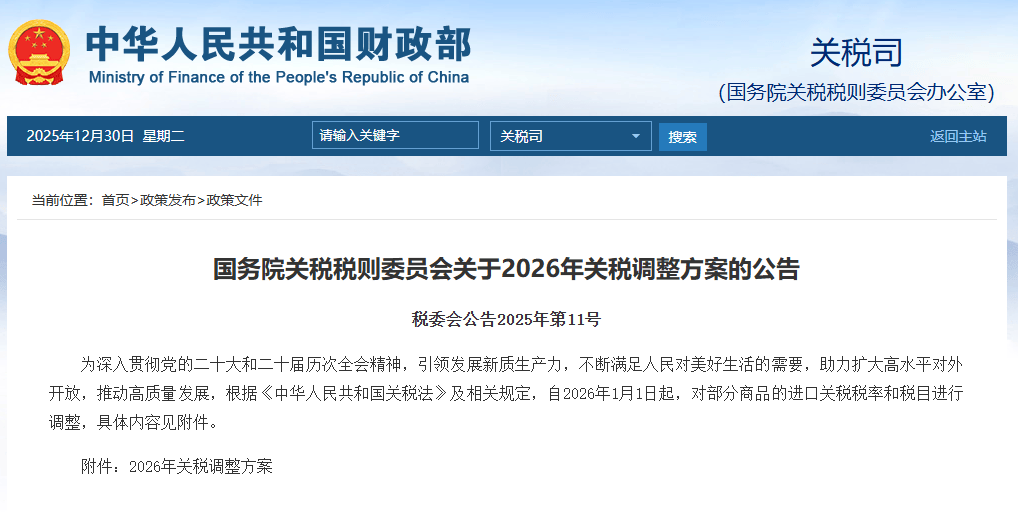
国务院:后天起这些仪器进口关税有调整
Xin Lang Cai Jing· 2025-12-30 11:04
《方案》中与仪器相关的商品主要集中在进口暂定税率表、税目调整表中,核心涉及测量、医疗、工业检测等类别,具体如下: 一、核心仪器类(进口暂定税率表) 1. 测量/计量仪器 ◦ 三坐标测量机用平衡气缸、自动控制柜(税则号列84123100、90328990) ◦ 机床用可编程序控制器(PLC)、数控单元(85371011、85371019) ◦ 气体流量阀(半导体/集成电路制造专用,84818039) ◦ 轮廓投影仪、光栅测量装置(90328990) 2. 医疗仪器及组件 ◦ 医用直线加速器用磁控管、高压固态调制器系统(862、90229090) ◦ 数字化X射线摄影系统平板探测器、X射线断层检查仪专用探测器(90229090) ◦ 医用可解脱弹簧圈、颅内取栓支架、伞形下腔静脉滤器(90189099) ◦ 人造关节、人造血管、人工心脏瓣膜(90213100、90213900) ◦ 诊断试剂盒(甲型肝炎/乙型肝炎/丙型肝炎/人类免疫缺陷病毒/梅毒螺旋体,38221900) 3. 工业检测/加工仪器 ◦ 半导体检测分选编带机(84224000) ◦ 光刻机用光斑调节装置、电机控制器(90138090、90328990 ...