
服装纺织

Search documents
新力量NewForce总第4986期
First Shanghai Securities· 2026-03-24 12:28
Group 1: Li Ning Company Analysis - Li Ning's revenue for 2025 is projected at RMB 29.59 billion, a year-on-year increase of 3.2%[5] - The company's gross profit margin decreased by 0.4 percentage points to 49.0% due to increased discounts and a lower proportion of self-operated channel revenue[5] - Operating profit increased by 6.0% to RMB 3.89 billion, while net profit decreased by 2.6% to RMB 2.94 billion[5] - The target price for Li Ning is set at HKD 24.64, reflecting an 18x multiple of the 2026 earnings per share (EPS) forecast[8] Group 2: China Unicom Analysis - China Unicom's revenue for 2025 is expected to be RMB 392.2 billion, with a slight year-on-year growth of 0.7%[14] - The company reported a net profit of RMB 20.82 billion, reflecting a 1.0% increase year-on-year[14] - Capital expenditure for 2025 is projected at RMB 54.2 billion, decreasing to RMB 50 billion in 2026, with a focus on enhancing computing power investments[14] - The target price for China Unicom is revised to HKD 10.00, indicating a potential upside of 39%[17]
李宁(02331):2025年全年业绩优于预期,奥委会的合作将能提升竞争优势
First Shanghai Securities· 2026-03-24 11:46
Investment Rating - The report maintains a "Buy" rating for the company with a target price of HKD 24.64, representing a potential upside of 17.8% from the current price of HKD 20.92 [4][6]. Core Insights - The company's performance in 2025 exceeded expectations, with total revenue reaching RMB 29.59 billion, a year-on-year increase of 3.2%. The growth was driven by wholesale and e-commerce channels, while retail and overseas operations faced challenges [2][4]. - The partnership with the Olympic Committee is expected to enhance the company's competitive advantage and brand strength, contributing to revenue growth in the coming years [4]. - The company anticipates a high single-digit revenue growth in 2026, supported by new store openings and improved brand power [4]. Financial Summary - Revenue for 2025 was RMB 29,598.4 million, with a projected increase to RMB 31,923.6 million in 2026, reflecting a growth rate of 7.9% [5][8]. - Net profit for 2025 was RMB 2,936 million, with a forecasted increase to RMB 3,094 million in 2026, indicating a growth of 5.4% [5][8]. - The gross margin for 2025 was 49.0%, with expectations to remain stable in 2026 [5][8]. - The company plans to open 50-55 new direct stores and 30-40 wholesale stores in 2026, alongside significant openings in children's apparel [4][5].

广东发布春节消费增值税发票数据 家电零售日均销售收入增长超137%
Nan Fang Ri Bao Wang Luo Ban· 2026-02-28 02:34
Group 1 - The core viewpoint highlights the positive impact of various policies and cultural activities on the consumption market in Guangdong during the Spring Festival, leading to a sustained economic growth trend [1] Group 2 - Upgrading consumer goods showed significant growth, with daily sales revenue of household appliances like robotic vacuum cleaners increasing by 137.9%, communication devices like smartphones by 53.1%, and new energy vehicles by 46.8%, indicating a clear trend of consumer upgrading [1] - The comprehensive retail sales revenue in the province grew by 51.7% year-on-year, with offline department stores and supermarkets seeing increases of 141.7% and 48.6% respectively. New retail models such as vending machines and mobile stalls experienced sales revenue surges of 12.2 times and 3.5 times respectively, while online retail sales grew by 75.7% [1] - The demand for clothing during the Spring Festival saw a concentrated release, with retail sales of pastries and bread increasing by 1.3 times and grain and oil by 11.0%. Retail sales of clothing, textiles, and knitted goods rose by 1.5 times and 2.6% respectively [1] Group 3 - Cultural and tourism consumption continued to rise, with traditional cultural activities significantly boosting related sales, leading to a 9-fold increase in sales revenue from cultural relics and intangible cultural heritage, and increases of 37.6% and 326.9% in museum and memorial sales respectively [2] - The dining and accommodation sectors experienced quality upgrades, with unique homestays and Cantonese cuisine attracting many tourists. Sales revenue for homestay services and budget chain hotels grew by 52.6% and 42.8% respectively, while the restaurant industry saw a revenue increase of 48.1% [2]
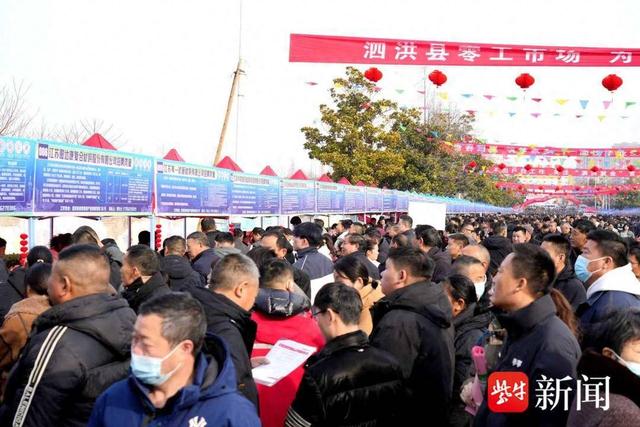
泗洪新春招聘会火热开启!6600余个岗位送到家门口,让返乡人员留乡就业
Xin Lang Cai Jing· 2026-02-19 08:40
Group 1 - The "Spring Breeze Action" job fair in Sihong County attracted 162 companies offering over 6,600 quality job positions across various sectors including machinery manufacturing, textile, electronics, and new materials [1][6] - The event created a vibrant atmosphere with many citizens actively seeking job opportunities, indicating a strong local interest in employment [4] - Companies reported positive outcomes from the job fair, with significant engagement from job seekers, alleviating labor shortages and enhancing recruitment efforts [4][6] Group 2 - The job fair resulted in over 4,000 employment intentions and 9,600 consultations regarding employment and entrepreneurship policies, showcasing the effectiveness of the event [6] - The initiative aims to meet the local demand for employment while supporting companies in their recovery and production efforts, promoting a seamless integration of employment and entrepreneurship [6] - The job fair will continue until the fifth day of the Lunar New Year, allowing job seekers to find suitable positions close to home, reinforcing the message that local employment opportunities are available [6]

一季度《中国经济观察》发布:经济韧性与分化并存,政策蓄力构建再平衡
Sou Hu Cai Jing· 2026-02-12 09:18
Group 1 - The core viewpoint of the articles indicates that China's economy is projected to reach 140 trillion yuan in 2025, with a real GDP growth of 5.0%, meeting the initial target growth rate [2] - In 2025, the industrial production showed steady improvement, with the manufacturing value-added growing by 6.1% year-on-year, supported by strong export demand and domestic equipment renewal policies [5] - The retail sales of consumer goods in 2025 increased by 3.7% year-on-year, although the fourth quarter saw a decline of 1.8%, marking the first quarterly negative growth since 2023 [9] - Fixed asset investment in 2025 experienced a decline of 3.8%, marking the first annual negative growth since records began, with significant contractions in real estate and infrastructure investments [12] - Exports in 2025 grew by 5.5%, with a trade surplus reaching nearly 1.2 trillion USD, the highest on record, driven by high-end manufacturing categories like integrated circuits and new energy products [15] Group 2 - Looking ahead to 2026, the central economic work conference emphasizes higher quality requirements for economic growth, with macro policies expected to maintain a steady expansion [3] - The government plans to support domestic demand and optimize supply, with a focus on increasing investment in human capital and lowering financing barriers for private enterprises [3] - The manufacturing PMI for January 2026 was reported at 49.8%, indicating a contraction in manufacturing activity, primarily due to insufficient domestic demand recovery [18] - The non-manufacturing business activity index for January 2026 was at 49.4%, with the construction sector returning to contraction territory, influenced by adverse weather and the upcoming holiday [19] - Public fiscal revenue in 2025 saw a year-on-year decline of 1.7%, with expenditures also falling short of budgeted growth, reflecting a cautious fiscal environment [22]

US apparel sector backs Nicaragua tariffs on supply chain risks
Yahoo Finance· 2026-01-22 11:54
Core Viewpoint - The U.S. Trade Representative (USTR) plans to implement phased tariff increases on Nicaraguan imports starting in 2027 due to concerns over labor rights, human rights, and rule-of-law issues [1] Group 1: Tariff Details - An additional tariff will be applied to all Nicaraguan goods not qualifying under the CAFTA-DR, starting at 0% from January 1, 2026, increasing to 10% in 2027, and 15% in 2028 [2] - These new tariffs will be in addition to existing duties, including most-favored-nation tariffs and an 18% "reciprocal" tariff imposed earlier [2] Group 2: Industry Reactions - The American Apparel & Footwear Association (AAFA) welcomed the decision to exclude CAFTA-DR qualifying goods from additional tariffs, emphasizing the importance of maintaining regional supply chains [3][4] - AAFA's president noted that the decision allows the U.S. to hold trading partners accountable while protecting essential free trade agreements that support American jobs [5] - The organization highlighted the risks of broad trade actions on apparel and textile supply chains, stressing that CAFTA-DR rules have created complex supply chains involving U.S. cotton farmers and manufacturers across Central America [6]
从卖衣服到卖机器人,中国出口“换挡”加速
Xin Jing Bao· 2026-01-21 13:21
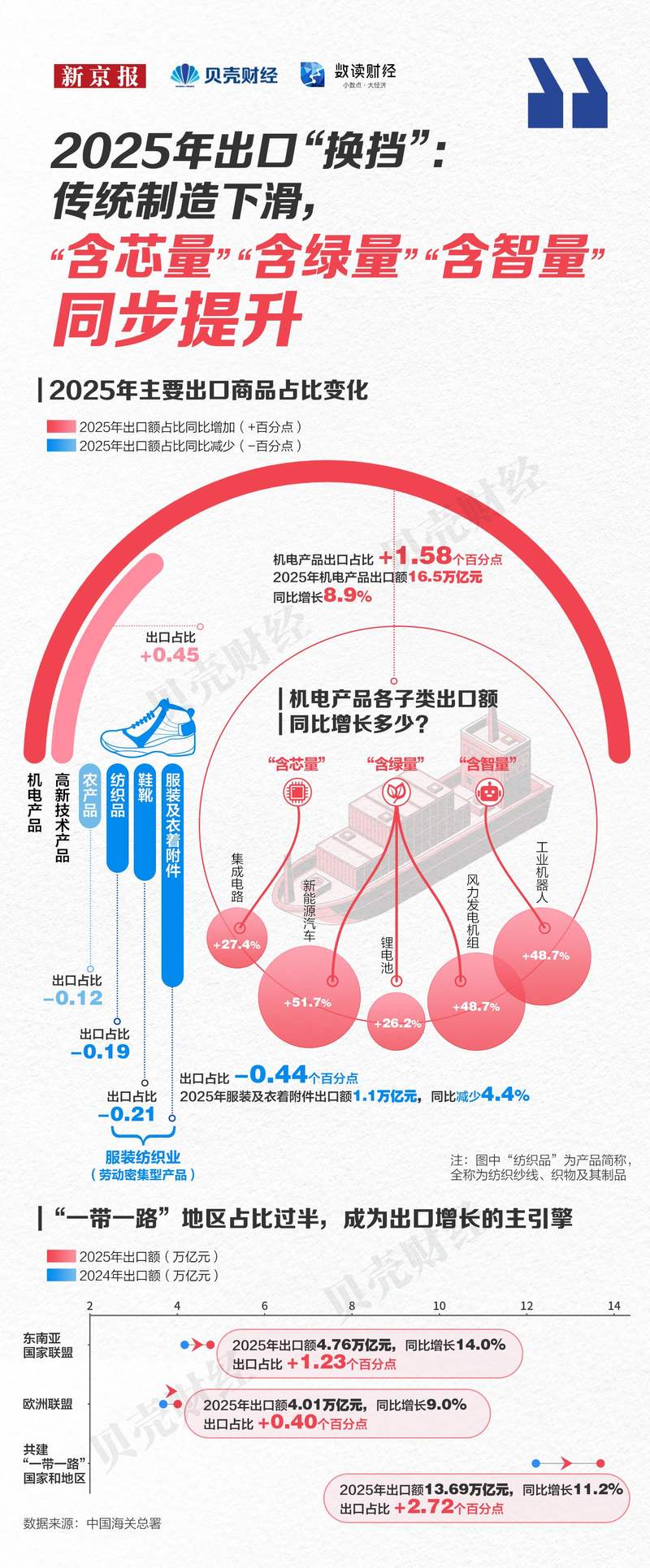
Core Insights - In 2025, China's total goods import and export volume reached 45.47 trillion yuan, marking a 3.8% increase from the previous year, setting a historical record [1] - Exports amounted to 26.99 trillion yuan, growing by 6.1%, while imports were 18.48 trillion yuan, with a modest growth of 0.5% [1] Export Structure - The export structure is shifting from traditional labor-intensive manufacturing to mid-to-high-end manufacturing, with a notable decline in labor-intensive exports such as textiles and clothing [1] - The share of textile yarns, fabrics, and their products in exports decreased by 0.19 percentage points, while clothing and accessories saw a decline of 0.44 percentage points [1] - Conversely, the share of electromechanical and high-tech products in exports is increasing, with electromechanical product exports rising to 16.5 trillion yuan, a year-on-year growth of 8.9%, and high-tech product exports reaching 6.8 trillion yuan, growing by 8.0% [1] Key Growth Drivers - Key growth drivers in electromechanical products include integrated circuits, lithium batteries, and new energy vehicles, which experienced growth rates of 27.4%, 26.2%, and 51.7% respectively [1] - Industrial robot exports surged by 48.7%, making China a net exporter of industrial robots for the first time [1] Export Destination Diversification - The diversity of China's trade partners is increasing, with the top ten trading partners accounting for 47.7% of total foreign trade, down 2 percentage points from 2024 [2] - The "Belt and Road" economies significantly contributed to export growth, with exports to these regions rising from 12.21 trillion yuan to 13.69 trillion yuan, a year-on-year increase of 11.2%, now representing over half of total exports [2]

2025年我国服装鞋帽针纺织品类商品零售额同比增长3.2%
Guo Jia Tong Ji Ju· 2026-01-19 02:32
Group 1 - In December, the retail sales of clothing, footwear, and textile products in China reached 166.1 billion yuan, showing a year-on-year growth of 0.6% [1] - For the entire year of 2025, the retail sales of clothing, footwear, and textile products in China totaled 1,521.5 billion yuan, reflecting a year-on-year increase of 3.2% [1]
亚洲增长最快国家,又变了
创业邦· 2026-01-16 03:43
Core Viewpoint - Vietnam is emerging as the fastest-growing economy in Asia, with a projected GDP of approximately $514 billion in 2025 and an actual growth rate of 8.02%, significantly surpassing initial expectations of 6.1%-6.5% [6][9]. Economic Growth Drivers - The rapid economic growth of Vietnam is primarily driven by three main factors: consumption, investment, and exports [17]. - Vietnam's foreign trade volume exceeded $900 billion last year, with exports reaching $475 billion, marking a 17% year-on-year increase [20]. - The country is benefiting from the global supply chain shift, with tariff negotiations reducing U.S.-Vietnam tariffs from over 40% to 20%, allowing for cost absorption through currency depreciation and supply chain optimization [21]. Industrial Development - Vietnam's industrial and construction sectors are expected to grow by 8.95% by 2025, increasing their share of the economy to 37.65%, establishing Vietnam as a new emerging industrial nation [22]. - The manufacturing sector remains labor-intensive, focusing on electronics, textiles, and footwear, while still being dependent on imported intermediate goods from China for exports [23][24]. Real Estate and Infrastructure - Real estate prices in Vietnam have surged, with prices in Hanoi and Ho Chi Minh City rising over 30% in the first three quarters of the year, and a 59% increase over the past five years, outpacing other countries [31]. - Infrastructure investment is projected to reach $189 billion by 2025, a historical high, with significant projects like the North-South High-Speed Railway aimed at enhancing connectivity [33][35]. Challenges and Comparisons - Despite rapid growth, Vietnam faces challenges such as power shortages and a heavy reliance on foreign investment, particularly from China [27][36]. - Vietnam's GDP per capita is expected to exceed $5,000 by 2025, comparable to Indonesia but only about one-third of China's level, indicating room for growth [37]. - The country is adopting various strategies from China's development model, including administrative reforms and economic planning, while maintaining a stable policy environment favorable to foreign investment [39].

上海美特斯邦威服饰股份有限公司 关于拟对外投资设立参股公司的 公 告
Zhong Guo Zheng Quan Bao - Zhong Zheng Wang· 2026-01-05 16:58
Investment Overview - The company plans to establish a joint venture named Guizhou Metersbonwe New Energy Textile and Apparel Technology Co., Ltd. in Dafa County, Bijie City, Guizhou Province, with a total investment of RMB 100 million, where the company's subsidiary will contribute RMB 10 million, accounting for 10% of the total investment [3][4][6]. Joint Venture Structure - The registered capital of the joint venture is set at RMB 10 million, with Guizhou Textile Industry Development Group contributing RMB 51 million (51% stake), Guizhou Agricultural Modernization Development Equity Investment Fund contributing RMB 39 million (39% stake), and the company's subsidiary contributing RMB 10 million (10% stake) [3][6][7]. Governance and Management - The joint venture will have a governance structure including a shareholders' meeting and a board of directors, with the board consisting of 7 members, where the company can nominate 1 director [9][10][11]. The chairman will be nominated by Guizhou Textile Industry Development Group [9]. Performance Targets - The joint venture has set performance targets, including achieving a cumulative net profit of RMB 50 million and cumulative tax of RMB 100 million by December 31, 2030, with a product quality qualification rate of over 98% [18][57]. If these targets are not met, the company will have to fulfill a compensation obligation [22][57]. Investment Rationale - The investment aims to leverage the resources and advantages of all parties involved to promote local employment and economic development, utilizing modern technology and scientific management methods in the apparel production and processing project [21].
