生命科学

Search documents
复旦管院2025最具潜力企业榜单揭晓
Sou Hu Cai Jing· 2025-11-08 14:13
Core Insights - The "2025 Most Promising Enterprises" list, jointly released by Fudan University School of Management and Ernst & Young, focuses on identifying high-growth innovative companies in emerging fields such as embodied intelligence, artificial intelligence, life sciences, mobile transportation, and chip technology [2][3] - A total of 26 companies received the "Most Promising Enterprise Award," while 8 companies were awarded the "Seed Enterprise Award," highlighting the rigorous selection process based on technological innovation, practical application, and growth potential [2] - Since its inception in 2011, over 60 awarded companies have successfully entered domestic and international capital markets, showcasing the list's effectiveness in fostering companies with breakthrough potential in technology and business models [3] Group 1 - The evaluation committee consists of industry experts and academic scholars, ensuring a comprehensive assessment of the nominated companies [2] - The event marks the 15th year of collaboration between Fudan University and Ernst & Young, emphasizing the importance of management empowerment in supporting the growth of innovative enterprises [2] - The awards ceremony and roundtable forum aim to deepen resource connections with partners like Ernst & Young, facilitating the integration of awarded companies into the global innovation network [2] Group 2 - The focus on the embodied intelligence sector is particularly notable, with 14 companies spanning the entire industry chain, reflecting China's innovative vitality in this area [3] - The "Most Promising Enterprises" designation is intended to inject sustained momentum into the sci-tech ecosystem by recognizing companies that can rapidly respond to market changes [3]

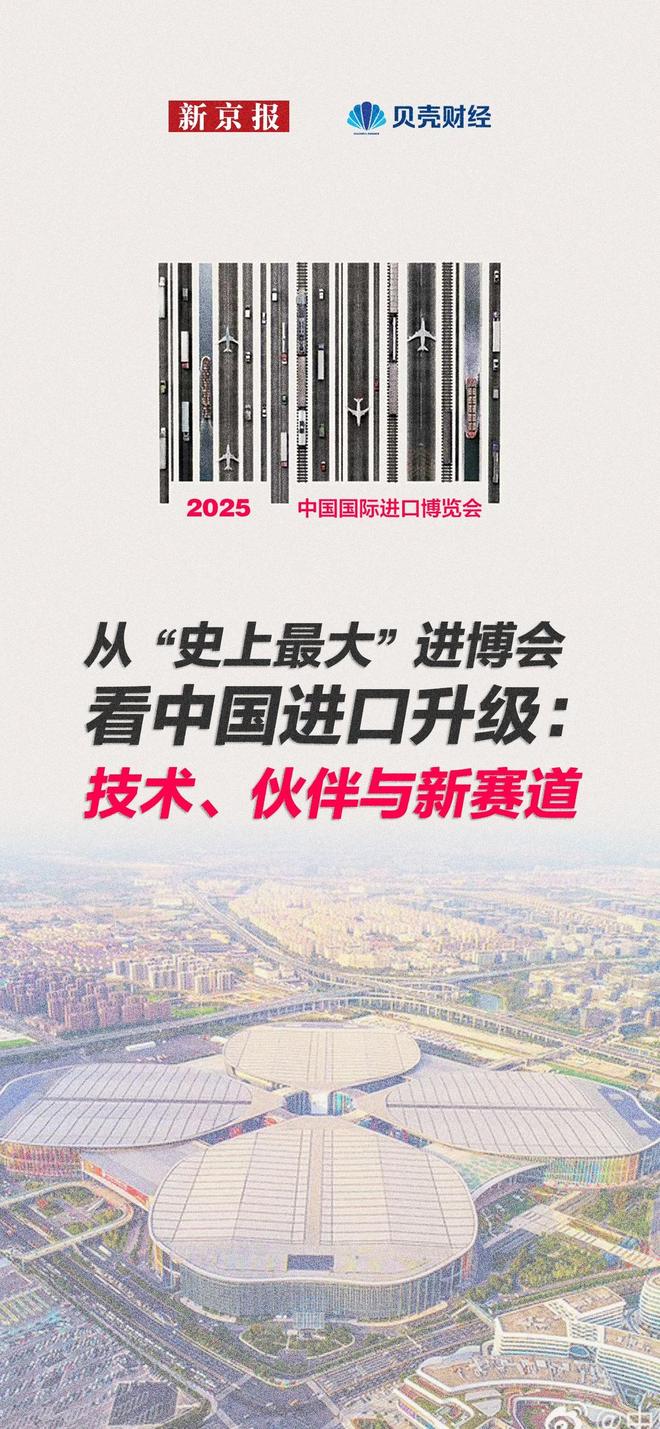
数读|从“史上最大”进博会看中国进口升级:技术、伙伴与新赛道
Xin Jing Bao· 2025-11-07 15:05
Core Insights - The eighth China International Import Expo (CIIE) is the largest ever, featuring 4,108 foreign exhibitors and over 430,000 square meters of exhibition space, marking a 43% increase from the first expo [3][6][8] - The expo showcases 461 items making their global, Asian, or Chinese debuts, highlighting trends in aging population needs and cutting-edge technology [8][13] - China remains the world's second-largest import market, with a total import value of 13.66 trillion yuan in the first three quarters of 2025, reflecting a commitment to expanding its trade relationships [16][27] Exhibition Scale and Participation - The total exhibition area exceeds 430,000 square meters, up from 300,000 square meters in the first expo, and the number of participating countries has increased from 151 to 155 [3][6] - The number of Fortune Global 500 companies participating has risen from 220 to 290, indicating a higher quality of exhibitors [3][6] - The newly established "Least Developed Countries Product Zone" features 163 exhibitors from 37 least developed countries, a 23.5% increase year-on-year [13] Import Trends and Data - In the first three quarters of 2025, imports of mechanical and electrical products reached 5.42 trillion yuan, a 5.8% increase, with electronic components leading at 2.45 trillion yuan [24] - High-tech products saw a total import value of approximately 4.3 trillion yuan, growing by 10.3%, driven by aerospace technology products which surged by 41.1% [24] - The import structure is shifting from quantity expansion to quality upgrades, with mechanical and high-tech products becoming the top categories [19][24] Trade Partnerships - Asia remains China's largest import source region, with imports totaling 7.43 trillion yuan, while Africa shows the fastest growth at 0.66 trillion yuan [27] - Major import partners include South Korea and Japan, with significant imports of integrated circuits and semiconductor devices [27] - The ongoing expansion of China's import market and the CIIE platform reflect a commitment to global trade opportunities and economic cooperation [27]
蓝晓科技(300487):盈利质量持续提升,生命科学板块前景广阔
Tai Ping Yang Zheng Quan· 2025-11-04 09:44
Investment Rating - The report maintains a "Buy" rating for the company [1] Core Insights - The company's profitability quality continues to improve, with a historical high sales gross margin of 52.81% achieved in the first three quarters of 2025 [4] - The life sciences segment shows promising growth, with significant investments in high-end materials and breakthroughs in lithium extraction and water treatment [5] - The company reported a revenue of 1.933 billion yuan in Q3 2025, a year-on-year increase of 2.20%, and a net profit attributable to shareholders of 652 million yuan, up 9.27% year-on-year [4] Financial Performance Summary - For the first three quarters of 2025, the company achieved a revenue of 1.933 billion yuan, with a net profit of 652 million yuan and a basic earnings per share of 1.28 yuan [3][4] - The revenue from the adsorption separation materials business reached 1.565 billion yuan, accounting for 80.95% of total revenue, while the system device business contributed 248 million yuan, representing 12.83% [4] - The company expects net profits of 919 million yuan, 1.085 billion yuan, and 1.262 billion yuan for 2025, 2026, and 2027, respectively, with corresponding PE ratios of 30x, 26x, and 22x [5][6]

学习贯彻党的二十届四中全会精神·权威访谈丨坚持以科技创新引领产业创新推动高质量转型发展——访鹤壁市委书记赵宏宇
He Nan Ri Bao· 2025-11-04 00:01
Core Insights - The 20th Central Committee's Fourth Plenary Session outlines a strategic plan for China's economic and social development over the next five years, emphasizing the importance of modernization and the need for effective implementation of policies [1] Group 1: Economic Development Strategy - The "14th Five-Year Plan" period is crucial for achieving socialist modernization, with a focus on systematic research and development of economic and social measures [1] - The city of Hebi aims to align its development plans with national and provincial directives, considering international trends and technological advancements [1] Group 2: Industrial Transformation and Innovation - There is a strong emphasis on driving industrial transformation and upgrading through technological innovation, particularly in traditional industries like functional new materials and electronics [2] - The city plans to promote the development of emerging industries such as commercial aerospace, biomanufacturing, and semiconductors, while enhancing the integration of technology and industry [2] Group 3: Infrastructure and Research Development - The establishment of key research facilities, such as the Qihe Laboratory, is aimed at advancing core technologies in fields like artificial intelligence and life sciences [2] - The city is focused on creating more pilot platforms to facilitate the application of scientific research outcomes and improve the business environment for innovation [2] Group 4: Safety and Environmental Initiatives - The city is committed to enhancing safety measures and environmental quality through targeted actions and pollution prevention strategies [2] - There is a call for a comprehensive approach to ensure high-quality development while maintaining high levels of safety [2]
蓝晓科技(300487):Q3基本仓业绩稳步增长,生科板块加速布局
Huaan Securities· 2025-11-03 02:31
Investment Rating - The investment rating for the company is "Buy" (maintained) [1] Core Insights - The company reported steady growth in its core business for Q3, with a significant acceleration in the life sciences segment [5][6] - For Q3 2025, the company achieved operating revenue of 6.86 billion yuan, a year-on-year increase of 14.86% and a quarter-on-quarter increase of 2.29% [5] - The net profit attributable to the parent company for Q3 was 2.07 billion yuan, reflecting a year-on-year increase of 7.72% but a quarter-on-quarter decline of 17.58% due to increased income tax expenses [6] Summary by Sections Financial Performance - In the first three quarters of 2025, the company achieved operating revenue of 19.33 billion yuan, a year-on-year increase of 2.20%, and a net profit of 6.52 billion yuan, up 9.27% year-on-year [5] - The gross profit margin for Q3 2025 was 52.81%, an increase of 4 percentage points year-on-year, driven by higher contributions from high-margin businesses [5] Business Segments - The adsorption materials segment showed robust growth, with revenue from adsorption separation materials reaching 15.65 billion yuan, a year-on-year increase of 7.19% [5] - The life sciences business is expected to continue its strong growth trajectory, particularly in the peptide solid-phase synthesis carrier business, with several key GLP-1 peptide projects progressing well [5][8] Future Outlook - The company plans to invest 1.15 billion yuan in a high-end materials industrial park for life sciences, which is expected to enhance production capacity and support future growth [8] - Projections for net profit from 2025 to 2027 are 9.69 billion yuan, 11.89 billion yuan, and 14.49 billion yuan, respectively, with corresponding P/E ratios of 29, 24, and 19 [9]
国脉科技向厦大捐赠630万股股份 情系母校助力人才建设与发展
Chang Jiang Shang Bao· 2025-10-31 00:06
Core Viewpoint - Guomai Technology (国脉科技) announced a donation of 6.3 million shares to Xiamen University Education Development Foundation, valued at approximately 72.58 million yuan, to support educational reforms and the establishment of a world-class university [1][2][3] Donation Details - Guomai Group plans to donate 6.3 million shares, representing 0.63% of the total share capital, with a market value of about 72.58 million yuan based on the closing price of 11.52 yuan per share [2] - The shares are sourced from Guomai Group's non-public issuance and are unrestricted tradable shares [2] - The foundation can choose to hold the shares or sell them after meeting regulatory holding periods, with proceeds used for the university's development [2] Shareholding Impact - Following the donation, Guomai Group's shareholding will decrease from 3.72% to 3.10%, while the combined shareholding of Guomai Group and its concerted actors will drop from 52.64% to 52.02% [3] - The donation will not change the controlling shareholder or the actual controller of the company, nor will it significantly impact the company's governance structure or ongoing operations [3] Previous Donations and Collaborations - This is not the first significant donation from Chen Guoying; in 2021, he donated 100 million yuan to establish a fund for mathematics and life sciences at Xiamen University [4] - Guomai Technology has a major collaboration project with Xiamen University, the "Guomai Future Science City," with a total investment of 5 billion yuan, aimed at enhancing education and technology integration [5] Financial Performance - In the third quarter of 2025, Guomai Technology reported a revenue of 382 million yuan, a year-on-year increase of 4.54%, and a net profit of 196 million yuan, reflecting a growth of 32.30% [6]

【新华社】神二十一乘组航天员张洪章:带着自己实验飞天的载荷专家
Xin Hua She· 2025-10-30 06:41
Core Points - Zhang Hongzhang is a key figure in China's space program, serving as a payload expert for the Shenzhou 21 mission, highlighting the importance of collaboration between ground and space teams [2][4] - His journey from a curious child in Shandong to a leading researcher and astronaut reflects a commitment to national scientific advancement and the application of research in space [6][11] - Zhang's expertise in electrochemical energy storage and his contributions to optimizing critical materials underscore the significance of domestic research in supporting China's space ambitions [9][11] Background and Education - Born in 1986 in Shandong, Zhang developed a strong interest in life sciences from a young age, despite initially pursuing a degree in chemical engineering at Shandong University [6][8] - His academic journey continued at the Chinese Academy of Sciences, where he focused on research that has practical applications for national needs [9][11] Career Development - Zhang's selection as one of the four payload experts in China's third astronaut selection batch marks a significant milestone in his career, emphasizing the rigorous training and transformation he underwent [11][12] - His unique approach to training, incorporating principles from Tai Chi, demonstrates innovative methods in preparing for the challenges of space missions [14] Current Mission and Responsibilities - As a payload expert on the Shenzhou 21 mission, Zhang is responsible for conducting scientific experiments in the space station, which reflects the culmination of efforts from ground researchers [16] - The mission includes experiments in life sciences, an area Zhang is passionate about, showcasing the integration of his personal interests with national scientific goals [16][18] Future Aspirations - Zhang expresses excitement about witnessing technological breakthroughs in China's space endeavors, representing the aspirations of a generation committed to scientific exploration [18]
中科美菱(920992):生物细胞超低温存储领域的先行者
Jianghai Securities· 2025-10-30 05:18
Investment Rating - The investment rating for the company is "Accumulate" (首次) [1][9] Core Insights - The company is a pioneer in the field of ultra-low temperature storage for biological cells, breaking foreign monopolies and focusing on technological innovation and market expansion [6][30] - The company has achieved a revenue of 1.5 billion yuan in the first half of 2025, with a year-on-year growth of 2.16%, and a net profit of 11.05 million yuan, reflecting a 5.94% increase [9][31] - The domestic medical device market is projected to reach 1.35 trillion yuan in 2024, with a compound annual growth rate of 7.53% from 2025 to 2030 [9][31] Company Overview - The company, established in 2002, is backed by Changhong Group and supported by the Chinese Academy of Sciences, focusing on ultra-low temperature storage [9][15] - It has received numerous accolades, including being recognized as a national-level "Little Giant" enterprise and winning the National Technology Invention Award [19][23] - The company has a diverse product portfolio, including ultra-low temperature storage boxes and laboratory equipment, with applications in medical, research, and biopharmaceutical fields [30][31] Financial Performance - Revenue projections for 2025-2027 are 320.91 million, 356.79 million, and 406.46 million yuan, with respective growth rates of 8.50%, 11.18%, and 13.92% [7][9] - The net profit for the same period is expected to be 25.22 million, 29.55 million, and 32.70 million yuan, with growth rates of 39.43%, 17.19%, and 10.64% [7][9] - The company's gross margin is reported at 36.67%, with a net margin of 7.35% for the first half of 2025 [9][31] Industry Analysis - The medical device industry is driven by policy and demand, with a significant push for domestic alternatives [11][30] - The market for biological low-temperature storage equipment is expected to grow from 6.772 billion yuan in 2022 to 21.543 billion yuan by 2028 [9][31] - The company is positioned to benefit from increasing demand for medical equipment in rural areas and supportive government policies [9][31] Product and Technology - The company has developed a comprehensive range of products, including ultra-low temperature storage devices and laboratory equipment, covering temperature ranges from -196°C to 8°C [30][31] - It has a strong focus on R&D, with 11.19% of revenue allocated to research, resulting in 436 patents as of the end of 2024 [9][45] - The company aims to enhance its technological capabilities and expand its product offerings in the ultra-low temperature storage sector [42][45]
探讨光学前沿应用潜能 “好望角科学沙龙”超快光学专场活动举行
Zheng Quan Ri Bao Wang· 2025-10-28 11:13
Group 1: Core Insights - The event "Good Hope Cape Science Salon" focused on ultrafast optics, highlighting its significance in precision measurement, strong field physics, biological imaging, and information processing [1] - Researchers discussed the rapid advancements in time scale exploration, from femtoseconds to attoseconds, emphasizing the acceleration of scientific discovery [1] - The development of three-dimensional chips using femtosecond laser-based nano-printing technology is expected to significantly enhance data processing capabilities [2] Group 2: Technological Advancements - Terahertz technology is gaining attention for its unique advantages in detecting large organic molecules, particularly in cancer diagnostics [2] - The high intensity characteristics of lasers, particularly ultra-strong lasers, are noted for their important scientific and strategic value [2] - The salon aimed to promote the integration of ultrafast optical technology with academic research and industrial capital, facilitating discussions on China's photon industry transitioning from "technology catching up" to "industry leading" [3] Group 3: Event Overview - The "Good Hope Cape Science Salon" serves as a platform for cross-disciplinary exchange among professionals from technology, industry, and investment sectors [3] - The event gathered over 40 experts, including scholars, tech entrepreneurs, and investment leaders, to discuss trends in artificial intelligence, photon science, quantum computing, and more [3] - The theme of the salon was "Ultrafast Light: From Laser Pulses to a New Era in the Photon Industry," aiming to foster collaboration and innovation in cutting-edge technologies [3]
多位诺贝尔奖、图灵奖得主集聚广州!共探科技发展趋势
Nan Fang Du Shi Bao· 2025-10-28 04:03
Core Insights - The event "2025 'Rui Ju Guangzhou Connects the World'" was held in Guangzhou, featuring prominent scientists discussing advancements in life sciences, quantum physics, and artificial intelligence, highlighting the importance of technological development and future industry opportunities [1][3]. Group 1: Event Overview - The event was attended by notable scientists including Randy Schekman, Serge Haroche, and Joseph Sifakis, who shared insights on cutting-edge scientific fields [1]. - This marks the third consecutive year that Peng Rui has hosted this high-level scientific event, aiming to inject continuous momentum into technological innovation and industrial upgrades in the Guangdong-Hong Kong-Macao Greater Bay Area [1]. Group 2: Government and Social Collaboration - The event exemplified deep cooperation between the Tianhe District government and social forces, aiming to accelerate the transformation of scientific achievements into industrial applications [3]. - The Peng Rui Public Welfare Foundation emphasized that technological innovation is the core engine driving social progress, reflecting a commitment to fostering international scientific exchanges [3]. Group 3: Talent Development and Education - A dialogue session with scientists allowed students to engage with complex topics, showcasing the new generation's interest in science and exploration [5]. - The event included a tradition of planting a "Top Scientist Bay Area Memorial Forest," symbolizing the intergenerational transmission of scientific spirit and commitment to sustainable development and youth science education [5]. - Guangzhou·Peng Rui 1 has become a high-end platform for gathering global wisdom and promoting technological innovation, playing a crucial role in enhancing the international influence of the Greater Bay Area [5].