机电产品

Search documents
1-2月工业企业利润点评:强劲的外需,和不请自来的通胀
Changjiang Securities· 2026-03-27 15:08
Group 1: Economic Performance - In the first two months of 2026, the total profit of industrial enterprises increased by 15.2% year-on-year, while operating revenue grew by 5.3% year-on-year, marking the strongest performance since 2023[4]. - The profit recovery is primarily driven by strong external demand and rising prices of upstream cyclical products, particularly in the mining and manufacturing sectors[2][8]. - The mining industry's profit growth reached 9.9%, while manufacturing profits surged by 18.9%[8]. Group 2: Sector Analysis - The computer electronics, non-ferrous metallurgy, and chemical industries collectively contributed 17.6 percentage points to the profit growth in January-February 2026, significantly outperforming other sectors[8]. - The electronic industry showed the highest growth rate, supported by robust export and industrial growth data, with machinery and high-tech products driving exports[8][16]. - The inclination for enterprises to replenish inventory has returned, with nominal inventory growth reaching 6.6%, the highest since April 2023[8]. Group 3: Future Outlook - The interplay between external demand and inflation may lead to a tug-of-war effect on future corporate profits, as rising oil prices could increase production costs for downstream enterprises[2][33]. - The external economic environment remains volatile, with uncertainties in policy decisions affecting domestic demand growth[6][38].
国泰海通|策略:原油链持续涨价,出海制造景气提升
国泰海通证券研究· 2026-03-20 09:20
Group 1 - The core viewpoint of the article highlights the differentiated economic conditions, with rising prices in the oil and chemical chain, an upward shift in emerging technology sectors, and strong growth in travel and consumer goods in the first quarter [1][2]. Group 2 - The oil chain continues to see price increases due to disruptions in oil transportation through the Strait of Hormuz, with Brent crude oil futures settling at a +11.3% increase as of March 13, and domestic chemical prices rising by +12.5% [2]. - Emerging technology sectors, particularly in semiconductors, show significant growth, with South Korea's semiconductor exports increasing by +40.0% year-on-year as of February 2026, and domestic machinery exports rising by +27.1% [3]. - Traditional consumer sectors are experiencing a slight decline, with real estate transactions in 30 major cities down by -3.8% year-on-year, while tourism remains strong, evidenced by a +281.9% increase in visitor numbers at Shanghai Disneyland [4]. Group 3 - Passenger transport volume in major cities has increased by +5.5% year-on-year, indicating robust travel activity, while freight transport also shows growth with national road and rail freight volumes up by +0.6% and +4.3% respectively [4].


经济开门红——全面解读1-2月经济数据
泽平宏观· 2026-03-16 16:06
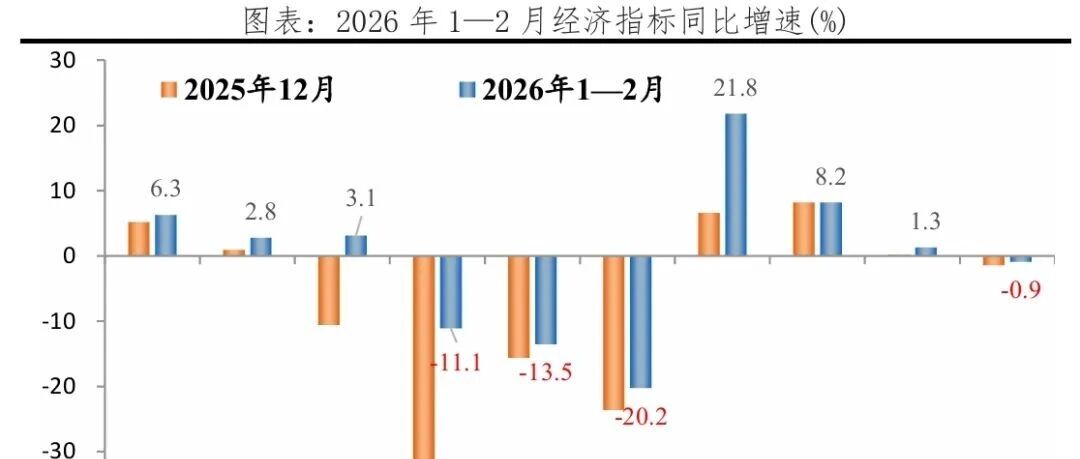
Economic Overview - The national economy showed a "new strong, old weak, external strong, internal stable" trend in the first two months of 2026, with high-tech manufacturing and equipment manufacturing leading the growth [2][3] - Industrial production accelerated, with a year-on-year increase of 6.3% in industrial added value, up 1.1 percentage points from December [2][8] - Fixed asset investment turned positive, growing by 1.8% year-on-year, a significant recovery of 16.9 percentage points from December [2][12] Industrial Production - High-tech manufacturing and equipment manufacturing sectors experienced significant growth, with high-tech manufacturing value-added increasing by 13.1% year-on-year [6][9] - The production of upstream raw materials improved due to rising international oil prices, while midstream machinery and equipment sectors benefited from policy effects [9][10] Investment Trends - Fixed asset investment (excluding rural households) showed a year-on-year increase of 1.8%, with high-tech industry investment growing by 5.1% [12][20] - Infrastructure investment surged by 11.4% year-on-year, driven by the acceleration of major projects and statistical adjustments [17][18] Real Estate Market - The decline in real estate investment narrowed, with sales area and sales amount decreasing by 13.5% and 20.2% respectively, but showing improvement from December [15][16] - Real estate companies are still cautious in land acquisition, with a significant drop in land transaction volume [16] Export Performance - Exports exceeded expectations, with a year-on-year growth of 21.8%, driven by global manufacturing recovery and enhanced competitiveness [25][26] - Exports to countries along the Belt and Road increased by 28.5%, accounting for over 50% of total exports [25][26] Consumer Spending - Social retail sales increased by 2.8% year-on-year, with service consumption performing well due to the long Spring Festival holiday [23][24] - Traditional consumer goods saw a significant demand boost during the holiday period, with restaurant income rising by 4.8% [23] Financial Data - Social financing maintained a stable growth rate of 8.2%, supported by government bonds and bank loans [28][29] - M2 growth remained at 9.0%, while M1 increased by 5.9%, indicating a shift in deposit trends towards non-bank institutions [29] Price Trends - CPI rose by 1.3% year-on-year, the highest in nearly three years, influenced by the timing of the Spring Festival [31][32] - PPI decline narrowed, reflecting input inflation and strong demand in certain technology sectors [31][32]
1-2月贸易数据点评:出口保持强韧性,进口同比增速上行
Tai Ping Yang Zheng Quan· 2026-03-13 14:40
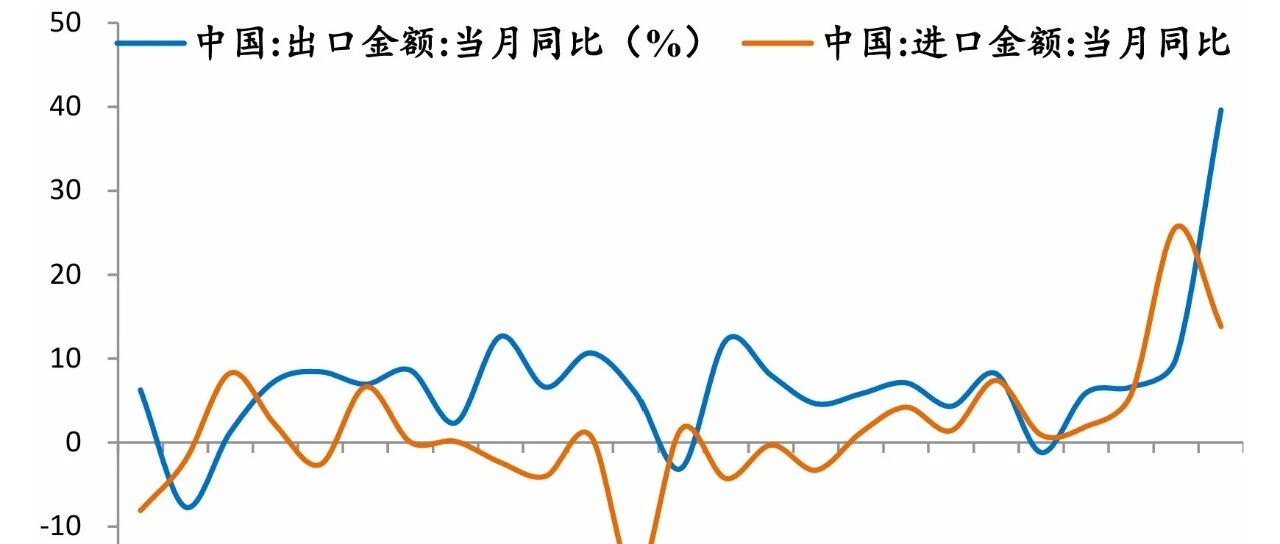
Export Performance - In January-February 2026, China's export value reached $656.58 billion, a year-on-year increase of 21.8%[3] - In February 2026, exports amounted to $299.88 billion, showing a significant year-on-year growth of 39.6%[4] - The export growth was supported by a low base effect from the previous year and a recovery in global manufacturing PMI, which remained above the threshold at 50.9% and 51.9%[4] Regional Export Trends - Exports to the EU increased by 27.8%, up 19.4 percentage points from the previous month, driven by the recovery in EU manufacturing[4] - Exports to Africa saw a remarkable growth of 49.9%, while exports to ASEAN and Japan grew by 29.4% and 8.9%, respectively[4] - Exports to the US decreased by 11.0%, although the decline was less severe compared to a 20.0% drop in December 2025[4] Import Performance - In January-February 2026, China's import value totaled $442.96 billion, with a year-on-year growth of 19.8%[5] - February imports were $208.90 billion, reflecting a 13.8% increase compared to the same month last year[5] - The increase in imports was primarily due to recovering domestic demand and higher imports of intermediate goods related to rising exports[5] Regional Import Trends - Imports from the EU rose by 11.7%, while imports from South Korea surged by 35.8%[5] - Imports from Japan increased by 26.5%, whereas imports from the US fell by 26.7%, marking a significant widening of the decline compared to December 2025[5] Product-Specific Insights - Imports of electromechanical products and high-tech products grew by 24.0% and 27.7%, respectively, contributing significantly to overall import growth[5] - Agricultural products saw a year-on-year growth of 9.7%, with edible vegetable oil surging by 52.4%[5] - Integrated circuit imports increased by 39.8%, reflecting the impact of the AI technology wave on demand[5] Risk Factors - Potential risks include policy uncertainties, unexpected changes in macroeconomic fundamentals, and geopolitical risks overseas[6]
外贸环境修复,外贸结构变化、增速上行
北京大学国民经济研究中心· 2026-03-12 02:18
Export Performance - In January-February 2026, China's total export value reached $656.58 billion, a year-on-year increase of 21.8%, up 15.2 percentage points from the previous period[6] - The low base effect from January-February 2025, where exports grew only 2.3%, significantly contributed to the current surge in export growth[12] - Exports to the EU and ASEAN saw substantial increases, with growth rates of 27.8% and 29.4% respectively, indicating a recovery in trade relations[14] Import Performance - In January-February 2026, China's total import value was $442.96 billion, reflecting a year-on-year increase of 19.8%, up 14.1 percentage points from the previous month[17] - Imports from most countries increased, with significant growth in crude oil and food imports, while steel imports continued to decline due to domestic structural adjustments[18] - Imports from RCEP countries grew by 22.7%, accounting for 34.5% of total imports, with notable increases from Japan (26.5%) and South Korea (35.8%)[17] Trade Balance - The trade surplus for January-February 2026 was $213.62 billion, indicating a robust trade performance amid a recovering external trade environment[6] - The overall trade environment is improving, with structural changes in trade contributing to the upward trend in both exports and imports[12] Future Outlook - The external environment is expected to remain complex, with potential fluctuations in trade growth anticipated for 2026[21] - Continued recovery in trade relations with the EU and ASEAN, alongside the impact of the Federal Reserve's interest rate policies, may influence export growth dynamics[22]
2026年1-2月进出口数据点评:出口同比持续超预期增长
KAIYUAN SECURITIES· 2026-03-11 13:15
1. Report Industry Investment Rating No information about the report industry investment rating is provided in the given content. 2. Core Viewpoints of the Report - The export growth in January - February 2026 exceeded expectations. The cumulative export from January to February increased by 21.8% year - on - year, and the export in February alone increased by 39.6% year - on - year, far exceeding the market's forecast [3]. - The reasons for the export growth exceeding expectations are the later Spring Festival in 2026 and the improvement of external demand. The development of the AI - related industrial chain, export diversification, and positive port high - frequency data also contributed to the growth. Although the Spring Festival holiday in March may put pressure on imports and exports, the long - term positive trend remains unchanged [4][5]. - The root cause of China's continuous export exceeding expectations lies in the high cost - performance of Chinese goods, which is the result of domestic "involution" and technological progress. Even after "anti - involution", China's price advantage may last for a long time, so the report is optimistic about China's exports [6]. - In the bond market, on March 10, the long - term yield first rose and then fell. The report predicts that the target range of the 10 - year Treasury bond is 2 - 3%, with a central value of 2.5% [7][8]. 3. Summary by Relevant Catalogs 3.1 2026 January - February Import and Export Data - **Import and Export Growth**: In February 2026, imports increased by 13.8% year - on - year (25.7% in January), and exports increased by 39.6% year - on - year (10.0% in January). The trade surplus increased by 190.9% year - on - year. The cumulative export from January to February increased by 21.8% year - on - year, and imports increased by 19.8% year - on - year [3]. - **Exceeding Expectations**: The export in February far exceeded the market's forecast. The median and average of the 4 - institution forecast for February's export year - on - year growth were +4.0% and +3.8% respectively, while the actual growth was 39.6%. The median and average of the 6 - institution forecast for the cumulative export year - on - year growth from January to February were +7.5% and +7.3% respectively, and the actual growth was 21.8% [3]. 3.2 Reasons for the Export Growth Exceeding Expectations in January - February 2026 - **Spring Festival Factor**: The Spring Festival in 2026 was in late February, later than in 2025. The holiday disturbance was postponed, which was one of the reasons for the export growth exceeding expectations [4]. - **External Demand Improvement**: The external demand improved, and the export momentum was strong, with the export amount at a historical high [4]. - **Product Structure**: The development of the AI - related industrial chain promoted the high - growth of exports of electromechanical products and high - tech products. From January to February, the cumulative export of electromechanical products increased by 27.1% year - on - year, and the export of integrated circuits increased by 72.6% year - on - year, while high - tech products increased by 26.9% year - on - year [5]. - **Export Destination**: Except for the United States, exports to other major countries increased significantly. From January to February, exports to ASEAN increased by 29.4% year - on - year, and exports to Africa increased by 49.9% year - on - year [5]. - **Port High - Frequency Data**: The monthly average weekly container throughput of key ports in January and February increased by 13.5% and 10.9% year - on - year respectively, and the weekly throughput in the first 7 weeks was higher than that in the same period of 2025 [5]. 3.3 Root Cause of China's Continuous Export Exceeding Expectations The root cause is the high cost - performance of Chinese goods, which is the result of domestic "involution" and technological progress. Even after "anti - involution", China's price advantage may last for a long time due to the faster price increase in other countries [6]. 3.4 Bond Market Situation - **Market Performance on March 10**: The long - term yield first rose and then fell. The yield of the 10 - year Treasury bond's second - active bond reached 1.8190% in the early trading, and then the bond market recovered in the afternoon [7]. - **Bond Market Outlook**: It is predicted that the target range of the 10 - year Treasury bond is 2 - 3%, with a central value of 2.5%. The factors considered include economic fundamentals, monetary policy, inflation, capital interest rates, and the real estate market [8].
2026年1-2月外贸数据点评
Ping An Securities· 2026-03-11 05:29
Group 1: Export Performance - In January-February 2026, China's export value increased by 21.8% year-on-year, a rise of 15.2 percentage points compared to December 2025[2] - The global manufacturing PMI index remained above the expansion threshold, indicating a recovery in manufacturing demand, which positively impacted exports[4] - The Lunar New Year effect contributed to a lower base, enhancing the year-on-year export growth rate for January-February 2026[4] Group 2: Import Performance - China's import value grew by 19.8% year-on-year in January-February 2026, with an increase of 14.1 percentage points from December 2025[2] - The increase in imports was driven by mechanical and high-tech products, which saw a rise of 7.0 and 5.5 percentage points respectively compared to 2025[4] - Agricultural products contributed 0.8 percentage points to import growth, reflecting a recovery in demand[4] Group 3: Regional and Product Insights - Exports to developed regions and Belt and Road countries showed significant growth, with the EU contributing 4.1 percentage points to export growth in February 2026[4] - Mechanical and high-tech products were the main drivers of export growth, contributing 16.3 and 6.6 percentage points respectively[4] - Labor-intensive products shifted from a drag to a boost, contributing 2.9 percentage points to export growth[4]
出口大增22%,春节错位、外需拉动
HUAXI Securities· 2026-03-11 05:11
Group 1: Export Performance - Total export value for January-February 2026 reached $656.6 billion, a year-on-year increase of 21.8%, exceeding market expectations of 7.33%[1] - The export growth rate for January-February 2026 was significantly higher than the average seasonal decline of -18.7% observed in previous years (2015, 2018, 2021), with this year's rate at -8.2%, an improvement of approximately 10.5 percentage points[2] - Exports to ASEAN, EU, and Africa showed the strongest growth, contributing 4.7, 4.1, and 2.6 percentage points to the overall export growth, respectively[2] Group 2: Import Performance - Total import value for January-February 2026 was $443.0 billion, with a year-on-year increase of 19.8%, significantly higher than the previous value of 5.7%[1] - The main contributors to import growth were electromechanical and high-tech products, which contributed 5.3 and 3.9 percentage points, respectively[5] - The import of automatic data processing equipment surged by 51% to 68.7%, while integrated circuits increased by 23% to 39.8%[5] Group 3: Product-Specific Insights - Exports of electromechanical products increased by 14.9 percentage points to 27.1%, while high-tech products rose by 10.2 percentage points to 26.9%, together contributing 22.8 percentage points to overall export growth[4] - The export growth of integrated circuits reached 72.6%, contributing 3.4 percentage points to total exports[4] - Labor-intensive products saw a positive growth shift from -8.6% to 18.4%, contributing 3 percentage points to exports[4] Group 4: Future Outlook and Risks - March 2026 export growth may see a slight decline due to the Chinese New Year effect, but overall resilience is expected to remain, with a projected annual growth of over 5% despite potential currency appreciation[7] - Risks include unexpected domestic policy adjustments, changes in monetary policy from developed economies, and liquidity fluctuations that could impact trade data[8]
外贸数据追踪20260310:出口:两个大分化将现
Orient Securities· 2026-03-11 03:44
Export Growth - China's exports in January-February 2026 increased by 21.8% year-on-year, significantly higher than the previous value of 6.6%[10] - Imports also grew by 5.7%, consistent with the previous value of 5.7%[10] - The total trade surplus for January-February reached $213.62 billion, with a rebound in trade surplus growth[10] Regional Analysis - Exports to the U.S. saw a recovery with a growth rate of -11.0%, up from -30.0%[18] - Exports to ASEAN increased by 29.4%, compared to the previous 11.1%[18] - Exports to Latin America rose by 16.4%, up from 9.8%[18] Product Structure - Consumer goods exports, excluding consumer electronics, showed significant recovery, while electromechanical exports remained strong[25] - The export of capital goods continues to be robust, indicating a stable demand in this sector[25] Future Outlook - The report highlights two major divergences in exports: quantity-price divergence and divergence between RMB and USD denominated exports[28] - The short-term forecast indicates a significant drop in March's dollar-denominated export growth due to high base effects, with the extent of the decline being a key point of discussion[30]
我国出口开门红,朋友圈不断扩大
泽平宏观· 2026-03-10 16:05
Core Viewpoint - China's foreign trade showed strong growth in the first two months of 2023, with exports increasing by 21.8% and imports by 19.8%, resulting in a trade surplus of 213.62 billion USD [3][4]. Group 1: Export Data Characteristics - The export growth rate exceeded expectations, with total exports reaching 656.58 billion USD, driven by global manufacturing recovery and enhanced competitiveness of Chinese manufacturing [4]. - The structure of exports is continuously optimizing, with high-tech and medium-high-end manufacturing becoming core engines, as evidenced by significant growth in machinery and high-tech product exports [5][7]. - The diversification of trade partners is evident, with exports to Belt and Road Initiative countries growing by 28.5%, while exports to the U.S. declined by 11.0% [6][10]. Group 2: Import Data Characteristics - Imports also saw significant growth, reaching 442.96 billion USD, primarily due to domestic consumption and rising commodity prices [4][8]. - The demand for key components in emerging industries is strong, with imports of semiconductors and integrated circuits increasing by 68.7% and 39.8%, respectively [8][9]. Group 3: Trade Partner Diversification - The Belt and Road Initiative continues to yield benefits, with exports to participating countries accounting for 51.3% of total exports [9]. - Trade with the EU remains stable, with exports to the EU growing by 27.8%, while exports to the U.S. have decreased [10]. Group 4: New Trade Dynamics and Private Sector Performance - The vitality of foreign trade entities is increasing, with private enterprises accounting for 58.3% of total foreign trade, reflecting their growing role in stabilizing orders and markets [12]. - New trade formats are developing rapidly, with general trade exports reaching 428.02 billion USD, indicating enhanced product innovation and competitiveness [12].