量化大数据

Search documents
减持与持股并行,看懂资金少踩坑
Sou Hu Cai Jing· 2026-01-26 14:54
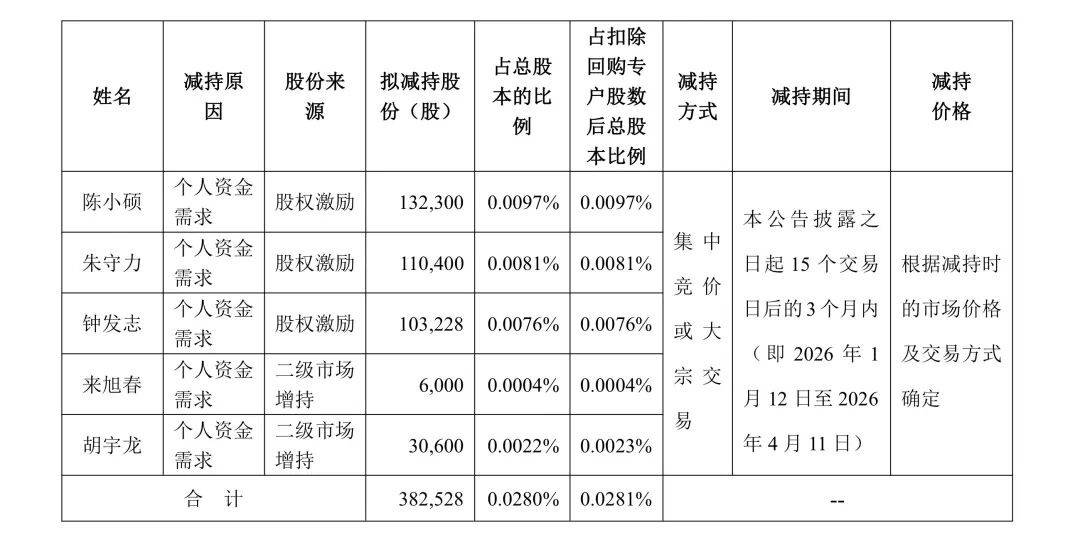
Core Viewpoint - The article discusses the impact of executive share reduction announcements on stock prices and the subsequent introduction of employee stock ownership plans, highlighting the potential for perceived arbitrage opportunities and the importance of understanding underlying market dynamics through quantitative data analysis [1][4]. Group 1: Executive Actions and Market Reactions - A company recently announced an executive share reduction plan followed by an employee stock ownership plan at a price lower than the current market price, raising concerns about potential arbitrage [1]. - The legal analysis indicates that the reduction and employee stock ownership plans are compliant with existing regulations, but the timing may create discomfort among ordinary investors [1][4]. Group 2: Investment Strategies and Data Analysis - Investors often react emotionally to stock price fluctuations and negative news, leading to hasty decisions such as selling or refraining from buying [4]. - Utilizing quantitative data tools can help investors understand the true trading behaviors behind stock price movements, moving beyond superficial trends [4][6]. Group 3: Understanding Market Dynamics - The article emphasizes the importance of distinguishing between different trading behaviors, such as buying, selling, and institutional activity, to gain insights into market trends [6]. - The presence of institutional trading activity can indicate whether a stock is undergoing a "shakeout" or if it is genuinely weakening, which can inform investment decisions [6][7]. Group 4: Cognitive Upgrades in Investment Approaches - The shift from emotional decision-making to data-driven analysis represents a significant cognitive upgrade for investors, leading to more stable and informed investment strategies [7]. - The article concludes that understanding the real actions of capital, rather than just reacting to news and price changes, is crucial for long-term investment success [7].

连续获融资净买,但背后的猫腻是致命的
Sou Hu Cai Jing· 2026-01-26 04:36
Group 1 - The article highlights that 93 stocks in the Shanghai and Shenzhen markets have received net financing inflows for five consecutive days or more, with some stocks experiencing net inflows for up to 15 trading days, indicating a potential investment signal [1] - Investors often face a dilemma in determining whether stock trends indicate a peak or a temporary pullback, as traditional judgment frameworks rely on questionable expert opinions or ambiguous interpretations, leading to decision-making anxiety [3] - The core pricing power of a stock is determined by the trading behavior of participating funds, suggesting that objective quantitative data is essential for accurately reflecting real trading activities [1][3] Group 2 - The traditional decision-making framework lacks a unified objective anchor, relying instead on uncertain external viewpoints or subjective interpretations, which complicates actual decision-making and can induce anxiety [3] - The "institutional inventory" data, which reflects the active participation of institutional funds in trading, is crucial for understanding market dynamics, as it does not represent fund inflows or outflows but rather indicates whether institutions are actively engaged [5] - When analyzing single stocks, the active status of "institutional inventory" data can help investors see beyond misleading price trends, providing a clearer picture of market behavior [5][7] Group 3 - The article emphasizes that the objective characteristics of trading behavior will ultimately be validated in the long-term performance of stocks, contrasting with traditional judgments that focus on short-term price movements [9] - Stocks that previously showed strong rebound trends but lacked institutional participation subsequently weakened, while those with weaker rebounds but consistent institutional involvement maintained their core driving logic [12] - The use of quantitative data not only addresses immediate decision-making challenges but also aids investors in establishing a sustainable investment cognitive framework, minimizing emotional interference and enhancing decision reliability over time [12]

再融资升温,背后的机构战略要清楚
Sou Hu Cai Jing· 2026-01-24 12:35
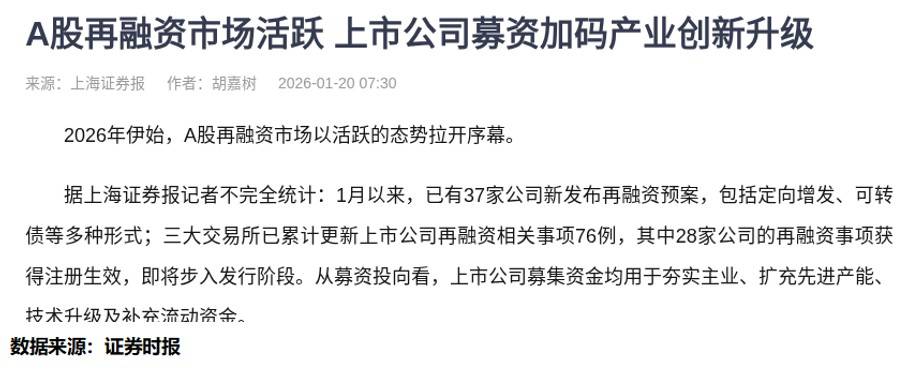
Group 1 - The core viewpoint of the article emphasizes the importance of understanding the underlying trading behaviors behind stock prices and performance, rather than relying solely on traditional metrics like earnings and price trends [1][12]. - The A-share refinancing market has seen increased activity in 2026, with 37 companies announcing plans across various sectors, including high-end manufacturing and new energy, and the efficiency of exchange reviews has improved [1][12]. - Many investors are still caught in the habit of making decisions based on performance and trends, leading to missed opportunities or losses [1][12]. Group 2 - The article discusses the illusion of stability in stocks that appear to be oscillating, where investors may feel secure and invest, only to face sudden downturns [3][5]. - The "institutional inventory" data is highlighted as a crucial indicator of institutional investment activity, which can reveal the true market sentiment behind price movements [5][11]. - Stocks that show significant rebounds may not reflect genuine opportunities if institutional participation is lacking, indicating that superficial price increases can be misleading [7][12]. Group 3 - The article addresses the challenges of trading in sideways markets, where investors may struggle to determine whether to hold or sell their positions due to uncertainty [9][12]. - The "institutional inventory" data can clarify whether institutional investors are actively participating in a stock's trading, helping investors make more informed decisions [9][12]. - Panic selling during price drops can lead to losses, as the underlying data may indicate continued institutional interest despite apparent declines [11][12]. Group 4 - The article concludes that a shift towards data-driven decision-making can enhance investment strategies, moving away from subjective judgments based on performance and market rumors [12]. - The use of quantitative data, such as "institutional inventory," allows for a clearer understanding of market dynamics and investor behavior [12]. - This approach encourages a more rational perspective on market movements, reducing the influence of emotional reactions to price changes [12].
IPO审核趋严,用数据读懂市场变化
Sou Hu Cai Jing· 2026-01-23 02:40
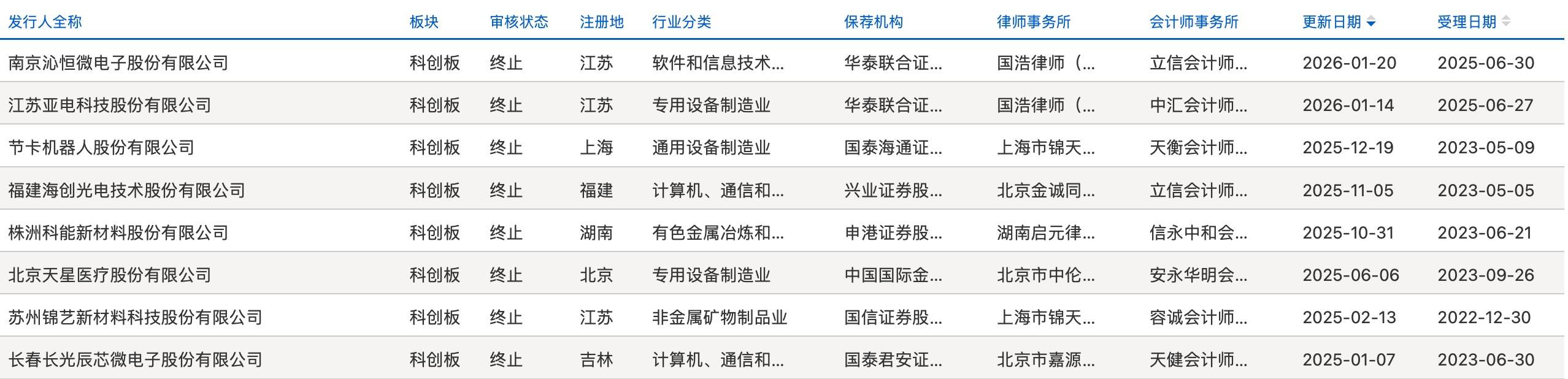
Core Viewpoint - Recent changes in the regulatory focus for IPO applications in the semiconductor sector indicate a shift towards evaluating core technological capabilities and operational stability, rather than just fundraising amounts and project plans [1] Group 1: IPO Applications - Two semiconductor companies have withdrawn their IPO applications from the Sci-Tech Innovation Board [2] - The regulatory review process is becoming increasingly stringent, with a focus on the details of the application process [1][2] Group 2: Market Dynamics - The true direction of the market is determined by the real attitude of capital, rather than external policies or news [1] - Quantitative data can reveal hidden behaviors of capital, allowing for a clearer understanding of market dynamics [1][5] Group 3: Institutional Participation - The "institutional inventory" metric reflects whether large institutional funds are actively participating in a stock's trading, indicating its long-term value [5][9] - Stocks with active institutional inventory tend to perform better, as they have been recognized by institutions prior to market hype [7][9] Group 4: Investment Logic - The reliance on subjective judgment and emotional responses in investment decisions can lead to poor outcomes; objective, quantifiable data should guide decisions instead [10] - A shift in understanding the importance of capital's attitude over external news can enhance investment strategies and decision-making [10]
金价屡破新高,小心机构金蝉脱壳
Sou Hu Cai Jing· 2026-01-22 13:45
近期,黄金市场迎来历史性异动:国际金价首次站上4800美元/盎司关口,十天内接连突破4600、4700、 4800三道整数关口,盘中最高价六次刷新历史纪录;国内现货黄金同步发力,单克价格涨幅超90元,七次 改写历史峰值。受访专家将此归因于三重推力:地缘政治博弈加剧的避险情绪、全球"高利率-高债务"格局 的担忧、多国央行加码黄金储备的信号。但也有专家提示,短期涨幅过快下技术性回调风险正在累积,盲 目追高需警惕波动率放大的冲击。 不过,从底层逻辑看,专家观点的分歧本质在于立场与视角的差异——部分观点可能受服务机构的利益导 向影响,或为维护自身专业话语权而模糊表述。真正决定市场走向的,始终是掌握定价权的机构大资金的 真实交易行为。要穿透表象看清本质,量化大数据提供了客观的认知工具。 一、金价异动的表层诱因与底层逻辑 黄金价格的短期暴涨,看似是地缘冲突、债务担忧、央行购金等事件的集中催化,但从交易的底层逻辑 看,所有事件最终都要通过资金的买卖行为体现。市场中,不同主体的观点往往受自身利益绑定:机构分 析师可能为持仓调仓造势,独立专家可能为维持影响力而模糊表述,其结论未必反映市场的真实供需与资 金态度。 通过量化数据可 ...

融资保证金上调,慢牛底色仍不变?
Sou Hu Cai Jing· 2026-01-22 12:13
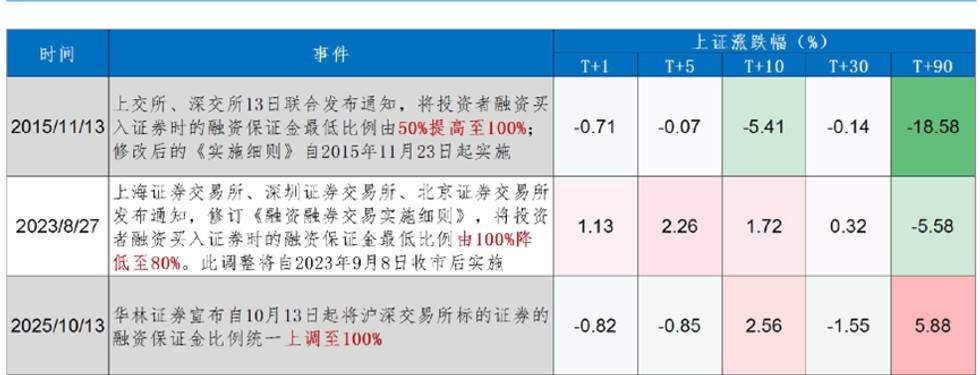
Core Viewpoint - Recent policy changes regarding margin requirements for financing purchases have caused market fluctuations, but historical data suggests that macroeconomic fundamentals are the primary drivers of market direction rather than short-term policy adjustments [1][14]. Group 1: Policy Changes and Market Reactions - The Shanghai, Shenzhen, and Beijing stock exchanges have raised the minimum margin requirement for financing purchases from 80% to 100%, leading to concerns about market stability [1]. - Historical analysis shows that similar policy changes have had varying impacts on market performance, with the 2015 increase coinciding with a downturn in economic conditions, while the 2025 increase occurred during a recovery phase [14]. Group 2: Quantitative Data Analysis - Utilizing quantitative data tools can help investors discern the true state of market participation by large-scale funds, which is crucial for making informed decisions [4]. - The "institutional inventory" data indicates whether large-scale funds are actively participating in the market, providing insights beyond mere inflow and outflow metrics [4][8]. Group 3: Macroeconomic Fundamentals - Current macroeconomic indicators show a positive trend, with A-share companies experiencing revenue growth and improved net profit forecasts, particularly in AI and new energy sectors [14]. - Key macroeconomic data, such as the manufacturing PMI returning to expansion territory and rising CPI and PPI, support the notion that the market's fundamental strength remains intact despite short-term policy adjustments [14]. Group 4: Investor Behavior and Decision-Making - Emotional responses to market fluctuations often lead to poor investment decisions; thus, relying on quantitative data can mitigate emotional biases [15]. - Investors are encouraged to focus on the participation of large-scale funds and the overarching macroeconomic trends to maintain a rational approach to market movements [15].
IPO格局生变,量化看清变局的本质
Sou Hu Cai Jing· 2026-01-22 02:53
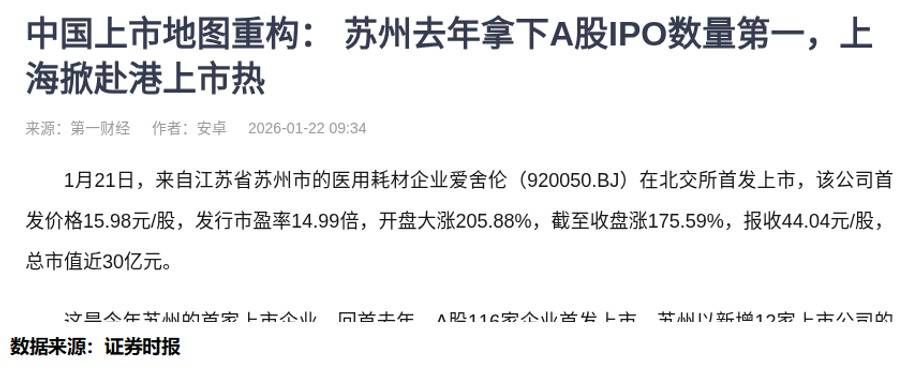
Group 1 - A city in Jiangnan has topped the A-share annual IPO ranking, with 1 in 10 new listed companies coming from there, while Shanghai dominates the Hong Kong IPO market, supporting half of the mainland companies going public in Hong Kong [1] - IPO resources are highly concentrated in the three major urban clusters: Yangtze River Delta, Beijing-Tianjin-Hebei, and Guangdong-Hong Kong-Macau Greater Bay Area, indicating a significant head effect [1] Group 2 - Investors often react emotionally to market fluctuations caused by external news, leading to impulsive decisions that may result in regret when the market reverses [3] - A quantitative data system can analyze trading behaviors, revealing insights such as "institutional inventory," which indicates the level of institutional participation in trades [3][5] Group 3 - The concept of "institutional shock" is introduced, where institutions may create panic through price drops to acquire shares from retail investors, which is not discernible through news alone [5] - The difference in trading behavior between two popular medical beauty stocks illustrates how institutional inventory can indicate whether a price movement is driven by institutional actions or merely short-term trading [6][8] Group 4 - During bullish market conditions, unexpected adjustments are common, often driven by institutions to filter out less committed investors, thereby easing future market pressures [9] - Quantitative data analysis can help identify the true market state by examining multiple dimensions such as funding, behavior, and institutional activity [9] Group 5 - Emotional responses are identified as the biggest enemy in investing, while data serves as the best weapon against such emotions [10] - Investors can build their own investment logic based on objective trading data, rather than being swayed by market fluctuations and news [10]
融资资金扎堆突进,但涨跌还得看机构的变招
Sou Hu Cai Jing· 2026-01-21 05:17
Core Viewpoint - The article emphasizes the importance of understanding the underlying market dynamics rather than being misled by superficial indicators such as popular stocks or financing attention. It highlights the significance of "institutional inventory" as a key metric to gauge real market participation and sentiment [1][3][10]. Group 1: Misleading Indicators - Many investors rely on news and superficial funding interest to make decisions, but these do not reflect true market behavior [3][6]. - The article cites examples from the mid-year reporting season where two stocks with similar positive earnings forecasts had drastically different market performances, illustrating that external appearances can be deceptive [3][6]. Group 2: Importance of Quantitative Data - The concept of "institutional inventory" is introduced as a crucial metric that captures the trading behavior of large funds, which is not influenced by external factors [6][9]. - Quantitative data can help investors see through market noise and identify genuine trading activity, as evidenced by the presence of "institutional inventory" before significant price movements [9][10]. Group 3: Cognitive Upgrade - The article discusses a shift from a "news-driven" approach to a "fundamentals-driven" approach, where investors should focus on whether large funds are actively participating in trades rather than just reacting to news [10][11]. - This cognitive upgrade allows investors to make more informed decisions based on actual trading behavior rather than speculative news, which can often lead to poor timing and losses [10][11]. Group 4: Effective Market Analysis - The article suggests that during market analysis, investors should avoid being distracted by various news and superficial data, and instead focus on the core indicators provided by quantitative data [11][12]. - By concentrating on stocks with active "institutional inventory," investors can identify genuine market opportunities and avoid being misled by transient market excitement [11][12].

部分股连续获融资净买入,行情要换个维度看了
Sou Hu Cai Jing· 2026-01-20 07:10
Core Insights - The article emphasizes the importance of analyzing market behavior through a multi-dimensional lens, focusing on funding, behavior, and probabilities rather than solely on price movements [1][3]. Group 1: Price and Funding Dynamics - Many investors tend to rely on price patterns to identify market bottoms or tops, which can lead to misjudgments as price movements are merely outcomes of trading, while the true drivers are institutional funding behaviors [3][6]. - A price rebound without corresponding institutional trading activity is often a false signal, indicating that without funding support, price movements are merely short-term fluctuations [7][11]. Group 2: Institutional Participation - Continuous institutional trading activity is crucial for validating price trends; price adjustments during an upward trend should not cause panic if institutional interest remains strong [12][16]. - The presence of institutional trading signals during price fluctuations provides a more reliable basis for investment decisions, allowing investors to navigate market uncertainties more effectively [19]. Group 3: Quantitative Multi-Dimensional Perspective - The advancement of quantitative data technology enables a more comprehensive analysis of market behavior, moving beyond simple price trends to a data-driven investment approach [16][19]. - Developing a sustainable investment strategy requires a shift from subjective judgments to objective assessments based on funding, behavior, and probability data [19].

全球配置成共识,换个维度看标的
Sou Hu Cai Jing· 2026-01-20 02:18
Group 1 - The core consensus in the market is that global multi-asset allocation is becoming a key strategy to cope with uncertainty due to profound changes in the global economic landscape [1] - Major economies are experiencing shifts in growth momentum, adjustments in monetary policy, and a reshaping of geopolitical dynamics, making it increasingly difficult to manage the volatility risks of single assets [1] - A new FOF product has been launched by a fund company to help ordinary investors access global multi-assets without needing to research each market's rules or select individual assets [1] Group 2 - The focus should be on identifying suitable assets that investors can understand and hold, rather than getting caught up in the search for "good assets" which can vary greatly among different investors [3] - Many investors fail to profit from assets that have shown good overall performance due to frequent trading during periods of volatility, leading to losses from transaction fees [3][7] Group 3 - Understanding the trading behavior behind price fluctuations is crucial; organized trading can create opportunities for investors to acquire assets at lower prices during market corrections [8] - Quantitative big data can help break down invisible trading behaviors into visible objective data, allowing investors to see the underlying trading logic rather than relying on subjective guesses [14] Group 4 - In the current market environment, global multi-asset allocation aims to address uncertainty, while using quantitative data to analyze trading behavior helps identify assets with sustained interest from capital [15] - Investors should focus on the long-term intentions of capital participation rather than being overly concerned with short-term price fluctuations, enabling them to navigate market changes more effectively [15]