
脑机接口

Search documents
AI医疗概念火爆,资金集中抢筹医疗设备ETF(159873)
Sou Hu Cai Jing· 2026-01-16 06:54
Group 1 - The medical device sector is experiencing volatility, with the medical device ETF (159873) achieving a trading volume of 48.6 million yuan and a turnover rate exceeding 26%, leading in its category [1] - The ETF has seen a net inflow of 57 million units, continuing a trend of net inflows over the past six days, totaling over 60 million yuan, with a net flow rate of 60% in the last ten days [1] - The semiconductor sector is showing strong growth, with the semiconductor ETF Tianhong (159310) index rising by 3.08% [1] Group 2 - The medical device ETF (159873) tracks the healthcare index and has a high concentration of brain-computer interface stocks, accounting for over 17% of its holdings, with nearly 80% of its components from the Sci-Tech Innovation Board and the Growth Enterprise Market [2] - The ETF is expected to benefit from domestic innovation, accelerated exports, and new technologies, leading to a potential comprehensive valuation recovery [2] - The semiconductor ETF Tianhong (159310) tracks the semiconductor industry index and covers key areas such as chip design, manufacturing, and packaging testing, directly benefiting from domestic substitution and technological breakthroughs in the semiconductor industry [2]
博拓生物(688767):战略参股“皓世天辉” 脑机接口侵入/非侵入全链条布局日趋完善
Xin Lang Cai Jing· 2026-01-16 06:31
Core Insights - The investment agreement between Botao Bio's subsidiary Botai Zhito and Hangzhou Haoshi Tianhui marks a significant step in the brain-computer interface (BCI) industry, enhancing the commercial viability of the sector [1][2] Group 1: Investment and Strategic Development - Botai Zhito has completed a strategic investment in Haoshi Tianhui, becoming the sole investor in this financing round [1] - This investment complements Botao Bio's previous strategic stake in Qingshi Yongjun, establishing a dual technology path in both invasive and non-invasive BCI [2] Group 2: Company and Product Overview - Haoshi Tianhui is an innovative high-tech enterprise focused on AI in healthcare, with a strong founding team possessing overseas entrepreneurial experience and deep technical expertise [2] - The company's core AI and non-invasive BCI products aim to create a closed-loop service for various mental health issues, including depression and anxiety, through assessment, intervention, and feedback [2] Group 3: Financial Projections - Revenue forecasts for the company from 2025 to 2027 are projected at 496 million, 693 million, and 887 million yuan, reflecting a year-on-year change of -11.42%, +39.78%, and +28.11% respectively [3] - The net profit attributable to the parent company is expected to be 60 million, 158 million, and 215 million yuan for the same period, with year-on-year changes of -64.49%, +162.50%, and +35.95% respectively [3]

ETF盘中资讯 AI医疗继续降温,阿里健康再挫5%,港股通医疗ETF(159137)续跌1%!A股最大医疗ETF下探2%,美年健康跌停
Jin Rong Jie· 2026-01-16 06:23
Group 1 - Alibaba Health experienced a decline of over 5% following a nearly 8% drop the previous day, with other AI healthcare stocks like Ark Health and Yimaitong also facing losses [1] - In the A-share market, Weining Health fell more than 12%, while Meinian Health hit a three-year high before facing a trading halt [3] - Market analysts suggest that the AI healthcare sector has seen significant short-term gains, leading to profit-taking behavior, and the overall performance of the AH market has weakened recently [5] Group 2 - The global AI healthcare market is projected to reach approximately $26.65 billion in 2024 and grow to about $505.59 billion by 2033, with a compound annual growth rate of 38.8% [6] - The Chinese AI healthcare industry was valued at 97.3 billion yuan in 2023, with expectations to increase to 159.8 billion yuan by 2028 [6] - The largest healthcare ETF in the market, with a scale of 27 billion yuan, covers 12 AI healthcare and brain-computer interface concept stocks, accounting for over 36% of its total weight [8]


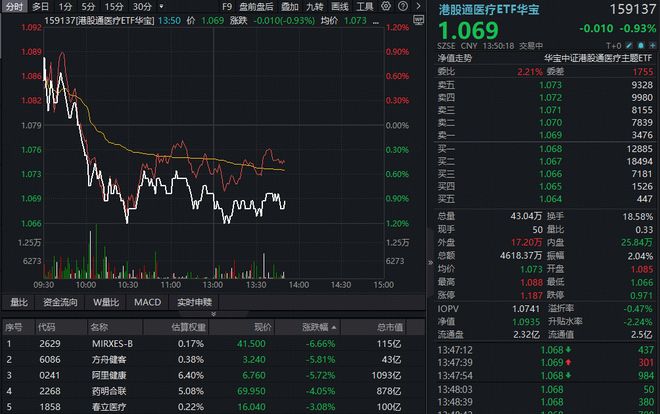
20cm速递|创业板医药ETF国泰(159377)回调超2.4%,医疗器械替代与脑机接口成焦点
Mei Ri Jing Ji Xin Wen· 2026-01-16 06:23
Group 1 - The core viewpoint of the article highlights the rapid development of brain-computer interfaces (BCIs) driven by both policy and technology in China and abroad [1] - Invasive BCIs are beginning clinical trials in China, with a focus on leading companies and advancements in flexible electrodes, implantation technology, and specific scenario algorithms [1] - Semi-invasive and invasive pathways emphasize "data readout" and "enrollment scale," which can significantly enhance commercialization certainty and industry attention [1] - Non-invasive BCIs are noted for their unique combination of "medical + consumer" driving forces, with faster commercialization of overall technology pathways [1] - The acceleration of AI applications in healthcare is evident, with OpenAI's launch of ChatGPT Health marking a significant penetration of general models into medical health scenarios [1] - The integration of internet healthcare and AI in China is gradually becoming a crucial direction in the AI era [1] Group 2 - The Guotai ETF (159377) tracks the Innovation Medicine Index (399275), which selects listed companies involved in biotechnology, genetic engineering, and new vaccine and drug development from the ChiNext market [1] - This index aims to reflect the overall performance of listed companies in the innovative biopharmaceutical sector [1]

ETF盘中资讯|AI医疗继续降温,阿里健康再挫5%,港股通医疗ETF(159137)续跌1%!A股最大医疗ETF下探2%,美年健康跌停
Sou Hu Cai Jing· 2026-01-16 06:14
Group 1 - The AI healthcare concept in the A-share and Hong Kong markets is experiencing a "cooling" phase, with significant declines in stocks such as Alibaba Health and Weining Health [1][3] - The overall performance of the AH market has weakened, leading to a decrease in short-term sentiment and risk appetite among investors [3] - Despite short-term volatility, the long-term investment logic for AI healthcare remains intact, with the industry entering a critical phase of commercialization driven by national strategy and market demand [3] Group 2 - The global AI healthcare market is projected to grow from approximately $26.65 billion in 2024 to about $505.59 billion by 2033, with a compound annual growth rate (CAGR) of 38.8% [4] - In China, the AI healthcare industry is expected to increase from 97.3 billion yuan in 2023 to 159.8 billion yuan by 2028 [4] - The largest medical ETF in the market, with a scale of 27 billion yuan, covers 12 AI healthcare and brain-computer interface concept stocks, accounting for over 36% of its total weight [4]
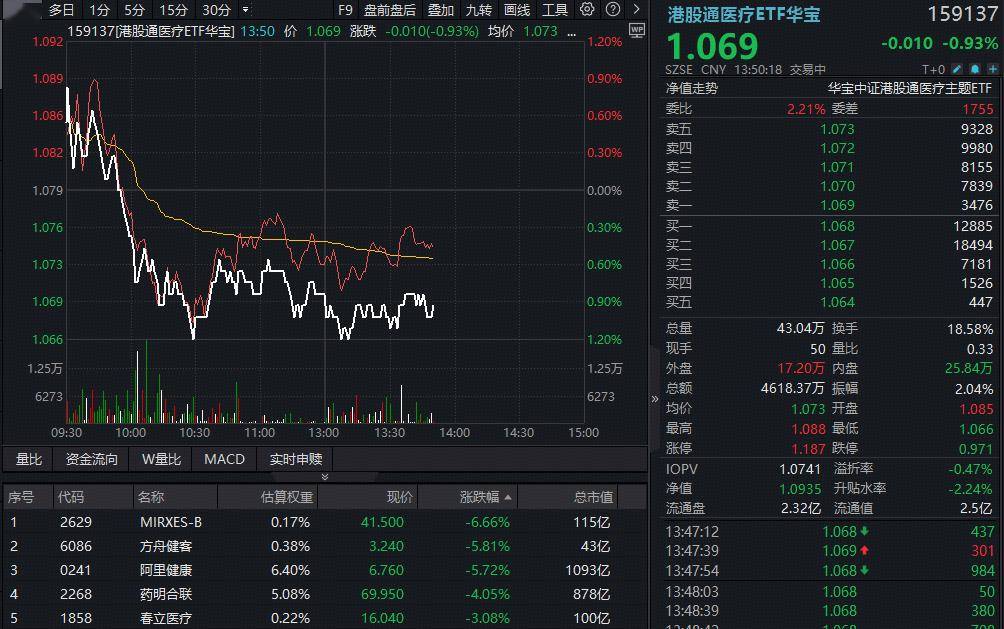
AI医疗继续降温,阿里健康再挫5%,港股通医疗ETF(159137)续跌1%!A股最大医疗ETF下探2%,美年健康跌停
Xin Lang Cai Jing· 2026-01-16 06:11
Market Performance - Alibaba Health experienced a decline of over 5% following a nearly 8% drop the previous day, with other AI healthcare stocks like Ark Health and Yidu Tech also falling [1][8] - In the A-share market, Weining Health dropped over 12%, while Meinian Health hit a three-year high before facing a trading halt [3][11] - The largest healthcare ETF in the market (512170) saw a decline of 2%, with real-time transactions exceeding 700 million yuan [3][11] Market Sentiment - Analysts noted that the AI healthcare sector had seen significant gains at the beginning of the year, leading to profit-taking behavior in the market [10] - The overall performance of the AH market has been weak in recent days, indicating a cooling of short-term sentiment and risk appetite [10] Long-term Outlook - Despite short-term volatility, the long-term investment logic for AI healthcare remains intact, with the industry entering a critical phase of commercialization driven by policy, hospital engagement, and product development [5][10] - The global AI healthcare market is projected to grow from approximately $26.65 billion in 2024 to about $505.59 billion by 2033, with a compound annual growth rate (CAGR) of 38.8% [5][10] - In China, the AI healthcare industry is expected to grow from 97.3 billion yuan in 2023 to 159.8 billion yuan by 2028 [6][10] Investment Tools - The Hong Kong Stock Connect Medical ETF (159137) is highlighted as a high-elasticity investment tool, focusing on core leaders in the healthcare sector, including AI healthcare and brain-computer interface innovations [12] - The A-share market's largest healthcare ETF (512170) and its associated funds cover 12 AI healthcare and brain-computer interface concept stocks, with a combined weight exceeding 36% [12]

OpenAI砸巨资投脑机接口,Altman又要和马斯克较量了
Hua Er Jie Jian Wen· 2026-01-16 04:09
Core Insights - Merge Labs, co-founded by OpenAI CEO Sam Altman, has raised $252 million in funding, with OpenAI as the largest investor, aiming to develop brain-computer interface devices to seamlessly connect humans with AI [1] - The funding round was led by Bain Capital, with other investors including Gabe Newell, co-founder of Valve Corporation [1] - Merge plans to initially focus on medical applications before expanding to consumer products, although it has not disclosed its valuation [1] Company Overview - Merge aims to develop non-invasive brain-computer interface devices, differentiating itself from competitors like Neuralink, which focuses on invasive implants [2] - The company is positioned as a research lab to tackle complex scientific and engineering challenges associated with high-bandwidth devices that can process large amounts of data [2] - Merge currently has fewer than 50 employees and is planning to continue hiring, without a designated president or CEO [5] Competitive Landscape - The launch of Merge intensifies the competition between Altman and Elon Musk, who were once close business partners and co-founders of OpenAI [3] - Musk founded Neuralink in 2016 to develop implantable devices aimed at enhancing human capabilities and preventing obsolescence in the age of AI [4] Industry Dynamics - The brain-computer interface sector has seen rapid growth, with over $2 billion in funding in the U.S., driven by advancements in AI that provide the necessary computational power for brain implants [5] - Companies are exploring non-surgical products, such as external headsets, which are perceived as more attractive to consumers [5]
AI医疗概念火爆,台积电业绩爆表!资金集中抢筹医疗设备ETF(159873),芯片ETF天弘(159310)标的指数涨超3%
Sou Hu Cai Jing· 2026-01-16 03:31
Group 1 - The medical device sector is experiencing volatility, with the medical device ETF (159873) achieving a trading volume of 48.6 million yuan and a turnover rate exceeding 26%, leading in its category [1] - The medical device ETF has seen a net inflow of over 60 million yuan in the past 10 days, with a net subscription of 57 million units in the latest session [1] - TSMC's fourth-quarter earnings report exceeded expectations, with a net profit growth of 35% year-on-year, signaling a sustained AI boom [1] Group 2 - The medical device ETF (159873) tracks the healthcare index and has a high concentration of brain-computer interface stocks, accounting for over 17% of its holdings [2] - The ETF includes significant exposure to innovative domestic companies and is expected to undergo a comprehensive valuation recovery due to accelerated exports and new technologies [2] - The chip ETF Tianhong (159310) tracks the semiconductor industry index and benefits directly from domestic substitution and technological breakthroughs in the semiconductor sector [2]

2026年八大科技风向标来了
21世纪经济报道· 2026-01-16 03:03
Core Insights - The article discusses the rapid advancements in technology expected by 2025 and the transformative impact on various industries, particularly in AI, quantum computing, fusion energy, and aerospace engineering [1] Group 1: Major Technological Events in 2025 - DeepSeek emerged as a leading open-source AI model, significantly improving GPU utilization and reducing model costs, thus enabling a new wave of AI efficiency [4][5] - The commercial space industry accelerated, with SpaceX's Starship achieving a complete flight cycle, marking a milestone in the maturity of commercial space transportation [6] - China made significant strides in lunar exploration with the Chang'e 6 mission, revealing critical insights into the moon's evolution [7] Group 2: Robotics and AI Integration - The 2025 Spring Festival featured humanoid robots performing traditional performances, showcasing China's advancements in robotics and AI technology [8] - The year saw a surge in interest and investment in humanoid robots, with applications expanding into various industrial sectors [9] Group 3: Semiconductor and Storage Innovations - A "super cycle" in storage chips was initiated as major companies shifted production towards AI-related storage solutions, leading to price increases across various hardware sectors [10] Group 4: Breakthroughs in Fusion and Quantum Computing - China's EAST facility achieved a significant milestone in controlled nuclear fusion, sustaining plasma at 100 million degrees Celsius for over 1,000 seconds [11] - The competition in quantum computing intensified, with China and Google making notable advancements in superconducting quantum processors [12] Group 5: AI in Consumer Electronics - The "battle of AI glasses" emerged in 2025, with various companies competing to establish a foothold in the AI-driven consumer electronics market [13][14] Group 6: AI Chip Market Dynamics - Domestic AI chip companies accelerated their market entry, while international firms like Broadcom and Google sought to reduce reliance on Nvidia by developing custom ASIC chips [15] Group 7: Future Trends in 2026 - AI agents are predicted to mature, enabling collaborative intelligence that could revolutionize interaction interfaces and operational efficiency for businesses [17] - AI technology is expected to transition from cloud-based systems to physical applications, with humanoid robots entering domestic and healthcare settings [18][19] - The commercialization of L3 autonomous driving is anticipated to expand, impacting urban transportation structures [20] - Quantum computing is nearing practical application, with significant advancements expected in 2026 [21] - The demand for computational power is driving upgrades in the energy sector, with tech companies investing in sustainable energy solutions [22][23] - Brain-computer interface technology is transitioning towards commercial applications, with significant investments and developments in the field [24] - The commercial space industry is expected to mature, with established revenue streams and reduced launch costs [25] - The low-altitude transportation sector is poised for large-scale development, with significant orders and strategic expansions in the eVTOL market [26][27]

医疗手术机器人观点汇报电话会
2026-01-16 02:53
Summary of Medical Surgical Robots Conference Call Industry Overview - The medical surgical robot market in China is in its early stages, with a market size of less than 100 billion RMB, but is experiencing rapid growth due to improvements in policies, payment systems, and hospital demand [1][2][5] - The laparoscopic surgical robot segment is a major focus, with a global market size of approximately 10.2 billion USD and a compound annual growth rate (CAGR) of 17%. The domestic market size is around 4 billion RMB, with a CAGR of 15% [1][3] Key Companies and Market Dynamics - Major players in the laparoscopic surgical robot market include Intuitive Surgical's Da Vinci system, which has a penetration rate in the U.S. of 5,800 units and nearly 10,000 globally, while domestic installations are below 500, indicating significant room for growth [3] - In the orthopedic surgical robot sector, Tianzhihang is a leading domestic company with a high market share, focusing on trauma, spine, and joint surgeries. The market is expected to grow rapidly due to improved policies and clinical demand [1][2][3] Technological Advancements - Significant advancements in surgical robot technology have been made, including breakthroughs in hardware and software systems. The integration of brain-machine interfaces is becoming essential, driving the industry towards high mobility and high-speed automation, significantly enhancing efficiency [4] - The Da Vinci system has achieved a mature status with multi-port and single-port systems, completing over a million cases in the U.S. and achieving a penetration rate of 22% [4] Policy Impact - Recent policy changes have clarified service operation projects and pricing mechanisms, promoting rationalization of service prices and enhancing hospitals' willingness to purchase and use surgical robots. This is expected to accelerate industry development [5] - The payment system is gradually improving, with more hospitals adopting relevant fee structures, which will enhance effective charging capabilities at the terminal level [5] Market Trends and Future Outlook - The demand for surgical robots is strong, particularly for cardiovascular and neurosurgery applications, with companies like Huake Precision capturing significant market shares [8] - Domestic companies are competing with imported brands and are moving towards multi-functional platforms. Tianzhihang has developed a technology platform that covers multiple surgical areas [7] - The overseas market for domestic companies is approaching 10 billion RMB, indicating potential for significant growth in international markets [7] Notable Companies in the Market - Tianzhihang is recognized as a leading orthopedic surgical robot company, with products covering spine, trauma, and joint surgeries, and has received EU CE certification [9][10] - MicroPort Medical is one of the strongest domestic companies, with a product range that includes laparoscopic and orthopedic robots, and has received significant orders [11] - Jingfeng Medical focuses on multi-port and single-port laparoscopic robots, with strong sales performance and a growing presence in international markets [12] - Sanyou Medical is developing a spine surgical robot expected to be launched in 2026, enhancing safety in complex procedures [13] Conclusion - The medical surgical robot industry in China is poised for rapid growth driven by technological advancements, supportive policies, and increasing clinical demand. Domestic companies are making significant strides in both the local and international markets, positioning themselves competitively against established global brands [1][2][5][7][8]

