
区块链技术

Search documents
央行新规正式实施——“现金”变“存款” 数字人民币迈入2.0时代
Sou Hu Cai Jing· 2026-01-13 01:52
Group 1: Core Insights - The People's Bank of China has officially implemented the "Action Plan" for enhancing the management and service system of digital RMB, marking the transition to the 2.0 era of digital currency [3][4] - By the end of November 2025, digital RMB is expected to process 3.48 billion transactions with a total transaction amount of 16.7 trillion yuan [3][4] Group 2: Changes in Digital RMB - The digital RMB will evolve from a digital cash model to a digital deposit currency model, allowing for interest accrual on wallet balances held at banks [5][6] - The new model will expand the application scenarios of digital RMB across various sectors, including retail, education, and cross-border payments, enhancing its usability [5][6] Group 3: Dual-Layer Architecture - The "Action Plan" optimizes the dual-layer operational framework, where the central bank sets the rules and standards while commercial banks manage customer wallets and ensure compliance [7][8] - This upgrade is expected to increase commercial banks' motivation to promote digital RMB, aligning their responsibilities and benefits [7][8] Group 4: Technological Advantages - China's approach to digital RMB combines account-based management with blockchain efficiency, aiming for lower costs and higher efficiency in digital payments [9][10] - The integration of blockchain technology is expected to enhance the security and traceability of transactions, benefiting various financial applications [9][10] Group 5: Internationalization and Cross-Border Payments - The establishment of an international digital RMB operation center in Shanghai aims to improve cross-border payment efficiency and facilitate the internationalization of the RMB [10] - By the end of November 2025, the multilateral central bank digital currency bridge is projected to handle 4,047 cross-border payment transactions, with digital RMB accounting for approximately 95.3% of the transaction volume [10]



央行新规正式实施 “现金”变“存款” 数字人民币迈入2.0时代
Ke Ji Ri Bao· 2026-01-13 00:55
Core Viewpoint - The People's Bank of China has launched the "Action Plan" to enhance the management and service system of the digital renminbi, marking the transition to the 2.0 era of digital currency, which includes a new measurement framework, management system, operational mechanism, and ecosystem [1] Group 1: Application Scenarios - The Action Plan indicates a shift from digital cash to digital deposit currency, allowing digital renminbi to function as a modern payment and circulation method with attributes of commercial bank liabilities [2] - Digital renminbi will now earn interest as it is treated as a deposit, enhancing benefits for both individuals and enterprises [3] - The digital renminbi has achieved full-scenario currency capabilities across various sectors, including retail, education, and cross-border payments, creating replicable and scalable application models [3] Group 2: Dual-Layer Architecture Optimization - The Action Plan optimizes the dual-layer operational system, where the central bank sets rules and standards while commercial banks manage customer wallets and ensure compliance [4] - The upgrade of the dual-layer architecture is expected to increase commercial banks' enthusiasm for promoting digital renminbi, as it aligns responsibilities and benefits [5] - Digital renminbi will be included in the reserve requirement framework, allowing banks to manage it as a liability, thus enhancing financial stability and security [5] Group 3: Technological Advantages - China's approach to digital renminbi combines account-based management with blockchain efficiency, aiming for lower costs and higher efficiency in digital payments [6][7] - The establishment of an international operational center for digital renminbi in Shanghai aims to enhance cross-border payment efficiency using blockchain technology [7] - The multi-central bank digital currency bridge has processed 4,047 cross-border payment transactions, with digital renminbi accounting for approximately 95.3% of the transaction volume, indicating its growing role in international trade [8]
“存款” 数字人民币迈入2.0时代
Xin Hua Wang· 2026-01-12 23:38
Core Viewpoint - The People's Bank of China has launched the "Action Plan" to strengthen the management and service system of digital RMB, marking the transition to the 2.0 era of digital currency, with significant implications for individuals, businesses, and banks [1][2]. Group 1: Changes in Digital RMB - The "Action Plan" indicates a shift from digital cash to digital deposit currency, with digital RMB now having attributes of commercial bank liabilities and being based on accounts [2][3]. - Digital RMB will now accrue interest for users, enhancing its appeal for both individuals and businesses [3]. - The digital RMB has achieved full-scenario currency capabilities, applicable in various sectors including retail, education, and cross-border payments [3]. Group 2: Optimization of the Dual-Layer Architecture - The "Action Plan" optimizes the dual-layer operational system, where the central bank sets rules and standards while commercial banks manage user wallets and ensure compliance [4][5]. - This upgrade encourages commercial banks to actively promote digital RMB, aligning their responsibilities and benefits [4][6]. Group 3: Technological Advantages - China's digital RMB development integrates account-based management with blockchain efficiency, aiming for lower costs and higher efficiency in payment services [7]. - The use of blockchain technology enhances security and traceability, making it advantageous for various financial applications [7]. Group 4: Internationalization and Cross-Border Payments - The establishment of a digital RMB international operation center in Shanghai aims to improve cross-border payment efficiency, facilitating the internationalization of the RMB [8]. - As of November 2025, the multilateral central bank digital currency bridge has processed significant cross-border transactions, with digital RMB accounting for approximately 95.3% of the total transaction volume [8].
协鑫新能源再涨超10% 月内累涨逾八成 公司近期引入Pharos战略投资
Zhi Tong Cai Jing· 2026-01-12 03:57
Core Viewpoint - GCL-Poly Energy (00451) has seen its stock price increase by over 80% in January, with a current rise of 6.52% to HKD 1.47, and a trading volume of HKD 33.09 million [1] Group 1 - On January 8, GCL-Poly Energy announced a plan to issue 186.5 million shares to the subscriber Pharos, raising approximately HKD 192 million [1] - Pharos is a next-generation Layer 1 blockchain focused on building institutional-level tokenized asset application scenarios, which will leverage its advanced technology and the group's resource advantages [1] - The investment aims to accelerate the integration of Web3 and the renewable energy industry, creating synergistic value for all parties involved [1] Group 2 - The investment allows the company to explore the potential of blockchain technology in innovating the renewable energy sector and aims to create sustainable value for shareholders [1] - The board believes that the subscription represents a good opportunity for the group to expand its capital and shareholder base [1]
港股异动 | 协鑫新能源(00451)再涨超10% 月内累涨逾八成 公司近期引入Pharos战略投资
智通财经网· 2026-01-12 03:56
Core Viewpoint - GCL-Poly Energy (00451) has seen its stock price increase by over 80% in January, with a current rise of 6.52% to HKD 1.47, and a trading volume of HKD 33.09 million [1] Group 1: Company Actions - On January 8, GCL-Poly Energy announced a plan to issue 186.5 million shares to the subscriber Pharos, aiming to raise approximately HKD 192 million [1] - The investment from Pharos, a next-generation Layer 1 blockchain focused on institutional-grade tokenized asset applications, is expected to leverage advanced technology and the company's resources to accelerate the integration of Web3 and the renewable energy sector [1] Group 2: Strategic Implications - The collaboration with Pharos is anticipated to create synergistic value for all parties involved, while also allowing the company to explore the potential of blockchain technology in renewable energy innovation [1] - The board believes that this subscription represents a good opportunity for the company to expand its capital and shareholder base [1]
茅台董事长最新表态
财联社· 2026-01-11 05:40
Core Viewpoint - iMoutai is making significant progress with the launch of its 2026 53-degree 500ml Flying Moutai liquor, which sold out immediately upon release, indicating strong demand in the market [2]. Group 1: Product Launch and Sales - On January 1, iMoutai officially launched the 2026 53-degree 500ml Flying Moutai liquor at a price of 1499 yuan per bottle, which sold out instantly [2]. - To meet user demand, iMoutai announced that from January 4 until before the Spring Festival, the maximum purchase limit for the 53% vol 500ml Guizhou Moutai liquor would be adjusted to 6 bottles per person per day, down from the previous limit of 12 bottles [2]. Group 2: User Growth and Business Expansion - As of January 9, the number of new users on the iMoutai platform exceeded 2.7 million, with over 400,000 users having made purchases [3]. - In addition to liquor sales, Guizhou Moutai is expanding into other business areas, as evidenced by the establishment of Guizhou Aimaotai Digital Technology Co., Ltd., with a registered capital of 600 million yuan. The company's business scope includes internet live streaming technology services, blockchain technology-related software and services, integrated circuit chip sales, and industrial internet data services [3].


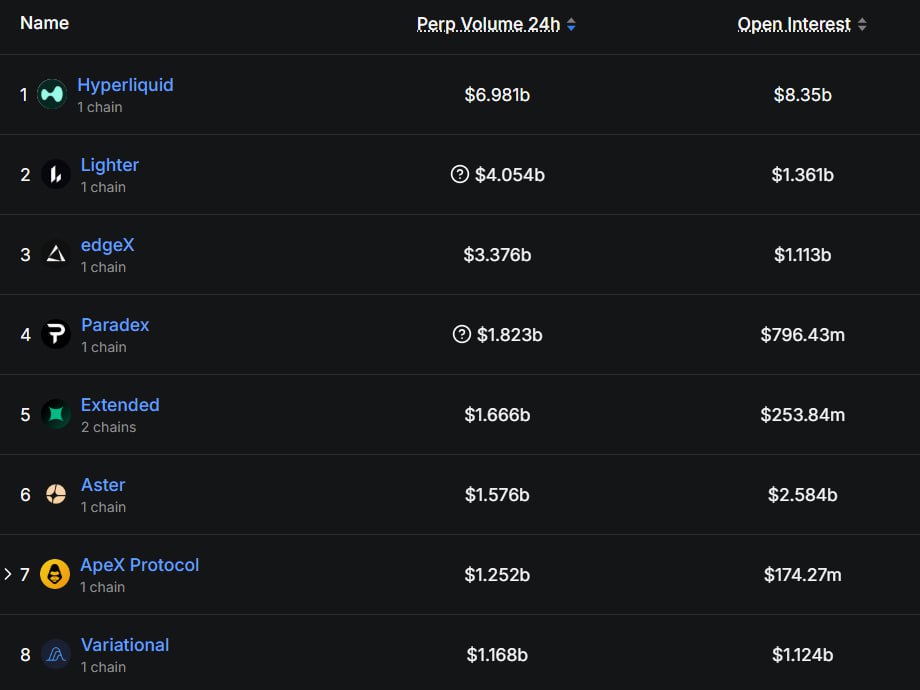
交易量前五的 Perp DEX 中有三家采用 StarkNet 技术
Xin Lang Cai Jing· 2026-01-11 03:47
Core Insights - In the past 24 hours, three of the top five Perpetual DEXs by trading volume have utilized StarkNet technology, indicating a growing trend in the adoption of Layer 2 solutions in decentralized finance [1] - Notably, eight Perpetual DEXs have recorded trading volumes exceeding $1 billion in the same timeframe, showcasing significant market activity and liquidity [1] Group 1 - The three Perpetual DEXs using StarkNet technology are edgeX with StarkEx, Paradex with StarkNet Appchain, and Extended with StarkNet mainnet [1] - The overall trading volume for the top Perpetual DEXs reflects a robust interest in decentralized trading platforms [1] - The presence of multiple DEXs surpassing $1 billion in trading volume highlights the competitive landscape within the DeFi sector [1]
NDV 眼中的 2025 加密货币大事件
Xin Lang Cai Jing· 2026-01-10 11:13
Core Insights - 2025 is marked as a pivotal year in financial history, transitioning the digital asset industry from the periphery to the core, and from speculation to institutionalization [2] - The market is experiencing a correction after a strong performance in 2024, with Bitcoin underperforming compared to traditional asset classes, but the establishment of infrastructure and regulatory frameworks lays a solid foundation for recovery in 2026 [2] - The year is characterized by unprecedented legislative breakthroughs in major economies, particularly in the U.S., ending a decade of regulatory ambiguity [2] Regulatory Framework: Three Major Acts Defining Global Compliance - The U.S. "GENIUS Act" establishes strict rules for the stablecoin market, requiring 100% reserve backing and prohibiting interest, thereby reinforcing the dollar's dominance [4] - The "CLARITY Act" creates a new category of "digital commodities," allowing certain tokens to be reclassified and granting exclusive regulatory authority to the CFTC over the digital commodity spot market [5] - The resolution of legal issues surrounding Binance and its founder, CZ, signifies a shift in regulatory attitudes, moving from conflict to compliance [7] Emergence of New Trading Categories: Three New Financial Instruments - Circle's IPO on June 4 marks a significant merger of crypto and traditional finance, with its stock price experiencing extreme volatility and raising concerns about its business model's sustainability [8] - The rise of prediction markets and tokenized stocks demonstrates the integration of blockchain technology into traditional financial systems, with significant trading volumes reported [9] - The adoption of Bitcoin as a reserve asset by 142 publicly traded companies, including MicroStrategy, highlights a growing trend in corporate treasury management [10] Crisis Moments: Three Major Events Testing Industry Resilience - The launch of the $TRUMP token raises ethical concerns regarding conflicts of interest and market manipulation, reflecting the intersection of politics and crypto [12] - A significant security breach resulted in over $3.4 billion in theft, showcasing vulnerabilities in the industry and the challenges of regulatory enforcement [13] - A market crash on October 10 led to over $19 billion in liquidations, illustrating the high leverage and sensitivity of the crypto market to macroeconomic sentiments [14] Conclusion - The year 2025 represents a critical transition for the crypto industry, establishing a legal framework that integrates digital assets into the dollar-centric financial system [15] - The exploration by companies like MicroStrategy and Circle serves as a model for the industry, while the emergence of prediction markets showcases the transformative potential of blockchain technology [15] - Despite regulatory advancements, the industry remains susceptible to volatility and risks, emphasizing the need for ongoing vigilance and adaptation [15]


PhotonPay光子易获数千万美元B轮融资,IDG领投
暗涌Waves· 2026-01-09 01:51
Core Viewpoint - PhotonPay, a global AI-driven digital financial infrastructure platform, has recently completed a multi-million dollar Series B funding round led by IDG Capital, with participation from several other investors, indicating strong market interest and potential for growth in the digital payment sector [2][3]. Group 1: Company Overview - The founder of PhotonPay, Chen Min, previously worked on overseas payment systems at Baidu, gaining insights into the fragmented global payment infrastructure [3]. - PhotonPay aims to create a comprehensive financial infrastructure that addresses the complexities of global payments, moving beyond just faster transactions to a more integrated solution for global enterprises [4][5]. Group 2: Business Model and Strategy - PhotonPay's business logic is based on the deep understanding of the fragmented nature of global payment infrastructures, opting for a "native" approach to reconstruct the foundational systems rather than relying on existing channels [7][8]. - The company has invested years in developing a modular system that allows for flexible and efficient global payment operations, significantly reducing transaction costs by over 75% for thousands of enterprises [9][10]. Group 3: Target Market and Client Engagement - PhotonPay focuses on high-complexity scenarios often overlooked by traditional payment systems, such as advertising, international logistics, and digital entertainment, where financial operations require precision and flexibility [11][12]. - The company employs an "embedded finance" model, integrating payment capabilities directly into clients' business systems, enhancing operational efficiency and creating a deeper partnership with clients [13]. Group 4: Future Vision and Technological Innovations - PhotonPay is exploring the integration of blockchain technology to enhance the speed and transparency of global transactions, potentially transforming the traditional payment landscape [15][16]. - The company plans to expand its financial services beyond payments to include asset management and innovative financial products, leveraging its growing platform and client base [17][18]. - PhotonPay is also internationalizing its organizational structure, establishing operational centers globally and aiming to attract local talent to enhance its service capabilities [18].

吴说每日精选加密新闻 - 美国至 1 月 3 日当周初请失业金人数 20.8 万人,预期 21 万人
Xin Lang Cai Jing· 2026-01-08 14:51
Group 1 - Initial jobless claims in the U.S. for the week ending January 3 were 208,000, lower than the expected 210,000, with the previous value revised from 199,000 to 200,000 [1] - The U.S. trade balance for October showed a deficit of $29.4 billion, significantly better than the expected deficit of $58.9 billion, with the previous value revised from -$52.8 billion to -$48.1 billion [1] Group 2 - Brazilian presidential candidate Renan Santos proposed the establishment of a national Bitcoin strategic reserve, claiming the plan is feasible and included in his campaign platform [1] - Santos, founder of the newly formed "Partido Missão," aims to emulate El Salvador's Bitcoin policy and anti-corruption approach, highlighting the increasing domestic discussions on incorporating Bitcoin into national financial reserves [1] Group 3 - Vitalik Buterin, co-founder of Ethereum, emphasized that improving bandwidth and scalability is more crucial for decentralization security than merely reducing latency [1] - He noted that latency is constrained by physical realities and that Ethereum should function as a "global heartbeat" rather than a low-latency game server, suggesting future applications will rely on Layer 2 and off-chain components [1] Group 4 - The Electric Coin Company (ECC), the core developer of Zcash, announced its collective departure from the governance structure due to a significant deviation from Zcash's core mission by the nonprofit organization Bootstrap [2] - ECC's CEO stated that the new company will maintain the original team's mission to create an "unstoppable privacy currency," and this governance conflict does not affect the Zcash protocol itself [2] Group 5 - A new phishing technique has emerged, with a high-risk privilege escalation vulnerability discovered in Anthropic's Claude Code, allowing attackers to execute commands without user authorization [2] - The vulnerability, identified as CVE-2025-64755, has been linked to similar issues previously disclosed in the Cursor tool, raising concerns for users during Vibe Coding or when using mainstream IDEs [2]