
南向资金

Search documents
南向资金今日净买入12.58亿港元
Zheng Quan Shi Bao· 2025-12-18 09:43
买入成交额 (亿港元) 卖出成交额 12月18日南向资金全天成交额734.94亿港元,成交净买入12.58亿港元。 证券时报•数据宝统计显示,12月18日恒生指数上涨0.12%,南向资金合计买入成交373.76亿港元,卖出 成交361.18亿港元,合计成交额734.94亿港元。 具体看,港股通(沪)买入成交202.50亿港元,卖出成交213.45亿港元,合计成交额415.95亿港元,成 交净卖出10.95亿港元;港股通(深)买入成交171.26亿港元,卖出成交147.73亿港元,合计成交318.99 亿港元,成交净买入23.53亿港元。(数据宝) 南向资金今日成交概况 (亿港元) 成交净买入 (亿港元) 港股通(深) 171.26 147.73 23.53 港股通(沪) 202.50 213.45 -10.95 合计 373.76 361.18 12.58 注:本文系新闻报道,不构成投资建议,股市有风险,投资需谨慎。 ...
12月17日南向资金ETF成交额19.13亿港元
Zheng Quan Shi Bao· 2025-12-17 13:26
注:本文系新闻报道,不构成投资建议,股市有风险,投资需谨慎。 南向资金ETF买入及卖出成交额 港股通(沪)(亿港元) 10.21 港股通(深)(亿港元) 8.92 港股通合计(亿港元) 19.13 今日(12月17日)南向资金ETF买入及卖出成交额为19.13亿港元,较前一日增加7.63亿港元,占南向资 金今日成交额的2.40%。 具体来看,港股通(沪)ETF买入及卖出成交额10.21亿港元,港股通(深)ETF买入及卖出成交额8.92 亿港元。(数据宝) ...
南向资金今日净买入79.09亿港元
Zheng Quan Shi Bao· 2025-12-17 10:10
南向资金今日成交概况 买入成交额 12月17日南向资金全天成交额796.25亿港元,成交净买入79.09亿港元。 证券时报•数据宝统计显示,12月17日恒生指数上涨0.92%,南向资金合计买入成交437.67亿港元,卖出 成交358.58亿港元,合计成交额796.25亿港元。 具体看,港股通(沪)买入成交238.60亿港元,卖出成交216.42亿港元,合计成交额455.02亿港元,成 交净买入22.18亿港元;港股通(深)买入成交199.07亿港元,卖出成交142.16亿港元,合计成交341.23 亿港元,成交净买入56.91亿港元。(数据宝) (亿港元) 成交净买入 (亿港元) 港股通(深) 199.07 142.16 56.91 港股通(沪) 238.60 216.42 22.18 合计 437.67 358.58 79.09 注:本文系新闻报道,不构成投资建议,股市有风险,投资需谨慎。 (亿港元) 卖出成交额 ...
招商证券:近期港股微观流动性存在什么问题?
智通财经网· 2025-12-16 12:55
Core Viewpoint - The Hong Kong stock market has not stabilized after recent overseas interest rate cuts, primarily due to two internal liquidity issues: the implementation of new public fund benchmark regulations, which may lead to selling of some Hong Kong stocks, and a significant demand for funds in the Hong Kong market. However, the overall impact of these issues is considered limited [1]. Group 1: Industry and Index Recommendations - Recommended sectors include Internet (930604.CSI), Non-ferrous Metals (931947.CSI), and Hong Kong Stock Connect Non-bank Financials (931024.CSI) [2]. Group 2: Market Performance - The Hong Kong market showed mixed performance last week (12/08-12/12), with the Hang Seng Index declining by 0.42% and the Hang Seng Tech Index down by 0.43%. The AH premium remains at 119.8. Among major sectors, only Financials and Information Technology saw gains, while the Energy sector experienced the largest decline [2]. Group 3: Micro Funding Conditions - For the first time in six months, there was a net outflow of southbound funds, while both Hong Kong and foreign capital saw net inflows. Specifically, southbound funds had a net outflow of 3.4 billion HKD, primarily directed towards non-essential consumption. Foreign capital net bought 260 million USD through ETFs, with cumulative net inflows nearing a new high since 1994. Local Hong Kong ETFs also saw a net inflow of 5.1 billion HKD, totaling 45.9 billion HKD year-to-date [2]. Group 4: Hong Kong Liquidity Changes - The liquidity in the Hong Kong market is becoming more accommodative, with the overnight Hibor at 1.71% and the 3-month Hibor at 3.03%. The USD to HKD exchange rate is at 7.78, approaching the strong-side Convertibility Undertaking [2]. Group 5: Overseas Liquidity Changes - In the U.S., the 2-year Treasury yield is at 3.522% (down 36 basis points), while the 10-year Treasury yield is at 4.182% (up 47 basis points). The U.S. Treasury General Account (TGA) balance is at 80.58 billion USD (a weekly decrease of 10.27 billion USD), and the usage of overnight reverse repos (ONRRP) has decreased to 8.4 billion USD (a weekly decrease of 650 million USD) [3].

南向资金累计净买入1.39万亿港元
Mei Ri Jing Ji Xin Wen· 2025-12-16 12:16
Group 1 - The core viewpoint of the articles highlights that 2025 has seen unprecedented inflows of southbound capital into the Hong Kong stock market, with a cumulative net purchase amount reaching 50,912.63 billion HKD as of December 15, 2025, and a record annual net purchase of 13,934.72 billion HKD [1][3] - The Hang Seng Index has performed exceptionally well, with a year-to-date increase of over 27%, making it the top-performing global index [3] - Major stocks favored by southbound capital include Tencent Holdings and Alibaba, with Tencent holding a market value of 6,204 billion HKD and Alibaba at 3,422 billion HKD [4] Group 2 - Despite significant purchases by southbound capital, not all companies have seen corresponding stock price increases, as evidenced by the performance of certain stocks that have declined despite increased holdings [5][6] - Southbound long-term capital is becoming a key driver for the restructuring of liquidity and optimization of valuation in the Hong Kong stock market, with expectations of continued inflows and improvements in market conditions [7]






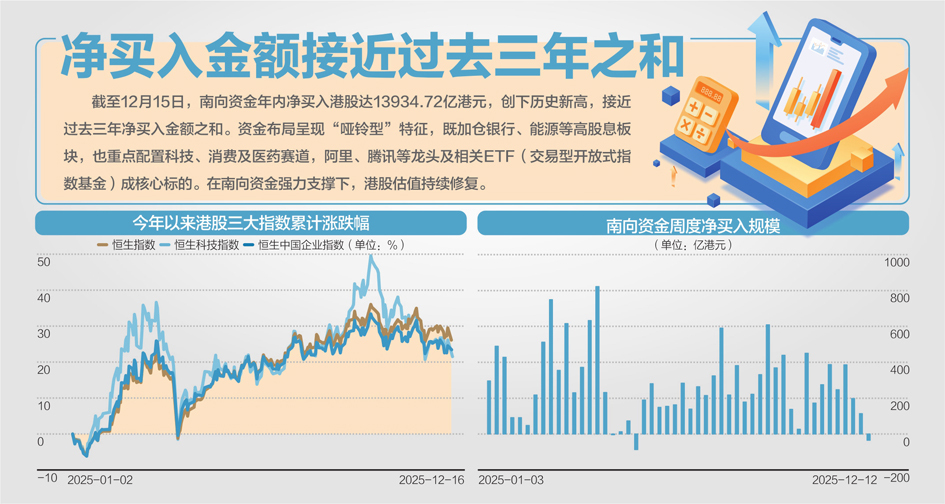
南向资金今日净买入0.83亿港元
Zheng Quan Shi Bao Wang· 2025-12-16 09:51
具体看,港股通(沪)买入成交254.07亿港元,卖出成交265.12亿港元,合计成交额519.19亿港元,成 交净卖出11.05亿港元;港股通(深)买入成交193.34亿港元,卖出成交181.46亿港元,合计成交374.80 亿港元,成交净买入11.88亿港元。(数据宝) 南向资金今日成交概况 证券时报•数据宝统计显示,12月16日恒生指数下跌1.54%,南向资金合计买入成交447.41亿港元,卖出 成交446.58亿港元,合计成交额893.99亿港元。 注:本文系新闻报道,不构成投资建议,股市有风险,投资需谨慎。 (原标题:南向资金今日净买入0.83亿港元) | | 买入成交额 | 卖出成交额 | 成交净买入 | | --- | --- | --- | --- | | | (亿港元) | (亿港元) | (亿港元) | | 港股通(深) | 193.34 | 181.46 | 11.88 | | 港股通(沪) | 254.07 | 265.12 | -11.05 | | 合计 | 447.41 | 446.58 | 0.83 | 12月16日南向资金全天成交额893.99亿港元,成交净买入0.83亿港元。 ...
港股速报|港股继续下跌 原因找到了!后市如何操作?
Mei Ri Jing Ji Xin Wen· 2025-12-16 09:09
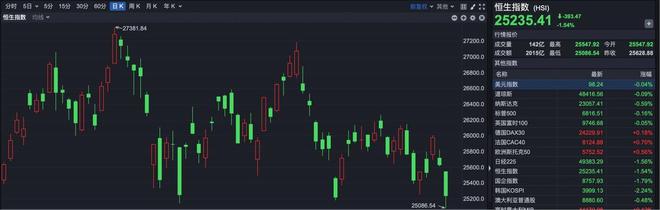
Market Performance - The Hong Kong stock market experienced a significant decline, with the Hang Seng Index closing at 25,235.41 points, down 393.47 points, representing a drop of 1.54% [1] - The Hang Seng Technology Index also fell, closing at 5,402.51 points, down 95.91 points, a decrease of 1.74% [2] Market Influences - The decline in the Hong Kong market was attributed to overall low market sentiment and a collective drop in the Asia-Pacific markets, notably the Nikkei 225 index down 1.56% and the KOSPI index down 2.24%, which negatively impacted both A-shares and H-shares [4] - Anticipation of the Bank of Japan's monetary policy meeting on December 18-19, where a potential interest rate hike from 0.5% to 0.75% is expected, may lead to foreign capital returning to Japan, increasing risk aversion and affecting the Hong Kong market [7] Sector Performance - The market saw widespread declines across various sectors, with notable drops in technology stocks such as Alibaba down nearly 3%, and other major players like Xiaomi, JD.com, and Bilibili down over 2% [7] - Gold stocks also faced declines, with Zijin Mining down over 4%, and other gold companies like Shandong Gold and Lingbao Gold down over 3% [7] Capital Flow - There was a net inflow of southbound funds into Hong Kong stocks, amounting to over 80 million HKD by the end of the trading day [8] Future Outlook - Analysts suggest that the Hong Kong market is at a potential rebound phase, with attractive long-term positioning despite existing risks. The focus remains on the economic fundamentals of China and the inflow of southbound capital [10] - The market is expected to remain volatile until the end of the year, with a consensus on a strong policy opening in the first quarter of the next year, particularly favoring sectors like technology and metals [10]





12月15日南向资金ETF成交额12.22亿港元
Zheng Quan Shi Bao Wang· 2025-12-15 14:44
Core Insights - The total trading volume of southbound funds in ETFs reached 1.22 billion HKD on December 15, marking an increase of 191 million HKD from the previous day, accounting for 1.28% of the total trading volume of southbound funds today [1] Summary by Category - **Southbound Funds Trading Volume** - The trading volume for southbound funds in ETFs was 1.22 billion HKD [1] - This represents an increase of 191 million HKD compared to the previous day [1] - The total trading volume accounted for 1.28% of today's southbound fund trading [1] - **Breakdown of Trading Volume** - The trading volume for Hong Kong Stock Connect (Shanghai) ETFs was 939 million HKD [1] - The trading volume for Hong Kong Stock Connect (Shenzhen) ETFs was 283 million HKD [1] - The combined trading volume for both Hong Kong Stock Connects was 1.22 billion HKD [1]
港股通12月15日成交活跃股名单
Zheng Quan Shi Bao Wang· 2025-12-15 14:35
Group 1 - The Hang Seng Index fell by 1.34% on December 15, with southbound trading totaling HKD 951.29 billion, including buy transactions of HKD 493.92 billion and sell transactions of HKD 457.37 billion, resulting in a net buy of HKD 36.54 billion [1] - The southbound trading through Stock Connect (Shenzhen) had a total transaction amount of HKD 440.12 billion, with buy transactions of HKD 235.89 billion and sell transactions of HKD 204.23 billion, leading to a net buy of HKD 31.66 billion [1] - The southbound trading through Stock Connect (Shanghai) had a total transaction amount of HKD 511.17 billion, with buy transactions of HKD 258.03 billion and sell transactions of HKD 253.14 billion, resulting in a net buy of HKD 4.89 billion [1] Group 2 - Among the actively traded stocks, Alibaba-W had the highest transaction amount at HKD 91.22 billion, followed by SMIC and Tencent Holdings with transaction amounts of HKD 40.01 billion and HKD 35.23 billion, respectively [1] - The net buy amounts for individual stocks included Xiaomi Group-W with HKD 13.82 billion, China Ping An with HKD 11.90 billion, and Meituan-W with HKD 5.48 billion [1] - Tencent Holdings had the highest net sell amount at HKD 7.74 billion, with other notable net sells from Hua Hong Semiconductor and China Mobile at HKD 5.55 billion and HKD 5.50 billion, respectively [1] Group 3 - Xiaomi Group-W, China Ping An, and Alibaba-W were among the seven stocks that appeared on both the Shenzhen and Shanghai Stock Connect active trading lists, with Xiaomi Group-W having a total transaction amount of HKD 34.84 billion and a net buy of HKD 13.82 billion [2] - The stocks with the longest consecutive net buys included Xiaomi Group-W and Meituan-W, with 12 days and 4 days of net buying, respectively, and total net buy amounts of HKD 121.52 billion and HKD 46.29 billion [2] - The stocks with the highest consecutive net sells included Tencent Holdings, SMIC, and Hua Hong Semiconductor, with net sell amounts of HKD 24.91 billion, HKD 19.86 billion, and HKD 15.48 billion, respectively [2]



港股投资周报:能源板块领跌,港股精选组合年内上涨59.33%-20251213
Guoxin Securities· 2025-12-13 07:02
证券研究报告 | 2025年12月13日 港股市场创新高热点板块跟踪 我们根据分析师关注度、股价相对强弱、股价路径平稳性、创新高连续性等 角度在过去 20 个交易日创出过 250 日新高的股票池中筛选出平稳创新高股 票。 近期,绿源集团控股等股票平稳创出新高。 按照板块来看,创新高股票数量最多的是周期板块,其次为消费、科技、制 造、大金融和医药板块,具体个股信息可参照正文。 港股市场一周回顾 本年,港股精选组合绝对收益 59.33%,相对恒生指数超额收益 29.83%。 港股精选组合绩效回顾 本周,港股精选组合绝对收益-1.94%,相对恒生指数超额收益-1.53%。 港股投资周报 能源板块领跌,港股精选组合年内上涨 59.33% 概念板块方面,本周电力设备概念板块收益最高,累计收益 9.19%;婴童概 念板块收益最低,累计收益-7.14%。 南向资金监控 南向资金整体方面,本周港股通累计净流出 34 亿港元,近一个月以来港股 通累计净流入 757 亿港元,今年以来港股通累计净流入 13898 亿港元,总 体来看近期南向资金呈现出整体流入的走势。 本周港股通资金中,小米集团-W、招商银行和零跑汽车流入金额最多, ...