
长时储能

Search documents
从拼价格到拼价值储能产业进入关键转型期
Zhong Guo Zheng Quan Bao· 2025-10-10 20:57
Core Insights - The energy storage industry is undergoing a significant material revolution, transitioning from a lithium-dominated landscape to a diversified technological approach, particularly in long-duration energy storage, which is becoming essential for new power systems [1][2] - The industry is moving away from price wars and single technology reliance, entering a critical transformation phase driven by technological diversification, improved market mechanisms, and multi-energy collaboration [1][2] Long-Duration Energy Storage Challenges - The primary challenge facing the energy storage sector is insufficient storage duration, with a need for over 4 hours of storage when renewable energy generation exceeds 20% of total capacity, and over 10 hours when it surpasses 50% [2] - Breakthroughs in long-duration storage hinge on material innovations, balancing technical, economic, and safety aspects to enhance performance and reduce costs [2] Industry Internal Competition - Low-price competition has led to thin profit margins and stifled technological innovation, prompting a shift from price competition to value competition as market mechanisms mature [3] - Recommendations include strengthening policy guidance, market leadership, and technical support, alongside fostering international cooperation to escape the cycle of internal competition [3] Multi-Energy Integration - The core value of energy storage lies in supporting renewable energy by addressing intermittency issues, transitioning from merely providing energy to offering capacity support and ancillary services [3] - The integration of energy storage with hydrogen energy is accelerating, driven by the dual carbon goals and the need for a new power system [3][4] Future Growth Projections - The installed capacity of energy storage is expected to grow nearly tenfold by 2030, with the hydrogen industry also entering a phase of explosive growth [4] - The development of energy storage and hydrogen industries is entering a critical window, with a shift from isolated technology views to a collaborative, multi-energy ecosystem approach [4][5] Application and Infrastructure - Energy storage systems are becoming foundational to computational infrastructure, with predictions that by 2030, 95% of computational power will be inference-based, necessitating enhanced real-time balancing capabilities in the grid [5] - Companies are exploring integrated platforms for wind, solar, and storage solutions, particularly in regions like the Middle East, to capitalize on investment opportunities in the energy storage sector [5]
储能的结构性需求确立,经济性加速兑现,推动储能行业景气度继续维持高位
First Capital Securities· 2025-10-10 11:54
Investment Rating - The industry investment rating is "Recommended," indicating a positive outlook for the industry fundamentals and an expectation that the industry index will outperform the benchmark index [22]. Core Insights - The rapid increase in the proportion of renewable energy generation has transformed energy storage from an "optional" to a "mandatory" component. For instance, in the EU, renewable energy accounted for 28.5% of the power consumption structure in 2024, leading to issues such as price volatility and curtailment of wind and solar energy [3][4]. - The structural demand for energy storage has been established, and its economic viability is accelerating. The first half of the year saw numerous domestic energy storage-related listed companies announcing expansion and investment plans, indicating a sustained upward trend in the industry's prosperity [19] [3]. Summary by Sections 1. Importance of Energy Storage in Renewable Energy - The increasing integration of renewable energy sources like wind and solar into the grid has led to significant challenges, including price fluctuations and curtailment issues. Energy storage is essential for providing stability and flexibility in the power system [4][6]. - In the EU, it is estimated that an additional 56GW of energy storage by 2030 could reduce curtailment by approximately 30TWh per year and lower annual system costs by €8 billion, while also reducing CO2 emissions by about 19 million tons [6][3]. 2. Commercialization of Energy Storage in China - The National Energy Administration's recent policies have shifted China's energy generation model towards market-oriented pricing, moving away from fixed prices and subsidies [13]. - Different regions in China are developing unique energy storage market mechanisms. For example, Shandong has established a spot market for energy storage, while Guangdong relies on diverse revenue streams [14][15]. 3. Expansion Plans of Energy Storage Companies - In the first half of the year, several domestic energy storage companies announced expansion and investment plans, including major players like CATL and EVE Energy, which are ramping up production capacities significantly [16][19]. - The overall trend indicates a parallel development of manufacturing expansion, project implementation, and capital investment, with a focus on both domestic and international markets [19][18]. 4. Positive Outlook for the Energy Storage Industry - The energy storage industry is expected to maintain an upward trajectory due to the established structural demand and the accelerating economic viability of storage solutions. The combination of declining equipment prices and increased revenue opportunities is enhancing project returns [19][3].





海博思创20251008
2025-10-09 02:00
Summary of Haibo Shichuang's Conference Call Industry Overview - The focus is on the energy storage system integration industry, with Haibo Shichuang being a leading player in this sector. The company is expected to benefit from significant growth in domestic energy storage installations, projected to reach 140-150 GWh in 2025, representing a year-on-year increase of over 30% driven by policy support and market demand growth [2][3][7]. Key Points and Arguments - **Revenue Composition**: In the first half of 2025, revenue from energy storage system integration accounted for 99.77% of total revenue, while other business segments are contracting [2][5]. - **Sales Guidance**: The company has consistently revised its shipment guidance upwards, with a target of 30 GWh for 2025, and plans to gradually increase this to 70, 100, and 120 GWh in subsequent years [2][3]. - **Quarterly Performance**: In Q2 2025, actual shipments were 6.57 GWh, generating a profit of 222 million yuan, slightly exceeding expectations [2][5]. - **International Market Focus**: 65% of the company's business is concentrated in Europe, 10% in the US, and the remainder in Australia and emerging Asia-Pacific markets. The higher pricing and profitability in these regions provide strong revenue and profit support [2][3][16]. - **Operational Capacity**: By the end of 2025, the company expects to participate in operational maintenance capacity exceeding 20 GWh, contributing approximately 120 million yuan in revenue and 60 million yuan in net profit [2][18]. Financial Performance - **Profitability Forecast**: For 2025, domestic shipments are expected to be around 25 GWh with a gross margin of 16%, leading to an estimated profit of 900 million yuan. The company anticipates profits of 1.7 billion yuan in 2026 and 2.5-3.2 billion yuan from 2027 to 2028 [4][21]. - **Cost Control**: The company has demonstrated excellent cost control and supply chain management, enhancing its competitive edge and maintaining high gross margins despite market pressures [4][29]. Competitive Advantages - **Market Position**: As a leading enterprise in energy storage system integration, Haibo Shichuang benefits from significant market presence and a strong brand reputation [3][33]. - **Technological Edge**: The company possesses comprehensive self-research capabilities for core components like PCS, EMS, and BMS, which enhances product competitiveness [2][3][32]. - **Supply Agreements**: The company has secured supply agreements with major manufacturers like CATL, ensuring stable supply and pricing for battery cells [18][20]. Industry Trends - **Policy Impact**: The domestic energy storage industry is significantly influenced by policy initiatives, such as the transition from mandatory energy storage for renewables to independent energy storage systems [7][11]. - **Market Growth**: The energy storage installation market is expected to maintain a compound annual growth rate of over 30% from 2024 to 2027, with optimistic projections for new installations [10][13]. Additional Insights - **Order Book**: The company anticipates approximately 30 GWh in independent energy storage orders for 2025, with a reserve of 30 GWh to meet 2026 delivery targets [22]. - **Operational Experience**: Haibo Shichuang has accumulated significant operational experience with around 40 projects, charging between 15-20 million yuan per GWh, which enhances its hardware development capabilities [24]. This summary encapsulates the key insights from Haibo Shichuang's conference call, highlighting the company's strategic positioning, financial outlook, and competitive advantages within the energy storage industry.
废弃盐穴变身“超级充电宝”!这一产业,迎来投资热潮
证券时报· 2025-09-30 07:56
Core Viewpoint - Compressed air energy storage (CAES) is emerging as a significant large-scale physical energy storage technology, with rapid cost reductions and competitive advantages over electrochemical storage, marking a critical phase of technological breakthroughs and large-scale applications in the energy sector [1][4][10]. Group 1: Project Overview - The CAES project in Shandong Feicheng utilizes underground salt caverns for high-pressure air storage, with a total capacity of 900,000 cubic meters, allowing for the absorption of 770,000 kWh of electricity during low-demand periods [4][5]. - The project has a total investment of 3.64 billion yuan, with a design charging duration of 8 hours and a continuous full-power generation duration of 6 hours, expected to generate an average annual grid electricity of 1.188 billion kWh, sufficient for 600,000 households [4][5]. Group 2: Industry Development - The CAES industry is experiencing a surge in investment and construction, with multiple large-scale projects underway in Feicheng, making it a hub for CAES technology in China [7][8]. - The domestic CAES market is expected to see a significant increase in installed capacity, with projections of 42.37 million kW of new installations by 2024, contributing to a total exceeding 73.76 million kW [8]. Group 3: Economic Viability - The unit investment cost for CAES currently ranges from 6,000 to 7,000 yuan per kW, with expectations of further reductions due to increased domestic production of key equipment [10][11]. - The economic model for CAES includes capacity-based, energy-based, and ancillary service revenue streams, enhancing project profitability through participation in electricity markets [10][11]. Group 4: Policy Support - The development of the CAES sector is bolstered by supportive policies from various levels of government, including measures that allow CAES projects to participate in electricity spot markets and receive enhanced compensation for capacity [11]. - By 2027, it is anticipated that the unit investment intensity for CAES will decrease by over 15%, with investment payback periods potentially shortening to 8-10 years, making the sector more attractive for investors [11].


废弃盐穴变身“超级充电宝”!这一产业,迎来投资热潮
Zheng Quan Shi Bao Wang· 2025-09-30 03:01
Core Insights - Compressed air energy storage (CAES) is emerging as a significant large-scale physical energy storage technology, gaining attention for its potential in the energy sector [1][4][6] - The industry is experiencing a critical phase of technological breakthroughs and large-scale applications, with costs decreasing rapidly and competitive advantages over electrochemical storage [1][4] Group 1: Project Overview - The CAES project in Feicheng, Shandong, involves the construction of a 2×300MW salt cavern energy storage station, utilizing two high-pressure gas storage caverns with a total capacity of 900,000 cubic meters [2][3] - The project has a total investment of 3.64 billion yuan, with a design charging duration of 8 hours and a continuous full-power generation duration of 6 hours, expected to generate an average annual grid electricity of 1.188 billion kWh [2][3] Group 2: Industry Growth and Investment - The CAES industry is witnessing a surge in investment, with multiple large-scale projects being developed in Feicheng, making it a hub for CAES technology [5][6] - By 2024, China's new energy storage installed capacity is projected to reach 42.37 million kW, with CAES's market share continuing to rise [5][6] Group 3: Technological Advancements - The domestic key equipment localization rate in the CAES sector has surpassed 90%, significantly reducing system construction costs and delivery times [6][7] - The unit investment cost for CAES is currently between 6,000 to 7,000 yuan per kW, with expectations for further reductions due to technological advancements and economies of scale [7][8] Group 4: Policy and Economic Support - The development of the CAES industry is supported by various policies and financial incentives, with over 20 provinces implementing specific plans to promote long-duration energy storage [8] - The expected reduction in unit investment intensity by over 15% by 2027, along with a shortened investment return period to 8-10 years, is anticipated to enhance the attractiveness of CAES projects [8]
海辰储能H股招股说明书失效,储能黑马IPO遇阻
Xin Lang Cai Jing· 2025-09-29 08:58
Core Viewpoint - The IPO application of Xiamen Haicheng Energy Storage Technology Co., Ltd. has officially expired, indicating significant challenges in its global strategic layout and raising concerns about its growth potential and financial health [1][2]. Group 1: IPO Application and Expiration - The IPO application submitted on March 25, 2025, became invalid after six months due to failure to complete regulatory approvals [2]. - The expiration is attributed to unresolved patent disputes and concerns regarding the company's high growth [2]. Group 2: Financial Performance and Concerns - Revenue is projected to grow from 3.615 billion to 12.917 billion yuan from 2022 to 2024, with a compound annual growth rate of 89% [2]. - The company reported a net profit of 259 million yuan in 2024, but this was heavily supported by government subsidies amounting to 414 million yuan [2]. - Accounts receivable surged from 823 million yuan in 2022 to 9.646 billion yuan in 2024, constituting 74.68% of revenue, with accounts receivable turnover days increasing from 83 to nearly 273 days [2]. Group 3: Technical Disputes and Challenges - The company claims to have filed over 4,400 patents, but its R&D expense ratio of 4.1% is significantly lower than competitors like CATL and BYD [3]. - A former executive was detained for alleged commercial secret violations, complicating the ongoing technical disputes [3]. - A lawsuit for unfair competition against the company by CATL is ongoing, with claims exceeding 150 million yuan, which is more than half of the company's projected net profit for 2024 [3]. Group 4: Future Path and Strategic Needs - The company needs to clarify technical disputes through legal means, improve accounts receivable management, and increase R&D investment to maintain competitive advantages [4]. - The IPO challenges reflect a broader shift in the energy storage industry from rapid expansion to a focus on quality and sustainability [4].
"AI+长时储能"赋能电力系统,如何提升城市能源韧性?
Nan Fang Du Shi Bao· 2025-09-22 08:37
Core Viewpoint - Long-duration energy storage, particularly all-vanadium flow batteries, is becoming essential for building resilient urban energy systems amid the acceleration of energy transition and the dual carbon goals [1][2][3] Group 1: Industry Context - The global energy transition is entering a critical phase, with renewable energy sources like wind and solar being integrated at large scales, leading to increased uncertainty and volatility in grid operations [2] - China's new energy storage capacity accounts for over 40% of the global total, but a significant long-duration storage gap remains, necessitating the deployment of up to 46 terawatt-hours of storage capacity by mid-century to achieve carbon neutrality [2][3] Group 2: Technology Advantages - All-vanadium flow batteries are recognized for their advantages, including over 20,000 cycles, a lifespan exceeding 20 years, inherent safety due to water-based electrolytes, and capacity that does not degrade [3][4] - In contrast, lithium-ion batteries, while dominant in short-duration applications, face limitations in long-duration storage due to a typical cycle life of around 2,000 cycles and significant performance degradation after 2-3 years [3] Group 3: Economic and Operational Benefits - A proposed "urban user-side all-vanadium flow battery + transmission network collaborative planning" approach can significantly reduce the need for new transmission lines, with total costs decreasing by 17% even when accounting for storage investments [3][4] - This approach can mitigate the risks of power outages caused by high renewable energy integration and reduce the costs associated with curtailing wind and solar energy by nearly 40% [3][4] Group 4: Future Outlook - The application of all-vanadium flow batteries is expected to transform urban energy systems from passive to active regulation, enhancing grid adaptability and reliability [4] - The integration of AI, big data, and digital twin technologies is anticipated to facilitate the intelligent management of energy systems, thereby providing resilience support for new power systems [7]
“AI+长时储能”赋能电力系统,如何提升城市能源韧性?
Nan Fang Du Shi Bao· 2025-09-21 13:21
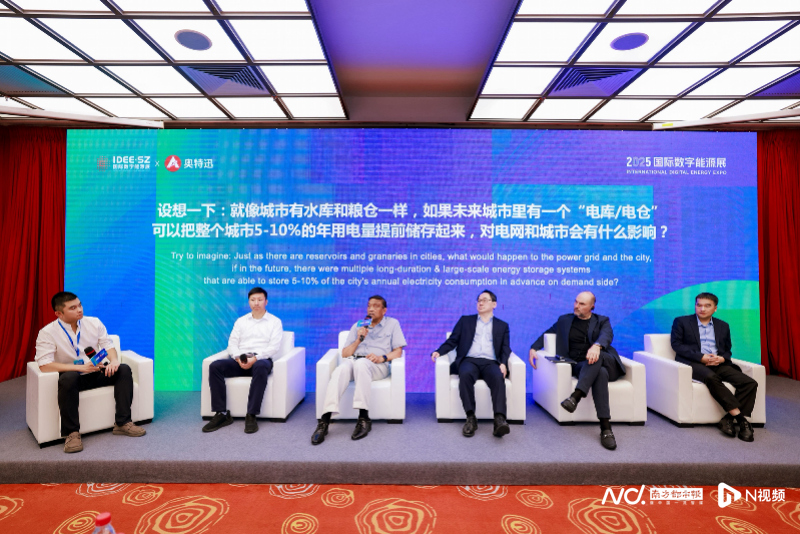
Core Viewpoint - Long-duration energy storage is becoming a critical component in the construction of new power systems, driven by the dual carbon goals and accelerated energy transition [1][4]. Group 1: Industry Context - The integration of high proportions of renewable energy into the grid has increased the demands for safety and flexibility in power systems [1]. - China's new energy storage installed capacity accounts for over 40% of the global total, but a significant gap remains in long-duration storage to meet carbon neutrality goals by mid-century [4]. - The current power grid faces challenges due to significant peak-valley differences, leading to resource waste and inefficient investments [4]. Group 2: Technology Insights - Vanadium redox flow batteries (VRFBs) are emerging as an ideal solution for urban energy storage due to their long lifespan, high safety, and capacity stability [3][4]. - VRFBs can achieve over 20,000 cycles and have a lifespan exceeding 20 years, making them suitable for long-duration energy storage [4]. - The integration of AI, big data, and digital twin technologies is expected to enhance the efficiency and reliability of VRFBs, transitioning them from "hardware storage" to "smart storage" [8]. Group 3: Economic Implications - A proposed collaborative planning scheme involving VRFBs and the transmission grid could reduce the need for new transmission lines, resulting in a total cost decrease of 17% even when accounting for storage investments [6]. - This approach can effectively mitigate the risks of power outages caused by high renewable energy integration and reduce the costs associated with curtailing wind and solar energy by nearly 40% [6]. Group 4: Future Outlook - The application of VRFBs is anticipated to shift urban energy systems from passive to active regulation, enhancing grid adaptability and resilience [6]. - The development of a "power bank" concept, capable of storing 5%-10% of annual electricity consumption, could significantly alleviate peak load pressures and reduce outage risks [8]. - The ongoing collaboration between companies and research institutions aims to create a more efficient, safe, and integrated charging and storage infrastructure in China [8].

第一创业晨会纪要-20250919
First Capital Securities· 2025-09-19 02:55
Group 1: Defense Industry - The report highlights the signing of a defense agreement between Saudi Arabia and Pakistan, with potential participation from UAE and Qatar, indicating a shift towards seeking security guarantees from Chinese weapon systems, which is expected to significantly enhance Pakistan's weapon procurement capabilities [2] - The report anticipates a rebound in the military industry due to increased funding from the wealthiest Middle Eastern nations supporting Pakistan's military procurement [2] Group 2: Semiconductor Industry - Huawei's recent announcements at the 2025 Huawei Connect Conference detail a roadmap for the Ascend chip series, with the Ascend 950PR expected in Q1 2026 and the Ascend 960 in Q4 2027, indicating a trend of increasing chip usage in computing clusters [3] - The report suggests that the growth in chip usage will lead to a significant increase in demand for high-speed optical interconnects and high-end PCB, thus improving the outlook for the optical connection, PCB, and high-end chip manufacturing supply chains [3] Group 3: Energy Storage Industry - The report discusses insights from the 2025 World Energy Storage Conference, where the focus is on long-duration energy storage as a key development direction as the power system transitions to a stage where renewable energy sources exceed 50% of total generation [6] - Technologies such as vanadium flow batteries, compressed air storage, and hydrogen storage are expected to gain traction due to their longer discharge times and lower capacity costs, indicating a sustained high demand in the energy storage sector [6] Group 4: Home Appliance Industry - The report notes that Boss Electric's revenue for the first half of 2025 was 4.608 billion yuan, a year-on-year decline of 2.58%, with net profit dropping by 6.28%, reflecting challenges in the kitchen appliance sector linked to the real estate market [8] - The report highlights a significant drop in new residential sales and a contraction in the market for high-end renovation projects, which is expected to continue impacting the kitchen appliance industry negatively [8]
中国能源研究会常务理事李俊峰:储能行业需破内卷 长时储能暂非当前刚需
Mei Ri Jing Ji Xin Wen· 2025-09-17 15:19
Core Viewpoint - The energy storage industry is crucial for the new power system and energy transition, but it faces multiple challenges such as internal competition and safety issues, necessitating a healthy and stable development path [1] Group 1: Industry Challenges - The energy storage sector has significant shortcomings, including risks of safety incidents and environmental pollution, as well as an incomplete global supply chain and raw material recycling system [1] - There is an urgent need to improve technical standards and quality control systems within the industry [1] - The phenomenon of "increased production without increased revenue, and increased revenue without increased profit" must be addressed, with the government showing strong determination to tackle internal competition issues [1] Group 2: Internationalization and Market Dynamics - The concentration of energy storage production in China is too high, accounting for 70% to 80% of global output, indicating a need for accelerated internationalization of the industry [1] - The focus should shift from merely exporting storage solutions to a broader concept of "energy storage internationalization" [1] Group 3: Long-Duration Energy Storage - Currently, long-duration energy storage is not necessary as the power system can still rely on coal, natural gas, hydropower, and nuclear power for supply-demand adjustments [2] - Long-duration energy storage will only be required when the share of renewable energy generation exceeds 60% [2] - The current emphasis should be on enhancing storage duration, reducing costs, and improving reliability [2] Group 4: Regional Energy Development - There is a lack of ready-made templates for energy transition, despite the availability of diverse resources such as wind, solar, nuclear, and fossil fuels across different regions [2] - Local energy development must leverage regional resource endowments to promote the coordinated development of various energy sources, achieving multi-energy complementarity and comprehensive utilization [2]