
双碳目标

Search documents
2025年中国废旧汽车循环利用行业发展历程、产业链、拆解总量、利用价值量、竞争格局及发展趋势分析:市场竞争格局正处于动态调整期,报废量持续扩大将推动产业进入高质量发展阶段[图]
Chan Ye Xin Xi Wang· 2025-12-23 01:22
Core Viewpoint - The rapid increase in the number of scrapped vehicles in China, driven by the surge in car ownership, aging vehicles, and supportive policies, is significantly boosting the automotive recycling industry, transitioning from incremental to stock-based resource supply [1][4]. Group 1: Industry Definition and Processing Flow - The automotive recycling industry focuses on efficiently utilizing and recycling scrapped vehicles' parts and materials, adhering to the principles of reduction, reuse, and recycling [2][3]. - The processing flow begins with the end user of the scrapped vehicle and ends with final processing companies, involving key steps such as recovery, dismantling, remanufacturing, and shredding [3]. Group 2: Current Industry Status - The automotive recycling industry is closely linked to the expansion of the automotive sector and the promotion of environmental policies, having evolved through four stages: spontaneous, preliminary regulation, transformation, and high-quality development [4]. - In 2024, approximately 10.24 million vehicles are expected to be scrapped in China, with a recovery rate of 76.84%, projected to rise to 13.75 million vehicles and a recovery rate of 78.06% by 2025 [4][6]. Group 3: Recycling Volume and Value - The total dismantling weight of scrapped vehicles in 2024 is estimated at 10.831 million tons, with steel accounting for 78.5% and a recycling value of approximately 44.682 billion yuan [1][6]. - By 2025, the dismantling weight is expected to reach 14.77 million tons, with a recycling value of around 60.419 billion yuan [1][6]. Group 4: Industry Chain - The upstream of the recycling industry includes vehicle supply and initial recovery services, primarily from individual car owners and commercial operators [8]. - The midstream consists of the core processing industry, including dismantling and remanufacturing, while the downstream encompasses various applications of recycled products, particularly in the automotive manufacturing sector [8]. Group 5: Competitive Landscape - The market is currently undergoing dynamic adjustments, with a trend towards concentration among leading firms driven by policy and technological innovation [12]. - Key players in the industry include Huahong Technology, Tianqi Co., Huanxin Environmental Protection, and others, forming a competitive landscape characterized by state-owned leaders and emerging private firms [12]. Group 6: Future Development Trends - The transition from incremental to stock-based automotive markets will provide a continuous resource supply for the recycling industry, with stricter regulations encouraging vehicles to return to the formal market [12][13]. - The global push for green development and carbon reduction is creating significant market opportunities for the recycling industry, as it aligns with the demand for recycled materials in automotive manufacturing [13].


煤炭与新能源融合发展,如何实现“1+1>2”
Ke Ji Ri Bao· 2025-12-23 01:19
Core Viewpoint - The integration of coal and renewable energy is essential for achieving China's dual carbon goals while ensuring energy security, as demonstrated by the successful projects in Anhui province, particularly the "Photovoltaic + Coal Mining Subsidence Area" initiative by Huaihe Energy [1][2][4] Group 1: Project Overview - The first integrated demonstration project in Anhui features 373,000 photovoltaic panels over 5,300 acres in a coal mining subsidence area, with a total installed capacity of 40,000 kilowatts across two phases [1] - The first phase has an operational capacity of 156,800 kilowatts, while the second phase, currently under construction, will have a capacity of 243,200 kilowatts [1] Group 2: Environmental Impact - The photovoltaic project is expected to reduce carbon dioxide emissions by approximately 11.27 million tons during its operational period, equivalent to saving 4.23 million tons of standard coal [3] - The first phase of the photovoltaic power station has generated 440 million kilowatt-hours of electricity, meeting the annual electricity needs of over 200,000 households and saving about 131,400 tons of standard coal, resulting in a reduction of approximately 340,000 tons of carbon dioxide emissions [6] Group 3: Industry Trends - The integration of coal and renewable energy is seen as a critical step in building a new energy system, where non-fossil energy serves as the main supply and fossil energy acts as a backup [4] - The coal industry, traditionally high in energy consumption, is now leveraging its electrification needs to create natural scenarios for renewable energy applications [3] Group 4: Technological and Policy Challenges - Despite progress, challenges remain in policy implementation and technological innovation, particularly in local regulations and subsidy disbursement affecting investment enthusiasm [9] - There is a call for increased investment in foundational research to overcome technical challenges related to low-concentration gas utilization and geothermal energy development [9][10] Group 5: Future Directions - Companies are encouraged to adopt a long-term perspective, prioritizing investments in renewable energy to cultivate core competitiveness and drive ecological restoration and carbon asset management [10] - Huaihe Energy aims to implement an integrated zero-carbon park model that combines wind, solar, storage, and charging facilities, revitalizing traditional coal bases [10]

煤炭与新能源融合发展,如何实现“1+1>2”
Zhong Guo Jing Ji Wang· 2025-12-23 00:16
Core Viewpoint - The integration of coal and renewable energy is essential for achieving China's dual carbon goals while ensuring energy security, as demonstrated by the successful projects in Anhui Province [1][2][4]. Group 1: Project Overview - The first integrated demonstration project of "Photovoltaic + Coal Mining Subsidence Area" in Anhui covers 5,300 acres with 372,800 solar panels, showcasing a significant investment by Huaihe Energy [1]. - The first phase of the project has a capacity of 156,800 kW, while the second phase, currently under construction, will have a capacity of 243,200 kW [1]. - The project is expected to reduce carbon dioxide emissions by approximately 11.27 million tons over its operational period, equivalent to saving 4.23 million tons of standard coal [3]. Group 2: Industry Context - The coal industry remains a high-energy-consuming sector, and the electrification needs of mining operations provide natural scenarios for renewable energy applications [3]. - Huaihe Energy has reduced carbon emissions significantly, with CO2 emissions per unit of output decreasing by 27% in the coal sector and about 60% in the clean energy sector from 2020 levels [2]. Group 3: Technological Integration - The integration of coal and renewable energy is seen as a key component in building a new energy system, where non-fossil energy serves as the main supply and fossil energy acts as a backup [4]. - Huaihe Energy's clean and efficient coal power units, which account for over 90% of its capacity, can be flexibly modified to work alongside solar and wind energy, enhancing energy system stability [4]. Group 4: Multi-Energy System Development - Various regions are exploring feasible paths for integrating coal and renewable energy, with examples including the multi-energy integration approach in Shaanxi and the comprehensive development in Guizhou [5]. - Huaihe Energy has developed a multi-faceted clean energy system that includes photovoltaic, wind, gas power, and energy storage [8]. Group 5: Policy and Technical Challenges - Despite progress, challenges remain in policy implementation and technological innovation, particularly in local execution of national policies and the complexity of approval processes [9]. - Experts suggest that companies should engage with local planning and that governments need to establish fair resource distribution mechanisms to reduce competition among enterprises [9]. Group 6: Future Directions - Companies are encouraged to adopt a long-term perspective, investing in renewable energy to build core competitiveness and create new value through ecological restoration and carbon asset management [10]. - Huaihe Energy aims to implement a zero-carbon park integrating wind, solar, storage, and charging facilities, revitalizing traditional coal bases [10].
青海“一主八辅”温室气体观测网初步建成
Xin Lang Cai Jing· 2025-12-22 19:20
Core Viewpoint - The establishment of the first batch of high-precision greenhouse gas observation stations in Qinghai Province marks a significant step towards supporting China's "dual carbon" goals and enhancing ecological civilization in the region [1] Group 1: Observation Stations - Six observation stations have passed the operational assessment by the China Meteorological Administration, covering key ecological areas such as Xining City and various autonomous prefectures [1] - The construction of these stations took three years, with locations selected to represent different functional areas, including urban clusters and national parks [1] Group 2: Technological Capabilities - The observation equipment is designed to withstand extreme environmental conditions, including high altitude, strong radiation, and significant temperature variations [1] - The stations are capable of continuous real-time monitoring of major greenhouse gases like carbon dioxide and methane, achieving over 95% stability and data accuracy during trial operations [1]
“十五五”和2026年可再生能源发展展望
2025-12-22 15:47
"十五五"和 2026 年可再生能源发展展望 20251222 摘要 国家能源局设定的 2026 年新能源装机目标为 200 吉瓦,低于市场预期, 主要基于非化石能源消费比重已接近完成 2025 年目标,但可能限制未 来发展。 2030 年前新能源发展面临单位 GDP 碳排放强度严格要求,现有减排进 度滞后于目标,需大幅提升可再生能源利用效率并发展核电等其他能源。 中国计划在"十五"期间新增约 1,000 吉瓦可再生能源装机,以满足非 化石能源消费比重目标,但要实现碳排放强度目标仍需进一步提升能源 利用效率。 未来几年,中国新能源政策将侧重需求侧,关注电价波动和供给侧改革, 并加强对氢能、氨、醇等非电领域可再生能源应用的支持。 能源领域固定资产投资对中国经济增长贡献显著,"十四五"期间增速 约为 16%,电力领域更高达 20%,涵盖充电桩、电解槽等新兴领域。 预计"十五五"期间每年将开工 3 至 4 条特高压外送通道,总计约 15 条,每条可支撑 5 至 10 吉瓦的可再生能源外送,总体支持规模在 100 至 200 吉瓦之间。 2026 年国内光伏新增装机容量预期为 160 至 200 吉瓦,地面电站度电 ...
“青氢一号”首航!探秘全球最大氢氨醇项目如何“链”接绿色未来
中国能源报· 2025-12-22 14:24
Core Viewpoint - The article emphasizes the emergence of a new era of green energy, driven by the dual carbon goals and the need for a reliable replacement of fossil fuels, with hydrogen energy being a key solution [5][6][7]. Group 1: Hydrogen Energy as a Solution - Hydrogen energy is identified as a crucial element in addressing the dual challenges of energy security and green transition [6][7]. - The launch of the world's largest integrated green hydrogen and ammonia project in Songyuan marks a significant step towards transforming natural energy into green hydrogen [9]. Group 2: Technological Innovations - The project employs a "wind-solar-storage-hydrogen-ammonia matching optimization technology," which involves extensive system simulations to ensure economic viability and reliability over decades [12][14]. - A "green electricity exclusive fast track" is established, ensuring that 100% of the electricity used for hydrogen production comes from renewable sources [19]. Group 3: Flexible Production Capabilities - The introduction of "green flexible hydrogen synthesis technology" allows for a production load adjustment range of 30%-110%, enabling the system to respond to fluctuations in renewable energy supply [21][23]. - This flexibility allows for continuous production even when renewable energy sources are variable, marking a breakthrough in chemical production [21][23]. Group 4: System Integration and Efficiency - The "scale-up wind-solar-storage-hydrogen-ammonia integrated control technology" acts as a central brain, coordinating thousands of devices for optimal operation [25][28]. - The project achieves significant green benefits, producing 666 tons of liquid ammonia daily and reducing carbon emissions by approximately 1,967 tons per day, equivalent to the carbon sequestration of 29,400 acres of forest [29]. Group 5: Broader Implications and Future Outlook - The company has over 50 "Qing Hydrogen No. 1" projects planned across the country, indicating a robust national strategy for hydrogen energy development [29]. - The vision is to create a leading brand in green hydrogen, contributing to a zero-carbon future and positioning China as a key player in global energy transition [38][40].

十八大以来中国是全球能耗强度降低最快的国家之一
Xin Lang Cai Jing· 2025-12-22 14:11
中新网北京12月22日电 (记者 谢雁冰 郭超凯)全国人大常委会副委员长肖捷22日表示,中共十八大以 来,中国万元GDP能耗累计下降27.2%,是全球能耗强度降低最快的国家之一。 当天,肖捷向十四届全国人大常委会会议作常委会执法检查组关于检查《中华人民共和国节约能源法》 实施情况的报告。 报告指出,节约能源法的实施取得显著成效。2007至2024年,全国万元GDP能耗累计降低43.0%左右, 累计节能量约23亿吨标准煤。中共十八大以来,全国万元GDP能耗累计下降27.2%,是全球能耗强度降 低最快的国家之一,以年均3.3%的能源消费增速支撑年均6.1%的经济增长,为新时代经济社会持续健 康发展和社会全面进步提供有力保障。 报告指出,中国国务院发布《民用建筑节能条例》《公共机构节能条例》等配套法规,工业、建筑、交 通、公共机构等重点领域出台800余件部门规章和政策文件,各地因地制宜出台2000余件相关法规规范 性文件,形成以节约能源法为统领,工业、建筑、交通、公共机构等领域和地方性法规为配套的较为完 善的节能法律法规体系。 围绕重点领域节能,报告表示,2024年全国新建绿色建筑面积占城镇新建建筑面积比例超过97 ...
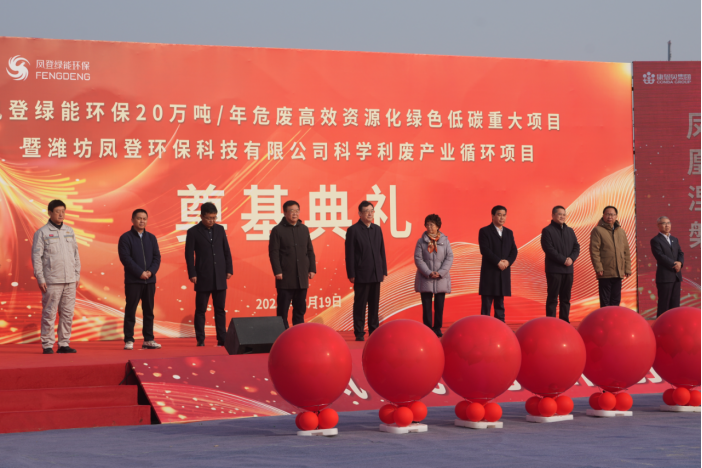
总投资50亿重大项目落地潍坊 “变废为宝”解锁绿色循环新路径
Xin Lang Cai Jing· 2025-12-22 11:20
各方嘉宾出席开工奠基仪式 "现在,我宣布,'凤飞九州一号工程'、潍坊凤登环保科技有限公司科学利废产业循环项目开工奠基!"12月19日10时50分,伴随着康恩贝集团有限公司董 事长、首席执行官胡季强的隆重宣布,各方嘉宾共同持铲,为该项目一期工程奠基。 潍坊市政协主席、党组书记李爱杰,中国化工环保协会理事长周献慧,潍坊市滨海经济技术开发区党工委书记、管委会主任韩文宏,康恩贝集团有限公司 董事长、首席执行官胡季强,凤登绿能环保董事长、总裁章磊,滨海经济技术开发区党工委委员、管委会副主任陈强,新和成精化科技有限公司副总经理 严晖,中国石化集团资本有限公司投资经理金岩,中国天辰工程有限公司党委委员、副总经理卞明,潍坊凤登环保科技有限公司总指挥陈林等嘉宾出席开 工奠基仪式。开工奠基仪式由凤登绿能环保总裁助理谢六英主持。 当日上午,康恩贝集团有限公司旗下浙江凤登绿能环保股份有限公司(以下简称"凤登绿能环保")在国家级开发区、潍坊滨海经济技术开发区绿色化工园 举行了首个浙江省外重点示范项目的开工奠基仪式。这一总投资50亿元重大项目的正式启动,标志着凤登绿能环保在全国资源循环利用产业布局上迈出关 键一步。 凤登绿能环保董事长、 ...
香港特区政府财政司司长陈茂波:抓紧未来发展机遇 制订践行全面的大宗商品发展策略
Xin Lang Cai Jing· 2025-12-22 11:05
新华财经香港12月22日电(记者 林迎楠)由香港特区政府财政司司长陈茂波担任主席的大宗商品策略 委员会22日召开第一次会议。陈茂波指出,香港特区政府会通过高层统筹规划,制订和践行全面的大宗 商品发展策略,抓紧未来的发展机遇。 委员会在22日的会议上听取了有关全球大宗商品市场趋势和香港发展潜力的汇报,并就委员会优先聚焦 调研探讨的商品范畴和重点进行讨论。 陈茂波表示,在地缘政治、科技变革、绿色转型等多个大趋势的多重驱动下,全球就贵金属、有色金 属、传统能源、新能源相关材料等大宗商品的供需形势正经历深刻变化。他指出,我国是大宗商品的主 要消费国和进出口市场之一,并正全速推动高质量发展、坚定迈向双碳目标,加大对绿色产业的投入; 这些发展都凸显国家在建设大宗商品资源配置枢纽上的优势。 编辑:郭洲洋 陈茂波强调,香港作为国际金融、贸易和航运中心,"一国两制"下有"内联外通"的独特优势,其中资 金、货物、资讯自由流动,加上高效的金融、物流和专业服务,以及便捷通达的交通运输网络,在发展 大宗商品市场方面具有庞大的潜力。 陈茂波指出,过去一两年间,香港正积极建构更蓬勃的大宗商品生态,从加入伦敦金属交易所的全球仓 库网络,以促 ...
南都电源固态电池技术获双项权威认可 助推储能产业升级
Zheng Quan Shi Bao Wang· 2025-12-22 10:57
Group 1 - Nandu Power has won the "High-tech Golden Ball Award for Annual Innovative Product" for its self-developed "Key Technology Development of High-Safety Long-Life Semi-Solid Lithium Battery and Energy Storage System Application" project at the 2025 High-tech Energy Storage Annual Conference [1] - The core product awarded is the 783Ah ultra-large capacity solid-state battery, which achieves a leap in energy density and safety performance through three core technological innovations, reaching industry-leading performance indicators [1] - The battery features a cycle life of no less than 10,000 times, a single unit energy exceeding 2.5kWh, energy efficiency over 95%, and a volumetric energy density greater than 430Wh/L, providing a safe, efficient, and economical solution for large-scale energy storage systems [1] Group 2 - The company has successfully entered mass production of its 314Ah semi-solid energy storage battery and secured the world's largest 2.8GWh semi-solid battery storage project, validating the maturity and reliability of its semi-solid technology [2] - In the all-solid-state battery sector, its 20Ah and 30Ah products have achieved an energy density of 350Wh/kg, with a capacity retention rate exceeding 92% after 500 cycles, showcasing significant potential for commercial applications in specialized scenarios [2] - Nandu Power has consistently prioritized technological innovation as its core development driver, accumulating deep technical expertise and rich market resources in lead-acid batteries, lithium-ion batteries, and energy storage system solutions [2] Group 3 - The company has outlined its strategic plan to continue focusing on technological innovation, accelerating the mass production and commercialization of the 783Ah ultra-large capacity solid-state battery [3] - Nandu Power aims to deepen its layout in core areas such as new energy storage, communication, and data center storage, providing safer, longer-lasting, and more economical energy storage solutions to support the achievement of "dual carbon" goals [3] - Through continuous technological iteration and precise market positioning, Nandu Power is empowering global energy transition with its "Nandu Wisdom" and "Nandu Solutions" [3]
