稳定币

Search documents
四方精创:稳定币运作系统由监管机构等多方机构构成
Jin Rong Jie· 2025-08-08 04:30
Core Viewpoint - The company acknowledges the complexity of stablecoin operations, which involve multiple institutions such as regulators, issuers, custodians, and traders, indicating that the capabilities mentioned by the investor depend on the collaboration of various systems [1] Group 1 - The company received an inquiry regarding the real-time visibility of Hong Kong dollar stablecoin reserves and its transaction speed compared to USDC [1] - The company expressed gratitude for the investor's interest and provided insights into the operational framework of stablecoins [1] - The response highlights that the processing speed and reserve visibility are contingent upon the cooperation of multiple systems [1]

超2900家个股下跌
第一财经· 2025-08-08 03:53
Core Viewpoint - The article discusses the performance of the Chinese stock market on August 8, 2025, highlighting the slight gains in major indices and the active sectors, particularly in hydropower, stablecoins, commercial aerospace, innovative pharmaceuticals, and liquid cooling servers, while noting a pullback in sectors like PEEK materials, AI agents, semiconductors, and robotics [3][4]. Market Performance - The Shanghai Composite Index closed at 3642.1 points, up 0.07% - The Shenzhen Component Index closed at 11173.87 points, up 0.14% - The ChiNext Index closed at 2347.83 points, up 0.21% [3][4]. Capital Flow - Major capital inflows were observed in sectors such as machinery, electric power, non-ferrous metals, and pharmaceuticals, while outflows were noted in computer, electronics, media, food and beverage, and banking sectors [8]. - Specific stocks with significant net inflows included Yingweike (16.56 billion), Shanhe Intelligent (13.08 billion), and Jihua Group (12.84 billion) [8]. Trading Volume - The trading volume in the two markets exceeded 1 trillion yuan for the 52nd consecutive trading day [9]. Sector Highlights - The hydropower sector saw notable gains, with Shanhe Intelligent hitting the daily limit, and other related stocks like Sheyan Institute and Deep Water Planning Institute also performing well [10][13]. - The electric power sector experienced a rise, with Huaguang Huaneng and Huayin Electric reaching the daily limit [13]. Stock Movements - Stocks such as Innovation Medical and Jihua Group reached their daily limit, while other stocks in the medical device sector also saw significant increases [17][21]. - The gas sector showed a short-term rise, with Hongtong Gas achieving four consecutive limits [19]. Economic Indicators - The People's Bank of China conducted a 122 billion yuan reverse repurchase operation at a fixed rate of 1.40%, with a net withdrawal of 40 billion yuan for the day [25]. - The RMB to USD exchange rate was adjusted down by 37 basis points, reported at 7.1382 [26].





资金回流稳定币概念股?楚天龙大涨超8%,金融科技ETF溢价频现!机构表示持续看好金融科技板块
Xin Lang Ji Jin· 2025-08-08 02:57
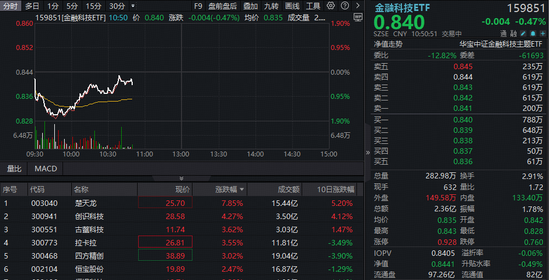
Core Viewpoint - The A-share market is experiencing a general pullback in thematic sectors, particularly in fintech, while certain segments like stablecoins and cross-border payments show strength [1][3]. Group 1: Market Performance - The fintech sector saw a decline of over 1% in early trading, with most constituent stocks falling [1]. - Despite the overall downturn, stocks like Chutianlong surged over 8%, and companies such as Chuangshijia and Guao Technology rose more than 3% [1]. - The financial technology ETF (159851) initially dropped nearly 2% but narrowed its loss to 0.47%, with a trading volume exceeding 200 million yuan, indicating strong buying interest [1][4]. Group 2: Industry Developments - The RWA registration platform launched in Hong Kong on July 7, coinciding with the establishment of three Web 3.0 standards, which may drive innovation in fintech [3]. - Minsheng Securities highlighted the revolutionary potential of stablecoins, suggesting that the fintech IT sector is poised for investment opportunities [3]. - According to招商证券, the fintech sector is expected to benefit from active market trading and the potential for performance releases, particularly in the internet finance segment [3]. Group 3: AI Integration in Finance - The integration of AI in finance is seen as a promising application area, with companies like Tonghuashun and Dongfang Caifu leveraging large models for various financial services [4]. - Tonghuashun is focusing on internet financial information services and enhancing its model technology for applications in intelligent advisory and financial Q&A [4]. - Dongfang Caifu has developed its own financial model, incorporating AI features into its Choice terminal, creating a comprehensive service loop from information acquisition to trade execution [4]. Group 4: Investment Opportunities - Investors are encouraged to focus on the fintech ETF (159851) and its associated funds, which cover a wide range of themes including internet brokerage, fintech IT, cross-border payments, and AI applications [4]. - As of August 4, the fintech ETF (159851) had a scale exceeding 8.2 billion yuan, with an average daily trading volume of over 600 million yuan, leading in scale and liquidity among similar ETFs [4].


拥抱数字资产!日本金融巨头SBI计划推出日本首个比特币-XRP双资产ETF
Hua Er Jie Jian Wen· 2025-08-07 13:48
Core Viewpoint - SBI Holdings plans to launch Japan's first dual-asset cryptocurrency ETF, providing exposure to Bitcoin and XRP, marking a significant breakthrough in Japan's strictly regulated financial market for cryptocurrency investment products [1] Group 1: Product Overview - The first product will package a gold ETF and cryptocurrency ETF into a trust, allocating 51% of funds to gold ETF and 49% to Bitcoin ETF and other crypto assets, to be publicly issued in Japan as an investment trust [2] - The second product will directly combine Bitcoin and XRP, with plans to list it on the Tokyo Stock Exchange, reflecting SBI Holdings' philosophy of balanced portfolio investment [2] Group 2: Regulatory Approval - The launch of these products is contingent upon "regulatory approval," with uncertainty regarding whether applications have been submitted to the Financial Services Agency (FSA) or are still in the planning stage [3] - The FSA proposed recognizing certain crypto assets as financial products under the Financial Instruments and Exchange Act (FIEA), which could pave the way for ETFs and reduce the tax burden on cryptocurrencies in Japan [3] Group 3: Global Market Context - Currently, XRP spot ETFs are only traded in Canada, with U.S. similar funds expected to gain approval by Q4 2025 [4] - SBI Holdings has been proactive in this field, recently partnering with Circle, the issuer of USD Coin (USDC), and showing interest in stablecoins, particularly USDC and Ripple's RLUSD [4]
中油资本股价下跌1.06% 公司回应稳定币业务传闻
Jin Rong Jie· 2025-08-07 13:32
Group 1 - The stock price of Zhongyou Capital on August 7 was 8.37 yuan, down 0.09 yuan or 1.06% from the previous trading day [1] - The trading volume on that day was 1.439 million shares, with a transaction amount of 1.205 billion yuan [1] - Zhongyou Capital is a diversified financial platform under China National Petroleum Corporation, covering banking, trust, financial leasing, insurance, and securities [1] Group 2 - In Q1 2025, the company achieved operating revenue of 8.947 billion yuan and a net profit attributable to shareholders of 1.269 billion yuan [1] - On August 7, the company announced that it is currently not involved in stablecoin-related businesses and is researching policies in this area [1] - On August 6, a block trade occurred involving 390,000 shares with a transaction amount of 2.9796 million yuan, at a discount of 9.69% compared to the closing price [1] Group 3 - On August 7, the net outflow of main funds from Zhongyou Capital was 119 million yuan, accounting for 0.11% of the circulating market value [1] - Over the past five days, the net outflow of main funds totaled 396 million yuan, representing 0.37% of the circulating market value [1]

年内再出手!Ripple砸2亿美元收购Rail,加码稳定币支付布局
智通财经网· 2025-08-07 13:29
Group 1 - Ripple announced the acquisition of stablecoin payment platform Rail for $200 million, expected to complete in Q4 of this year pending regulatory approval [1] - The acquisition aims to create a comprehensive stablecoin payment solution and enhance Ripple's existing payment capabilities with new virtual accounts and automated backend processes [1] - Rail, headquartered in Toronto, supports cross-border payments using stablecoins and claims to handle 10% of global stablecoin payment transactions [1] Group 2 - The signing of a federal regulatory framework for stablecoins by President Trump in July is anticipated to make digital assets a common method for daily payments and fund transfers [2] - Stablecoins are designed to maintain value stability, typically pegged 1:1 to the US dollar, and have seen explosive growth in usage, particularly among cryptocurrency traders [2] - Ripple previously announced a $1.25 billion acquisition of multi-asset brokerage Hidden Road in April, aimed at enhancing the utility of its stablecoin RLUSD [2] - Ripple applied for a US banking license in July, following the lead of stablecoin issuer Circle, to bring its digital asset business under federal regulatory oversight [2]
中油资本(000617) - 000617中油资本投资者关系管理信息20250807
2025-08-07 09:00
Group 1: Company Development Strategy - The company has established a "11445" strategic system, aiming to become an internationally renowned and domestically first-class financial service enterprise, focusing on "innovation, market, service, and green" strategies [1] - The four major platform functions include financial asset supervision, financial business integration, financial equity investment, and financial risk control [1] Group 2: Market Value Management and Dividend Policy - The company has maintained a stable cash dividend policy, distributing no less than 30% of the net profit attributable to the parent company as cash dividends since its restructuring in 2017 [2] - In 2024, the dividend payout ratio increased to 31.8%, with cumulative cash dividends amounting to 150.44 million yuan [2] - The company aims to balance performance growth with shareholder returns while ensuring stable cash dividends for investors [2] Group 3: Business Development and Trends - The company currently does not engage in stablecoin-related businesses but is researching relevant policies due to investor interest [2]
纳斯达克鸣钟日:孙宇晨见证波场TRON携Kripton激活拉美稳定币应用场景
Sou Hu Cai Jing· 2025-08-07 08:24
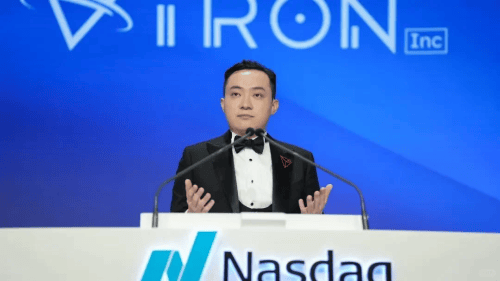
Core Insights - TRON officially commenced its journey in the capital market with a bell-ringing ceremony at NASDAQ, marking a significant milestone for the company [1] - The implementation of the "TRX Micro Strategy" positions TRX as a core strategic reserve asset, indicating a deeper integration of crypto assets with traditional finance [1][3] Group 1: Strategic Partnerships and Innovations - TRON has partnered with Kripton, a leading e-commerce platform in Argentina, to facilitate the acceptance of USDT payments across over 2000 merchants, enhancing the usability of stablecoins in daily transactions [3] - The collaboration includes a smart contract system that automatically prioritizes USDT settlements when the Argentine peso depreciates by more than 5% in a day, ensuring merchants' capital value is protected [3][6] - TRON's DPoS consensus mechanism supports high transaction throughput, with a daily processing capacity of 2500 TPS, significantly reducing transaction times from days to seconds [3] Group 2: Economic Context and Market Opportunities - Argentina's soaring inflation, projected at 27% for 2025, creates a conducive environment for the adoption of stablecoins, as traditional payment systems struggle with exchange rate volatility [5] - The USDT's anchoring mechanism and TRON's low transaction fees provide essential support to overcome challenges posed by inflation and payment delays [5] - TRON's initiatives extend beyond payment solutions, including the "Digital Dollar Inclusive Plan," which aims to promote crypto asset education and provide interest-free microloans to local workers [6] Group 3: Broader Impact on Digital Economy - The collaboration between TRON and Kripton is reshaping the digital economy in Latin America, with applications ranging from public transport payments to cross-border traceability and microfinance [9] - The integration of TRC20-USDT for direct recharge of public transport cards exemplifies the shift of cryptocurrencies from investment vehicles to everyday payment mediums [7] - This technological transformation not only addresses the challenges of conducting business in a high-inflation environment but also heralds a new paradigm for digital finance in emerging markets [9]
指数越涨量越小!热门板块一日游,还有哪些投资机会?
Sou Hu Cai Jing· 2025-08-07 07:34
Group 1 - The core driving force for the Chinese stock market in 2025 will come from the increase in discount rates, alongside the emergence of new business opportunities and positive economic structural changes, which will alter investor expectations [1] - The confirmation of the London framework details by China and the US is expected to lead to adjustments in US restrictions on China, positively impacting market sentiment [1] - The upcoming listing of technology innovation bond ETFs and the resumption of the fifth set of listing standards for the Sci-Tech Innovation Board will support financing needs and diversify investment options [1] Group 2 - In the first half of 2025, the approval of new coal power projects increased by 152% year-on-year, with a high probability of exceeding 60GW for the entire year, indicating a recovery in the profitability of thermal power [3] - The legal recognition of stablecoins in Hong Kong is expected to drive the expansion of the stablecoin industry chain, with particular benefits for RWA issuers, consulting/technical support providers, and cross-border payment companies [3] - The current market concerns regarding the profitability of electric companies from 2028 onwards may lead to a high level of approvals for coal power projects from 2025 to 2030, with an optimistic outlook for the valuation of the power generation equipment manufacturing industry [3] Group 3 - The AH premium index has been declining, reflecting a shift in mainland policies and a low-interest-rate environment, leading to increased southbound capital inflows into Hong Kong stocks [5] - The significant inflow of southbound capital since the "9.24" market rally in 2024 indicates a growing attraction of undervalued blue-chip stocks in Hong Kong for mainland investors [5] - The continuous listing of quality A-shares in Hong Kong is expected to enhance liquidity and narrow the valuation gap between A-shares and H-shares [5] Group 4 - The short-term market trend appears strong, with noticeable inflows of incremental capital and a favorable profit-making effect [7] - The Shanghai Composite Index is expected to test last year's high, although the profit-making effect in August has been weaker compared to July, suggesting potential profit-taking by institutional investors [11] - The brokerage sector is anticipated to improve due to multiple favorable factors, presenting investment opportunities worth focusing on [11]

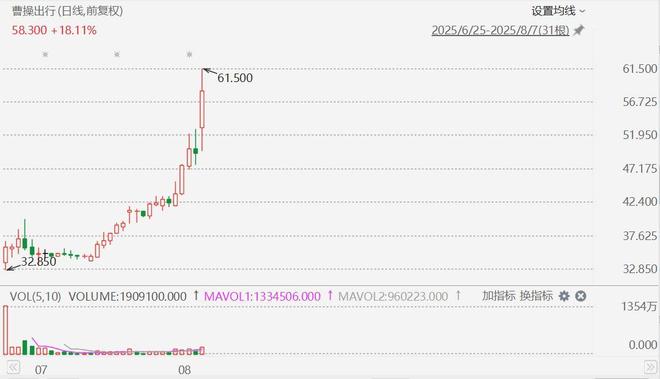
港股异动丨曹操出行飙升超24%创新高,战略布局RWA与稳定币
Xin Lang Cai Jing· 2025-08-07 06:49
Group 1 - The core viewpoint of the article highlights that Cao Cao Mobility's stock surged over 24%, reaching a new high of 61.5 HKD, with a market capitalization of 33.5 billion HKD following a strategic partnership with Victory Securities [1] - The partnership aims to advance the tokenization of real-world assets (RWA), stablecoin payments, and compliant digital currency issuance, marking a significant exploration of digital financial tools in the domestic transportation industry [1] - CEO Gong Xin stated that the collaboration will connect real assets with digital finance, optimizing capital efficiency and establishing a new payment infrastructure for the large-scale operation of Robotaxi services [1] Group 2 - The Robotaxi business, characterized by stable operations, and the company's fleet of new energy vehicles, which has cumulatively reduced emissions by over 3.1 million tons, will serve as core RWA assets, facilitating the digital transformation of environmental benefits [1]