
数字货币

Search documents
为啥中国明令禁止比特币交易和挖矿,美国却在疯狂抢筹?
Sou Hu Cai Jing· 2026-01-09 22:18
Group 1 - The core phenomenon in the cryptocurrency market is the significant purchase of Bitcoin by large U.S. financial institutions, while regulatory attitudes towards cryptocurrencies in China are becoming increasingly strict [1][5] - In 2024, U.S. investors are projected to acquire 450,000 Bitcoins through Bitcoin ETFs, surpassing the global Bitcoin mining output of 320,000 Bitcoins, indicating a daily purchase of 10,000 Bitcoins by U.S. investors [3] - The shift in Bitcoin mining dominance from China to the U.S. has occurred, with the U.S. now accounting for 40% of global Bitcoin production after China's ban on Bitcoin trading and mining in 2021 [5] Group 2 - The competition between the U.S. and China represents a struggle for future monetary hegemony, with China focusing on central bank digital currency and the U.S. on cryptocurrencies, both aiming to control financial systems [7] - The financial tools are redefining the Bitcoin ecosystem in the U.S., transforming Bitcoin into a standardized financial instrument through futures, trusts, and ETFs, thus shifting pricing power from Chinese enterprises to Wall Street [5] - The ongoing financial competition is intensifying, with potential changes in strategies from various countries, indicating a deeper financial conflict ahead [8]

中科金财涨2.16%,成交额5.86亿元,主力资金净流入1833.19万元
Xin Lang Cai Jing· 2026-01-09 06:41
Core Viewpoint - Zhongke Jincai's stock price has shown fluctuations with a recent increase of 2.16%, while the company faces challenges with a decline in net profit and a stagnant revenue growth [1][2]. Financial Performance - As of September 30, 2025, Zhongke Jincai reported a revenue of 544 million yuan, reflecting a year-on-year growth of 1.99%. However, the net profit attributable to shareholders was -112 million yuan, a decrease of 42.83% compared to the previous year [2]. - The company has cumulatively distributed dividends of 60.46 million yuan since its A-share listing, with no dividends paid in the last three years [3]. Stock Market Activity - On January 9, Zhongke Jincai's stock price was 29.35 yuan per share, with a trading volume of 586 million yuan and a turnover rate of 6.01%. The total market capitalization stood at 9.981 billion yuan [1]. - The stock has experienced a decline of 1.71% year-to-date, with a 7.27% increase over the last 20 days, but a 7.59% decrease over the last 60 days [1]. Shareholder Structure - As of September 30, 2025, the number of shareholders increased to 101,300, up by 5.73%. The average number of circulating shares per person decreased by 5.79% to 3,306 shares [2]. - Notable shareholders include Huabao Zhongzheng Financial Technology Theme ETF, which increased its holdings by 2.7 million shares, and several new institutional investors have entered the top ten shareholders list [3]. Business Overview - Zhongke Jincai, established on December 10, 2003, and listed on February 28, 2012, specializes in application software development, technical services, and related computer information system integration services. The revenue breakdown includes 50.81% from data center services, 31.66% from financial technology services, 14.01% from artificial intelligence services, and 3.52% from other services [1]. - The company operates within the IT services sector and is involved in concepts such as mobile payments, digital currency, electronic payments, financial technology, and internet finance [1].

先进数通涨2.05%,成交额2.36亿元,主力资金净流入1521.77万元
Xin Lang Cai Jing· 2026-01-09 06:38
Core Viewpoint - Advanced Communication Technology Co., Ltd. has shown significant growth in revenue and net profit, indicating strong performance in the IT solutions sector for commercial banks [2]. Group 1: Stock Performance - As of January 9, Advanced Communication's stock price increased by 2.05%, reaching 15.41 CNY per share, with a trading volume of 236 million CNY and a turnover rate of 3.99%, resulting in a total market capitalization of 6.627 billion CNY [1]. - Year-to-date, the stock price has risen by 2.32%, with a 5-day increase of 2.32%, a 20-day increase of 5.33%, and a 60-day decrease of 11.74% [1]. - The net inflow of main funds was 15.2177 million CNY, with large orders accounting for 23.77% of purchases and 17.83% of sales [1]. Group 2: Financial Performance - For the period from January to September 2025, Advanced Communication achieved a revenue of 2.273 billion CNY, representing a year-on-year growth of 49.83%, and a net profit attributable to shareholders of 86.1446 million CNY, reflecting a 163.10% increase [2]. - Cumulative cash dividends since the A-share listing amount to 173 million CNY, with 78.2802 million CNY distributed over the past three years [3]. Group 3: Shareholder Information - As of September 30, 2025, the number of shareholders decreased by 11.68% to 51,500, while the average number of tradable shares per person increased by 13.23% to 7,504 shares [2]. - The second-largest circulating shareholder is the Huabao Zhongzheng Financial Technology Theme ETF, holding 7.0084 million shares, an increase of 3.4042 million shares from the previous period [3].

楚天龙涨2.00%,成交额2.52亿元,主力资金净流出345.43万元
Xin Lang Cai Jing· 2026-01-08 06:26
Core Viewpoint - Chutianlong's stock price has shown volatility with a year-to-date decline of 3.87% and a recent 5-day drop of 2.17%, while experiencing a 20-day increase of 6.71% [2] Group 1: Stock Performance - As of January 8, Chutianlong's stock price increased by 2.00% to reach 19.88 CNY per share, with a trading volume of 252 million CNY and a turnover rate of 2.80% [1] - The company has a total market capitalization of 9.167 billion CNY [1] - Year-to-date, the stock has decreased by 3.87%, with a 5-day decline of 2.17% and a 20-day increase of 6.71% [2] Group 2: Financial Performance - For the period from January to September 2025, Chutianlong reported a revenue of 685 million CNY, reflecting a year-on-year decrease of 1.52%, and a net profit attributable to shareholders of -43.97 million CNY, down 55.45% year-on-year [2] - Cumulatively, the company has distributed 231 million CNY in dividends since its A-share listing, with 167 million CNY distributed over the past three years [3] Group 3: Shareholder Information - As of September 30, 2025, the number of shareholders for Chutianlong was 79,200, a decrease of 30.90% from the previous period, with an average of 5,770 circulating shares per shareholder, an increase of 44.72% [2] - The top ten circulating shareholders include notable entities such as Huabao Zhongzheng Financial Technology Theme ETF, which holds 3.8781 million shares, an increase of 1.8702 million shares from the previous period [3]
东信和平涨2.21%,成交额2.41亿元,主力资金净流出583.48万元
Xin Lang Cai Jing· 2026-01-08 03:15
Core Viewpoint - Dongxin Peace's stock price has shown fluctuations with a recent increase of 2.21%, while the company faces a decline in revenue and net profit year-on-year [1][2]. Group 1: Stock Performance - As of January 8, Dongxin Peace's stock price reached 22.62 CNY per share, with a trading volume of 2.41 billion CNY and a turnover rate of 1.88%, resulting in a total market capitalization of 13.129 billion CNY [1]. - The stock has increased by 1.43% since the beginning of the year, with a 3.19% rise over the last five trading days and a 7.20% increase over the last 20 days, although it has decreased by 10.52% over the past 60 days [1]. Group 2: Financial Performance - For the period from January to September 2025, Dongxin Peace reported a revenue of 961 million CNY, representing a year-on-year decrease of 9.77%, and a net profit attributable to shareholders of 112 million CNY, down 5.45% year-on-year [2]. - Cumulatively, the company has distributed 541 million CNY in dividends since its A-share listing, with 227 million CNY distributed over the past three years [3]. Group 3: Shareholder Information - As of September 30, 2025, the number of shareholders for Dongxin Peace increased to 94,500, marking an 8.16% rise from the previous period, while the average circulating shares per person decreased by 7.54% to 6,135 shares [2]. - Among the top ten circulating shareholders, Hong Kong Central Clearing Limited holds 9.3409 million shares, an increase of 3.8622 million shares from the previous period, while Huabao Zhongzheng Financial Technology Theme ETF holds 5.7646 million shares, up by 2.7659 million shares [3].

南天信息涨2.53%,成交额1.25亿元,主力资金净流入75.43万元
Xin Lang Zheng Quan· 2026-01-08 03:01
Group 1 - The core viewpoint of the news is that Nantian Information has shown a positive stock performance with a 4.01% increase year-to-date and a significant rise in recent trading days, indicating investor interest and potential growth in the company's market position [1][2]. - As of January 8, Nantian Information's stock price reached 18.67 yuan per share, with a total market capitalization of 7.279 billion yuan and a trading volume of 1.25 billion yuan [1]. - The company reported a revenue of 7.091 billion yuan for the first nine months of 2025, reflecting a year-on-year growth of 21.90%, although it faced a net loss of 10.8998 million yuan, a decrease of 119.49% compared to the previous year [2]. Group 2 - Nantian Information's main business segments include IT product sales and industrial internet (47.59%), integrated solutions (31.41%), software development and services (19.63%), and other areas [1]. - The company has distributed a total of 469 million yuan in dividends since its A-share listing, with 102 million yuan distributed over the past three years [3]. - As of September 30, 2025, the number of shareholders decreased by 20.65% to 59,900, while the average number of circulating shares per person increased by 26.02% to 6,494 shares [2].

博思软件:公司会持续关注数字货币等行业发展趋势
Zheng Quan Ri Bao Wang· 2026-01-07 14:11
Core Viewpoint - The company, Bosi Software, is actively developing its digital RMB business, focusing on enhancing user experience in various public service scenarios through partnerships with major banks [1] Group 1: Digital RMB Business Development - The digital RMB business is primarily built on the payment systems of Postal Savings Bank, Industrial and Commercial Bank, Bank of China, and China Construction Bank [1] - The company aims to provide convenient digital currency applications in scenarios such as non-tax payments, transportation, public payments, and commercial services [1] - Current operations are mainly conducted in domestic cities like Fujian, Shaanxi, and Chongqing [1] Group 2: Future Outlook and Compliance - The company will continue to monitor industry trends related to digital currency [1] - Any future developments will be disclosed in strict accordance with relevant laws and regulations [1]

上证指数收涨0.05% 录得14连阳
Yang Guang Wang· 2026-01-07 08:12
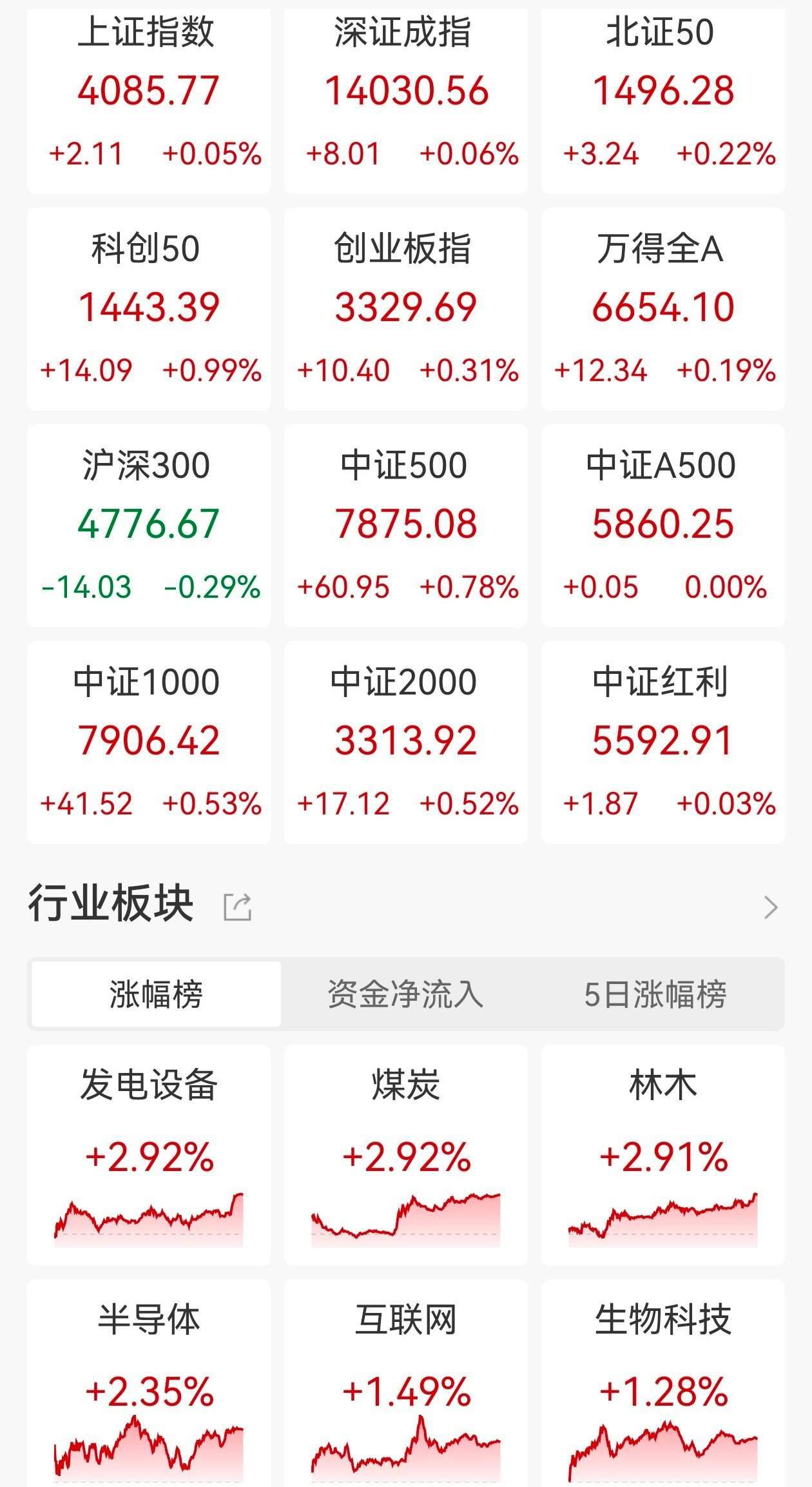
Core Viewpoint - The A-share market experienced a collective rise on January 7, with the Shanghai Composite Index achieving a 14-day consecutive increase, nearing the 4100-point mark [1] Market Performance - As of the close on January 7, the Shanghai Composite Index rose by 0.05% to 4085.77 points, while the Shenzhen Component Index increased by 0.06% and the ChiNext Index rose by 0.31% [1] - The total trading volume in the A-share market reached 2.88 trillion yuan, marking the second consecutive trading day exceeding 2.8 trillion yuan [1] Sector Performance - The semiconductor industry chain showed strength, particularly in the areas of photolithography machines and memory [1] - Other active sectors included rare earths, CPO, innovative pharmaceuticals, and short drama gaming themes [1] - Conversely, sectors such as digital currency, cross-border payments, brokerage firms, and oil and gas experienced notable declines [1]
A股收评:三大指数集体上涨,沪指涨0.05%14连阳创业板指涨0.31%,存储芯片爆发,光刻机(胶)走强!近3200股下跌,成交2.88万亿放量493亿
Ge Long Hui· 2026-01-07 07:55
Market Overview - The three major A-share indices experienced slight increases, with the Shanghai Composite Index rising by 0.05% to 4085 points, the Shenzhen Component Index increasing by 0.06%, and the ChiNext Index up by 0.31% [1][2] - The total market turnover reached 2.88 trillion yuan, an increase of 49.3 billion yuan compared to the previous trading day, with nearly 3200 stocks declining [1] Index Performance - Shanghai Composite Index: 4085.77 (+2.11, +0.05%) [2] - Shenzhen Component Index: 14030.56 (+8.01, +0.06%) [2] - ChiNext Index: 3329.69 (+10.40, +0.31%) [2] - Sci-Tech 50 Index: 1443.39 (+14.09, +0.99%) [2] - CSI 300 Index: 4776.67 (-14.03, -0.29%) [2] - CSI 500 Index: 7875.08 (+60.95, +0.78%) [2] Sector Performance - The storage chip sector saw a significant surge, with companies like Tongcheng New Materials and Hengkun New Materials hitting the daily limit [1][3] - The electronic chemicals sector also rose, with Guanggang Gas hitting the daily limit [1][3] - The photolithography machine sector strengthened, with companies like Nanda Optoelectronics reaching the daily limit [1][3] - The media sector experienced gains, with companies such as Dayou Energy and Shanxi Black Cat hitting the daily limit [3] Declining Sectors - The DRG/DIP concept saw a decline, with Rongke Technology hitting a 20% limit down [3] - The brain-computer interface sector faced a significant pullback, with companies like Chengyitong and Aipeng Medical dropping over 10% [3] - The titanium dioxide sector weakened, with Zhenhua Co. leading the decline [3] - Sectors related to digital currency, under-screen photography, and brokerage concepts also experienced notable declines [3]


东信和平跌2.02%,成交额3.82亿元,主力资金净流出918.00万元
Xin Lang Cai Jing· 2026-01-07 05:30
Core Viewpoint - Dongxin Peace experienced a stock price decline of 2.02% on January 7, with a trading volume of 3.82 billion yuan and a market capitalization of 12.973 billion yuan [1] Group 1: Stock Performance - As of January 7, Dongxin Peace's stock price was 22.35 yuan per share, with a year-to-date increase of 0.22% and a 5-day increase of 0.63% [1] - Over the past 20 days, the stock has increased by 5.18%, while it has decreased by 2.74% over the past 60 days [1] Group 2: Financial Performance - For the period from January to September 2025, Dongxin Peace reported a revenue of 961 million yuan, representing a year-on-year decrease of 9.77%, and a net profit attributable to shareholders of 112 million yuan, down 5.45% year-on-year [2] - Cumulatively, the company has distributed 541 million yuan in dividends since its A-share listing, with 227 million yuan distributed over the past three years [3] Group 3: Shareholder Information - As of September 30, 2025, the number of shareholders for Dongxin Peace increased to 94,500, up 8.16% from the previous period, while the average circulating shares per person decreased by 7.54% to 6,135 shares [2] - The top ten circulating shareholders include Hong Kong Central Clearing Limited, which holds 9.3409 million shares, an increase of 3.8622 million shares from the previous period [3]