
现金流管理

Search documents
金融街:2025年半年报显著减亏 战略转型持续推进
Zheng Quan Shi Bao· 2025-08-19 04:20
Core Viewpoint - Financial Street reported a narrowed loss in the first half of the year, demonstrating resilience in a challenging real estate market, with a net profit attributable to shareholders of -1.008 billion yuan, a 49.20% reduction in loss compared to the previous year [1] Financial Performance - The company achieved operating revenue of 4.655 billion yuan and a net profit of -1.008 billion yuan, reflecting a significant reduction in losses [1] - The net cash flow from operating activities was 1.606 billion yuan, maintaining a positive inflow [2] Market Environment - The real estate market is still in a period of adjustment, with national housing sales area down 3.5% and sales revenue down 5.5% year-on-year [1] - The average new residential sales price in 70 major cities decreased by 0.9% year-on-year, indicating significant pressure on the industry [1] Sales and Financing Strategy - The company implemented a three-pronged strategy focusing on sales acceleration, optimized financing strategies, and refined capital management [2] - Sales signed amounted to 4.76 billion yuan, with residential products contributing 4.27 billion yuan [2] - The financing balance reached 67.491 billion yuan, with a financing cost range of 1.00% to 3.80%, ensuring a good match between debt structure and business cycle [2] Cost Management - The company executed a refined management system for capital control, ensuring cash flow efficiency and reducing unnecessary expenditures [3] - Operating cash outflow decreased by 19.46% year-on-year, ensuring a positive net cash flow [3] Strategic Transformation - Financial Street is accelerating its strategic transformation, focusing on cultural tourism and urban renewal as key growth drivers [4] - The company has seen significant success in its cultural tourism projects, with visitor numbers and operating income reaching historical highs [4] - Urban renewal projects are being prioritized to revitalize inefficient assets, with a focus on innovative operational models [4] Future Outlook - The company plans to deepen its transformation efforts, enhancing existing projects and exploring new revenue streams [5] - The strategic layout aligns with industry development trends, providing a solid foundation for policy benefits [5] - Financial Street is positioned to leverage its operational stability and clear transformation path to capture opportunities in the evolving real estate market [6]

金融街:2025年半年报显著减亏 战略转型持续推进
Zheng Quan Shi Bao Wang· 2025-08-19 03:37
Core Viewpoint - Financial Street reported a narrowed loss in the first half of the year, demonstrating resilience in a challenging real estate market, with a net profit of -1.008 billion yuan, a 49.20% reduction in losses compared to the previous year [1] Group 1: Financial Performance - The company achieved operating revenue of 4.655 billion yuan, with a net profit attributable to shareholders of -1.008 billion yuan, reflecting a significant reduction in losses [1] - The net profit after excluding non-recurring gains and losses was -0.881 billion yuan, a 56.02% reduction in losses year-on-year [1] Group 2: Industry Environment - The real estate market is still in an adjustment phase, with national housing sales area down 3.5% and sales revenue down 5.5% year-on-year [1] - New residential sales prices in 70 major cities decreased by 0.9% year-on-year, indicating significant pressure on the industry [1] Group 3: Cash Flow Management - The company focused on cash flow safety, achieving a net cash inflow from operating activities of 1.606 billion yuan [2] - The financing balance reached 67.491 billion yuan, with financing costs controlled between 1.00% and 3.80%, ensuring a stable debt structure [2] Group 4: Strategic Transformation - Financial Street is advancing its strategic transformation, with a focus on "cultural tourism + urban renewal" as new growth drivers [4] - The cultural tourism business has shown significant operational success, with projects like the Mutianyu Great Wall and the Zunhua Ancient Spring Town achieving record visitor numbers and revenue [4] Group 5: Future Outlook - The company plans to deepen its transformation efforts, enhancing existing projects and exploring new business models to drive growth [5] - With a substantial land reserve of 11.61 million square meters in core cities, the company is well-positioned to capitalize on policy benefits and industry recovery [5][6]
金斯瑞生物科技2024年扭亏为盈,收益5.945亿美元增长6.1%,但持续经营业务增长仅2.9%存疑虑
Jin Rong Jie· 2025-08-18 05:59
Core Viewpoint - King’s Ray Biotechnology achieved a significant turnaround in profitability for 2024, reporting a net profit of approximately $2.962 billion, compared to a loss of $95.477 million in 2023, primarily due to accounting changes and a one-time gain from the merger cancellation with Legend Biotech [1][3] Financial Performance - The company reported revenues of approximately $594.5 million for 2024, a 6.1% increase from $560.5 million in the previous year [1] - Adjusted net profit from ongoing operations was approximately $59.8 million, reflecting a modest growth of 2.9% compared to $58.1 million in the prior year [3] Business Segments - The life sciences segment, which constitutes about 75.8% of total revenue, saw a revenue increase of 10.2%, driven by enhanced brand presence in Europe and the U.S. and the introduction of new competitive services and products [4] - The biopharmaceutical development services segment underperformed, with external revenue accounting for 14.8% of total revenue, declining by 13.2% to approximately $95.0 million, and adjusted operating losses widening by 46.1% to about $43.4 million [5] Financial Structure - The company's debt-to-asset ratio improved significantly from 39.65% to 18.09%, indicating a stronger financial structure [7] - The current ratio decreased from 4.76 to 2.72, remaining at a relatively safe level [7] Cash Flow and Management - The company reported a negative cash flow per share of -$0.61, worsening from $0.20 in the previous year, while operating cash flow per share improved slightly from -$0.14 to $0.04 [7] - The accounts receivable conversion cycle improved from 69 days to 59 days, indicating better management of customer payments, although the accounts payable conversion cycle decreased significantly from 21 days to 12 days, potentially straining cash flow management [7]



股市必读:公牛集团(603195)8月15日董秘有最新回复
Sou Hu Cai Jing· 2025-08-17 22:39
Group 1 - The stock price of Bull Group (603195) closed at 47.48 yuan on August 15, 2025, with a slight increase of 0.32% and a trading volume of 36,400 shares, resulting in a transaction amount of 172 million yuan [1] - As of March 31, 2025, the total number of common stock shareholders was 27,482, as disclosed in the company's first-quarter report [2] - The company has a healthy cash flow situation, with cash received from sales of goods and services consistently exceeding operating revenue, primarily due to the inclusion of value-added tax in cash receipts [2] Group 2 - Bull Group is actively developing its own charging gun production capabilities, covering home and commercial solutions, and has established a wide offline channel network to provide reliable products and services [2] - The company's interest income mainly comes from deposit interest generated by monetary funds [2] - On August 15, 2025, the net outflow of main funds was 2.5141 million yuan, accounting for 1.46% of the total transaction amount, while retail investors experienced a net outflow of 1.67805 million yuan, representing 9.74% of the total transaction amount [2]

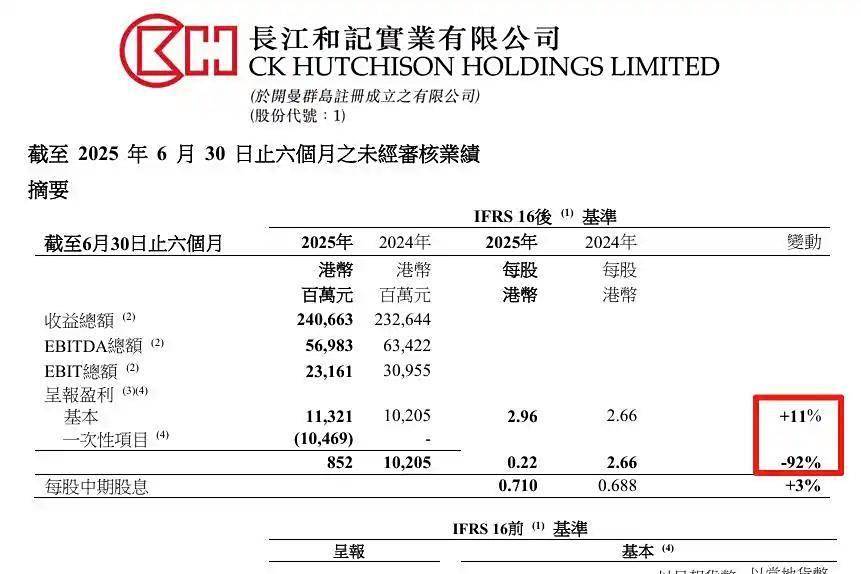
长和集团净利润暴跌92%,李嘉诚懵了!避而不谈卖港口
Sou Hu Cai Jing· 2025-08-16 11:52
Core Viewpoint - The financial report of CK Hutchison Holdings revealed a dramatic 92% drop in net profit, attributed to a one-time non-cash loss from the merger of its UK telecom business, which obscured the underlying growth in core operations [1][3]. Financial Performance - The company's net profit attributable to ordinary shareholders for the first half of 2025 was only HKD 852 million, down from HKD 10.205 billion in the previous year [2]. - Excluding the one-time non-cash loss of HKD 10.469 billion, the actual profit would have been HKD 11.321 billion, reflecting an 11% year-on-year increase [1][2]. - Total revenue for the first half of 2025 was HKD 240.663 billion, compared to HKD 232.644 billion in 2024 [2]. Strategic Moves - The company has remained silent on a significant transaction involving the sale of 43 ports valued at USD 22.8 billion to a BlackRock consortium, indicating a strategic adjustment in response to regulatory pressures [5]. - The management hinted that the transaction would be postponed until after 2025 and is seeking to involve major mainland investors [5]. Business Segments - The port division reported revenue of HKD 235.97 billion, a 9% increase, with significant growth in storage revenue from Mexico and Europe [7]. - Retail business revenue grew by 8%, driven by strong sales of health and beauty products in the UK and Poland [7]. Challenges - The retail business in mainland China showed weak performance due to sluggish consumer spending, and the real estate sector faced significant challenges, with a 92% drop in sales revenue in Hong Kong [7]. - The vacancy rate in Hong Kong's office market reached a historical high of 17%, reflecting the struggles of the real estate segment [7]. Cash Management Strategy - The company emphasized a cautious approach to capital expenditure and new investments, maintaining strict cash flow management [8]. - As of June 30, the total cash and liquid investments amounted to HKD 1,372.68 billion, with a net debt to total capital ratio of 14.7% [10]. - The merger with the UK telecom business generated approximately HKD 13 billion in cash, contributing to a substantial "cash moat" for the company [10].

华康洁净董事长被立案调查 公司称经营正常
Huan Qiu Wang· 2025-08-14 05:37
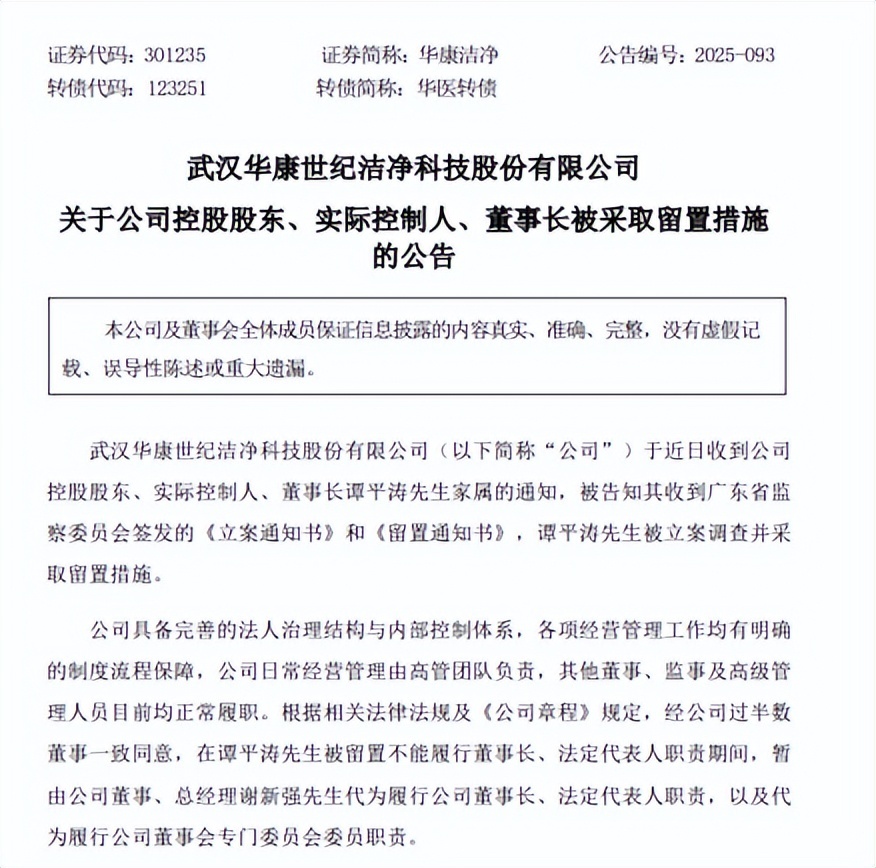
Group 1 - The core issue is that the chairman of Huakang Clean, Tan Pingtao, is under investigation by the Guangdong Provincial Supervisory Committee, which may impact the company's governance [1][4] - The company assures that daily operations are managed by the executive team, and there will be no significant adverse effects on production and operations during Tan's absence [4] - Huakang Clean's main business includes the research, design, implementation, and operation of cleanroom systems, as well as the sale of related medical equipment and consumables [4] Group 2 - In the first half of the year, Huakang Clean achieved a revenue of 835 million yuan, a year-on-year increase of 50.73%, and a net profit of 18.68 million yuan, marking a turnaround from losses [4] - The company reported a negative net cash flow from operating activities of 294 million yuan, a decline of 74.03% year-on-year [4][5] - The total order backlog as of June 30 was 3.827 billion yuan, primarily from purification integration business orders [4] Group 3 - The company faces cash flow pressure due to the capital-intensive nature of its purification system integration business, which requires significant upfront investment and has long project repayment periods [5] - To address cash flow challenges, the company plans to enhance budget control, improve project initiation standards, and accelerate project confirmations and payments [6] - The company is also monitoring short-term and long-term funding needs to ensure sufficient cash reserves and compliance with borrowing agreements [6] Group 4 - As of August 14, the stock price of Huakang Clean was 30.01 yuan, with a total market capitalization of 3.234 billion yuan [7]
301235,实控人被立案调查
Zheng Quan Shi Bao· 2025-08-13 22:29
Core Viewpoint - The company Huakang Clean (301235) is facing a significant event as its controlling shareholder and chairman, Tan Pingtao, is under investigation by the Guangdong Provincial Supervisory Committee, which may impact the company's governance and operations [1][4]. Company Overview - Huakang Clean's daily operations are managed by the executive team, with other board members and senior management continuing their duties normally. During Tan Pingtao's absence, the general manager, Xie Xinqiang, will assume the responsibilities of chairman and legal representative [4]. - The company specializes in the research, design, implementation, and operation of cleanroom purification systems, as well as the sale of related medical equipment and consumables [4]. Financial Performance - In the first half of the year, Huakang Clean reported a revenue of 835 million yuan, representing a year-on-year increase of 50.73%. The net profit was 18.68 million yuan, marking a turnaround from previous losses [4]. - However, the net cash flow from operating activities was -294 million yuan, a decline of 74.03% year-on-year [4]. Order Backlog - As of June 30, the company had a total order backlog of 3.827 billion yuan, primarily from purification integration projects. This includes 2.537 billion yuan in medical special orders, 774 million yuan in laboratory orders, and 121 million yuan in electronic cleanroom orders [4]. Cash Flow Challenges - The company faces cash flow pressure due to the capital-intensive nature of its purification system integration business, which requires significant upfront investment across various project phases. Delays in client payments can lead to ongoing negative cash flow [5]. - To address these challenges, Huakang Clean plans to enhance budget control, improve project initiation standards, and accelerate payment collection from completed projects. The finance department will monitor cash flow needs to ensure sufficient reserves [5]. Market Position - As of August 13, Huakang Clean's stock price was 32.27 yuan per share, with a total market capitalization of 3.48 billion yuan [6].
突发!301235,实控人被立案调查!
证券时报· 2025-08-13 15:10
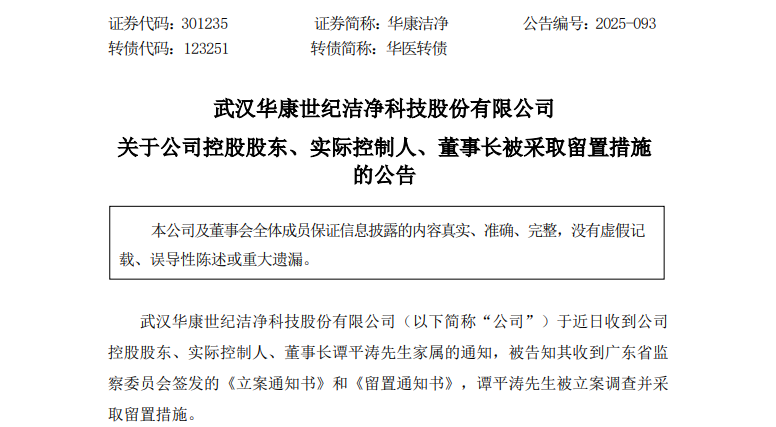
Core Viewpoint - The company Huakang Clean (301235) is facing challenges due to the investigation of its chairman, which has raised concerns about its operational stability and cash flow management [1][4]. Group 1: Company Management and Operations - Huakang Clean announced that its daily operations are managed by the executive team, and other board members and senior management are performing their duties normally [4]. - During the chairman's absence, the general manager, Xie Xinqiang, will assume the responsibilities of the chairman and legal representative [4]. - The company’s main business includes the research, design, implementation, and operation of cleanroom systems, as well as the sale of related medical equipment and consumables [4]. Group 2: Financial Performance - In the first half of the year, Huakang Clean achieved a revenue of 835 million yuan, representing a year-on-year increase of 50.73%, and a net profit of 18.68 million yuan, marking a turnaround from losses [4]. - The net cash flow from operating activities was -294 million yuan, a decline of 74.03% year-on-year [4]. - The revenue primarily came from cleanroom system integration and medical consumables sales, with 22 projects delivered [4]. Group 3: Order Backlog and Cash Flow Challenges - As of June 30, the total order backlog was 3.827 billion yuan, with significant contributions from cleanroom integration projects [4]. - The company highlighted cash flow pressures due to the capital-intensive nature of its cleanroom system integration business, which requires substantial upfront funding [5]. - Delays in customer payments could lead to ongoing negative cash flow, posing a risk to operational liquidity [5]. Group 4: Strategic Responses - To address cash flow issues, Huakang Clean plans to enhance budget control, improve project initiation standards, and prioritize cash flow management [5][6]. - The finance department will continuously monitor short-term and long-term funding needs to maintain adequate cash reserves [6].

301235 实控人被立案调查!
Zheng Quan Shi Bao Wang· 2025-08-13 14:03
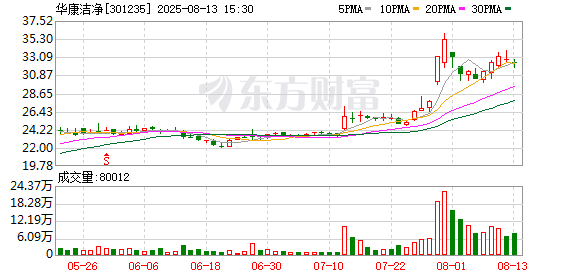
Group 1 - The core point of the article is that Huakang Clean (301235) announced that its controlling shareholder and chairman, Tan Pingtao, is under investigation by the Guangdong Provincial Supervisory Committee, but the company's operations remain normal with management responsibilities taken over by the executive team [2][4][5] Group 2 - Huakang Clean's main business includes the research, design, implementation, and operation of medical special projects, laboratory, and electronic cleanroom purification systems, along with the sale of related medical equipment and consumables [4] - In the first half of this year, Huakang Clean achieved a revenue of 835 million yuan, a year-on-year increase of 50.73%, and a net profit of 18.68 million yuan, marking a turnaround from losses [4] - The company reported a negative net cash flow from operating activities of 294 million yuan, a year-on-year decrease of 74.03% [4][5] - As of June 30, Huakang Clean had a total order backlog of 3.827 billion yuan, primarily from purification integration business, with medical special orders amounting to 2.537 billion yuan [4] - The company faces cash flow pressure due to the capital-intensive nature of its purification system integration business, which requires significant upfront investment and has long recovery periods for project payments [5] - To address cash flow challenges, Huakang Clean plans to enhance budget control, improve project initiation standards, and monitor cash flow needs to maintain sufficient cash reserves [5] Group 3 - As of August 13, Huakang Clean's stock price was 32.27 yuan per share, with a total market capitalization of 3.48 billion yuan [6]
卧龙新能:2025年中报显示营收增长但盈利能力下滑,需关注现金流及应收账款风险
Zheng Quan Zhi Xing· 2025-08-11 22:12
Core Insights - The company reported a total operating revenue of 2.15 billion yuan for the first half of 2025, representing a year-on-year increase of 36.38%. However, the net profit attributable to shareholders decreased by 26.97% to 81.55 million yuan, indicating a decline in profitability despite revenue growth [2][8]. Financial Overview - The second quarter revenue was 1.045 billion yuan, up 2.75% year-on-year, but the net profit attributable to shareholders fell by 28.73% to 46.51 million yuan, reflecting continued deterioration in profitability [3]. - The gross margin was reported at 13.28%, down 31.3% year-on-year, while the net margin decreased by 38.22% to 5.17% [9]. - The company’s accounts receivable surged by 2233.38% to 805 million yuan, raising concerns about potential bad debt risks [5]. - Operating cash flow per share increased by 334.31% to 1.07 yuan, indicating improvement in sales collection [5][9]. Business Composition - The main business segments include renewable energy and real estate development. The renewable energy sector encompasses wind, solar, energy storage, and hydrogen energy, while real estate activities are concentrated in Qingyuan, Shaoxing, and Wuhan [7]. Revenue Breakdown - Mineral trade generated 1.448 billion yuan, accounting for 67.33% of total revenue with a gross margin of 2.25% - Real estate sales contributed 301 million yuan, representing 13.99% of total revenue with a gross margin of 39.19% - Solar power revenue was 179 million yuan, making up 8.35% of total revenue with a gross margin of 57.75% - Energy storage system sales brought in 176 million yuan, accounting for 8.20% of total revenue with a gross margin of 8.09% [10].
