
融资结构优化

Search documents
日照港(600017.SH):集发公司拟发行规模不超30亿元(含30亿元)的公司债券
Ge Long Hui A P P· 2026-02-25 08:46
Group 1 - The core point of the article is that Rizhao Port (600017.SH) plans to issue corporate bonds not exceeding RMB 3 billion to enhance its financing channels and optimize its financing structure [1] Group 2 - The bond issuance will be directed towards professional investors and is part of the business development needs of Rizhao Port's wholly-owned subsidiary, Rizhao Port Container Development Co., Ltd. [1]

广东金融总量稳居全国第一
Xin Lang Cai Jing· 2026-01-17 00:12
Core Insights - Guangdong's financial total remains the highest in the country, with deposits reaching 38.7 trillion yuan and loans at 29.9 trillion yuan by the end of 2025, marking a year-on-year growth of 5.7% and 5.4% respectively [1][2] Financial Growth - As of November 2025, Guangdong's social financing scale stood at 42.3 trillion yuan, reflecting a year-on-year increase of 6.9%, which is higher than the nominal economic growth rate and loan growth rate [2] - The increase in loans indicates strong financial support for the real economy, with a total loan balance of 29.9 trillion yuan by year-end, showing a year-on-year growth of 5.4% and an increase of 1.5 trillion yuan since the beginning of the year [2] Financing Structure Optimization - Guangdong has focused on enhancing financial support for key strategies and sectors, resulting in a loan balance of 12.7 trillion yuan in these areas by November 2025, which is a year-on-year increase of 10.8% [3] - Specific loan categories such as technology, green, inclusive, elderly care, and digital economy loans have shown significant growth rates, with green loans increasing by 24.2% and elderly care loans by 95.0% [3] Economic Activity Enhancement - The overall financial situation across various sectors, including households, enterprises, and government deposits, has improved, indicating a healthy liquidity environment [4] - By the end of 2025, household deposits increased by 1.29 trillion yuan, with demand deposits growing significantly, reflecting enhanced economic activity and faster capital turnover [4]
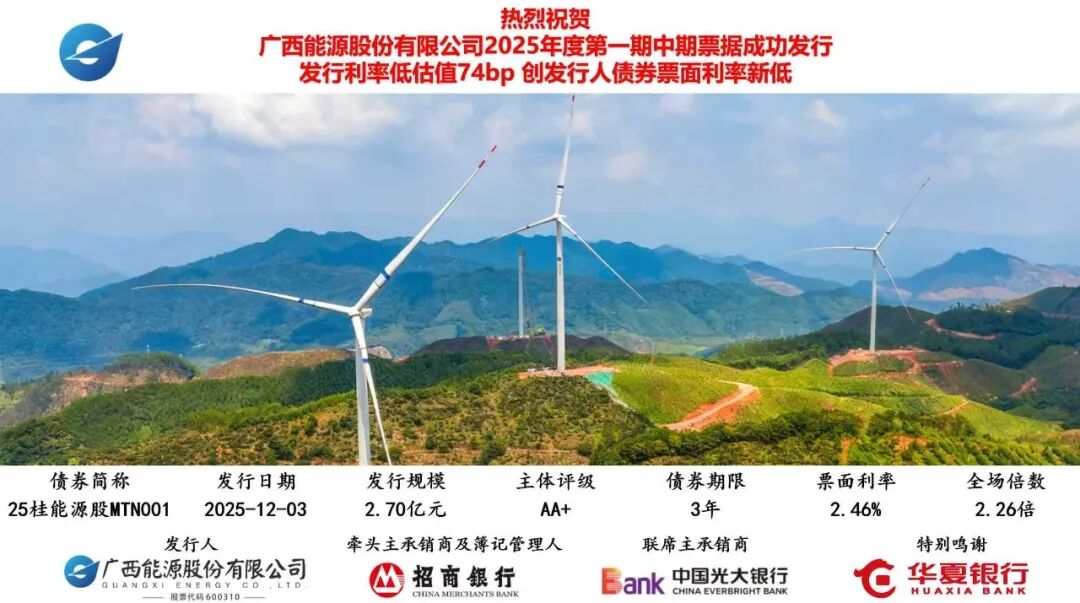
广西能源股份发行第一期中期票据 获得市场投资人踊跃认购
Xin Hua Cai Jing· 2025-12-06 08:04
Group 1 - The core viewpoint of the news is that Guangxi Energy successfully issued its first medium-term notes at a significantly lower valuation of 74 basis points, raising 270 million yuan with a maturity of 3 years and a coupon rate of 2.46% [1] - This issuance marks Guangxi Energy's first medium-term note since its listing 23 years ago, receiving enthusiastic subscriptions from market investors with a subscription multiple of 2.26 times, which optimizes the financing structure and effectively reduces financing costs [1] - The issuance is considered an important achievement in the company's credit system construction [1] Group 2 - Guangxi Energy plans to seize policy window opportunities to continuously expand financing channels, focus on reducing financing costs, and enhance the company's core competitiveness and sustainable development capabilities [3] - The company aims to provide solid energy support for the high-quality development of Guangxi's economy and society through green and low-carbon energy supply and stable and reliable power services [3]


越秀资本:公司及子公司拟发行不超350亿元债券及资产证券化产品
Xin Lang Cai Jing· 2025-12-01 10:22
Core Viewpoint - Yuexiu Capital announced the approval of a proposal to issue bonds and other financial instruments totaling up to 35 billion yuan, which aims to enhance financing channels, optimize structure, and reduce costs [1] Summary by Categories Issuance Details - The company plans to issue up to 7 billion yuan in corporate bonds and 6 billion yuan in medium-term notes among other securities [1] - The total issuance includes corporate bonds, medium-term notes, perpetual notes, and asset-backed securities [1] Approval Process - The proposal requires approval from the sixth extraordinary general meeting of shareholders in 2025 [1] - The final issuance plan is subject to regulatory approval and registration, indicating potential uncertainties [1]

贵州省发债城投企业财务表现观察:债务规模整体压降,融资结构有所改善,短期流动性仍承压
Lian He Zi Xin· 2025-11-24 15:09
1. Report Industry Investment Rating No relevant information provided in the report. 2. Core Viewpoints of the Report - Benefiting from the debt - resolution policy tilt towards key provinces, the release of special refinancing bonds and special new special bond quotas, and the orderly progress of debt - resolution measures such as debt extension, interest rate cuts, and replacement of financing platforms, the overall debt risk in Guizhou Province has been further mitigated. The debt scale of bond - issuing urban investment enterprises has continued to decline, and the financing structure has improved, but short - term solvency and liquidity still face significant pressure, and the net financing amount shows obvious regional differentiation. - In the short term, the debt resolution of bond - issuing urban investment enterprises in Guizhou Province still relies on the "combination punch" of debt - resolution policies to reduce debt risks, with obvious regional differentiation and greater difficulty in improving the financial fundamentals of tail - end regions. In the long run, urban investment enterprises need to "develop while resolving debts and resolve debts while developing", promoting high - quality economic development through optimizing the investment structure and expanding domestic demand to create conditions for debt resolution [4]. 3. Summary by Relevant Catalogs 3.1 Guizhou Province's Debt Control Situation - In 2024, Guizhou's debt ratio continued to rise, with Guiyang, Zunyi, and Liupanshui exceeding the provincial average. The overall debt risk was further mitigated due to policy support and debt - resolution measures [5]. - From the end of 2022 to 2024, Guizhou's comprehensive financial resources continued to grow, but the growth rate dropped significantly in 2024. Government debt balance increased, while the debt balance of bond - issuing urban investment enterprises decreased. Both the government debt ratio and the broad - sense government debt ratio continued to rise [5]. - By the end of 2024, government debt in Guizhou was mainly concentrated in the provincial - level, Guiyang, and Zunyi, accounting for 50.43% of the total. Liupanshui, Tongren, and Qianxinan had relatively fast - growing government debt balances. Most prefecture - level cities' government debt ratios exceeded 160%, and some cities' broad - sense government debt ratios were above the provincial average [6]. - In 2024, a series of debt - resolution policies were introduced. Guizhou received 352.8 billion yuan of the new local government debt quota from the central government for debt replacement, and 800 billion yuan was allocated annually from new local government special bonds for five years starting from 2024. From 2024 to September 2025, Guizhou issued 226.843 billion yuan of special refinancing bonds and 64.99 billion yuan of special new special bonds [8]. - The provincial and local governments actively promoted debt - resolution work. Various cities and counties achieved certain results, such as some areas changing their debt risk levels and reducing debt ratios [9][10][11]. 3.2 Changes in Financial Indicators of Urban Investment Enterprises in Guizhou Province Investment - From 2024 to the first half of 2025, the investment growth of Guizhou's urban investment enterprises further slowed down, and the investment structure continued to be adjusted, but the proportion of urban - construction assets was still much higher than the national average. The investment scale of provincial - level and Guiyang's urban investment enterprises increased, and most prefecture - level cities still mainly invested in urban - construction assets, while Anshun and Tongren had relatively high proportions of self - operated assets, equity, and fund - type investments [12][13]. - From 2022 to the end of June 2025, the overall investment scale of urban investment enterprises continued to grow, but the growth rate slowed down from 2.29% at the end of 2022 to 0.11% at the end of June 2025. The scale of urban - construction assets fluctuated and decreased, while self - operated assets and equity and fund - type investments fluctuated and increased. As of the end of June 2025, urban - construction assets accounted for 72.73%, self - operated assets 19.34%, and equity and fund - type assets 7.94% [15]. - Regionally, provincial - level, Guiyang, Tongren, and Qianxinan's urban - construction asset investments increased, while Bijie and Zunyi had significant declines. In terms of self - operated asset investment, provincial - level, Anshun, Qiannan, and Qianxinan had growth rates exceeding 5%. In terms of equity and fund - type investment, except for Zunyi, provincial - level, Guiyang, and Liupanshui had growth, and Qiannan's total investment decreased the most at the end of June 2025 [16]. 回款 - From 2024 to the first half of 2025, the accounts receivable scale of Guizhou's urban investment enterprises continued to expand, but the growth rate slowed down, and the cash - income ratio remained at a high level. Guiyang, Zunyi, Liupanshui, and Bijie had large accounts receivable scales, with Zunyi's decreasing and Guiyang's growing rapidly. In 2024, Bijie's回款 was poor, while provincial - level, Guiyang, Zunyi, and Qianxinan had relatively good回款 [18]. - From 2022 to the end of June 2025, the accounts receivable scale of urban investment enterprises continued to grow, but the growth rate slowed down. The cash - income ratio was above 85%. At the end of June 2025, Guiyang, Zunyi, Liupanshui, and Bijie had accounts receivable exceeding 20 billion yuan, accounting for 73.25% of the total. In 2024 - 2025, Zunyi's accounts receivable decreased, and Bijie's cash - income ratio was less than 30% [21][22]. Fund - raising - In 2024, the fund - raising activities of Guizhou's urban investment enterprises showed a net inflow, but the scale was much narrower than in 2022 due to restricted new financing. There was obvious regional differentiation, with provincial - level and Guiyang having large net inflows, while Zunyi, Liupanshui, Tongren, and Qiandongnan had continuous net outflows, and Zunyi's net outflow exceeded 10 billion yuan in 2024 [23]. - From 2022 - 2024, the cash inflow from fund - raising activities decreased significantly, and the cash outflow fluctuated and decreased. In 2024, provincial - level, Guiyang, and Zunyi had large inflows, and provincial - level, Bijie, Anshun, and Qiannan had growth rates exceeding 20%. Provincial - level, Guiyang, Bijie, Anshun, and Qiannan had net inflows, while others had net outflows. From January - June 2025, only provincial - level and Liupanshui had net inflows [26][27]. Interest - bearing Debt - From 2024 to the first half of 2025, the debt scale of Guizhou's urban investment enterprises continued to decline, with debt concentrated in provincial - level, Guiyang, Zunyi, and Liupanshui. Provincial - level debt increased, while Zunyi and Liupanshui had significant declines. The overall short - term debt ratio changed little, and the short - term debt ratios of provincial - level, Bijie, Liupanshui, and Tongren decreased to a low level. The financing structure was still dominated by bank loans, with bond financing decreasing and other financing increasing [28]. - From 2024 - June 2025, the debt scale of urban investment enterprises continued to decline. At the end of June 2025, provincial - level, Guiyang, Zunyi, and Liupanshui had high debt scales, accounting for 78.13% of the total. In 2024, provincial - level and Tongren's debt increased, while others decreased. At the end of June 2025, Liupanshui and Qianxinan's debt increased slightly, while others decreased [31]. - The debt term structure was mainly long - term debt, and the short - term debt ratio was 21.83% at the end of June 2025. Provincial - level, Bijie, Liupanshui, and Tongren's short - term debt ratios were below 20%, and Qiandongnan's was the highest at 28.88% [32]. - From 2022 - 2024, bank loans and bond financing decreased, while other financing increased. Bank loans and other financing accounted for 67.22% and 13.89% respectively, and bond financing accounted for 18.89%. Regionally, provincial - level and Guiyang's bank loans increased, and most cities' bond financing decreased. Tongren and Zunyi's other financing grew rapidly, while Zunyi and Anshun's decreased slightly [33]. Solvency - At the end of June 2025, the overall debt ratio of Guizhou's urban investment enterprises decreased, but the cash - to - short - term - debt ratio dropped to a low level. Regionally, Tongren's debt ratio was high, and Zunyi, Bijie, and Anshun faced great short - term solvency pressure [35]. - From 2022 - June 2025, the overall asset - liability ratio increased, the total debt capitalization ratio decreased, and the cash - to - short - term - debt ratio fluctuated and decreased to 0.24 times. At the end of June 2025, Tongren's total debt capitalization ratio exceeded 50%, and Zunyi, Bijie, and Anshun's cash - to - short - term - debt ratios were no more than 0.10 times [36]. 3.3 Summary - Since 2024, Guizhou's government debt ratio has continued to rise, with some cities exceeding the provincial average. The overall debt risk has been mitigated due to policy support. - The debt scale of bond - issuing urban investment enterprises has decreased, and the financing structure has improved, but there are still problems such as high short - term solvency pressure, unoptimized financing structure in some regions, obvious regional differentiation in net financing, and slow investment growth. - In the short term, debt - resolution relies on policies, and in the long term, urban investment enterprises need to promote economic development to resolve debts [37][39].
国家金融与发展实验室理事长李扬:为科技创新提供更好的融资环境
Zheng Quan Ri Bao· 2025-11-16 17:08
Core Insights - The core viewpoint emphasizes that technology empowerment is the key driver for the transformation and upgrading of listed companies in China as the economy enters a stock development phase [1][2] Group 1: Technology Empowerment and Market Dynamics - Technology innovation and industry integration are essential for establishing industrial value ecosystems, driven by rapid technological advancements [1] - The importance of market capitalization management is highlighted, focusing on maintaining a healthy capital structure and maximizing shareholder value through reasonable operational investments and strategic adjustments [1] - Cash dividends are identified as a crucial method for returning value to investors, helping to stabilize the capital market and enhance investor confidence [1] Group 2: Financing Structure and Asset Management - China's financing structure is undergoing positive changes, with an overall increase in social financing scale and an optimization trend in its structure, where direct financing is gradually rising [1] - The asset management market is projected to exceed 32 trillion yuan by 2025 and reach 45 trillion yuan by 2026, providing significant funding sources for capital markets and supporting technological innovation [2] - The implementation of the "merger and acquisition six guidelines" by the CSRC facilitates cross-industry mergers, enabling technology companies to integrate resources and achieve rapid development [2] Group 3: Future Development Suggestions - Recommendations for future capital market development include enhancing inclusivity and adaptability for technology innovation companies, steadily developing the derivatives market, and emphasizing the role of mergers and acquisitions in industrial integration [2] - The new paradigm of technology empowerment and value return to patient capital is seen as a reflection of market maturity and a vital mission for promoting high-quality economic development in China [2]
新城控股(601155):整体经营稳定向好 境外融资斩获成果
Xin Lang Cai Jing· 2025-11-03 12:29
Core Insights - The company reported a significant decline in revenue and net profit for Q1-Q3 2025, with total revenue of 34.37 billion yuan, down 33.3% year-on-year, and a net profit of 970 million yuan, also down 33.0% [1] - Despite the overall decline, the commercial operations segment showed strong performance, with total commercial revenue reaching approximately 10.51 billion yuan, up 10.8% year-on-year [1] Group 1 - The company achieved a total revenue of 12.27 billion yuan in Q3 2025, a decrease of 30.5% year-on-year, with a net profit of 79.01 million yuan, down 42.1% [1] - The commercial operations segment maintained robust growth, with September revenue of approximately 1.17 billion yuan, reflecting a 10.1% increase compared to the same month last year [1] - The company reported a total of 177 leased properties by the end of Q3 2025, an increase of 10 properties from 2024, with a rental income of 9.81 billion yuan, up 10.8% year-on-year [1] Group 2 - The company recorded a total contract sales amount of approximately 15.05 billion yuan and a sales area of about 1.959 million square meters for Q1-Q3 2025 [2] - The company successfully issued a total of 160 million USD in unsecured fixed-rate bonds in the overseas market, enhancing its financing structure [2] - The company forecasts a compound annual growth rate (CAGR) of 19.4% for net profit from 2025 to 2027, supported by strong resilience and operational efficiency in its commercial segment [2]

帝科股份:质押控股子公司股权申请并购贷款
Xin Lang Cai Jing· 2025-09-10 09:10
Core Viewpoint - The company has pledged 60% of its controlling subsidiary, Zhejiang Suote Material Technology Co., Ltd., to secure a bank loan of up to RMB 400 million, aimed at optimizing its financing structure and covering acquisition-related costs [1] Group 1: Company Actions - The pledged equity is part of the company's strategy to optimize its financing structure [1] - The loan will be used for payment or replacement of acquisition transaction costs [1] - The equity pledge aligns with the company's funding usage plan and long-term development strategy [1] Group 2: Subsidiary Information - Zhejiang Suote was established on November 27, 2020, with a registered capital of RMB 869.8 million [1] - The subsidiary focuses on research and development of new material technologies and electronic specialized materials [1] Group 3: Financial Impact - The equity pledge is not expected to have a significant impact on the company's financial condition or operating results [1]
武商集团: 关于拟注册发行超短期融资券的公告
Zheng Quan Zhi Xing· 2025-08-26 17:08
Group 1 - The company plans to apply for the registration of a super short-term financing bond not exceeding RMB 2 billion, which will require approval from the shareholders' meeting and the China Interbank Market Dealers Association [1][2] - The proposed bond will have a maximum term of 270 days, with the specific issuance period determined by the company's funding needs and market conditions [1][2] - The funds raised will be used for repaying loans and supplementing working capital, in accordance with the regulations of the China Interbank Market Dealers Association [1][2] Group 2 - The board of directors seeks authorization from the shareholders' meeting to manage the issuance process, including adjusting the issuance terms based on market conditions [2][4] - The board will have the authority to decide on the issuance scale, timing, interest rates, and other related matters to maximize the company's interests [2][4] - The registration and issuance process will remain valid until the completion of the bond issuance [2][4] Group 3 - The registration of the super short-term financing bond is seen as a significant step for the company to optimize its financial structure, broaden financing channels, and reduce financing costs [4]

国星光电: 关于超短期融资券注册批复到期的公告
Zheng Quan Zhi Xing· 2025-08-25 19:07
Core Viewpoint - The company has registered to issue short-term financing bonds amounting to a maximum of RMB 1 billion, with a maturity period not exceeding 270 days, but the registration has expired without issuance due to various assessments [1][2]. Group 1 - The company received approval from the China Interbank Market Dealers Association to register for issuing short-term financing bonds totaling RMB 1 billion, with the registration valid for two years starting from August 23, 2023 [1]. - The company has not implemented the issuance of the registered short-term financing bonds within the validity period due to a comprehensive evaluation of the issuance timing, actual funding needs, and the suitability of other financing channels [2]. - The expiration of the registration for the short-term financing bonds will not have a significant impact on the company's production and operational activities [2]. Group 2 - The company will plan its financing arrangements reasonably based on future operational development needs [2].
