险资入市

Search documents
港股异动 内银股午后涨幅扩大 险资继续扫货银行股H股 机构称险资配置逻辑仍将持续
Jin Rong Jie· 2025-08-07 07:29
Core Viewpoint - The article highlights the recent performance of Chinese bank stocks, driven by significant investments from insurance companies and regulatory support for long-term investments in the capital market [1]. Group 1: Stock Performance - Postal Savings Bank of China (01658) increased by 3.42%, trading at HKD 5.75 - Agricultural Bank of China (01288) rose by 2.09%, trading at HKD 5.38 - Bank of China (03988) saw a 1.77% increase, trading at HKD 4.61 - Industrial and Commercial Bank of China (01398) grew by 1.47%, trading at HKD 6.20 [1]. Group 2: Investment Activities - Hongkang Life purchased 30.386 million shares of Zhengzhou Bank H-shares, marking its fourth acquisition since June - Ping An Asset Management bought 3.7425 million shares of China Merchants Bank H-shares, increasing its stake to 16.03% - Notable insurance companies such as Ping An, Xinhua Life, Ruizhong Life, and Hongkang Life have all made purchases in bank stocks this year [1]. Group 3: Regulatory Support - The Ministry of Finance issued a notice aimed at guiding insurance funds towards long-term stable investments, enhancing the assessment of state-owned commercial insurance companies - According to CITIC Securities, the measures proposed in the notice are expected to improve insurance funds' tolerance for short-term market fluctuations, thereby stabilizing investment behaviors and promoting the entry of insurance capital into the market - The dividend sector is anticipated to contribute to stable net investment returns in a low-interest-rate environment, while the FVOCI measurement model may help mitigate the impact of stock price volatility on profits [1].


内银股午后涨幅扩大 险资继续扫货银行股H股 机构称险资配置逻辑仍将持续
Zhi Tong Cai Jing· 2025-08-07 06:28
Group 1 - The core viewpoint highlights a significant increase in the share prices of major Chinese banks, with Postal Savings Bank rising by 3.42% to HKD 5.75, Agricultural Bank by 2.09% to HKD 5.38, Bank of China by 1.77% to HKD 4.61, and Industrial and Commercial Bank by 1.47% to HKD 6.2 [1] - On July 25, Hongkang Life purchased 30.386 million shares of Zhengzhou Bank H-shares, marking the fourth time since June that it has crossed the Hong Kong Stock Exchange's disclosure threshold [1] - On July 28, Ping An Asset Management bought 3.7425 million shares of China Merchants Bank H-shares, increasing its holding to 16.03% [1] - Notably, several insurance companies, including Ping An, Xinhua Life, Ruizhong Life, and Hongkang Life, have purchased bank stocks this year [1] Group 2 - The Ministry of Finance has issued a notice aimed at guiding insurance funds towards long-term stable investments, which is expected to enhance the tolerance of insurance capital for short-term market fluctuations [2] - According to a report by CITIC Securities, the measures proposed in the notice are likely to stabilize investment behaviors and further promote the entry of insurance capital into the market [2] - The dividend sector is expected to contribute to stable net investment returns in a low-interest-rate environment and mitigate the impact of stock price fluctuations on profit through FVOCI measurement [2]



港股异动 | 内银股午后涨幅扩大 险资继续扫货银行股H股 机构称险资配置逻辑仍将持续
智通财经网· 2025-08-07 06:25
Group 1 - The core viewpoint of the article highlights the significant increase in the share prices of Chinese banks, with notable gains for Postal Savings Bank, Agricultural Bank, Bank of China, and Industrial and Commercial Bank [1] - On July 25, Hongkang Life purchased 30.386 million shares of Zhengzhou Bank H-shares, marking the fourth time since June that it has crossed the Hong Kong Stock Exchange's equity disclosure threshold [1] - On July 28, Ping An Asset Management bought 3.7425 million shares of China Merchants Bank H-shares, increasing its holding to 16.03% [1] Group 2 - The article mentions that several insurance companies, including Ping An, Xinhua Life, Ruizhong Life, and Hongkang Life, have purchased bank stocks this year [1] - The Ministry of Finance recently issued a notice aimed at guiding insurance funds towards long-term stable investments, which is expected to enhance the stability of investment behaviors and promote the entry of insurance capital into the market [1] - According to a report by CITIC Securities, the measures proposed in the notice are likely to improve insurance funds' tolerance for short-term market fluctuations, thereby stabilizing profit performance and maintaining relative stability in net investment returns in a low-interest-rate environment [1]
大举入市!7月已有7家险资出手
证券时报· 2025-08-02 00:08
Core Viewpoint - The continuous entry of insurance capital into the market is evident, with multiple insurance companies actively purchasing shares of various listed companies, particularly in the banking sector, indicating a strong confidence in the long-term prospects of these assets [1][14]. Group 1: Recent Insurance Capital Activities - On July 25, Hongkang Life purchased 30.386 million shares of Zhengzhou Bank H-shares at an average price of 1.3788 HKD per share, increasing its holding to 10.45% [2][3]. - On July 28, Ping An Asset Management bought 3.7425 million shares of China Merchants Bank H-shares, raising its holding to 16.03% [2]. - Within a month, seven insurance companies have made multiple purchases involving eight different stocks, showcasing a trend of increased investment activity [3]. Group 2: Significant Purchases by Insurance Companies - On July 9, Taikang Life participated as a cornerstone investor in the IPO of Fengjian Technology, investing 25 million USD for an 8.69% stake [4]. - On July 16, Ping An bought 1.2532 million shares of China Telecom H-shares at an average price of 5.7 HKD, increasing its holding to 5.00% [5]. - On July 22, Ping An Life acquired 22.909 million shares of Postal Savings Bank H-shares, raising its stake to 14.10% [6]. Group 3: Trends in Insurance Capital Investments - As of July 30, insurance companies have made 21 significant share purchases in 2025, surpassing the total for the previous three years combined, marking a five-year high [6]. - The banking sector remains a favored investment area for insurance capital, with companies like Ping An and Xinhua Life heavily investing in bank stocks [8][12]. - Ping An has reportedly spent over 100 billion HKD on bank stocks this year, with current holdings valued at over 260 billion HKD [8]. Group 4: Investment Rationale and Market Conditions - The low interest rate environment and the need for high-yield quality assets have driven insurance companies to increase their equity investments [10][12]. - Insurance companies prefer stable, high-dividend stocks, particularly in the banking sector, due to their solid operational fundamentals and liquidity [12][13]. - The trend of increasing equity investment is seen as a strategy to enhance investment returns amid changing accounting standards and declining long-term bond yields [13][14].



大举入市,7月已有7家险资出手
Zheng Quan Shi Bao· 2025-08-01 09:07
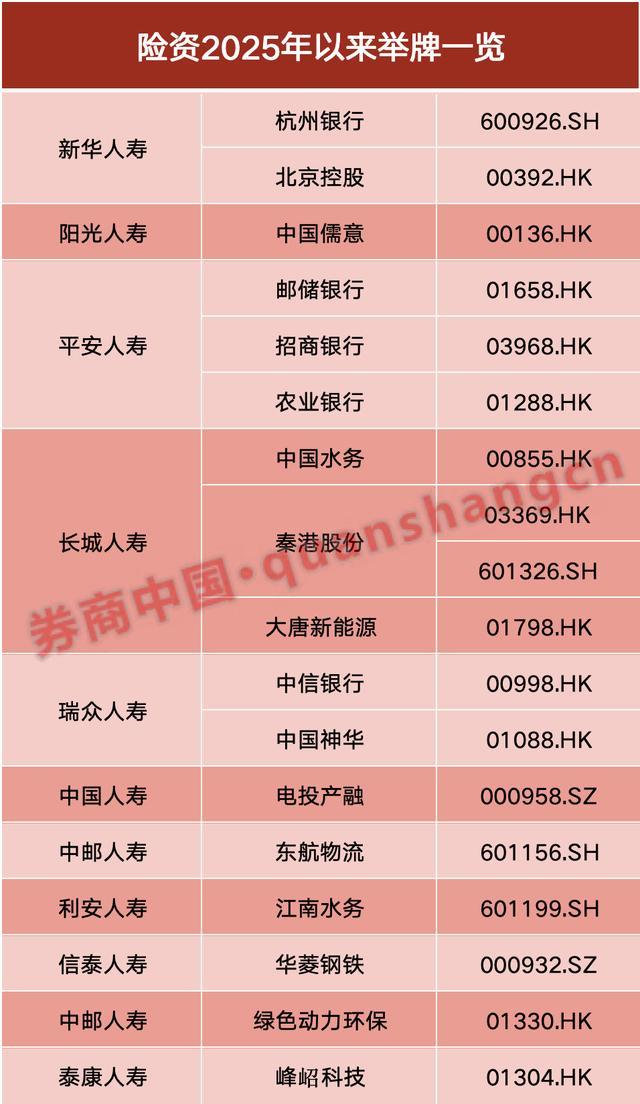
一月内7家险资出手 7月25日,弘康人寿买入3038.6万股郑州银行H股,每股均价1.3788港元,持股比例升至10.45%。短短不 到一个月,弘康人寿已耗资逾亿港元买入郑州银行H股,这对于一家小型保险公司来说并非易事。 弘康人寿的投资布局是险资持续入市的一个缩影。据券商中国记者根据公开披露信息不完全统计,一个 月内已有7家险资数度出手买入标的资产,涉及8只股票。 7月1日,利安人寿买入110万股江南水务股票,持有江南水务股票增至4699.54万股,占该上市公司总股 本的比例升至5.03%。 7月3日,信泰人寿通过二级市场买入69.09万股华菱钢铁股票,持有华菱钢铁股票增至3.45亿股,占该上 市公司总股本的比例升至5.00%。同日,信泰人寿以6.7263港元的每股均价买入约3.41亿股龙源电力H股 股票,持股比例从10.03%升至10.27%。 险资入市正在持续推进。 近日,又有两家险资出手。7月25日,弘康人寿买入3038.6万股郑州银行H股,这是弘康人寿6月以来第 四次突破港交所权益变动披露线。7月28日,平安资产以投资经理的身份买入374.25万股招商银行H股, 持有该行H股比例升至16.03%。根据 ...

大举入市!7月已有7家险资出手
券商中国· 2025-08-01 08:14
险资入市正在持续推进。 近日,又有两家险资出手。7月25日,弘康人寿买入3038.6万股郑州银行H股,这是弘康人寿6月以来第四次突破港交所权益变动披露线。7月28 日,平安资产以投资经理的身份买入374.25万股招商银行H股,持有该行H股比例升至16.03%。根据平安资产受托资产情况来看,此次投资背后 的委托人大概率仍是险资。 一月内7家险资出手 7月25日,弘康人寿买入3038.6万股郑州银行H股,每股均价1.3788港元,持股比例升至10.45%。短短不到一个月,弘康人寿已耗资逾亿港元买入 郑州银行H股,这对于一家小型保险公司来说并非易事。 弘康人寿的投资布局是险资持续入市的一个缩影。据券商中国记者根据公开披露信息不完全统计,一个月内已有7家险资数度出手买入标的资 产,涉及8只股票。 7月1日,利安人寿买入110万股江南水务股票,持有江南水务股票增至4699.54万股,占该上市公司总股本的比例升至5.03%。 7月3日,信泰人寿通过二级市场买入69.09万股华菱钢铁股票,持有华菱钢铁股票增至3.45亿股,占该上市公司总股本的比例升至5.00%。同日, 信泰人寿以6.7263港元的每股均价买入约3.41亿股 ...


长盛基金杨秋鹏:银行、钢铁等领域标的有望受益于险资入市
Zhong Zheng Wang· 2025-07-31 14:13
杨秋鹏表示,一方面,险资起到了压舱石的作用,其持股周期较长,对分红比较看重,偏好中大盘股, 因此,险资入市对于市场指数有很强的托底作用;另一方面,险资的个股选择很看重利润的稳定性、自 由现金流的持续性、分红的能力与意愿。因此,其偏好的标的具有明显特征,比如净资产收益率与资产 回报率水平较高、企业中长期自由现金流较好、分红比例有提升空间、市净率较低的个股。银行、钢铁 等领域中具备以上几种特征的标的就会比较受益。 中证报中证网讯(记者王雪青)7月31日晚间,长盛基金社保业务管理部基金经理杨秋鹏在"中证点金 汇"直播间表示,在险资入市方面,由于险资有低市净率资产计入FVOCI(以公允价值计量且其变动计入 其他综合收益的金融资产)科目的诉求,因此,险资和公募基金追求的资产类别是有所差异的,关注的 个股指标也会有所差异。 ...
A股市场资金研究系列(四):千亿险资入市背后的四重追问
Ping An Securities· 2025-07-24 09:47
Group 1 - The core driving forces behind the entry of insurance funds into the A-share market include a low interest rate environment, asset-liability mismatch, and new accounting standards that challenge insurers to smooth their financial statements [3][6][12] - The low interest rate environment has made it difficult for insurance companies to generate returns on their asset side, with 10Y and 30Y government bond yields fluctuating below 2% and 2.2% respectively [7][8] - The implementation of IFRS9 has compelled insurers to increase investments in stable, high-dividend stocks, as these assets help mitigate the impact of fair value fluctuations on financial statements [9][10] Group 2 - Policies aimed at facilitating the entry of insurance funds into the market include increasing the equity allocation ratio, optimizing long-term assessments, and establishing pilot projects for long-term stock investments [12][13][14] - The regulatory framework has been adjusted to allow for a higher proportion of equity investments, with the upper limit raised to 50% for certain insurance companies [12][15] - New tools have been created to provide low-cost leverage for insurance funds, enhancing their ability to invest in the capital market [14][15] Group 3 - Insurance funds are increasingly favoring high-dividend blue-chip stocks and long-term equity investments to address asset-liability duration mismatches [8][18] - In Q1 2025, insurance companies increased their stock holdings by approximately 390 billion yuan, with a notable rise in the proportion of OCI (Other Comprehensive Income) investments [18][19] - The trend of passive investment is expanding, with a focus on broad-based ETFs, which have seen a 34.8% increase in holdings by insurance funds compared to 2023 [26][27] Group 4 - There is significant potential for further investment from insurance funds, with an estimated 2.9 trillion yuan of additional capacity to enter the market based on current regulatory limits [29][30] - From a dynamic perspective, the annual incremental investment from four major state-owned insurance companies is projected to be between 347.7 billion and 659.8 billion yuan starting in 2025 [30][34] - The ongoing entry of insurance funds is expected to enhance the stability of the capital market and promote a shift towards institutional and professional investment practices [39][40]
从“一年一考”到“五年一盘”,A股市场的慢变量来了
和讯· 2025-07-21 09:40
Core Viewpoint - The recent policy shift by the Ministry of Finance aims to guide insurance funds towards long-term and stable investments, moving from an annual assessment to a five-year evaluation cycle, which is expected to enhance the stability and structure of the A-share market [1][2][5] Group 1: Policy Changes and Implications - The new assessment mechanism for state-owned commercial insurance companies will focus on a combination of annual, three-year, and five-year performance indicators, with weights adjusted to 30%, 50%, and 20% respectively [2] - This adjustment is intended to align financial performance assessments with the actual operational cycles of insurance products, reducing the pressure for short-term financial results [2][3] - The policy is seen as a dual approach to encourage long-term investment behavior while providing clear guidelines for fund allocation in the A-share market [2][5] Group 2: Market Impact and Predictions - It is anticipated that the allocation of insurance funds in the A-share market will increase from approximately 11% to 15% or higher over the next two to three years, with a potential net increase of 300 billion to 500 billion yuan annually [5] - The long-term investment focus is expected to optimize the investment structure of insurance funds, leading to a gradual shift from defensive to a balanced investment strategy [5] - The influx of long-term capital is likely to reduce market volatility and enhance the market's resilience to external shocks, contributing to overall market stability [5][6] Group 3: Investment Preferences and Concerns - There are concerns that insurance funds may concentrate their investments in high-dividend stocks, which could contradict the goal of enhancing market vitality and structure [7][8] - However, high-dividend companies are typically stable and well-governed, and their attractiveness to insurance funds could lead to improved valuations and governance practices [8] - The regulatory framework encourages diversified investments, suggesting that insurance funds will not be limited to specific sectors but will consider a balanced risk-return profile [8][9] Group 4: Risk Management and Regulatory Considerations - The dual nature of insurance funds as stabilizers in the market and potential sources of systemic risk has been highlighted, emphasizing the need for robust regulatory frameworks [9][10] - Recommendations include strict monitoring of investment ratios, dynamic risk management, and enhanced transparency in risk disclosures to mitigate potential financial instability [9][10] - Historical lessons from the UK and US suggest that developing insurance products where investment risks are borne by policyholders could be a viable strategy for promoting insurance fund participation in the market [10]


A股,重大利好!最新解读!
天天基金网· 2025-07-21 05:24
Core Viewpoint - The establishment of a long-cycle assessment mechanism for insurance funds aims to shift the focus from short-term profit-seeking to long-term stable investment, enhancing the overall investment logic of insurance capital [2][4][6]. Group 1: Long-Cycle Assessment Mechanism - The long-cycle assessment mechanism addresses the "long money, short investment" dilemma by increasing the weight of long-term indicators such as net asset return and capital preservation to 70% [4][10]. - This mechanism is expected to stabilize market fluctuations, introduce incremental funds, and optimize the investment ecosystem by focusing on high-dividend and technology growth sectors [4][5][10]. - Insurance funds are encouraged to adopt a long-term investment approach, which aligns with their inherent characteristics and supports the stability of the capital market [5][6][12]. Group 2: Impact on Capital Market - The increase in insurance capital's A-share investment ratio is anticipated to benefit dividend assets and high-quality growth sectors, promoting a shift towards value investment in the market [3][15]. - The long-cycle assessment mechanism will reduce the impact of short-term market volatility on investment decisions, allowing insurance companies to focus on fundamental value and long-term growth potential [5][6][7]. - The expected influx of insurance capital into the market could lead to a significant increase in A-share investment, potentially injecting over 3.5 trillion yuan in new funds if equity allocation rises to 15% [4][11][12]. Group 3: Policy Support for Insurance Capital - Recent policies have been implemented to encourage insurance capital to enter the market, aiming to leverage its long-term stable funding advantages to support capital market stability and economic development [8][9]. - Future policies are expected to further optimize the investment environment for insurance capital, including lowering stock investment risk factors and expanding pilot programs for long-term equity investments [9][10]. - The ongoing policy framework is designed to address the needs of insurance companies while promoting high-quality development in the capital market [10][12]. Group 4: Role of Public Funds - Public funds are positioned as key partners for insurance companies in equity investment, with opportunities for significant business growth in areas such as customized accounts and low-volatility dividend products [19][20]. - The demand for public funds is expected to rise as insurance capital increases its allocation to equity assets, particularly in index funds and thematic funds that align with insurance capital's investment strategies [19][20]. - Public funds can help insurance companies optimize their asset allocation through professional investment management and a diverse product lineup [20][21].