
预测市场

Search documents
美股异动丨Coinbase夜盘涨近5%,Q3净利润同比大增4.7倍且超预期
Ge Long Hui A P P· 2025-10-31 01:16
Core Viewpoint - Coinbase reported strong third-quarter earnings, exceeding market expectations in both revenue and net profit, while also announcing future product developments aimed at expanding its financial services offerings [1] Financial Performance - Revenue for the third quarter increased by 55% year-over-year to $1.87 billion, surpassing market expectations of $1.8 billion [1] - Net profit surged 4.7 times year-over-year to $430 million, translating to earnings per share of $1.50, which is higher than the anticipated $1.10 [1] - Trading volume reached $295 billion during the quarter, although this figure fell short of market expectations [1] Future Plans - CEO Brian Armstrong indicated plans to share more details on stock tokenization and prediction markets at a product showcase scheduled for December 17 [1] - The company reiterated its vision to become a "super app" that provides all financial functionalities desired by consumers [1]

交易量创新高!Coinbase营收大涨55%,CEO称12月展示“股票代币化和预测市场细节”,继续迈向“万物交易所”
Hua Er Jie Jian Wen· 2025-10-31 00:27
Core Insights - Coinbase reported a record third-quarter revenue of $1.9 billion, a 55% year-over-year increase, surpassing analyst expectations of $1.8 billion [1] - The net profit surged nearly fivefold to $433 million, equating to $1.50 per share, compared to $75.5 million in the same period last year [1] - Following the earnings report, Coinbase's stock price rose by 4% in after-hours trading, marking a 32% increase year-to-date [1] Group 1: Trading Volume and Revenue Drivers - Coinbase's trading volume reached $295 billion in the third quarter, with strong momentum expected to continue into the fourth quarter [3] - Despite market volatility, trading revenue for the current quarter hit $385 million in the first month [3] - Revenue from stablecoins and derivatives contributed significantly, with $354.7 million from USDC and $52 million from the newly acquired options platform Deribit [3][4] Group 2: Future Plans and Vision - CEO Brian Armstrong announced plans to share more details on stock tokenization and prediction markets at a product showcase on December 17 [4] - The company aims to evolve into an "everything app" that provides all financial functionalities desired by consumers [5] - Coinbase remains interested in acquisitions, particularly in the trading and payment sectors [5]

当「首席交易员」已不够了 特朗普要亲自「开场子」了?
Hua Er Jie Jian Wen· 2025-10-30 14:19
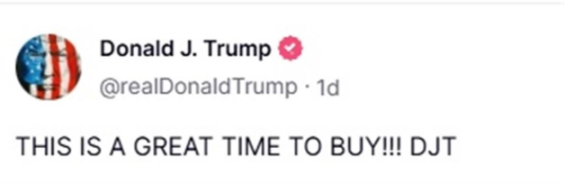
Core Insights - Trump Media Technology Group is entering the prediction market business through a partnership with Crypto.com, launching the Truth Predict service on its social platform Truth Social, allowing users to bet on various event outcomes [1][2] - The timing of this move is notable, as Trump's trading activities have faced scrutiny due to suspicious stock price movements and insider trading allegations involving him and his family [1][4] - The prediction market is gaining traction on Wall Street, with a record trading volume exceeding $2.3 billion recently, attracting investments from major financial institutions [1][8] Company Developments - Truth Predict will be tested on Truth Social before a full rollout in the U.S. and eventually globally, as the company aims to deepen its ties with the cryptocurrency industry [2][3] - The collaboration with Crypto.com is not the first; earlier this year, they formed a joint venture to accumulate the native token CRO, further solidifying their connection to the crypto sector [3] Industry Trends - The prediction market is evolving from a niche concept to a mainstream financial avenue, with platforms like Polymarket and Kalshi leading the charge, attracting significant venture capital interest [8][9] - Major financial players, including the Chicago Mercantile Exchange, are planning to introduce financial contracts linked to sports events and economic indicators, indicating a shift towards broader acceptance of prediction markets [8][9] - The recent surge in trading volume and valuation of platforms like Polymarket, which received a $2 billion investment from the parent company of the New York Stock Exchange, highlights the growing legitimacy of prediction markets [8][9]

当“首席交易员”已不够了,特朗普要亲自“开场子”了?
Hua Er Jie Jian Wen· 2025-10-30 09:15
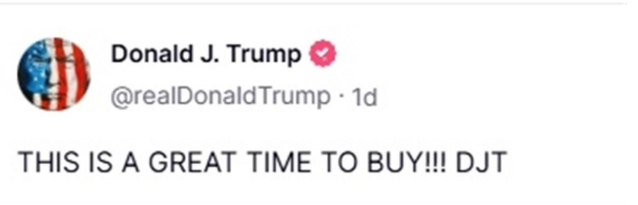
Core Insights - Trump is expanding his influence in financial markets by launching a prediction market service called Truth Predict through his media company, in partnership with Crypto.com [1][2] - The timing of this move is notable, given ongoing scrutiny regarding potential insider trading and stock price manipulation involving Trump and his family [1][4] - Prediction markets are gaining traction on Wall Street, with significant investments from traditional financial giants, indicating a shift from a niche concept to mainstream acceptance [9][10] Group 1: Company Developments - Trump Media Technology Group is launching Truth Predict on its social platform Truth Social, allowing users to bet on outcomes in sports, entertainment, politics, and economics [1][2] - The service will undergo beta testing before a full rollout in the U.S. and plans for global expansion once regulatory requirements are met [2] - The partnership with Crypto.com is part of a broader strategy to deepen ties with the cryptocurrency industry, following previous collaborations [2] Group 2: Market Trends - The prediction market sector has seen a surge in trading volume, with over $2.3 billion traded last week, marking a historical high [1][9] - Major players like Polymarket and Kalshi are leading this trend, with Polymarket's valuation nearing $15 billion after receiving a $2 billion investment from the parent company of the New York Stock Exchange [10] - Traditional financial institutions, including the Chicago Mercantile Exchange, are entering the prediction market space, further legitimizing this emerging financial avenue [10] Group 3: Controversies and Scrutiny - Trump's entry into the prediction market comes amid ongoing allegations of insider trading linked to his family and associates, raising concerns about market manipulation [4][8] - Notable incidents include significant stock price movements preceding major announcements, suggesting potential misuse of information [4][5] - The scrutiny extends to other political figures associated with Trump, highlighting a broader concern regarding the integrity of trading practices within this circle [8]
X @杀破狼 WolfyXBT
杀破狼 WolfyXBT· 2025-10-30 09:02
Industry Perspective - The report equates the insurance market to a gambling market [1] - Buying insurance is described as betting on one's own death [1]
“预测市场龙头”Polymarket即将11月底重返美国,主打体育博彩业务
Sou Hu Cai Jing· 2025-10-28 23:21
Core Viewpoint - Polymarket is preparing to re-enter the U.S. market focusing on sports betting after being expelled for illegal trading, with plans to launch by the end of November [1][4]. Company Summary - Polymarket was expelled from the U.S. market nearly three years ago due to illegal trading and paid a $1.4 million fine to settle with the Commodity Futures Trading Commission (CFTC) [1]. - The company has acquired QCX, which holds a CFTC license for derivatives trading and clearing, as a strategic move to ensure compliance for its return [2]. - The U.S. version of Polymarket's website has set up a waiting list for users to register for updates on the platform's launch [4]. Industry Summary - The return of Polymarket coincides with explosive growth in the prediction market industry, with platforms like Polymarket and Kalshi allowing users to bet on various events [6]. - Kalshi recently won a lawsuit against U.S. regulators, allowing it to trade on "event contracts," significantly advancing the industry [6]. - The industry is attracting attention from major institutions, with the CME Group considering launching its own sports betting contracts after partnering with FanDuel [6]. - Despite positive industry prospects, prediction market companies face a complex regulatory environment and ongoing legal challenges, with some state regulators explicitly prohibiting operations [6][7]. - Kalshi has filed a lawsuit against the New York State Gaming Commission, highlighting the tension between federal jurisdiction and state regulatory power in the sports betting sector [7].
“市场预测龙头”Polymarket即将11月底重返美国,主打体育博彩业务
Hua Er Jie Jian Wen· 2025-10-28 21:01
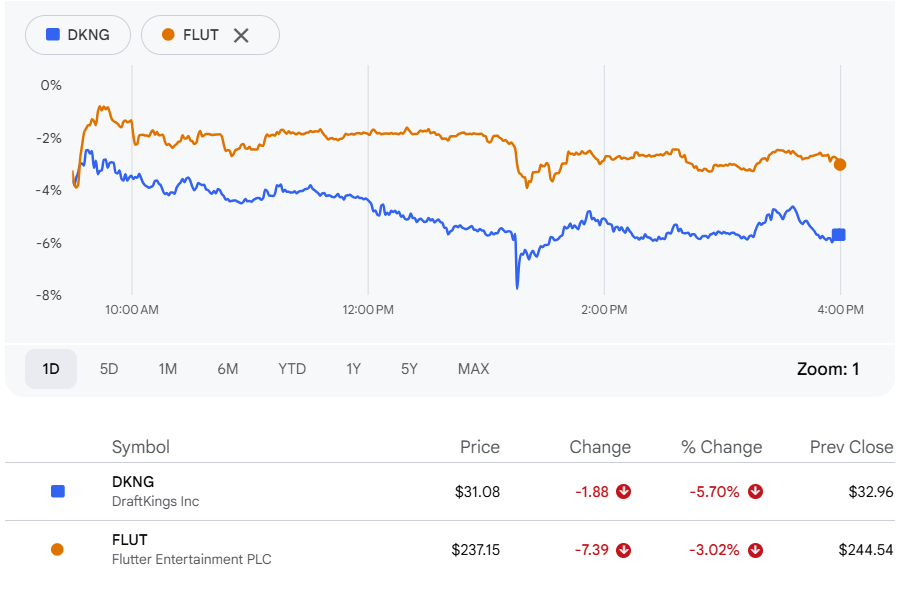
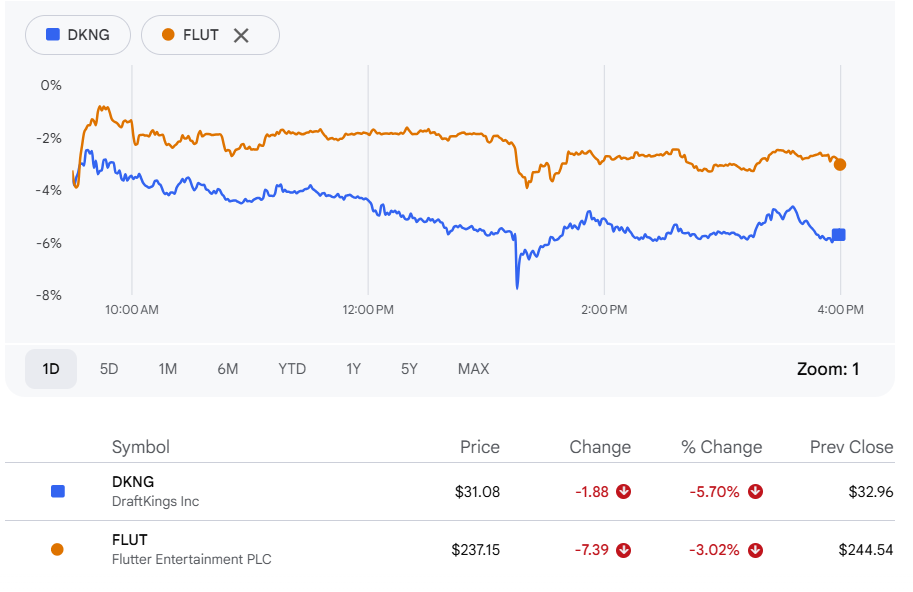
Core Insights - Polymarket is preparing to return to the U.S. market focusing on sports betting after being expelled for illegal trading nearly three years ago [1] - The company plans to launch by the end of November, targeting peak trading volumes during the American football and basketball seasons [1] - Following the news, shares of U.S. gambling companies, including DraftKings and Flutter Entertainment, experienced declines [1][3] Company Strategy - To ensure compliance for its return, Polymarket acquired QCX, a licensed derivatives exchange and clearinghouse, after investigations by the DOJ and CFTC were dropped earlier this year [4] - The U.S. version of Polymarket's website has set up a waiting list for users to register for updates, indicating preparations for the platform's launch [4] Industry Trends - The return of Polymarket coincides with explosive growth in the prediction market industry, with platforms allowing users to bet on various events [6] - Competitor Kalshi recently won a lawsuit allowing it to trade on "event contracts," significantly advancing the industry [6] - Business volumes have surged to record levels as exchanges leverage federal financial licenses to operate in states where sports betting was previously prohibited [7] Regulatory Environment - Despite positive industry prospects, prediction market companies face a complex regulatory landscape and ongoing legal challenges in the U.S. [8] - Some state regulators have explicitly stated that prediction markets cannot operate within their jurisdictions, creating uncertainty for industry expansion [8] - Kalshi has filed a lawsuit against the New York State Gaming Commission, highlighting tensions between federal jurisdiction and state regulatory powers [8]
X @Yuyue Ⓜ️Ⓜ️T
Yuyue· 2025-10-28 10:32
预测市场目前有点像 Pump 发币前的情况,而我也认为预测市场有成为下一个 meme launchpad 级别甚至以上的赛道潜力,一种新型的营销工具当时是 Pump、Believe、Bonk 御三家抢市场,Pump 是龙头,Believe 通过另一个 niche ICM 吸引了市场注意,又有 Letsbonk 后来居上;现在是 Polymarket、Opinion、Kalshi 三家,Polymarket(很巧也是 P 家人),Kalshi 用强势的合规资源居于优势,Opinion @opinionlabsxyz 则通过目前最强的 BNBChain 地利借东风迅速抢了身位,尤其是在亚洲地区声量起得飞快个人会对这三家的观点是:都会参与并保持关注。但是非常显然,Opinion 给予散户的参与机会是最清晰、最明确的,而且目前还属于主网刚上线不久的早期,和其他几家相比可能是最有机会在项目本体上拿到结果的 ...
下一只黑天鹅,关税退款“大赌局”!
美股研究社· 2025-10-28 10:24
Core Viewpoint - A potential legal battle may force the U.S. government to refund hundreds of billions in tariffs, creating a unique speculative market around this issue [3][4]. Group 1: Legal Context and Implications - U.S. Treasury Secretary Yellen acknowledged that if the Supreme Court rules certain tariffs imposed by the Trump administration as illegal, the Treasury may have to refund "about half of the tariffs," which he described as a "terrible" blow to the department [3][4]. - Two lower courts have already ruled that the Trump administration lacked legal authority to impose certain tariffs under the International Emergency Economic Powers Act, with the case now set for oral arguments at the Supreme Court on November 5 [4][12]. - As of August this year, over $70 billion in disputed tariffs have been collected, and a reversal of this policy could have profound effects on U.S. finances and importing businesses [4][12]. Group 2: Market Reactions and Investment Strategies - Wall Street investment banks, including Jefferies and Oppenheimer, are facilitating unique transactions connecting importers who have paid high tariffs with investors seeking high returns, primarily hedge funds [5]. - The core logic of these transactions involves cash-strapped importers selling their future potential claims for tariff refunds at a significant discount, allowing them to receive guaranteed payments without waiting for court decisions [5]. - Investors typically purchase these claims for 20 to 40 cents on the dollar, meaning favorable Supreme Court rulings could yield several times the original investment [5]. Group 3: Retail Investor Participation - Unlike institutional investors, retail investors are participating in this speculative market through emerging prediction markets like Kalshi and Polymarket, where they can place small bets on outcomes such as whether the Supreme Court will uphold the tariffs [7][8]. - The trading prices of contracts on these platforms reflect the market's implied probability of the tariffs being upheld, estimated at around 40% [8][10]. - However, the liquidity in these markets is low, with total trading volumes on Kalshi and Polymarket being less than $250,000 and $400,000 respectively, making them ineffective for large-scale risk hedging [10]. Group 4: Challenges Ahead - The outcome of all bets hinges on the Supreme Court's decision, which may be influenced not only by legal interpretations but also by the justices' views on executive power [12]. - Even if the Supreme Court rules the tariffs illegal, the refund process could be complicated, described as a "logistical nightmare," particularly for small importers who may struggle to provide detailed documentation for refunds [13][14].

X @何币
何币· 2025-10-23 12:59
Project Launch & Platform - Opinion prediction market has launched on BNB Chain mainnet [1] - Opinion is positioned as a strong prediction market on BSC (Binance Smart Chain) [1] User Incentives - Users can receive up to 10% fee reduction by joining a team [1] - An OPN points system is launching, rewarding users for trading, providing liquidity, and holding specific tokens [1] Future Development - X-ray pioneers are next, invitation-only [2]