
3D打印技术

Search documents
长江材料(001296.SZ):有生产用于砂型3D打印的3D打印砂
Ge Long Hui· 2025-09-15 07:17
Group 1 - The company, Changjiang Materials (001296.SZ), has announced its production of 3D printing sand used for sand mold 3D printing [1] - The company plans to expand its 3D printing sand products and provide sample trial services to customers by integrating 3D printing technology [1] - The focus is on enhancing the application of related technologies and products in the casting industry [1]
3D打印助力肺癌治疗“新突破”!今年已注册相关企业3.26万家
Qi Cha Cha· 2025-09-12 06:45
(原标题:3D打印助力肺癌治疗"新突破"!今年已注册相关企业3.26万家) 企查查数据显示,从经营时间来看,近六成3D打印相关企业成立于近三年,其中成立年限在1-3年的相 关企业最多,占比34.71%。成立年限在1年内的相关企业占比24.71%。 3D打印(3DP)又称增材制造技术,是一种依据三维CAD数据通过逐层材料累加的方法制造实体零件 的技术。目前在珠宝设计、工业设计、建筑设计、工程设计与施工、汽车设计与制造等设计与制造领 域,以及航空航天、牙科等医疗领域都有所应用。 3.分布在新一线城市的相关企业最多 据媒体报道,近日,浙江大学医学院附属第四医院/浙江省肺癌精准诊疗重点实验室主任王凯教授团队 在国际顶级材料科学期刊《AdvancedMaterials》在线发表研究论文《一种协同作用的3D打印套环将射 频消融转化为有效的肺癌热免疫疗法》创新性提出解决方案。其研究设计的"3D打印项圈"可以成功地 提高肺癌治疗的整体效果,为提升肺癌治疗效果、降低复发风险提供了全新治疗策略。 企查查数据显示,从城市线级分布来看,分布在新一线城市的3D打印相关企业最多,占比26.17%。其 次,分布在一线城市、二线城市的相关企 ...
地山打印科技(江苏)有限公司成立 注册资本1000万人民币
Sou Hu Cai Jing· 2025-09-12 00:17
Group 1 - The establishment of Dushan Printing Technology (Jiangsu) Co., Ltd. has been recently reported, with a registered capital of 10 million RMB [1] - The legal representative of the company is Xu Chunhong [1] - The company's business scope includes technology services, development, consulting, and various sales related to 3D printing and casting materials [1] Group 2 - The company is involved in the sales and manufacturing of molds, mechanical parts, and general equipment [1] - It also engages in the import and export of goods, excluding projects that require approval [1] - The company aims to operate independently under its business license [1]
“万机之母”工业母机ETF(159667)盘中净流入近2000万份,盘中涨超2.8%,技术升级与需求回暖提振板块预期
Mei Ri Jing Ji Xin Wen· 2025-09-01 03:41
Group 1 - The industrial mother machine ETF (159667) has seen a net inflow of 17 million units, indicating strong capital interest in the industrial mother machine assets [1] - The robotics industry is experiencing active performance due to recent catalysts such as Nvidia's new model launch, Zhiyuan Robotics' new product releases, and Tiantai Robotics securing the largest global order [1] - The design schemes and technologies for humanoid robots are still relatively diverse, but as the industry accelerates and application scenarios materialize, the technical paths are expected to converge [1] Group 2 - The combination of 3D printing technology and new materials is expected to drive the miniaturization of core components to meet lightweight demands [1] - Electrification is becoming a significant trend in the engineering machinery sector, with various electric devices already applied in major domestic projects [1] - The industry is projected to see a year-on-year increase in import and export sales in the first half of 2025, with positive mid-year performance expectations [1] Group 3 - The China Securities Machine Tool Index (931866), which the industrial mother machine ETF tracks, selects listed companies involved in machine tool manufacturing and related technology development to reflect the overall performance of the machine tool industry [1] - The index has high industry representativeness and focuses on the industrial machinery sector, reflecting the market value and technological strength of related enterprises [1]
刷新世界纪录!中国新型3D打印技术制造“全能”抗疲劳钛合金
Zhong Guo Xin Wen Wang· 2025-08-29 08:29
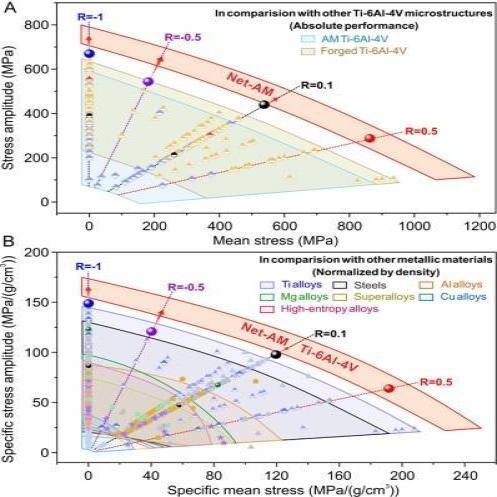
Core Insights - A new type of 3D printing technology has been developed by the research team at the Chinese Academy of Sciences, which produces a titanium alloy material known for its "universal" fatigue resistance, setting a new world record for metal materials' fatigue resistance [1][3]. Group 1: Research and Development - The research team, led by Zhang Zhefeng and Zhang Zhenjun, has successfully created a post-processing technique for 3D printing that addresses significant obstacles in high-end applications [1][3]. - The new process, named Net-AM preparation (NAMP), allows for precise control over the internal structure and defects of the material, resulting in a titanium alloy (Ti-6Al-4V) that eliminates micro-voids and coarse structures, both of which contribute to fatigue [3][5]. Group 2: Material Properties - The "universal" fatigue resistance refers to the material's unprecedented ability to withstand repeated stress without damage under various stress ratio conditions [3][5]. - Experimental data indicates that the new titanium alloy exhibits superior fatigue strength compared to all other metal materials across different stress ratios [5]. Group 3: Application Potential - The ability to manufacture complex, lightweight metal parts through 3D printing is particularly attractive for next-generation aircraft and spacecraft, which require weight reduction and integration [3][4]. - Traditional titanium alloys often perform well only under specific stress ratios, making it challenging to create a material that can perform optimally across all conditions [4].


机械设备3D打印(增材制造)行业专题报告:工业消费双驱动,多领域仍有海量空间
Dongguan Securities· 2025-08-29 06:49
Investment Rating - The report maintains a "Market Perform" rating for the 3D printing industry [5][76]. Core Insights - The global 3D printing market is projected to reach approximately $19.33 billion in 2024, with significant growth expected in various downstream applications, particularly in automotive manufacturing, consumer electronics, and medical devices [5][35]. - The Chinese 3D printing market is anticipated to grow to around 41.5 billion yuan in 2024, driven by industrial applications in aerospace, automotive, and medical sectors [5][35]. - The report highlights the low penetration rates of 3D printing technology in various sectors, indicating substantial growth potential, especially in aerospace, healthcare, automotive, consumer electronics, and robotics [5][27][52]. Summary by Sections 1. 3D Printing Overview - 3D printing technology has evolved through three stages: research and development, mass application, and profitability [12]. - The technology allows for high design freedom, complex structures, and efficient material usage, with a material utilization rate exceeding 95% [13]. 2. Industrial Dominance and Consumer Penetration - The industrial segment leads the market, with a shift towards consumer applications as technology matures [5][27]. - The report emphasizes the increasing demand for 3D printing in aerospace, automotive, and medical sectors, with significant growth expected in these areas [5][27]. 3. Low Penetration and Growth Potential - Aerospace: 3D printing is increasingly used for lightweight and complex components, with a projected market size of $2.77 billion in 2024, growing at a CAGR of 26.13% [56]. - Healthcare: The market for 3D printing in healthcare is expected to reach $1.7 billion in 2024, with a growth rate of 20.57% [57]. - Automotive: The automotive sector is projected to reach $3.36 billion in 2024, with applications in lightweight components and customized parts [63]. - Consumer Electronics: The market size for 3D printing in consumer electronics was $2.13 billion in 2022, with significant growth potential as technology advances [68]. - Robotics: The market for 3D printing in robotics is estimated at $1.5 billion in 2023, with a projected CAGR of 13.90% [75]. 4. Investment Recommendations - The report suggests maintaining a "Market Perform" rating and highlights companies to watch, including Plater (688333), Huazhu High-Tech (688433), Dazhu Laser (002008), Ruike Laser (300747), and Obi Zhongguang (688322) [5][76].




新技术造出溶于水的电路板
Ke Ji Ri Bao· 2025-08-29 00:30
Core Viewpoint - The research from the University of Maryland presents a breakthrough in sustainable electronics by utilizing 3D printing technology to create water-soluble circuit boards, which could significantly reduce electronic waste and promote a more sustainable future for the consumer electronics industry [1][2]. Group 1: Innovation and Technology - The team developed circuit boards using polyvinyl alcohol (PVA), a water-soluble polymer, and demonstrated the assembly of functional electronic products like Bluetooth speakers and toys [1]. - The circuit boards can dissolve in water after a certain period, allowing for easy separation of electronic components and the recovery of up to 99% of the PVA material after evaporation [1]. Group 2: Environmental Impact - Traditional printed circuit boards contribute to significant electronic waste, with only a small fraction being recycled; the new technology offers a more environmentally friendly alternative [1][2]. - According to a UN report, Asia generates 600,000 tons of waste circuit boards annually with a recycling rate of only 17%, while Europe and North America produce around 300,000 tons each, with recycling rates of 61% and 44%, respectively [2]. Group 3: Market Application and Limitations - The dissolvable circuit boards are particularly suitable for rapid prototyping and testing of electronic devices, presenting an eco-friendly advantage over traditional circuit boards [2]. - Current limitations include the durability of the circuit boards, which makes them more appropriate for prototype development rather than large-scale production; the team is in discussions with manufacturers to explore feasible pathways for broader application [2].
3D打印神经支架可用于修复脊髓损伤
Ke Ji Ri Bao· 2025-08-29 00:29
Core Insights - A groundbreaking method combining 3D printing, stem cell biology, and lab-cultured tissue technology has been developed by a research team at the University of Minnesota, offering new hope for spinal cord injury repair [1][2] - Over 300,000 individuals in the U.S. suffer from spinal cord injuries, with no effective means to fully reverse the resulting neurological damage and paralysis [1] - The innovative 3D-printed scaffold supports the growth of spinal cord organoids and contains region-specific spinal neural progenitor cells (sNPC) derived from human adult stem cells, which can self-renew and differentiate into various mature neural cells [1] Research Findings - The scaffold creates a neural relay system that, when implanted into the spinal cord, bypasses the damaged area and reconstructs neural signal pathways [1] - In animal experiments, the sNPC-containing scaffold was transplanted into completely transected rat spinal cords, resulting in the successful differentiation of implanted cells into functional neurons, extending nerve fibers in both rostral and caudal directions, and establishing new synaptic connections with the host spinal cord's existing neural network [1][2] Future Implications - The integration of newly formed neural tissue with the host spinal cord significantly enhances motor function recovery in rats, indicating the potential of this technology to restore neural conduction capabilities in damaged spinal cords [2] - The research is still in its early stages, primarily validating feasibility in animal models, but the scaffold presents unprecedented hope for curing spinal cord injuries [2]
威高骨科20250828
2025-08-28 15:15
Summary of Weigao Orthopedics Conference Call Company Overview - **Company**: Weigao Orthopedics - **Industry**: Orthopedic Medical Devices Key Financial Performance - **Revenue**: 741 million CNY in H1 2025, a decrease of 1.28% YoY due to adjustments in the marketing model for joint products [2][3] - **Net Profit**: 142 million CNY, an increase of 52.43% YoY [2][3] - **Sales Expense Ratio**: 26.49%, down by 10.63 percentage points YoY [2][3] Segment Performance - **Spine Products**: Revenue of 250 million CNY, up 13% YoY; Q2 saw a 21% increase from Q1 [4][5] - **Trauma Products**: Revenue of 130 million CNY [4] - **Joint Products**: Revenue of 180 million CNY, down 21% YoY due to marketing model changes [5] - **Sports Medicine and Tissue Repair**: Revenue of 143 million CNY, up 13.26% YoY [2][5] International Expansion - **Overseas Revenue**: 43.21 million CNY, up 19% YoY [6] - **Market Strategy**: Differentiated strategies for various markets, focusing on logistics in price-sensitive markets and acquisitions in high-end markets [6][10] - **Team Expansion**: Plans to expand the overseas marketing team to 30-40 members by year-end, with expected overseas revenue nearing 100 million CNY [9][10] Research and Development - **Innovations**: Focus on minimally invasive spine surgery, sports medicine, and orthopedic regenerative repair [7] - **Regulatory Approvals**: 16 Class I medical device registrations, 15 Class II, and 12 Class III in H1 2025 [7] - **Total Registrations**: 314 Class I, 45 Class II, and 160 Class III devices as of the reporting period [7] Future Development Plans - **Market Focus**: Continued emphasis on increasing domestic market share, cost reduction, and global expansion [8] - **Product Development**: Plans to enhance product lines in minimally invasive surgery and pain management [8][11] - **Automation**: Increase in automated production capabilities to modernize operations [8] Market Trends and Challenges - **Surgical Volume Growth**: Anticipated growth in surgical volumes across spine (13-15%), joint (12-15%), and trauma (single-digit) surgeries [19] - **Micro-Invasive Surgery**: Increasing trend driven by navigation and AI technologies, with a current penetration rate of about 10% in China [20][22] - **3D Printing**: Significant potential for application in orthopedics, focusing on personalized and regenerative solutions [21] Regulatory Environment - **Collective Procurement**: Ongoing adjustments in procurement policies, with a focus on rational pricing and support for innovation [28] - **Market Access**: Efforts to ensure new innovative products are included in medical insurance directories and exempt from DRG fees [29] Conclusion Weigao Orthopedics is navigating a challenging market environment with strategic adjustments in product marketing, a focus on international expansion, and a commitment to innovation in orthopedic solutions. The company is well-positioned to leverage its R&D capabilities and market strategies to enhance its competitive edge in the orthopedic medical device industry.

威高骨科: 山东威高骨科材料股份有限公司关于部分募投项目延期的公告
Zheng Quan Zhi Xing· 2025-08-27 16:18
Core Viewpoint - The company has announced a delay in the completion of its research and development center project, extending the timeline to December 2026 due to adjustments in product development planning influenced by industry policies [1][5][6]. Fundraising Overview - The company raised a total of RMB 150,002.23 million by issuing 41.4142 million shares at a price of RMB 36.22 per share, with a net amount of RMB 138,228.49 million after deducting related expenses [1][2]. Fund Utilization and Project Adjustment - The company adjusted the planned investment amounts for its fundraising projects due to discrepancies between the originally planned and actual amounts raised, with total project investments amounting to RMB 203,694.15 million and adjusted investments of RMB 188,066.62 million [2][3]. Delay Details and Reasons - The delay in the R&D center project is attributed to the impact of orthopedic centralized procurement policies, necessitating adjustments in product development strategies. The project has expanded to include new locations in Shanghai and Wuhan, focusing on high-value product lines such as spinal minimally invasive techniques and 3D printing [4][5]. Impact on Operations - The delay in project completion is a cautious decision based on actual implementation needs and does not affect the project's investment content, total investment, or implementation entity. It is aligned with the company's operational status and long-term development plans [5][6][7]. Review Procedures - The board and supervisory committee approved the delay without requiring a shareholder meeting, confirming that the decision adheres to relevant regulations and does not harm shareholder interests [6][7].