具身智能

Search documents
荣耀入局,手机厂商竞速人形机器人新长征
Cai Jing Wang· 2026-02-25 05:18
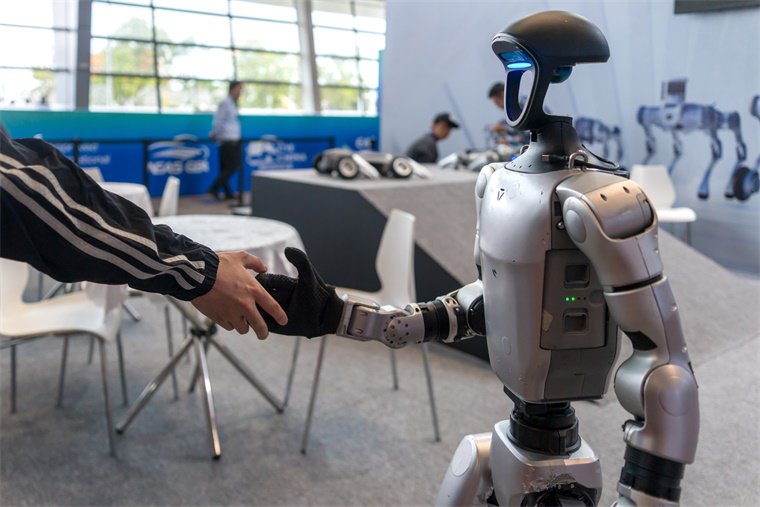
Core Insights - Honor's entry into the humanoid robot market signifies that smartphone manufacturers are becoming key players in this sector, marking the beginning of a long journey in embodied intelligence [1] - The competition among smartphone brands like Honor, Vivo, and Xiaomi is driven by the saturation of the smartphone market, with humanoid robots seen as the next major growth opportunity [2][5] Group 1: Market Entry and Strategy - Honor plans to launch its first humanoid robot at the 2026 Mobile World Congress (MWC), as part of its "Alpha Strategy," which includes a $10 billion investment over five years to transition from a smartphone manufacturer to a global AI terminal ecosystem company [2][3] - The establishment of new departments focused on embodied intelligence and AI hardware indicates a strategic shift towards integrating humanoid robots into their product offerings [3][4] Group 2: Industry Trends and Competition - The consumer humanoid robot market is viewed as the most commercially viable segment, with a significant increase in demand expected, as evidenced by IDC's projection of 18,000 units shipped globally by 2025, a 508% increase year-on-year [5] - The entry of multiple smartphone manufacturers into the humanoid robot space is seen as a race for first-mover advantage, leveraging existing brand recognition and distribution channels to reduce market education costs [4][6] Group 3: Technological and Operational Challenges - The transition from smartphones to humanoid robots presents challenges, particularly in mechanical engineering and the complexity of robotics, which require different skill sets than traditional smartphone development [8][9] - The commercialization of humanoid robots remains a significant hurdle, as many products risk becoming obsolete after initial novelty, necessitating a focus on practical applications in everyday life [9] Group 4: Competitive Landscape and Ecosystem - The competitive landscape is intensifying, with over 150 domestic humanoid robot companies emerging, leading to a focus on technology, production, and cost efficiency [6][7] - Smartphone manufacturers possess advantages in supply chain management and customer engagement, which can be leveraged to enhance the market presence of humanoid robots [6][7]

宇树发布马年首个重磅机器人新品,小身板扛起200斤大汉
3 6 Ke· 2026-02-25 05:01
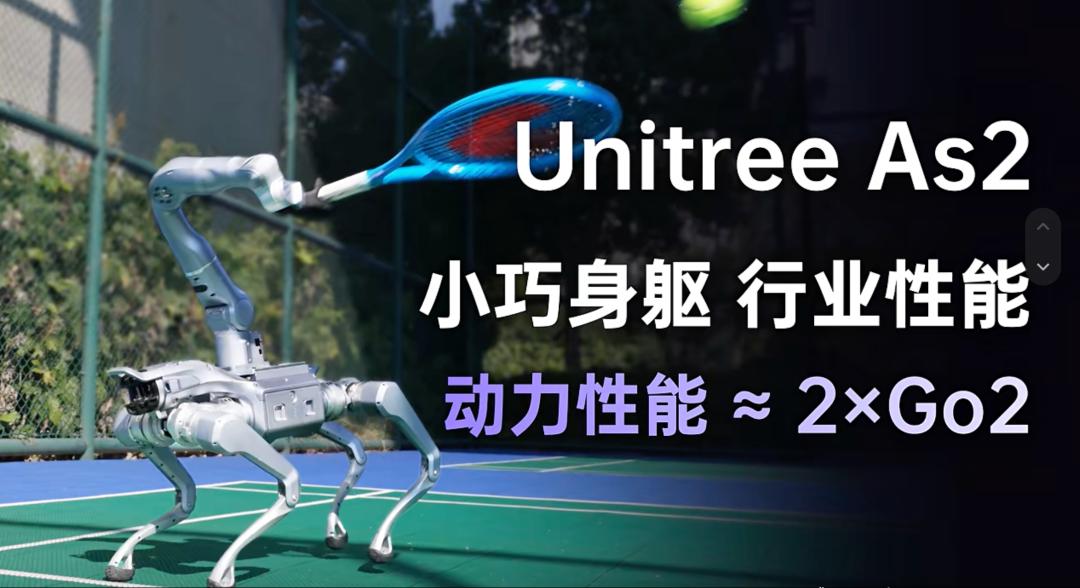
Core Insights - Yushu Technology has launched a new quadruped robot, Unitree As2, following the success of its humanoid robot during the Spring Festival, positioning it as a lightweight industry-grade robot with performance capabilities approximately double that of its consumer-grade counterpart, Unitree Go2 [1][20] Product Specifications - Unitree As2 weighs 18 kg, comparable to the 15 kg of Unitree Go2, while significantly lighter than the previous industry-grade models, Unitree A2 (42 kg) and Unitree B2 (60 kg) [5][20] - The robot boasts a peak torque of 90 N.m, an empty load endurance of over 4 hours, and can carry a load of 15 kg with a range exceeding 13 km [3][5] - It features an IP54 waterproof design, allowing it to traverse water obstacles without issue [7] Performance Capabilities - Unitree As2 can run at a maximum speed of 5 m/s (18 km/h), matching the speed of many electric bicycles and outperforming most adults [10] - The robot is designed to navigate complex terrains and harsh environments, demonstrating its ability to carry heavy loads while maintaining mobility [12] Intelligent Features - The robot is equipped with a bionic embodiment model, showcasing advanced algorithm capabilities that allow it to follow users seamlessly [9][14] - It includes an upgraded ISS 3.0 intelligent following system, although further details on its capabilities, such as language model interaction or user intent recognition, are yet to be disclosed [14] Market Positioning - The launch of Unitree As2 fills a gap in the lightweight industrial-grade market, creating a more segmented product lineup that includes consumer-grade (Go series), lightweight industry (As2), heavy-duty industry (A2), and industrial-grade (B series) robots [20] - The robot's compact size, strong performance, and open ecosystem are expected to enable applications in inspection, research, education, and lightweight operations [20]

机器人板块延续震荡,机器人ETF易方达(159530)半日净申购近9000万份
Sou Hu Cai Jing· 2026-02-25 04:57
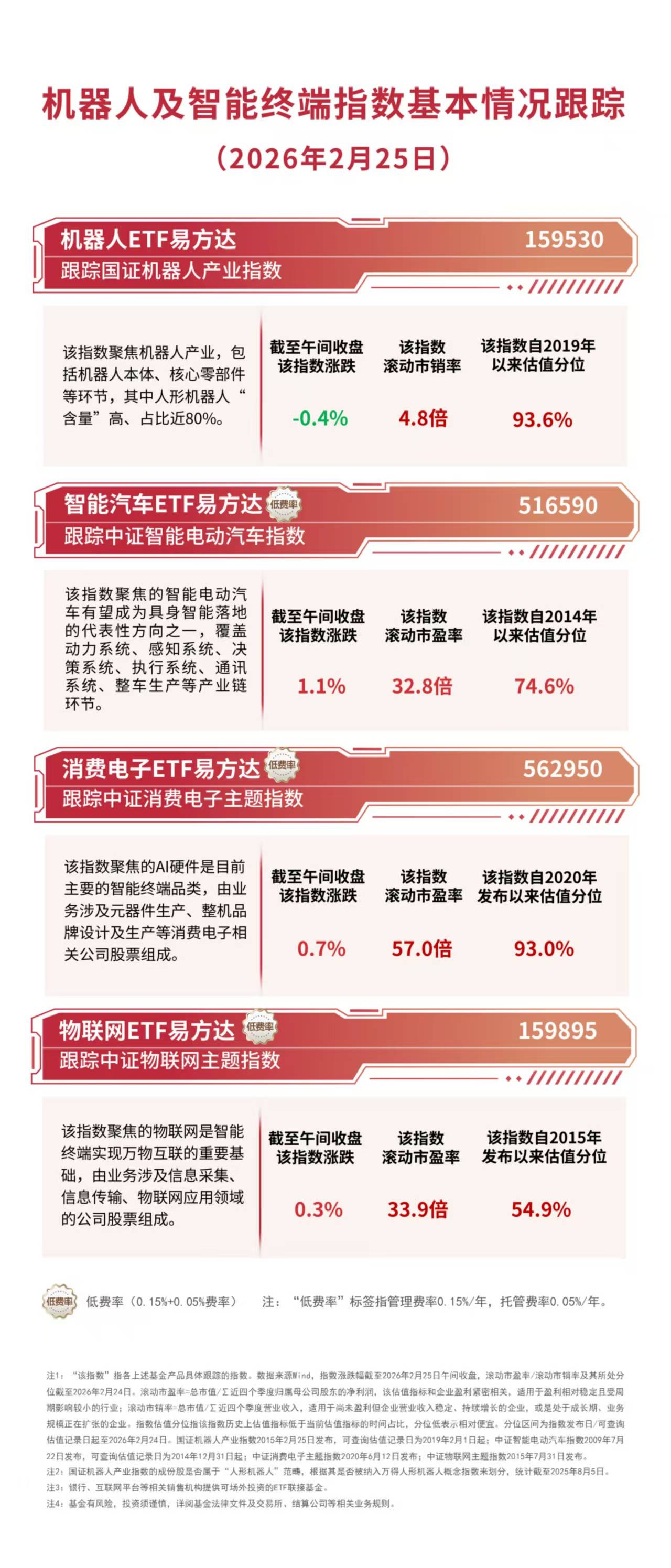
Group 1 - The China Securities Intelligent Electric Vehicle Index rose by 1.1%, the China Securities Consumer Electronics Theme Index increased by 0.7%, and the China Securities Internet of Things Theme Index went up by 0.3%, while the National Securities Robotics Industry Index fell by 0.4% [1] - The E Fund Robotics ETF (159530) saw a net subscription of nearly 900 million units in half a day [1] - CITIC Construction Investment Securities forecasts that by 2026, the global liquidity easing pattern will deepen, and domestic financial market policy dividends will continue to increase, enhancing the motivation for individual investors to enter the market [1] Group 2 - The overall A-share market is expected to see incremental funds covering a larger base, with the core logic supporting the bull market likely to continue or even strengthen [1] - The projected market size for embodied intelligence is expected to exceed one trillion, with a focus on the humanoid robot sector shifting from thematic investment to production expectations [1]
德国总理默茨抵京,开启任内首次访华,他是农历马年中方接待访华的首位外国领导人
Zhong Guo Ji Jin Bao· 2026-02-25 04:41
Group 1 - German Chancellor Merz is on his first official visit to China, highlighting the importance of bilateral relations as he is the first foreign leader to visit China in the Year of the Horse [1] - The visit includes meetings with President Xi Jinping and Premier Li Qiang to discuss bilateral relations and mutual concerns [1] - China and Germany have a strong economic partnership, with trade exceeding $200 billion and bilateral investment stock surpassing $65 billion, accounting for nearly a quarter of China's total trade with the EU [1] Group 2 - The Chinese Ministry of Commerce encourages German companies to seize new opportunities from China's high-level opening-up, focusing on traditional sectors and emerging fields like clean energy and biotechnology [2] - The Chinese Ministry of Foreign Affairs emphasizes that the good development of Sino-German relations aligns with the interests of both nations and the expectations of the world [2] - China aims to deepen practical cooperation with Germany based on mutual respect, equality, and win-win principles, contributing to global peace and prosperity [2]
智元宣布进入德国市场,联和敏实集团推进机器人本地化生产
Xin Lang Cai Jing· 2026-02-25 04:30
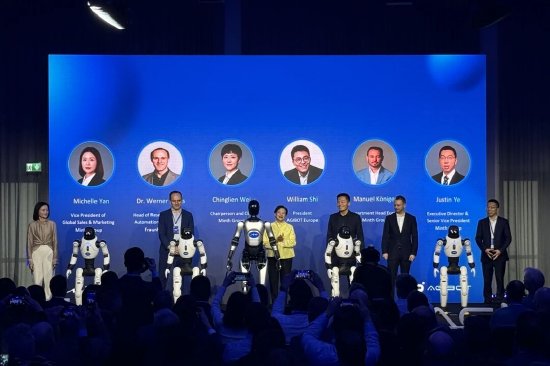
Core Insights - AGIBOT has officially entered the German market, launching a full range of general-purpose embodied robot products and system-level industry solutions [1][4] - A strategic cooperation agreement has been signed with Minth Group, a leading global manufacturer of automotive exterior and structural components, to accelerate the localization and large-scale deployment of robotic technology in Europe [1][4] Company Overview - Minth Group operates 78 factories and offices globally, employing over 27,000 people, with a strong international presence [1][4] - The company has been deeply engaged in the European market for 15 years, holding over 40% market share in aluminum trim and battery housing structural components [1][4] Strategic Collaboration - The partnership aims to promote localized production of robots in Europe, providing continuous and reliable full-cycle service support to customers [1][4] - Minth Group's modern factories worldwide will serve as exclusive training bases for robot learning and data collection, enhancing both Minth's smart manufacturing upgrade and the robotics industry through valuable real-world data [1][4] Product Capabilities - AGIBOT's full range of robotic products is now capable of mature deployment and deep integration with real industrial scenarios [2][5] - The company aims to empower German and European enterprises to enhance production efficiency through advanced embodied intelligence technology [2][5][6]
陈茂波:香港特区政府将积极推动具身智能生态圈建设及产品应用
Xin Lang Cai Jing· 2026-02-25 04:24
2月25日,香港特区政府财政司司长陈茂波在立法会发表2026至2027财政年度政府财政预算案。陈茂波 表示,香港特区政府将积极推动具身智能生态圈建设及产品应用。 2月25日,香港特区政府财政司司长陈茂波在立法会发表2026至2027财政年度政府财政预算案。陈茂波 表示,香港特区政府将积极推动具身智能生态圈建设及产品应用。 ...
0224早知道
2026-02-25 04:08
Summary of Conference Call Notes Industry Overview - The humanoid robot market in China is projected to reach a scale of 75 billion yuan by 2029, with a market share exceeding 30%, making China the leading country in the global humanoid robot market [3][4][5] - The robot industry is expected to transition from the concept phase (0-1) to large-scale production (1-10) starting in 2026, with major companies like Tesla and domestic leaders beginning mass production [3][11] Key Company Insights - Wanxiang Qianchao is focusing on the development of planetary roller screws and precision bearings for robots, targeting key robot users for product development [4] - Wuzhou Xinchun is prioritizing the development of embodied intelligent robots and has already launched several new products, including micro screws and linear actuators [4] - ByteDance's Seedance 2.0 is integrated into the Spring Festival Gala, enhancing the event with AI-driven content creation and interaction capabilities [4][5] Technological Advancements - The integration of AI tools in various sectors, including marketing, film, and gaming, is expected to reshape industry dynamics. ByteDance's Seedance 2.0 aims to address video generation consistency issues through multi-modal technology [5] - Companies like Fantou Digital are leveraging AI and big data to provide integrated solutions across various industries, including smart cities and intelligent manufacturing [5] Market Trends - The robot sector gained significant attention during the Spring Festival Gala, leading to increased consumer interest and sales on e-commerce platforms [3][11] - The trading volume in the market decreased by 159.1 billion yuan, with a notable reduction in the number of stocks exceeding 1 billion yuan in transaction value [11] - The robot sector is highlighted as a key area of focus, with several companies experiencing stock price increases due to heightened visibility during the festival [11][21] Notable Company Developments - Dazhu Laser is expected to see growth in its 3D printing business, while other companies are engaging in strategic acquisitions and partnerships to enhance their technological capabilities [18] - Windy Building has formed strategic partnerships to enhance its AI and 3D capabilities, focusing on cultural and technological integration [20] Investment Opportunities - The semiconductor industry is experiencing a price surge across the supply chain, presenting investment opportunities in areas such as wafer foundry and power devices [16] - The AI and robot sectors are poised for growth, with several companies showing potential for significant returns as they transition to mass production and commercialization [11][16] Conclusion - The humanoid robot market is on the verge of significant growth, driven by technological advancements and increased consumer interest. Companies in this space are strategically positioning themselves to capitalize on emerging opportunities, making it a key area for potential investment.
京基智农拟跨界控股汇博机器人,一场关于场景与技术的双向奔赴
Huan Qiu Wang· 2026-02-25 03:38
Core Insights - The emergence of robots at the Spring Festival Gala signifies a shift from concept to practicality, indicating a rise in product maturity and potential for the humanoid robot industry by 2026 [1] - The investment focus is shifting towards companies with mass production capabilities and cost advantages, particularly those with core technologies and mature commercial applications [1][4] Industry Dynamics - The collective practical showcase of robots at the Spring Festival is a natural outcome of the industry's development, addressing the previous pain points of having technology without market application [3] - As the industry transitions to a "scene-oriented" era, high-quality scene resources are becoming more valuable than technology itself, which is a unique competitive advantage for the company [4] Company Strategy - The strategic acquisition of Jiangsu Huibo Robot Technology Co., Ltd. by the company aligns with the core logic of industry upgrading and value reassessment, leveraging its dual-scene resources in agriculture and urban life [1][8] - The company’s robust financial fundamentals, including a cash flow of 525 million yuan and a net profit of 298 million yuan in the first three quarters of 2025, provide a solid foundation for long-term investments in technology [7] Market Positioning - The company is positioned to capitalize on high-value vertical scenes in B-end applications, such as security and data collection, which are essential for validating the economic viability of robotic technologies [6] - The dual structure of "industry testing ground + commercial transformation" creates an unreplicable competitive moat for the company, enhancing its market position [7] Future Outlook - The company’s collaboration with Huibo Robot aims to create a dual-loop system where scenes empower technology and technology benefits the industry, fostering a new growth curve [8] - Huibo Robot plans to launch two humanoid robot products by 2026, with an expected annual growth rate of over 30% in the next three years, complementing the company's scene advantages [8]


专家共话广东“新春第一会”:“两业协同”下智能经济怎么干
Nan Fang Du Shi Bao· 2026-02-25 03:29
Core Viewpoint - The Guangdong High-Quality Development Conference emphasizes the coordinated development of manufacturing and service industries as a key direction for industrial upgrading and economic growth in the province [1] Group 1: Opportunities and Challenges of "Two-Industry Coordination" - Guangdong has three main advantages: a solid manufacturing base with complete industrial chains in electronics, home appliances, and equipment manufacturing; a vibrant private economy with strong digitalization willingness; and a high degree of openness as a frontier of reform and opening up [2][3] - Current challenges include insufficient penetration of productive services into manufacturing, a mismatch between high-end service supply and manufacturing upgrade needs, and a lack of tight coordination among different regions in Guangdong [2] Group 2: Key Technologies and Policy Adaptation - The main bottlenecks for technologies like low-altitude economy, autonomous driving, and embodied intelligence transitioning from labs to daily life are not technical maturity but rather institutional adaptability and scenario openness [4] - Key policy adaptations include establishing a "negative list + sandbox regulation" mechanism, creating large-scale demonstration corridors in key cities, clarifying accident responsibilities, and establishing a compliant data circulation framework [4] Group 3: Talent Introduction and Support - Guangdong's annual absorption of over one million college graduates provides essential talent support for AI ecosystem construction, technology transfer, and service innovation [5][6] - Continuous inflow of talent, especially in basic research and technical application, is crucial for long-term support of AI ecology and service innovation in Guangdong [6][7] Group 4: AI Empowerment and Economic Restructuring - AI is reshaping production and service models across various industries, with core application scenarios including digital twin factories, smart quality inspection, predictive maintenance, and flexible production in advanced manufacturing [8] - To help small and medium-sized enterprises perceive the value of AI, lightweight and low-cost AI SaaS tools should be promoted, along with subsidies for technological upgrades and policies to lower digital transformation barriers [8] Group 5: Transition from "Scientific Content" to "Economic Value" - Guangdong's "scientific content" is evident in high policy precision, strong innovation practices among leading enterprises, and an active talent ecosystem [9] - The key path to converting "scientific content" into "economic value" involves building an AI industry innovation alliance, improving the "listing and hanging" mechanism for technology transfer, and creating a talent hub for AI [9][10]

专家预测:人类未来一周只需工作2天,工资甚至更高,10年后机器人数量将超过人类【附人形机器人行业市场分析】
Qian Zhan Wang· 2026-02-25 03:26
Group 1 - The core viewpoint of the articles highlights the rapid advancement and integration of humanoid robots into daily life, with predictions that by 2035, the number of robots will exceed the human population, leading to a significant transformation in work patterns and job creation [2][3]. - Zhang Yaqin from Tsinghua University predicts that in the next decade, humans may only need to work two days a week without a reduction in salary, reflecting the optimistic outlook on the humanoid robot industry's impact on labor [2]. - The Chinese government has elevated the humanoid robot industry to a strategic level, aiming for mass production by 2025 and achieving world-class capabilities by 2027, marking it as a core area for new productive forces [3]. Group 2 - According to Morgan Stanley's report, China leads the global humanoid robot industry, with 37% of the top 100 companies being Chinese, compared to 35% from the U.S. and 10% from Japan [4]. - In the "brain" segment of the humanoid robot value chain, China has fewer companies compared to North America, while it dominates the "body" segment with about 37% of the 64 core global companies being Chinese [5]. - The Yangtze River Delta region is the leading area for humanoid robot enterprises in China, with over 130 companies, accounting for more than 40% of the national total [6][10]. Group 3 - The industry outlook is optimistic, with expectations that annual sales of humanoid robots could exceed 100 million units, creating a market worth over 10 trillion yuan [13]. - Morgan Stanley has revised its forecast for China's humanoid robot sales, predicting a 133% year-on-year increase to 28,000 units this year, with projections of 262,000 units by 2030 and 2.6 million units by 2035 [13]. - The cost of producing humanoid robots is expected to decrease significantly, with material costs projected to drop by 16% this year, making robots more accessible in low-income countries [13].