创造性破坏

Search documents
2025年诺贝尔经济学奖公布!
Jin Rong Shi Bao· 2025-10-13 11:12
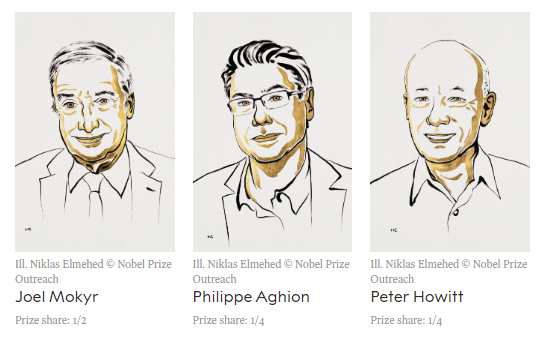
Core Points - The 2025 Nobel Prize in Economic Sciences is awarded in two parts: one half to Joel Mokyr for highlighting the prerequisites for sustained growth through technological advancement, and the other half jointly to Philippe Aghion and Peter Howitt for their theoretical contributions to sustained growth through creative destruction [1][3] Summary by Sections Nobel Prize Announcement - The Nobel Prize in Economic Sciences for 2025 recognizes contributions to understanding economic growth, with Joel Mokyr focusing on technology and Aghion and Howitt on creative destruction [1][3] Historical Context - The Nobel Prize in Economic Sciences, officially known as the Sveriges Riksbank Prize in Economic Sciences in Memory of Alfred Nobel, was established in 1968 by the Swedish National Bank and is awarded for outstanding contributions in economics [3][4] - The first award in 1969 was given to Ragnar Frisch and Jan Tinbergen for developing dynamic models to analyze economic processes [3][4] Recent Winners - The 2021 Nobel Prize was awarded to David Card for contributions to labor economics, and jointly to Joshua D. Angrist and Guido W. Imbens for methodological contributions to causal analysis [4] - The 2022 prize recognized Ben S. Bernanke, Douglas W. Diamond, and Philip H. Dybvig for their research on banks and financial crises [4] - The 2023 prize was awarded to Claudia Goldin for enhancing understanding of women's labor market outcomes [4] - The 2024 prize was shared by Daron Acemoglu, Simon Johnson, and James A. Robinson for their research on how institutions shape and influence prosperity [6]

2025年诺贝尔经济学奖揭晓 三位学者以解释“创新驱动的经济增长”获奖
Jing Ji Guan Cha Wang· 2025-10-13 10:56
Core Points - The 2025 Nobel Prize in Economic Sciences is awarded to Joel Mokyr, Philippe Aghion, and Peter Howitt for their contributions to understanding "innovation-driven economic growth" with a total prize of 11 million Swedish Krona [1][2][3] - Joel Mokyr receives half of the prize for identifying the conditions necessary for sustained growth through technological advancement, while Aghion and Howitt share the remaining half for their theory on achieving sustained growth through "creative destruction" [1][2][3] Group 1: Contributions of the Laureates - Joel Mokyr's work reveals the reasons behind sustained economic growth becoming the new norm, emphasizing the need for scientific explanations of why certain technologies are effective [3][4] - Aghion and Howitt developed a mathematical model in 1992 to explain "creative destruction," where the introduction of better products leads to the failure of companies selling outdated products [4][5] - The laureates collectively highlight the importance of managing the conflicts arising from creative destruction to prevent innovation from being hindered by existing companies and interest groups [4][5] Group 2: Historical Context and Implications - The Nobel Prize continues the tradition of focusing on practical economic issues, with this year's award emphasizing the mechanisms behind economic growth [2][3] - The work of the laureates illustrates that economic growth is not guaranteed and must be actively maintained to avoid stagnation [5]
刚刚!2025年诺贝尔经济学奖揭晓!
Zheng Quan Shi Bao Wang· 2025-10-13 10:41
Core Points - The 2025 Nobel Prize in Economic Sciences was awarded to Joel Mokyr, Philippe Aghion, and Peter Howitt for their contributions to understanding innovation-driven economic growth [1] - Mokyr received half of the prize for identifying prerequisites for sustained growth through technological advancement, while Aghion and Howitt shared the other half for their theory on sustained growth through creative destruction [1] Summary by Sections Recent Nobel Prize Winners - The 2024 Nobel Prize in Economic Sciences was awarded to Daron Acemoglu, Simon Johnson, and James A. Robinson for their research on how institutions form and affect prosperity [3] - The 2023 prize went to Claudia Goldin for her work on understanding women's labor market outcomes [3] - The 2022 prize recognized Ben Bernanke, Douglas W. Diamond, and Philip H. Dybvig for their research on banks and financial crises [4] Historical Context of the Nobel Prize in Economics - The Nobel Prize in Economic Sciences, officially known as the Sveriges Riksbank Prize in Economic Sciences in Memory of Alfred Nobel, was established in 1968 and has been awarded 56 times to 96 individuals by 2025 [4] - Notably, 26 laureates have won independently, while 20 times two laureates and 10 times three laureates have shared the prize [4] - The youngest laureate is Esther Duflo, who won in 2019 at the age of 46, while the oldest is Leonid Hurwicz, who was 90 when he won in 2007 [5] Financial Aspects of the Nobel Prize - The Nobel Prize has a history of financial growth, with the prize amount increasing from 10 million Swedish Krona to 11 million Swedish Krona (approximately 836,000 RMB) starting in 2023, marking a record high [6] - The Nobel Foundation's assets have grown significantly, now exceeding 6.1 billion Swedish Krona (approximately 4.6 billion RMB), representing nearly a 200-fold increase since its inception [7]
三名科学家共享2025年诺贝尔经济学奖,表彰其“对创新驱动型经济增长的阐释”
Bei Jing Shang Bao· 2025-10-13 10:07
北京商报讯(记者 赵天舒)10月13日,瑞典皇家科学院宣布,决定将2025年瑞典中央银行纪念阿尔弗 雷德·诺贝尔经济学奖授予乔尔·莫基尔、菲利普·阿吉翁和彼得·豪伊特,以表彰他们"对创新驱动型经济 增长的解释"。 其中,一半奖金授予乔尔·莫基尔,以表彰他"通过技术进步确定了持续增长的先决条件",另一半奖金 则由菲利普·阿吉翁和彼得·豪伊特共同获得,以表彰他们提出的"通过创造性破坏实现持续增长的理 论"。 莫基尔(Mokyr)利用历史资料作为揭示持续增长成为新常态原因的一种手段。阿吉翁(Aghion)和豪 伊特(Howitt)也研究了持续增长背后的机制。在1992年的一篇文章中,他们为所谓的创造性破坏构建 了一个数学模型:当一种更新、更好的产品进入市场时,销售旧产品的公司就会失败。 ...
2025年诺贝尔经济学奖公布
财联社· 2025-10-13 10:00
2025年诺贝尔经济学奖得主揭晓。 瑞典皇家科学院决定将2025年度瑞典中央银行纪念阿尔弗雷德·诺贝尔经济学奖授予乔尔·莫基尔、菲 利普·阿吉翁和彼得·豪伊特,以表彰他们"对创新驱动型经济增长的阐释"。 下载财联社APP获取更多资讯 准确 快速 权威 专业 7x24h电报 头条新闻 VIP资讯 实时盯盘 诺贝尔经济科学奖委员会表示,获奖者以不同的方式展示了创造性破坏如何制造冲突,必须以建设性的方式进行管理。否则,创新将受到老 牌公司和利益集团的阻碍,这些公司和利益集团可能会处于不利地位。 "获奖者的工作表明,经济增长不能被视为理所当然。我们必须维护创造性破坏背后的机制,这样我们就不会再次陷入停滞,"诺贝尔经济科 学奖委员会主席约翰·哈斯勒说。 ...

做人守底线 做事敢破圈——读《适度不敬:REITs之父萨姆·泽尔自传》
Shang Hai Zheng Quan Bao· 2025-09-28 17:12
Core Insights - Sam Zell, known as the "father of REITs," has significantly impacted the global commercial real estate sector through innovative investment strategies and a strong ethical foundation [3][4][6] - The book "Moderate Disrespect: The Autobiography of Sam Zell" encapsulates his experiences and lessons aimed at contemporary investors and entrepreneurs [3][4] Group 1: Principles and Philosophy - Zell emphasizes the importance of maintaining a moral compass in business, believing that reputation is a crucial asset [4][5] - His core principles include supply and demand dynamics, liquidity equating to value, good corporate governance, and the significance of reliable partnerships [4][5] - Zell's approach to business is characterized by a balance of respect for traditional values and a willingness to challenge norms when necessary [4][6] Group 2: REITs Innovation - Zell played a pivotal role in transforming the REITs industry by making it accessible to a broader range of investors through transparent regulations [6][7] - Under Zell's leadership, Equity Lifestyle Properties (ELS) became one of the first REITs to be publicly listed, focusing on manufactured housing communities and recreational vehicle parks [6][7] - ELS has maintained an average annual return of 17%, showcasing its stability and resilience against market fluctuations [6][7] Group 3: Investment Strategy - Zell's investment philosophy encourages looking for opportunities in overlooked sectors, as demonstrated by his focus on manufactured housing during a time when it was considered low-end [7][8] - He advocates for a negotiation style that ensures mutual benefit, believing that successful transactions should not come at the expense of one party [8] - Zell's approach aligns with Joseph Schumpeter's theory of "creative destruction," emphasizing the importance of innovative thinking in business [8]

赛道Hyper | 可灵AI角逐首尾帧生成战场
Hua Er Jie Jian Wen· 2025-09-02 01:00
Core Insights - Kuaishou's launch of the Keling AI 2.1 model introduces a "first and last frame" feature, enhancing content generation effectiveness by 235% compared to version 1.6, marking a shift in competition towards content production quality [1] - The traditional short video platform paradigm of "distribution-recommendation-duration" is evolving, with generative AI lowering production barriers and shifting focus to who can enable creators to produce distributable content more efficiently [1][3] - The first and last frames are critical for content usability, influencing viewer engagement metrics such as click-through rates and completion rates [1] Production and Economic Implications - The Keling 2.1 model's improvements are not generic but focus on aspects like transition naturalness and style consistency, directly impacting production quality [3] - This advancement leads to increased output per unit time for creators, reduced advertising production costs, and enhanced internal platform cycles, resulting in lower marginal costs and a rightward shift in the supply curve [3][5] - The role of creators is shifting from manual editing to strategic content planning, emphasizing narrative structure and character management over mere technical skills [4][5] Advertising and Financial Aspects - The transition from custom video production to template-based creation allows for faster creative testing cycles and measurable results, enhancing budget turnover rates [6][7] - The potential for financialization of creative assets emerges as template assets can be reused and monetized, leading to new financial instruments around high-efficiency templates [9] - The revenue structure of platforms may evolve to include stable non-advertising income streams from tool subscriptions, template transactions, and data services [9][10] Competitive Landscape - The competitive dynamics among platforms are shifting, with Kuaishou's strategy focusing on enhancing production capabilities to create a differentiated stack of abilities [11] - The first and last frame functionality is pivotal as it directly relates to content usability and commercial viability, positioning Kuaishou favorably in the market [11][20] User Experience and Industry Evolution - The consistency of first and last frames enhances narrative flow and allows for individualized content experiences, reflecting a deeper transformation in content generation [16] - The standardization of frame generation is likely to reorganize industry roles, with platforms taking on foundational infrastructure roles while MCNs and agencies focus on character building and cross-platform distribution [17] - The underlying logic of this feature iteration integrates technological, commercial, and industrial dimensions, positioning generative capabilities as a key asset for platforms [18][19]

即时零售大战:从流量争锋到数字基建的终极对抗
Di Yi Cai Jing· 2025-08-24 12:35
Group 1 - The competition in local life services is shifting from user scale to the effectiveness of digital infrastructure and ecological resilience, marking a fundamental change in the competitive landscape [1][7] - The ongoing instant retail war is predicted to last "one hundred weeks," with the focus moving from user acquisition and high subsidies to deep competition centered around smart algorithms, cloud collaboration, and the Internet of Things [1][7] - Companies are now competing not just on business models but on the robustness and extensibility of their infrastructure, including IoT node deployment and real-time data processing capabilities [1][5] Group 2 - Alibaba's attempt to reshape user habits through subsidies is fundamentally a capital-driven challenge against Meituan's established user path dependency, which has created structural barriers in high-frequency demand scenarios [2][3] - The ultimate competition is about capturing user time, behavior, and cognition, which is more fundamental than market share [2][3] - The need for long-term capital support is critical for the evolution of the digital market, with the core driving force of China's economic transformation being the improvement of resource allocation efficiency [3][4] Group 3 - Alibaba faces challenges beyond subsidies, as it must integrate "far-field e-commerce" with "near-field retail" through foundational restructuring and digital integration [4][5] - Meituan's ecosystem is inherently designed for "near-field" services, showcasing high internal cohesion and structural advantages that are difficult for Alibaba to replicate [5][6] - The intense competition is seen as a unique soil for the "extreme evolution" of Chinese business, pushing digital infrastructure capabilities to their limits and enabling strong external output potential [6][7] Group 4 - The competition has evolved into a comprehensive confrontation of systems, architectures, and algorithms, where only a highly efficient, stable, and resilient digital foundation can dominate service and cost [7][8] - The transformation of the local ecosystem into a dynamic digital infrastructure is essential for empowering various industries and driving economic evolution [7][8] - This competitive landscape reflects a broader narrative of an era's transformation, where traditional success metrics may hinder future insights [7][8]
从格雷厄姆视角看创业投资:努力与价值的经济学逻辑
Sou Hu Cai Jing· 2025-08-17 10:35
Core Insights - The essence of "effort" in entrepreneurship is a quantifiable economic behavior variable that plays a crucial role in value creation [2] - The concept of "effort" is linked to the economic principles of "anti-entropy" and the dynamics of capital returns [3][4] Group 1: Economic Nature of Effort - The economic nature of effort in entrepreneurship is described as "anti-entropy," countering the natural tendency of market systems towards inefficiency and resource dispersion [3] - SpaceX's efforts to reduce launch costs from approximately $150 million to $62 million per launch exemplify the successful application of effort in overcoming industry challenges [3] - The formula for great outcomes is identified as talent, practice, and effort, with SpaceX achieving a 97% rocket recovery success rate after 13 years of persistent effort [3] Group 2: Investment Strategies and Effort - In venture capital, effort manifests as a deep understanding of industry cycles, with Sequoia Capital's "zeitgeist investment method" focusing on predicting future demand gaps [4] - The investment logic aligns with the idea of creating currently missing value, where systematic effort leads to asymmetrical risk and return distributions [4] - The principle of "marginal returns" and "opportunity cost" in investment emphasizes focusing effort on critical issues rather than spreading resources thinly [4][5] Group 3: Capital Returns and Effort Density - The density of effort directly impacts capital return rates, with data showing that founders working over 60 hours a week have a 47% higher success rate in securing funding compared to those working fewer hours [5] - The concept of "effective effort zone" is introduced, highlighting the importance of matching effort with physiological limits and cognitive load [5] - Successful examples, such as ByteDance's focus on algorithm development, demonstrate how concentrated effort can lead to significant improvements in operational efficiency [5] Group 4: Creative Destruction and Industry Transformation - The theory of "creative destruction" is linked to the sustained effort required for disruptive innovation in industries, as seen in OpenAI's investment in AI model training [6] - OpenAI's investment of over $1.5 billion and the increase in training data from 10TB to 100PB illustrate the transformative potential of dedicated effort [6] - The combination of talent, practice, and effort is essential for achieving breakthroughs in technology and industry paradigms [6] Group 5: Long-term Value Creation - The long-term accumulation of knowledge and effort leads to "cognitive compounding," which is crucial for value creation in investment [8] - Historical examples, such as Warren Buffett's extensive research and reading, demonstrate how sustained effort can yield significant returns over time [8] - The emphasis is placed on recognizing and filling future value gaps through systematic effort, aligning with the principles of creating technological, market, and cognitive barriers [8] Group 6: Conclusion on Effort in Business - The narrative concludes that true greatness in business arises from persistent efforts towards unclear goals, moving away from shortcut thinking [9] - The framework of effort as a calculable and verifiable value formula is reinforced, suggesting that capital returns and industry advancements are natural outcomes of dedicated effort [9]


从军事基地到工业区:大规模化学战对越南的影响持续至今
Di Yi Cai Jing· 2025-08-16 04:50
Core Viewpoint - The book "Camps in the Graveyard: The Militarized Landscape of Vietnam" offers a unique perspective on the environmental history of Vietnam, focusing on the lasting impacts of the Vietnam War on the local environment, which have persisted to this day [1][2]. Group 1: Historical Context - The Vietnam War (1961-1975) had profound global implications, with its scars still felt by both the U.S. and Vietnam [1]. - Traditional studies of the Vietnam War have primarily focused on political, military, and diplomatic aspects, often neglecting environmental consequences [1]. - The author, David Biggs, provides a fresh perspective on the war's impact through his personal connection to Vietnam, being married to a Vietnamese-American scholar [1]. Group 2: Environmental Impact - Biggs explores the relationship between military actions and environmental degradation, particularly in the Thừa Thiên-Huế province, tracing back to early conflicts from the 15th century through to the Vietnam War [2][3]. - The book discusses how military activities have shaped local landscapes, lifestyles, and collective memories, highlighting the visible and invisible scars left by the war [3][5]. Group 3: Creative Destruction - The concept of "creative destruction" is examined, where military actions clear existing landscapes, potentially paving the way for new developments [7]. - However, this notion is challenged by the long-term consequences of chemical pollution and nuclear radiation resulting from warfare, which may not be easily remedied [7][8]. Group 4: Military and Environmental Interactions - Biggs emphasizes the ongoing presence of war remnants as a form of "incomplete destruction," contrasting it with the physical destruction seen in World War II [8]. - The use of chemical agents during the Vietnam War, such as Agent Orange, has had lasting ecological and health impacts, complicating recovery efforts [8][9]. Group 5: Historical Legacy and Future Implications - The book suggests that understanding the historical context of military actions can inform future environmental restoration efforts, particularly in areas affected by warfare [10][12]. - Biggs' research highlights the importance of historical documentation in addressing the legacy of military pollution and its implications for local communities [10][12].