天猫

Search documents
看涨AI云业务前景
citic securities· 2026-03-20 12:10
Investment Rating - The report maintains a bullish outlook on Alibaba's AI cloud business, despite the company's third-quarter performance not meeting expectations [4]. Core Insights - Alibaba's total revenue increased by 1.7% year-on-year to 284.8 billion yuan, with a notable 36% growth in cloud revenue [4]. - The company anticipates external cloud revenue to accelerate, reaching a scale of $100 billion within five years, with a compound annual growth rate (CAGR) of 40% [4][5]. - The management expects customer management revenue (CMR) to rebound to a year-on-year growth of 5% in the March quarter [4]. Summary by Sections Cloud Business - Alibaba Cloud's revenue growth accelerated to 36% year-on-year, reaching 43.3 billion yuan, driven by increased adoption of public cloud and AI-related products [5]. - The management projects that the model-as-a-service (MaaS) will be the primary driver of cloud business growth, alongside AI computing [5]. - The company aims to enhance cloud business profitability to approximately 20% through cost optimization and scale expansion [5]. E-commerce Performance - China's e-commerce CMR grew by 1% year-on-year to 103 billion yuan, influenced by weak consumer spending and extended promotional periods [7]. - The management observed a significant recovery in consumer spending since early 2026, suggesting potential for CMR to achieve year-on-year growth in the March quarter [7]. Market Catalysts - Key catalysts include optimizing marketing tools to enhance e-commerce monetization rates and a recovery in IT/cloud spending in China [9].

阿里巴巴(BABA):首次覆盖报告:AI赋能成长提速大消费平台再启航
Western Securities· 2026-03-18 11:41
Investment Rating - The report assigns a "Buy" rating for Alibaba (9988.HK) [1][6] Core Insights - The report predicts Alibaba's revenue for FY2026-2028 to be CNY 1,037.73 billion, CNY 1,185.38 billion, and CNY 1,330.86 billion, representing year-on-year growth of +4.2%, +14.2%, and +12.3% respectively. The net profit attributable to shareholders is forecasted to be CNY 97.75 billion, CNY 122.51 billion, and CNY 144.48 billion, with year-on-year changes of -24.5%, +25.3%, and +17.9% respectively [1][6] Summary by Sections Business Overview - Alibaba has transitioned from an e-commerce platform to a "technology + big consumption platform" since 2019, focusing on enhancing its core business and AI capabilities [27][28] E-commerce Group - The domestic e-commerce revenue for FY2026H1 increased by +9%, driven by improved take rates and customer management revenue (CMR) growth of +10%. Instant retail business saw a significant increase of +37% [2][34] - The company is enhancing efficiency through AI-driven marketing tools, which have improved merchant ROI and increased advertising revenue [2][34] - The instant retail segment is expected to see revenue growth of +70.0%, +40.9%, and +20.0% for FY2026-2028 [12][69] International Digital Commerce Group (AIDC) - AIDC achieved profitability for the first time in FY26Q2, with revenue growth of +10% driven by improved unit economics in its international retail business [12][45] - The international wholesale business is expected to grow at +11.3%, +9.6%, and +8.0% for FY2026-2028 [12][69] Cloud Business - The cloud revenue is projected to grow by +33.4%, +33.0%, and +27.5% for FY2026-2028, supported by strong demand for AI-related products [13][70] - Alibaba plans to invest over CNY 380 billion in AI and cloud infrastructure over the next three years to enhance its capabilities [13][70] Investment Thesis - The report highlights that Alibaba's focus on AI and cloud services, along with its upgraded organizational structure, positions the company for significant growth in the consumer platform and technology sectors [3][16]
胡泳:未来企业组织的进化蓝图
经济观察报· 2026-03-10 11:50
Core Viewpoint - Organizations are transitioning from being "containers of resources" to "nodes in an ecosystem" driven by AI and platform economies, with those who successfully complete this paradigm shift likely to seize growth opportunities in the next decade [4][36]. Group 1: Exponential Organizations - The concept of "Exponential Organizations" (ExO) refers to entities that leverage information flow, technology, and network effects to achieve explosive growth at minimal marginal costs [5][6]. - The "SCALE+IDEAS" model outlines five external elements (on-demand workforce, AI and algorithms, leveraged and shared assets, community and participation) and internal elements (experimental culture, data dashboards, user interfaces, decentralized decision-making, social technologies) that characterize ExOs [6]. - The book introduces pathways for traditional companies to transition to exponential growth, providing frameworks like "ExO Sprint" and "ExO Canvas" to facilitate this transformation [6]. Group 2: Platform Organizations - Platform organizations are structured around a technology or service platform, fostering multi-party interactions and value co-creation, which allows for rapid expansion and reduced marginal costs [10][11]. - These organizations emphasize a "light company" approach, focusing on technology architecture and ecosystem governance rather than traditional production or logistics [11]. Group 3: Decentralization and Self-Organization - Decentralization involves weakening or eliminating traditional hierarchical structures, promoting self-driven employees and task autonomy, which can enhance initiative but may also lead to coordination challenges [13]. - Examples include Zappos' "holacracy" model and GitHub's project-centered collaboration structure, which prioritize contribution over hierarchy [14]. Group 4: Dual-Mode Organizations - Dual-mode organizations can flexibly operate between different maturity levels of business, balancing exploitation of existing models with exploration of new strategies [18][19]. - This concept addresses the structural tension organizations face, allowing them to maintain competitiveness and adaptability in changing environments [20]. Group 5: Hacker Culture - Hacker culture emphasizes creative problem-solving and experimentation, becoming a mainstream organizational culture in tech companies like Google and Facebook [21][22]. - This culture encourages rapid iteration and innovation, exemplified by practices such as Facebook's "move fast and break things" and Google's "20% time policy" [22]. Group 6: Case Studies of Exponential Organizations - ByteDance exemplifies ExO characteristics through its modular design, data-driven culture, and rapid experimentation processes [26][28]. - Alibaba's growth trajectory showcases the transition from a small internet startup to a leading digital ecosystem, leveraging external resources and platform rules to drive expansion [29][30]. Group 7: Implications for Chinese Enterprises - The insights from "Exponential Organizations" highlight the need for structural transformation in organizations, moving beyond mere tool upgrades to fundamental growth model changes [36]. - The frameworks provided can guide organizations in executing systematic transformations, addressing the urgency for speed and adaptability in competitive environments [36].


2025年Q4移动互联网行业数据研究报告
Sou Hu Cai Jing· 2026-02-26 04:48
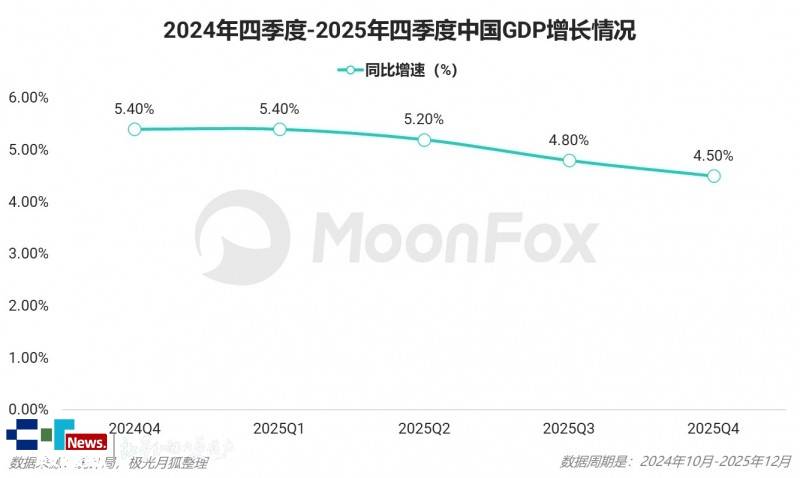
Macro Insights - In 2025, China's GDP surpassed 140 trillion yuan, reaching 1401879 billion yuan, with a year-on-year growth of 5.0% [1][6] - In Q4 2025, GDP was 387911 billion yuan, with a year-on-year growth of 4.5% [1][6] - The contribution of final consumption expenditure to economic growth was 52.0% in 2025, and 52.9% in Q4 [6] - The industrial sector showed stable growth, with a year-on-year increase of 5.0% in Q4, contributing 1.5 percentage points to economic growth [6][9] - Net exports demonstrated resilience, contributing 32.7% to economic growth in 2025 [9] Internet Sector Development Analysis AI Sector - The focus of the AI industry shifted from algorithm competition to deep exploration of commercial value and efficient realization [21][22] - AI technology integration into market applications is accelerating, with significant growth in smart terminal devices [22][25] - The AIGC application scenarios expanded, with notable growth in industrial and autonomous driving sectors [25][30] Video Sector - The online video industry experienced a seasonal decline in Q4 2025, with a slight year-on-year decrease of 0.9% [39] - Ten S+ series were launched in Q4, with overall video content showing a decline compared to the previous year [44][48] - Platforms are actively promoting high-quality content strategies, with significant successes in series like "反人类暴行" [49][66] E-commerce Sector - The e-commerce industry continued to grow, with user device coverage reaching 11.66 billion [75] - Regulatory policies are being optimized to promote healthy development in the e-commerce sector [73][74] - Major players like Alibaba and JD.com are deepening their integration into lifestyle services and enhancing AI applications [79][81] Tourism Sector - Winter tourism is becoming a new growth engine for the tourism industry, particularly during the traditional peak season [2] Short Drama Sector - The short drama industry is rapidly growing, with an estimated annual output value nearing 900 billion yuan in 2025 [1] Social Sector - The social media market remains stable, with vertical social platforms continuing to show significant potential [1]
阿里巴巴-W(09988.HK):2月13日南向资金减持325.48万股
Sou Hu Cai Jing· 2026-02-13 19:41
Group 1 - Southbound funds reduced their holdings in Alibaba-W (09988.HK) by 3.25 million shares on February 13 [1] - Over the past five trading days, southbound funds increased their holdings on four days, with a total net increase of 18.55 million shares [1] - In the last 20 trading days, there were 12 days of net increases in southbound fund holdings, totaling 27.27 million shares [1] - As of now, southbound funds hold 2.238 billion shares of Alibaba-W, accounting for 11.71% of the company's total issued ordinary shares [1] Group 2 - Alibaba Group Holding Limited provides technological infrastructure and marketing platforms, operating across seven business segments [1] - The China commerce segment includes retail businesses such as Taobao, Tmall, and Hema, as well as wholesale operations [1] - The international commerce segment encompasses international retail and wholesale businesses, including Lazada and AliExpress [1] - The local services segment includes location-based services such as Ele.me, Amap, and Fliggy [1] - The Cainiao segment offers domestic and international logistics services and supply chain management solutions [1] - The cloud segment provides public and hybrid cloud services to domestic and international enterprises, including Alibaba Cloud and DingTalk [1] - The digital media and entertainment segment includes Youku, Quark, Alibaba Pictures, and other content and distribution platforms, as well as online gaming [1] - The innovation and other segment comprises DAMO Academy, Tmall Genie, and other businesses [1]

阿里巴巴-W(09988.HK):2月11日南向资金增持31.7万股
Sou Hu Cai Jing· 2026-02-11 19:32
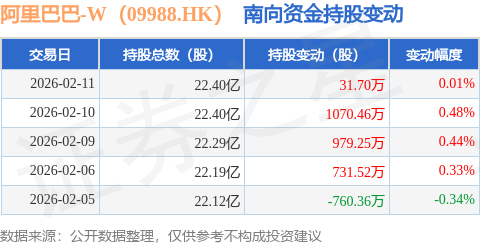
Group 1 - Southbound funds increased their holdings in Alibaba-W (09988.HK) by 317,000 shares on February 11, 2026, marking an increase of 0.01% [1][2] - Over the past five trading days, southbound funds have increased their holdings on four occasions, with a total net increase of 20.53 million shares [1] - In the last 20 trading days, there have been 13 days of net increases, totaling 42.86 million shares, bringing the total shares held by southbound funds to 2.24 billion, which represents 11.72% of the company's issued ordinary shares [1][2] Group 2 - Alibaba Group operates seven business segments, including Chinese retail (Taobao, Tmall, Hema), international retail (Lazada, AliExpress), local services (Ele.me, Amap, Fliggy), logistics (Cainiao), cloud services (Alibaba Cloud, DingTalk), digital media and entertainment (Youku, Quark, Alibaba Pictures), and innovation and other businesses (Damo Academy, Tmall Genie) [2]
阿里巴巴-W(09988.HK):2月9日南向资金增持979.25万股
Sou Hu Cai Jing· 2026-02-09 19:35
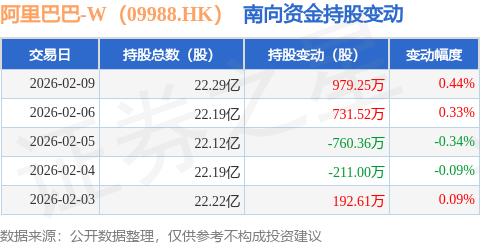
Group 1 - Southbound funds increased their holdings in Alibaba-W (09988.HK) by 9.79 million shares on February 9, 2026, marking a 0.44% increase [1] - Over the past 5 trading days, there were 3 days of net increases in holdings, totaling 9.32 million shares [1] - In the last 20 trading days, there were 12 days of net increases, with a total of 15.53 million shares added [1] - As of now, southbound funds hold 2.229 billion shares of Alibaba-W, accounting for 11.66% of the company's total issued ordinary shares [1] Group 2 - The total number of shares held by southbound funds on February 9, 2026, was 2.229 billion [2] - The shareholding changes over the last few trading days include: - February 6: Increased by 7.32 million shares (0.33%) - February 5: Decreased by 7.60 million shares (-0.34%) - February 4: Decreased by 2.11 million shares (-0.09%) - February 3: Increased by 1.93 million shares (0.09%) [2] - Alibaba Group operates seven business segments, including Chinese retail, international commerce, local services, logistics, cloud computing, digital media, and innovation [2]
电商行业的奇才,为了爱情远赴美国,他的退出成就了马云
Sou Hu Cai Jing· 2026-02-07 06:44
Core Insights - Online shopping has become an integral part of life in China, with Taobao and Tmall dominating over 50% of the market share, making them the leading platforms in the industry [1] - Before Taobao's emergence, eBay's Chinese counterpart, eBay China, led the C2C market with a 70% market share, founded by Shao Yibo [1][5] Group 1: Company Overview - Taobao and Tmall, under Alibaba, have established a significant presence in the Chinese e-commerce market, capturing more than 50% of the market share [1] - eBay China, founded by Shao Yibo, initially dominated the C2C market with a 70% market share before the rise of Taobao [1][5] - Shao Yibo successfully raised $6.5 million from three U.S. private equity firms within four months of founding eBay China, followed by investments from Louis Vuitton and eBay totaling $205 million and $300 million respectively [5] Group 2: Founder Background - Shao Yibo demonstrated exceptional mathematical talent from a young age, achieving third place in a national math competition at the age of 11 [3] - He became the first Chinese student to receive a full scholarship to Harvard University, graduating with top honors [4] - After working at Boston Consulting Group and being recognized as an outstanding employee, Shao Yibo made the decision to return to China to start eBay China at the age of 26, leaving behind a $200,000 salary [5] Group 3: Market Dynamics - The launch of Taobao in 2003, coinciding with Shao Yibo's decision to sell eBay China, allowed Alibaba to capture the market and become the highest-valued internet company in China [6][8] - Shao Yibo's exit from the market provided an opportunity for competitors like Alibaba to thrive, as noted by Jack Ma, who stated that Taobao would not have been created if Shao Yibo had not sold eBay China [8]

阿里巴巴-W(09988.HK):2月5日南向资金减持760.36万股
Sou Hu Cai Jing· 2026-02-05 19:43
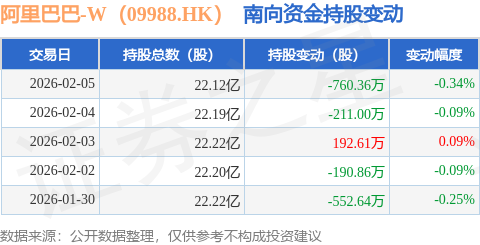
Group 1 - The core point of the news is that southbound funds have reduced their holdings in Alibaba-W (09988.HK) by 7.60 million shares on February 5, 2026, marking a trend of net reductions over the past five trading days [1] - Over the last 20 trading days, there have been 12 days of net increases in holdings by southbound funds, totaling an increase of 1.67 million shares [1] - As of now, southbound funds hold a total of 2.21 billion shares of Alibaba-W, which represents 11.57% of the company's total issued ordinary shares [1] Group 2 - The trading data shows a total shareholding of 2.21 billion shares on February 5, 2026, with a decrease of 0.34% from the previous day [2] - The shareholding changes over the last five trading days include a reduction of 0.09% on February 4, 2026, and a reduction of 0.25% on January 30, 2026 [2] - Alibaba Group operates across seven business segments, including Chinese retail, international commerce, local services, logistics, cloud services, digital media and entertainment, and innovation and other businesses [2]
2026年电商百科:天猫平台代运营是什么意思?
Sou Hu Cai Jing· 2026-02-05 18:10
Core Insights - The core viewpoint of the article is that by 2026, the Tmall platform has evolved into a critical partner model for brands to efficiently reach consumers and achieve sustainable growth through professional third-party operation services [1][3]. Group 1: Tmall Platform Operations - Tmall's代运营 (third-party operation) has transformed from a basic service of "opening a store and listing products" to a comprehensive e-commerce solution focused on brand growth, integrating data technology, content ecology, and omnichannel strategies [3]. - The role of代运营 companies is likened to that of an "online business unit" or "strategic digital partner," engaging in market positioning, product planning, and real-time strategy adjustments based on data [5]. - The operational foundation relies on a precise understanding of Tmall's latest rules, traffic distribution mechanisms, and strong data analysis capabilities to convert consumer behavior data into actionable operations [5]. Group 2: Service Scope and Content - The modern代运营 service adopts a modular and customized approach, covering essential areas such as store setup, visual design, product and supply chain management, traffic acquisition, and data-driven user asset management [7][8]. - Key service areas include: - Store foundation and visual system setup, ensuring alignment with Tmall's brand tone and enhancing conversion rates [7]. - Collaborative management of products and supply chains, including product planning and pricing strategies [7]. - Flow acquisition and precise marketing through various Alibaba marketing tools [7]. - Comprehensive event planning and execution for major promotional events [7]. - Data-driven operations and user asset management, focusing on user profiling and behavior analysis [7]. Group 3: Collaboration Models and Trends - The collaboration models between brands and代运营 companies include full management, partial module outsourcing, and strategic consulting, each catering to different brand needs [9]. - Key considerations for selecting a合作伙伴 (partner) include past performance, team expertise, data capabilities, and alignment of business models [9]. - The Tmall代运营 industry is expected to evolve with trends such as deeper technology integration, holistic consumer operations, and a focus on brand building, effective marketing, and sales conversion [9].