供应链安全

Search documents
欧洲人 “面子论” 破防:安世风波,让欧洲终于看清了中国决心
Sou Hu Cai Jing· 2025-11-06 10:40
Core Points - The Dutch government's recent decision to take control of Nexperia, a semiconductor company, reflects the complexities of international relations and the influence of U.S. pressure [1] - China's swift response to the Dutch actions has led to significant disruptions in the European automotive supply chain, highlighting the interdependence of global supply chains [1][2] Group 1: Company Actions - The Dutch government has taken control of 99% of Nexperia's shares and removed the Chinese CEO, citing national security concerns [1] - In response, China's Ministry of Commerce has banned the export of finished products and components from Nexperia's Chinese factories, leading to immediate supply chain issues for major European automakers [1][2] - Nexperia China has announced it will operate independently, accepting only domestic orders and using RMB for transactions, disregarding directives from the Dutch headquarters [1] Group 2: Industry Impact - Major European automakers, including Volkswagen, Volvo, and Nissan, are facing supply chain disruptions, with some factories halting production due to a lack of semiconductor components [2][4] - The German automotive industry association has warned that the chip shortage will impact the entire supply chain, from suppliers to assembly plants, leading to inevitable production halts [4] - The situation has escalated to the point where European automotive workers are facing reduced hours and potential job losses, with unions considering strikes [10][12] Group 3: Broader Implications - The incident has exposed the EU's awkward position regarding technological sovereignty, as 80% of Nexperia's production capacity is based in China, making it difficult to decouple from Chinese supply chains [12] - The ongoing tensions have led to over 5,000 vehicle production delays in Europe, resulting in losses exceeding €1 billion [12] - The event has prompted a shift in public perception in Europe, with initial support for the Dutch government's actions giving way to concerns about the economic consequences and the resilience of Chinese responses [8][18]

荷兰安世断供东莞工厂 内部人员:国内还在正常出货!三家大型代理商最新回应
Mei Ri Jing Ji Xin Wen· 2025-11-03 23:33
Core Viewpoint - Nexperia, a leading global power semiconductor company, has decided to stop supplying wafers to its packaging and testing factory in Dongguan, China, effective October 26, 2025, which raises concerns about the impact on the semiconductor supply chain and market dynamics [1][5]. Group 1: Company Overview - Nexperia ranks third in global revenue for power discrete devices in 2024 and is the top domestic power semiconductor company in China, recognized as one of the "Top Ten Power Device Companies" in the Chinese semiconductor industry [5]. - The company leads in several segments, including being the largest supplier of small signal diodes and transistors, second in logic ICs, and first in ESD protection devices and small signal MOSFETs [5]. Group 2: Supply Chain Impact - Nexperia China has stated that it has sufficient finished and in-process inventory to meet customer demand until the end of the year and is actively working on validating new wafer production capacity to ensure long-term supply [5]. - Despite Nexperia China's assurances, the actual sentiment in the supply chain remains critical for assessing risks [5]. Group 3: Responses from Distributors - Zhongdian Port, a distributor of Nexperia products, reported that while short-term supply is normal, there is long-term uncertainty depending on negotiations between China and the Netherlands [6][7]. - Weiyali, another distributor, indicated that there is currently no stock available from Nexperia, and the timeline for future availability is uncertain [8]. - Shangluo Electronics continues to distribute Nexperia products but emphasizes that it does not rely solely on Nexperia, having prepared alternative products to mitigate potential risks [9].
安世断供东莞工厂,内部人员:国内还正常出货!有客户上门催货
Mei Ri Jing Ji Xin Wen· 2025-11-03 22:27
Core Viewpoint - Nexperia, a leading global power semiconductor company, has announced a unilateral decision to stop supplying wafers to its packaging and testing factory in Dongguan, China, effective October 26, 2025, leading to significant concerns in the industry [1]. Group 1: Company Impact - Nexperia China claims to have sufficient finished and in-process inventory to meet customer demands until the end of the year and is actively validating new wafer production capacity to ensure long-term supply [6]. - The company holds a significant position in the global power semiconductor market, ranking third in revenue for power discrete devices globally and first in China, with leading positions in various sub-segments [6]. - The disruption in the supply chain is expected to have a considerable impact on the market, raising concerns among industry participants [6]. Group 2: Customer Reactions - Customers of Nexperia, such as a downstream client with over 1 billion yuan in annual chip procurement, are seeking clarity on future product supply amid the announcement [4]. - Zhongdian Port, a distributor of Nexperia products, reported that while short-term supply remains stable, long-term uncertainty exists, heavily dependent on negotiations between China and the Netherlands [9]. - Weili Electronics, another distributor, indicated that they currently have no stock from Nexperia, and the timeline for future availability is uncertain [12]. - Shangluo Electronics continues to distribute Nexperia products but emphasizes that their business is not solely reliant on Nexperia, having prepared alternative products to mitigate potential risks [14]. Group 3: Market Reactions - As of November 3, 2023, Zhongdian Port's stock price increased by 0.75%, with a market capitalization of 20.441 billion yuan [10]. - Weili Electronics' stock closed at 5.78 HKD, with a market capitalization of 595 million HKD [12]. - Shangluo Electronics' stock rose by 6.24%, reaching 14.64 yuan, with a market capitalization of 10.1 billion yuan [14].
荷兰安世断供东莞工厂,内部人员:国内还在正常出货!有客户上门“催货”,订单达10多亿元;三家大型代理商最新回应→
Mei Ri Jing Ji Xin Wen· 2025-11-03 16:32
Core Viewpoint - Nexperia, a leading global power semiconductor company, has decided to stop supplying wafers to its packaging and testing factory in Dongguan, China, effective October 26, 2025, leading to significant concerns in the semiconductor supply chain [1][6]. Group 1: Company Actions and Responses - Nexperia China announced that it has sufficient finished and in-process inventory to meet customer demands until the end of the year and is actively validating new wafer production capacity to ensure long-term supply continuity [6]. - The company has initiated multiple contingency plans to maintain supply chain reliability and is confident in meeting all customer needs starting next year [6]. Group 2: Market Position and Impact - Nexperia ranks third globally in revenue for power discrete devices and is the top domestic company in China, holding leading positions in various semiconductor segments, including small-signal diodes and transistors [6]. - The public severance of the supply chain is expected to have significant implications for the market, raising concerns among industry stakeholders [6]. Group 3: Customer and Distributor Reactions - Distributors such as Zhongdian Port and Weiyali reported that they currently have normal supply channels, but there are uncertainties regarding long-term availability due to the situation between China and the Netherlands [9][12]. - Zhongdian Port indicated that their annual cooperation scale with Nexperia is around 100 million yuan, which is a small portion of their overall revenue of 40-50 billion yuan [9]. - Merchants like Shangluo Electronics continue to work with Nexperia but have diversified their product lines to mitigate risks associated with reliance on a single supplier [14]. Group 4: Stock Market Reactions - As of November 3, Zhongdian Port's stock price increased by 0.75%, closing at 26.9 yuan, with a market capitalization of 20.441 billion yuan [10]. - Weiyali's stock price closed at 5.78 HKD, with a market capitalization of 595 million HKD [12]. - Shangluo Electronics saw a stock price increase of 6.24%, closing at 14.64 yuan, with a market capitalization of 10.1 billion yuan [15].
荷兰安世“断粮”东莞工厂 国内供应链影响几何?三家上市公司代理商回应来了
Mei Ri Jing Ji Xin Wen· 2025-11-03 14:06
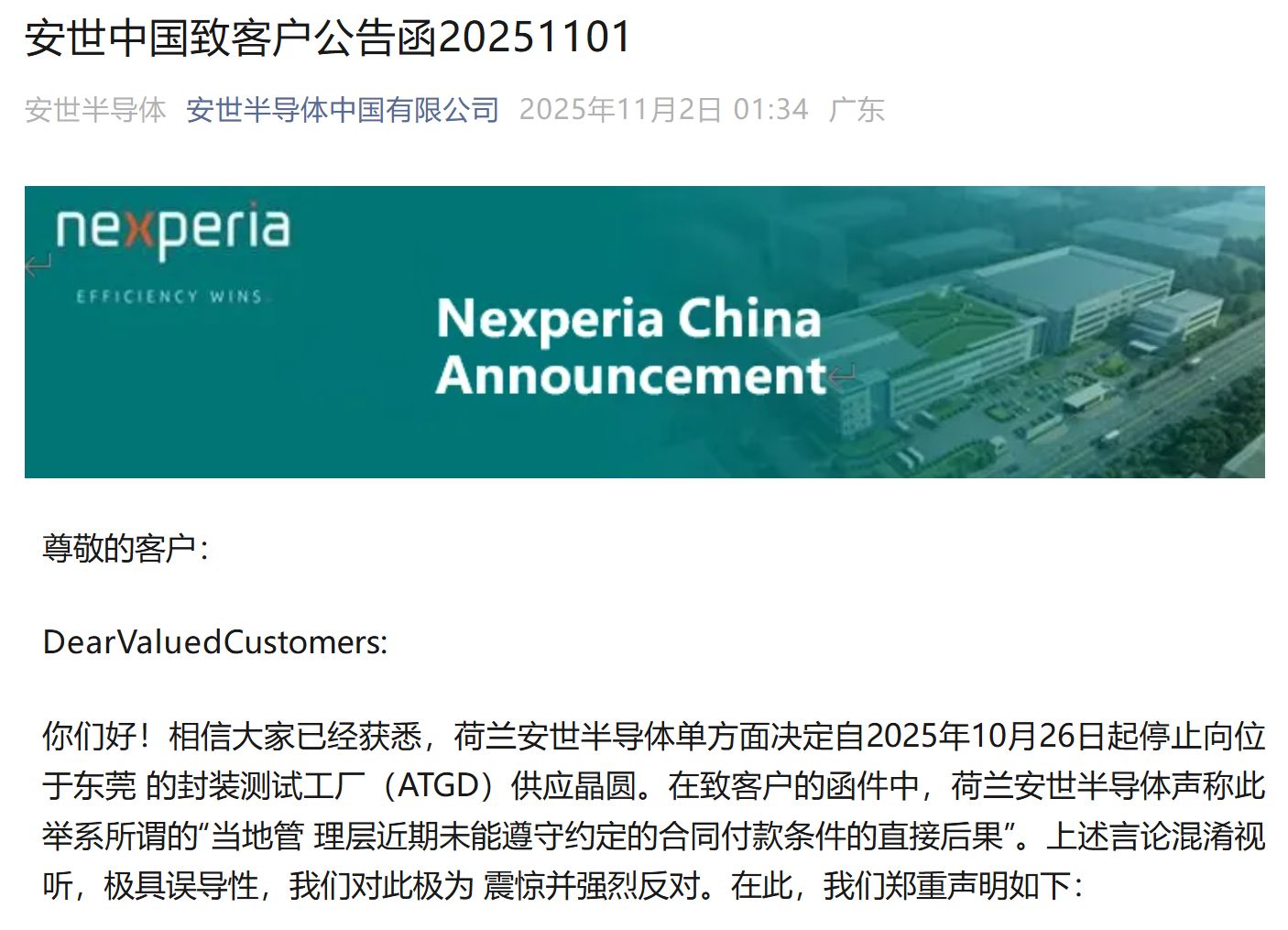
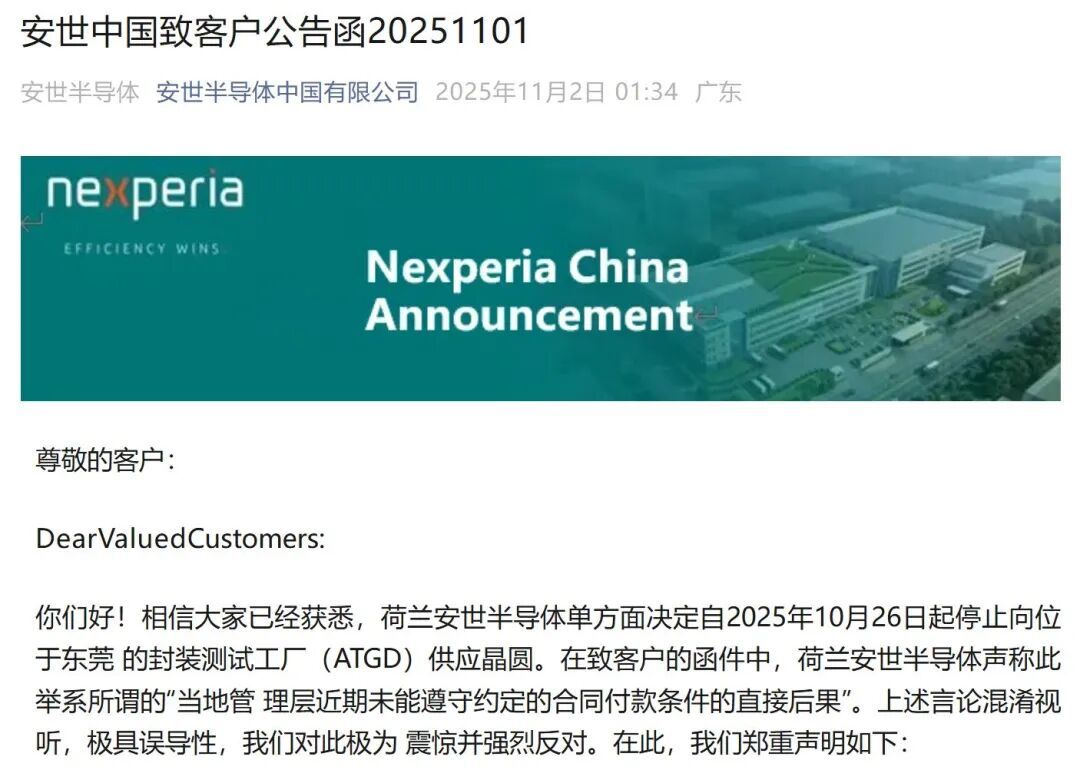
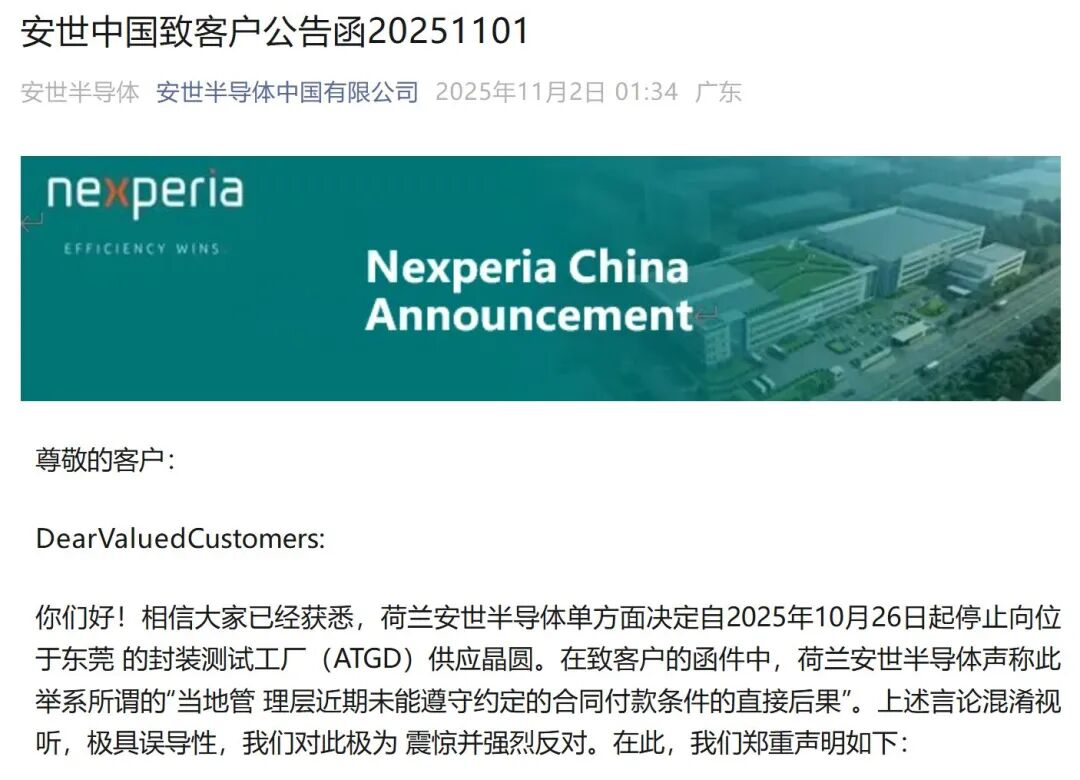
一纸来自荷兰的"断供"通知,让全球功率半导体龙头安世半导体(Nexperia)与其位于东莞的封测工厂走向"决裂"。 11月2日凌晨,安世半导体中国有限公司(以下简称安世中国)微信公众号发文称,荷兰安世半导体单方面决定自2025年10月26日起停止向位于东莞的封装 测试工厂(ATGD)供应晶圆。 图片来源:安世半导体中国有限公司微信公众号 安世半导体在全球功率半导体市场中占据重要地位。根据芯谋研究数据,2024年安世半导体位居全球功率分立器件营收第三位,并稳居国内功率半导体公司 第一名,荣获"中国半导体行业功率器件十强企业"称号。 作为半导体行业的重要参与者,安世半导体产品线覆盖广泛,其供应链的公开割裂将对市场产生何种影响,引发业界高度关注。 安世中国在11月2日的声明中表示:"目前,安世中国已建立充足的成品与在制品库存,能够稳定、持续地满足广大客户直至年底乃至更长时间的订单需求, 供应链安全可靠。为确保供应的长期性与韧性,公司已积极启动多套预案,正在加紧验证新的晶圆产能。我们对在短期内完成验证、并自明年起无缝衔接满 足所有客户需求充满信心。" 尽管安世中国对外传递了稳定信号,但供应链上下游的真实感受仍是判断风 ...
全球车企被卡了一个月“脖子”,终于能缓一口气了
2 1 Shi Ji Jing Ji Bao Dao· 2025-11-02 10:49
Core Viewpoint - The global automotive industry is facing a significant chip shortage exacerbated by the Dutch government's intervention in the semiconductor company Nexperia, which has led to supply chain disruptions and production halts among major automakers [1][2][5]. Group 1: Supply Chain Disruptions - The Dutch government has taken control of Nexperia, a subsidiary of the Chinese company Wingtech Technology, citing national security concerns, which has triggered a global chip supply crisis [2][5]. - Nexperia's actions have resulted in a substantial debt of 1 billion RMB owed to its packaging and testing factory in Dongguan, China, raising concerns about the reliability of the supply chain [1][2]. - Major automakers like Volkswagen and Honda have reported production halts and significant financial impacts due to the ongoing chip shortages [2][9]. Group 2: Impact on Automakers - Volkswagen reported its first quarterly loss in five years, warning that chip shortages could jeopardize its annual profit targets [2][9]. - Honda's factories in Mexico and Canada have announced production cuts and temporary shutdowns due to the lack of chips, which are critical for vehicle functionality [2][9]. - The European Automobile Manufacturers Association has warned of potential production interruptions across Europe if Nexperia's supply does not resume soon [3][9]. Group 3: Market Position of Nexperia - Nexperia is a leading supplier of discrete and power semiconductors, holding over 30% of the global market share in automotive power semiconductors [8][12]. - The company's components are essential for various vehicle functions, and their absence can halt production lines, as even low-cost components are critical for vehicle assembly [8][12]. - The semiconductor market is characterized by long certification processes, making it difficult for automakers to quickly switch suppliers in response to shortages [11][12]. Group 4: Responses from the Industry - Automakers are actively seeking alternative suppliers to mitigate the impact of Nexperia's supply disruptions, but the transition is complicated by lengthy certification processes and increased costs [11][12]. - The automotive industry is facing a shift in supply chain risks from predictable shortages to acute disruptions caused by geopolitical factors [13][17]. - The situation has prompted discussions about increasing domestic semiconductor production capabilities in response to geopolitical tensions and supply chain vulnerabilities [17].


被安世风波卡了一整月“脖子”的全球车企,终于能缓一口气了
2 1 Shi Ji Jing Ji Bao Dao· 2025-11-02 09:13
Core Viewpoint - The global automotive industry is facing a significant chip shortage exacerbated by the Dutch government's intervention in the semiconductor company Nexperia, which has led to supply chain disruptions and production halts among major automakers [1][2][3]. Group 1: Supply Chain Disruptions - The Dutch government took control of Nexperia, which has triggered a global chip shortage impacting major automotive manufacturers like Volkswagen and Honda, leading to production halts and financial losses [2][3]. - Nexperia's Chinese subsidiary has reported a significant debt of 1 billion RMB to its packaging and testing factory in Dongguan, indicating financial strain and potential supply issues [1][4]. - Major automakers, including Ford and BMW, are facing imminent production cuts if the chip supply issue is not resolved within weeks [7][9]. Group 2: Impact on Automotive Manufacturers - Volkswagen reported its first quarterly loss in five years, attributing it to the ongoing chip shortage, while Honda has announced production halts at key facilities in North America [2][5]. - The European Automobile Manufacturers Association warned of potential production interruptions across the continent if Nexperia's supply does not stabilize soon [2][7]. - The automotive industry relies heavily on Nexperia's components, which are critical for various vehicle functions, making the shortage particularly acute [5][6]. Group 3: Market Dynamics and Alternatives - Automakers are scrambling to find alternative suppliers, but the transition is complicated by lengthy certification processes that can take 18 to 24 months, making immediate solutions difficult [10][11]. - The cost of sourcing components from alternative suppliers is expected to rise by 20-30%, further straining manufacturers already facing financial pressures [11][12]. - The geopolitical landscape is influencing supply chain decisions, with companies urged to mitigate risks by diversifying suppliers and considering local production options [13]. Group 4: Future Implications - The current crisis may accelerate the push for domestic semiconductor production capabilities in China, as companies seek to reduce reliance on foreign suppliers [13]. - The situation highlights the need for the automotive industry to adapt to geopolitical risks and enhance supply chain resilience [13].
知名企业声明:极为震惊,强烈反对!
21世纪经济报道· 2025-11-02 04:14
Core Viewpoint - Nexperia Netherlands has unilaterally decided to suspend wafer supply to its Dongguan assembly and test site (ATGD) starting October 26, 2025, citing alleged non-compliance with contractual payment terms by local management, which is strongly contested by Nexperia China, claiming that the accusations are fabricated and misleading [1][4]. Group 1 - Nexperia China asserts that it has not breached any contracts and that Nexperia Netherlands currently owes ATGD over RMB 1 billion in outstanding payments [1][4]. - The management of Nexperia Netherlands is accused of severe dereliction of duty, prioritizing personal interests over the company's overall interests, which violates professional ethics and corporate governance [1][4]. - The unilateral suspension of supply by Nexperia Netherlands is described as irresponsible, disregarding customer interests and violating contractual agreements, thereby undermining customer trust [1][4]. Group 2 - Nexperia China has established sufficient inventories of finished goods and work-in-progress, ensuring stable fulfillment of customer orders through the end of the year and beyond, with a reliable supply chain [2][4]. - The company is actively implementing multiple contingency plans to verify new wafer production capacity, expressing confidence in seamlessly meeting all customer demands starting next year [2][4]. Group 3 - The Chinese Ministry of Commerce has commented on the situation, emphasizing that improper intervention by the Dutch government in corporate affairs has led to global supply chain disruptions, and encourages companies facing difficulties to contact the ministry for support [5].
欧洲集体施压中国,德法力挺荷兰,谈判关键条件曝光
Sou Hu Cai Jing· 2025-11-02 02:19
Core Points - The article discusses the escalating tensions between Europe and China, particularly focusing on the Netherlands' takeover of ASML and the subsequent reactions from Germany and France, highlighting the urgency for negotiations and the complexities involved [1][3][9] Group 1: Events Timeline - On September 29, 2025, the U.S. placed Wingtech Technology on the export control entity list, prompting the Netherlands to take control of ASML the next day, citing "economic security" [3] - On September 30, the Netherlands announced the custody of 99% of ASML's shares and dismissed Chinese executives, claiming governance issues [3] - By mid-October, German automotive manufacturers faced significant disruptions, with Volkswagen reducing production due to shortages of electric motor modules [3][5] Group 2: Export Controls and Responses - On October 9, China's Ministry of Commerce announced export regulations on specific rare earth elements, further escalating tensions [5] - Germany and France expressed support for the Netherlands at an EU summit while urgently seeking negotiations with China, indicating a desire to resolve semiconductor and rare earth issues [5][9] - China stated that discussions on rare earth and high-tech exports could occur but required reciprocal easing of high-tech export approvals from the EU [7][9] Group 3: Supply Chain Impact - The takeover of ASML has led to significant supply chain disruptions in Europe, particularly affecting companies reliant on Chinese packaging and assembly [7][10] - European industries, especially in the electric vehicle sector, are heavily dependent on rare earth elements, with China controlling over 80% of global supply, leading to stockpiling and delivery issues [7][10] - The ongoing negotiations and the concept of "reciprocity" are critical to resolving the current supply chain crisis, with both sides facing pressure to reach an agreement [10]

安世中国,郑重声明
半导体芯闻· 2025-11-02 01:39
Core Viewpoint - Nexperia Netherlands has unilaterally decided to suspend wafer supply to its Dongguan assembly and test site (ATGD) starting October 26, 2025, citing alleged non-compliance with contractual payment terms by local management, which Nexperia China strongly refutes as misleading and defamatory [1][4][5]. Group 1: Allegations and Responses - Nexperia China asserts that the claims made by Nexperia Netherlands regarding local management's failure to meet payment terms are entirely fabricated and constitute malicious defamation, emphasizing that Nexperia China has not breached any contracts [5][6]. - Nexperia Netherlands is reported to owe Nexperia China over RMB 1 billion in outstanding payments, contradicting their claims of non-compliance [5][6]. - The management team at Nexperia Netherlands is accused of severe dereliction of duty, prioritizing personal interests over the company's overall interests, which violates professional ethics and corporate governance [6][7]. Group 2: Supply Chain and Customer Assurance - Nexperia China has established sufficient inventories of finished goods and work-in-progress to meet customer orders through year-end and beyond, ensuring a secure and reliable supply chain [8][9]. - The company has initiated multiple contingency plans to ensure long-term supply resilience and is accelerating the qualification of new wafer supply sources, expressing confidence in meeting all customer demands starting next year [8][9]. - Nexperia China emphasizes its commitment to product quality and fulfilling customer promises, stating that the unilateral supply suspension by Nexperia Netherlands will not alter this commitment [9][10].