大数据分析

Search documents
新纽科技发布2025年中期业绩公告:稳经营、强韧性、促发展
Zheng Quan Zhi Xing· 2025-08-26 02:04
Core Insights - New New Technology (09600.HK) reported a solid performance in its mid-year results for 2025, focusing on innovation in IT solutions leveraging AI and big data across various industries [1][2] Group 1: Revenue Performance - In the first half of 2025, the company achieved total revenue of RMB 133.7 million, representing an 8.8% increase compared to the same period in 2024 [2] - Software development services, the core revenue source, generated RMB 118.7 million, a 13.3% increase year-on-year [2] - Innovative solutions within software development accounted for RMB 69.4 million, making up 58.5% of the software development revenue [2] Group 2: R&D and Innovation - The company is committed to long-term development through continuous R&D and innovation, focusing on key technology breakthroughs and core product upgrades [3] - A strategic partnership with Hong Kong Polytechnic University was established to enhance collaboration in research and technology application [3] Group 3: Operational Strategy - The company has adopted a proactive management approach to enhance operational resilience and quality amid global economic challenges [4] - Plans for the second half of 2025 include strengthening collaborative mechanisms among subsidiaries and integrating internal and external technology supply chains [4] - The company aims to implement a dual-path expansion strategy focusing on core regional penetration and emerging market cultivation [4] Group 4: Future Outlook - New New Technology is dedicated to maintaining a long-term, stable development approach by improving operational performance, optimizing asset allocation, and enhancing cash flow management [5]
云仓:直播电商的智能基础设施
Sou Hu Cai Jing· 2025-08-25 16:36
Core Insights - The explosive growth of live e-commerce presents unprecedented challenges to traditional logistics systems, with cloud warehouses emerging as a new intelligent infrastructure reshaping the supply chain landscape [1] - Cloud warehouses offer elastic scheduling capabilities, enabling rapid resource allocation during peak demand, as demonstrated by a beauty brand that processed 250,000 orders within 2 hours during a live broadcast [1] - The distributed warehousing network of cloud warehouses allows for intelligent inventory allocation based on historical data, significantly reducing average delivery distances and improving delivery efficiency [1] Cloud Warehouse Advantages - The digital management platform of cloud warehouses provides full-process visibility, allowing merchants to monitor inventory status, order processing progress, and logistics tracking in real-time, enhancing supply chain controllability and stability [1] - The large-scale application of smart devices is crucial for the efficient operation of cloud warehouses, with automated sorting systems processing over ten thousand items per hour, AGV robots working 24/7, and intelligent packaging systems optimizing packaging solutions [2] - Cloud warehouses leverage big data analytics to support merchant decision-making, helping to identify sales trends, predict popular products, and optimize inventory structures, as evidenced by an appliance brand reducing inventory turnover days from 45 to 20 [2] Future Outlook - With the advancement of 5G, IoT, and AI technologies, cloud warehouses are expected to become more intelligent and automated, evolving into a core hub of the live e-commerce ecosystem and driving the industry towards greater efficiency and sustainability [2]


智能家居行业双周报:促消费政策再加码,贴息+以旧换新组合拳共促消费活力-20250825
Guoyuan Securities· 2025-08-25 11:44
Investment Rating - The report maintains a "Recommended" rating for the smart home industry [5][28][7] Core Insights - The report highlights the combination of subsidy policies and trade incentives aimed at boosting consumer spending in the smart home sector, particularly through the promotion of old-for-new exchange programs and interest subsidies [3][19][28] - The smart home index has shown significant growth, outperforming major indices, indicating a robust market performance [12][16] - The report emphasizes the ongoing technological advancements in IoT, AI, and big data, which are expected to enhance product offerings and meet diverse consumer needs [5][28] Summary by Sections Market Review - In the past two weeks (August 9-22, 2025), the Shanghai Composite Index rose by 5.24%, the Shenzhen Component Index by 9.32%, and the ChiNext Index by 14.94%. The smart home index (399996.SZ) increased by 14.16%, outperforming the Shanghai Composite by 8.92 percentage points [12][16] - Year-to-date performance shows the smart home index up by 27.75%, significantly ahead of the Shanghai Composite's 14.14% increase [12][15] - Within the smart home index, the electronic components and parts sector saw a 23.68% increase over the past two weeks, while year-to-date gains were 62.20% [16][17] Industry Policy Tracking - A national conference was held to advance the old-for-new exchange program for consumer goods, emphasizing the government's commitment to stimulating consumption through coordinated policy efforts [18] - The combination of interest subsidy policies with the old-for-new exchange program aims to enhance consumer spending and market vitality [19][21] Industry News Tracking - Sales of old-for-new related and upgraded products have performed well, with significant year-on-year growth in retail sales for home appliances and communication devices [24] - Aux Electric has passed the listing hearing for the Hong Kong Stock Exchange, marking a significant step towards its market entry [25][26] Investment Recommendations - The report suggests that the smart home industry will benefit from government policies aimed at expanding consumer spending, technological advancements, and increasing domestic demand driven by rising living standards and aging population [5][28]





多家银行,紧急声明!
Jin Rong Shi Bao· 2025-08-21 08:49
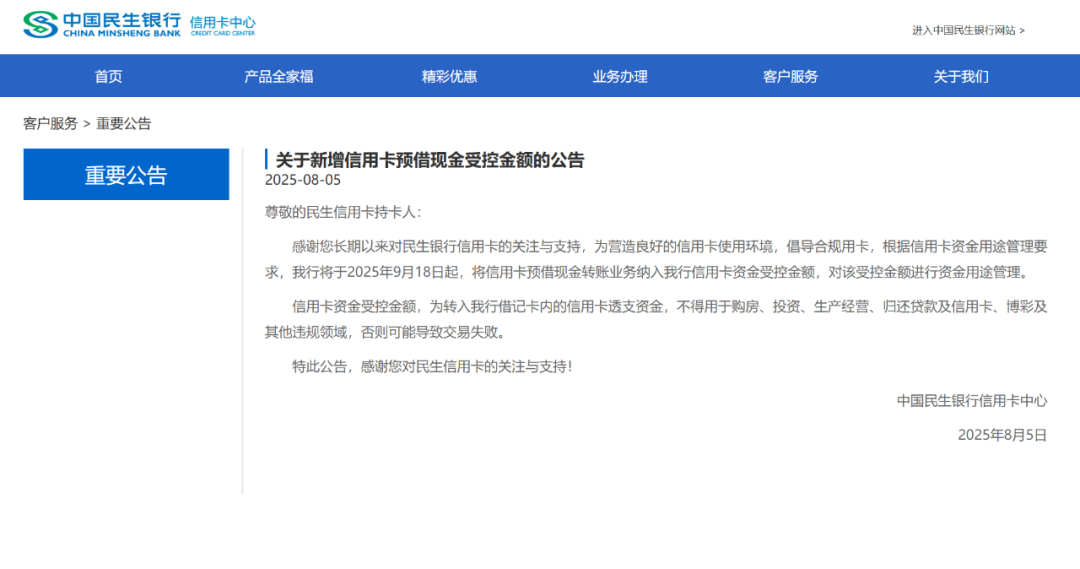
Core Viewpoint - The discussion around "loan speculation" in the A-share market is intensifying as banks tighten controls on credit card fund usage to prevent risks associated with credit funds flowing into investment areas [1][4][5] Group 1: Regulatory Actions - Since August, numerous banks, including Minsheng Bank and Huaxia Bank, have issued announcements prohibiting credit funds from entering the housing and stock markets [1] - Starting September 18, 2025, Minsheng Bank will manage the usage of credit card cash advance transfers, restricting them from being used for housing purchases, investments, or debt repayments [1] - Huaxia Bank updated its credit card cash advance terms, explicitly stating that funds cannot be used for non-consumption activities, including investments and debt repayment [1] Group 2: Regional Bank Responses - Various regional banks, such as those in Zhejiang, Shaanxi, and Yunnan, have also reinforced credit card fund usage management, warning against using credit for investment purposes [4] - The Shaanxi Rural Credit Cooperative reiterated that credit card funds must not be used for investment, with potential penalties for violations [4] - Local banks in Shaanxi have followed suit, issuing similar statements regarding the management of credit card funds [4] Group 3: Historical Context and Market Implications - The flow of bank credit funds into non-consumption areas has long been a regulatory red line, as highlighted by previous notices from the China Banking and Insurance Regulatory Commission [5] - The recent recovery of the A-share market has led some cardholders to attempt to illegally transfer credit card cash advances into the stock market, raising concerns about the risk of funds moving from real to virtual assets [5] - Experts suggest that banks should enhance customer qualification checks during credit card applications and utilize technology for transaction monitoring to prevent misuse of credit card funds [5]


“保险老三”地位不稳!中国太保“双降”背后
Zhong Jin Zai Xian· 2025-08-21 03:52
Core Insights - The insurance market in China is undergoing a significant structural adjustment, with major players experiencing varied revenue trends, leading to a notable decline in China Pacific Insurance's net profit by 18.1% year-on-year, indicating operational challenges and a potential reshaping of the competitive landscape in the life insurance sector [1][4]. Group 1: Financial Performance - In Q1 2025, China Pacific Insurance's fair value change income plummeted by 89% to 1.655 billion yuan, contrasting sharply with a 5.6% investment return in 2024, highlighting the impact of new financial accounting standards on profit and loss statements [2]. - The company's reliance on equity markets has exposed weaknesses in its asset allocation and risk hedging strategies, particularly during market downturns [2]. Group 2: Market Dynamics - The overall new premium growth in the industry has slowed, with a more than 20% year-on-year decline in new single premiums across the sector. China Pacific's agent channel new single premiums fell by 15.2%, while the bancassurance channel surged by 130.7%, contributing 87% to overall premium growth [3]. - Despite the growth in the bancassurance channel, the insurance service revenue only increased by 0.6%, indicating a disparity between premium growth and value creation [3]. Group 3: Competitive Landscape - Competition among leading insurance companies is intensifying, with the premium gap between China Pacific and Taikang Life narrowing from 10.5 billion yuan in 2024 to less than 10 billion yuan [4]. - China Pacific's new product structure is lagging behind industry trends, with the proportion of participating insurance new premiums rising to 18.2%, still far from the 50% target [4]. Group 4: Strategic Challenges - The management of China Pacific needs to focus on upgrading investment capabilities, restructuring channel value, and accelerating product innovation to navigate the multifaceted challenges it faces [5]. - Digital transformation is seen as a potential key to overcoming these challenges, with plans to enhance investment decision-making efficiency and optimize product pricing through big data analysis [5].

科技推动金融行业创新,服务更加高效
Sou Hu Cai Jing· 2025-08-20 07:46
Group 1 - The core viewpoint emphasizes the rapid transformation of the financial industry through the integration of advanced technologies such as artificial intelligence, blockchain, and cloud computing, leading to increased efficiency and broader access to financial services [2] Group 2 - Technology is restructuring service processes, significantly reducing loan approval times from days to minutes through big data analysis and machine learning, with a notable decrease in bad loan rates by 1.2 percentage points [3] - AI and blockchain technologies are enhancing efficiency in various sectors, such as insurance and cross-border payments, with costs reduced by over 60% and real-time transaction capabilities [3] Group 3 - The rise of inclusive finance is evident as technology bridges service gaps, with mobile payments and digital credit reaching underserved rural areas, providing credit loans to over 30 million agricultural users with an average credit limit increase of three times [5] - Financial technology development in China has led to a 28% increase in banking service coverage and a 4.2 percentage point reduction in financing costs for small and micro enterprises [5] Group 4 - Regulatory technology is evolving to enhance risk management, with the central bank's financial risk monitoring platform integrating data from over 2 million financial institutions for proactive risk alerts [6] - Local regulators are employing blockchain for comprehensive management of innovative businesses, ensuring that innovation occurs within a controlled risk environment [6] Group 5 - The future of finance is expected to see deeper integration of technology, with advancements like 5G and IoT facilitating automatic payment settlements and quantum computing enhancing financial security [7] - The emergence of generative AI may lead to the development of "digital employees" that participate in customer service and investment research, making financial services more seamless and user-friendly [7] - This technological revolution is anticipated to expand from efficiency improvements to deeper changes in service models, industry ecosystems, and social governance, promoting high-quality economic development [7]

上市保险中介公司的发展路径与挑战
Sou Hu Cai Jing· 2025-08-20 07:02
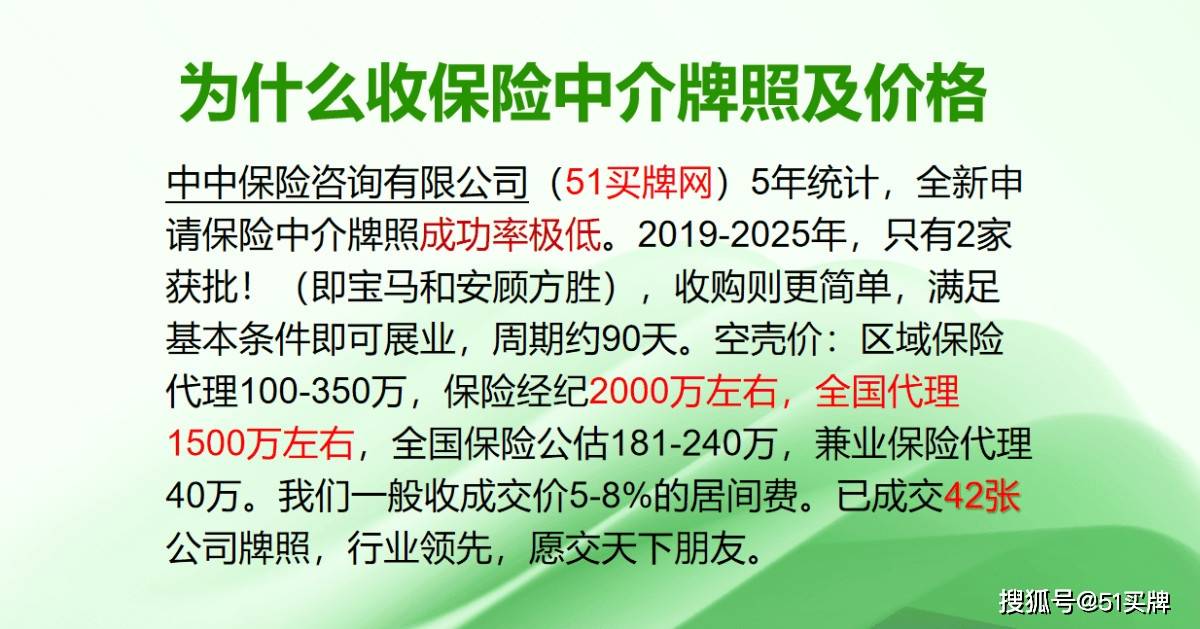
Core Viewpoint - The insurance intermediary industry is undergoing a transformation by 2025, facing multiple development paths and challenges due to stricter regulations, intensified market competition, and evolving consumer demands [1] Group 1: Development Paths - Insurance intermediaries need to shift from "scale expansion" to "value creation," balancing short-term profits with long-term value through enhanced professional services and exploring sustainable business models [1] - Companies should leverage technology and digital transformation, utilizing AI and big data to optimize processes and improve customer experience, as seen with Yuanbao Group's AI-driven underwriting system [2] - Focusing on niche markets and differentiated competition is essential, with leading firms developing products for the silver economy and offering "insurance + health management" services [2] - Mergers and acquisitions are crucial for market share expansion, with companies acquiring regional firms or collaborating with tech and financial institutions to enhance service capabilities [2] - Capital operations and global expansion are vital, with firms utilizing stock issuance and asset-backed securities to enhance liquidity and enter emerging markets [2] Group 2: Challenges - The implementation of the "Uniform Pricing and Reporting Policy" has led to a 30% decrease in average commission rates, impacting short-term revenues for intermediaries [2] - Stricter regulations have increased compliance costs, requiring firms to invest in compliance systems and digital auditing tools to mitigate regulatory risks [2] - Smaller intermediaries face survival challenges amid increasing industry concentration, with many struggling to maintain operations and some even surrendering licenses [2] - The contradiction between technology investment and return on investment poses a challenge, as digital transformation requires significant upfront costs with delayed benefits [2] Group 3: Future Direction - The future direction for the industry emphasizes specialization and sustainable development, focusing on building long-term value through innovative and responsible business practices [2]
物流网络货运平台的创新力量:跨越速运的智慧物流之路
Sou Hu Cai Jing· 2025-08-20 02:19
Core Insights - The rise of logistics network freight platforms marks a new era of intelligence in the logistics industry, with KuaYue Express emerging as a key player driving industry development through technological strength and innovation [1][9] Group 1: Intelligent Dispatch - KuaYue Express's logistics network freight platform features an intelligent dispatch system that utilizes advanced big data analysis and AI algorithms to match vehicles and cargo in real-time, significantly reducing transit time and transportation costs [3][9] Group 2: Digital Services - The platform incorporates IoT and blockchain technologies to enhance transparency, safety, and convenience in logistics services, allowing customers to monitor cargo status in real-time, including critical information such as location, temperature, and humidity [4][9] Group 3: Personalized Services - KuaYue Express offers customized logistics solutions to meet diverse customer needs, whether for large-scale e-commerce shipments or small parts delivery in manufacturing, thereby increasing customer satisfaction and loyalty [6][9] Group 4: Continuous Innovation - The company's success is attributed to its ongoing commitment to innovation, investing in R&D to explore new technologies that enhance logistics service efficiency and quality, keeping KuaYue Express at the forefront of industry innovation [7][9]

以“三位一体”创新路径促进债券市场高质量发展
Xin Lang Cai Jing· 2025-08-20 00:24
Core Viewpoint - The article emphasizes the need for reform and innovation to promote high-quality development in the bond market, focusing on product, technology, and institutional innovations to address existing challenges and stimulate financing for innovative enterprises [1][2][3]. Group 1: Current State of the Bond Market - China's bond market has achieved significant growth, with a total outstanding scale exceeding 180 trillion yuan, maintaining its position as the second largest globally [2]. - The bond market plays a crucial role in China's financial system, with recent reforms aimed at increasing direct financing and supporting technological innovation [2][3]. - Despite its size, the bond market faces structural challenges compared to mature international markets, including market segmentation and liquidity issues [3][4]. Group 2: Structural Challenges - There are issues with market segmentation and liquidity, particularly between the interbank and exchange markets [4]. - Product innovation and risk management tools are insufficient, with a low issuance ratio of bonds rated below AA, failing to meet the financing needs of small and medium-sized enterprises [4]. - The credit rating mechanism has systemic biases, with over 90% of bonds rated AA or above, leading to distorted risk pricing [4]. - The application of financial technology is lagging, particularly in integrating blockchain and digital currency with traditional systems [4][5]. Group 3: Innovation Pathways - The article proposes a "three-in-one" innovation approach focusing on product, technology, and institutional innovations to enhance the bond market [5][6]. - Product innovation should target the financing needs of innovative enterprises, particularly in the technology sector, with a significant increase in the issuance of technology bonds expected in 2024 [6][7]. - The bond market's product system needs improvement, with gaps in areas such as inflation-linked bonds and catastrophe bonds [8]. Group 4: Technological Innovation - Technological innovation is essential for the digital and intelligent transformation of the bond market, with applications of blockchain, AI, and big data expected to enhance market efficiency [10][11]. - The integration of blockchain technology has already begun in China, with the launch of a blockchain digital bond platform [11][12]. - Future technological advancements should focus on establishing unified standards and data ecosystems to overcome current fragmentation and privacy concerns [12]. Group 5: Institutional Innovation - Institutional innovation is critical for addressing structural contradictions in the bond market, including market segmentation and inadequate risk pricing mechanisms [13][14]. - Proposed reforms include creating unified management regulations for the bond market and enhancing the interconnectivity between different market segments [13]. - Strengthening risk prevention measures through AI and big data technologies is necessary for maintaining market stability [14]. Group 6: Synergistic Development - The synergy between product, technology, and institutional innovations is vital for enhancing market efficiency and resource allocation [15][16]. - This collaboration can lead to improved risk management and support for national strategies, particularly in green finance and technological innovation [16][17]. - The development of a new market ecosystem driven by these innovations is expected to foster long-term competitiveness in the bond market [17].
688788,实控人被留置!
Zhong Guo Ji Jin Bao· 2025-08-19 15:01
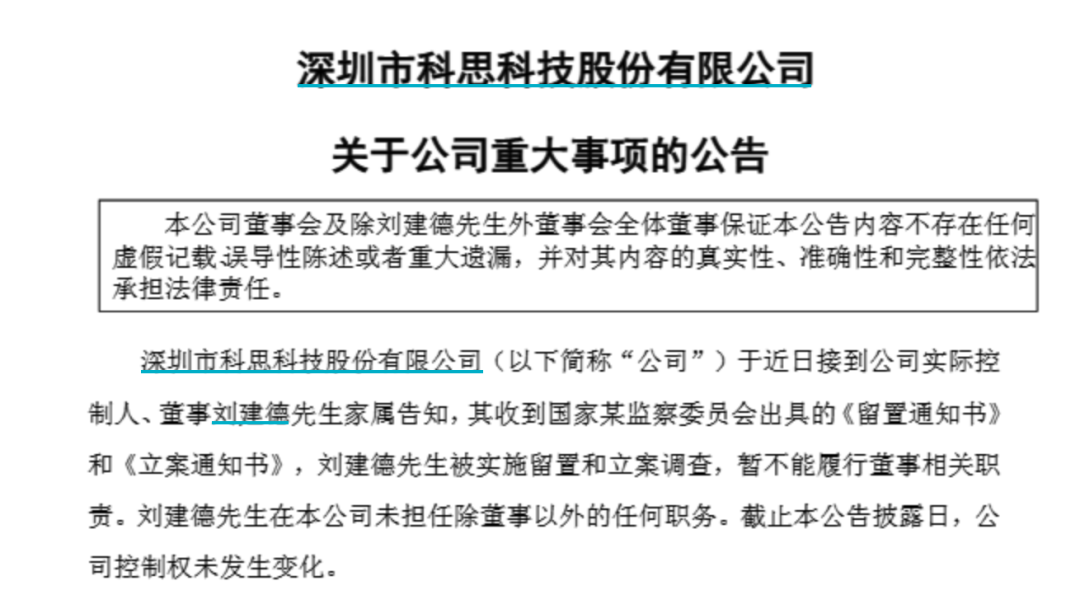
Core Viewpoint - Kesi Technology, referred to as the "Chinese version of Palantir," announced that its actual controller and director, Liu Jiande, is under investigation by the National Supervisory Commission, but this has not affected the company's control or operations [1][3]. Company Operations - The daily management of Kesi Technology is handled by senior management, and the company has a robust governance structure and internal control mechanisms in place. The board of directors is functioning normally, and other directors and senior management are fulfilling their duties without disruption. The company's production and operational conditions remain stable, and its financial accounts are normal [3]. - Kesi Technology specializes in command and control information processing equipment and systems, software radar information processing equipment and systems, and intelligent unmanned devices and systems [3]. Financial Performance - Kesi Technology experienced a significant decline in revenue, dropping to 233 million yuan in 2022, a year-on-year decrease of 62.20%. Over the past three years, the company's revenue has remained between 200 million and 250 million yuan, with a total net loss exceeding 700 million yuan [5]. - The company's stock price has also fallen from a peak of 117 yuan per share at the time of its IPO to around 14 yuan per share [5]. Management Changes - Since June 2023, Kesi Technology has undergone a significant management reshuffle, which has sparked investor interest. Liu Zonglin has been appointed as the chairman and non-independent director, while Shen Jian has been appointed as the general manager [6]. - Following the management changes, Kesi Technology's stock price has doubled in just 19 trading days [7]. Market Position - Kesi Technology is strategically positioned in the unmanned equipment cluster combat field and has advantages in AI command and control systems and networked combat [4].