
全国统一电力市场

Search documents
中电联党委书记、常务副理事长杨昆:电力资源的“全国一盘棋”,下了这几招“大棋”
Zhong Guo Dian Li Bao· 2025-09-01 00:45
Core Viewpoint - The construction of a unified national electricity market in China is progressing towards a high-quality development model, with significant achievements expected by 2025, marking a historic leap in electricity market reform [2][3]. Group 1: Historical Achievements and Current Status - Since the initiation of the new round of electricity system reform, the market-based trading volume of electricity has been increasing annually, with 2.95 trillion kWh traded in the first half of 2025, accounting for approximately 61% of total electricity consumption [3]. - It is projected that the total market-based trading volume will exceed 6 trillion kWh in 2025, representing about two-thirds of total electricity consumption and three-quarters of national sales volume, indicating a doubling of trading volume compared to the end of the 13th Five-Year Plan [3]. Group 2: Market Structure and Rules - A foundational rule system for the national unified electricity market has been established, including the "1+N" basic rule framework, which supports various trading mechanisms and ensures a structured market operation [4]. - The overall framework for a "unified market and collaborative operation" has been largely completed, enhancing the market's role in supply assurance, price stability, and resource allocation across regions [4]. Group 3: Market Functionality and Trading Mechanisms - The electricity market's functionality is continuously improving, with a multi-variety and multi-functional trading system beginning to take shape, where long-term trading mechanisms account for over 90% of market transactions [5]. - Provincial-level electricity spot markets have accelerated development, with several provinces transitioning to formal operations, indicating a positive trend in market expansion [5]. Group 4: Pricing Mechanisms and Reforms - The electricity pricing mechanism has been refined, with a comprehensive reform of grid connection prices and the establishment of a sustainable pricing mechanism for renewable energy, allowing for competitive participation in the market [6]. - A capacity guarantee mechanism has been established to enhance system security and supply capacity, marking a significant adjustment in the electricity pricing structure [7]. Group 5: Green Energy and Low-Carbon Transition - A green electricity trading system is being developed, with a robust policy foundation for environmental value realization, including the issuance of green electricity certificates [8]. - The scale of green electricity and certificate trading has seen exponential growth, with over 450 billion kWh of green electricity traded by mid-2025, reflecting a strong momentum for renewable energy development [8]. Group 6: Future Development Goals - The national unified electricity market aims to achieve "five unifications and one openness," focusing on standardizing market rules and enhancing interconnectivity among various market entities [10]. - A comprehensive market transaction mechanism and pricing system will be constructed to adapt to the new electricity system, ensuring that market signals effectively guide development and investment [13].
能源高质量发展专家谈丨电力资源的“全国一盘棋”,下了这几招“大棋”
国家能源局· 2025-08-29 10:20
Core Viewpoint - The article emphasizes the significant progress made in establishing a unified national electricity market in China, which is expected to be fully operational by 2025, enhancing the quality and efficiency of electricity development [2]. Group 1: Historical Progress and Achievements - Since the initiation of the new round of electricity system reform, the market-based trading volume of electricity has been increasing annually, with 2.95 trillion kilowatt-hours traded in the first half of 2025, accounting for approximately 61% of total electricity consumption [3]. - It is projected that the total market-based trading volume will exceed 6 trillion kilowatt-hours in 2025, representing about two-thirds of total electricity consumption and three-quarters of national sales volume, marking a doubling of trading volume compared to the end of the 13th Five-Year Plan [3]. Group 2: Establishment of Basic Rules and Framework - A foundational rule system for the national unified electricity market has been established, including the "1+N" basic rule framework, which consists of the Basic Rules for Electricity Market Operation and various trading rules [4]. - The overall structure of the electricity market has been formed, significantly enhancing its role in ensuring supply, stabilizing prices, and promoting consumption [4]. Group 3: Market Functionality and Trading Mechanisms - The electricity market's functionality has been continuously enhanced, with a multi-variety and multi-functional trading system beginning to take shape, where long-term trading mechanisms have been normalized, accounting for over 90% of market trading volume [5]. - Provincial-level electricity spot markets have accelerated development, with several provinces transitioning to formal operations, indicating a positive trend in market expansion [5]. Group 4: Price Mechanism and Resource Allocation - The electricity pricing mechanism has been progressively improved, with the complete liberalization of coal-fired power generation prices and the establishment of a sustainable pricing mechanism for renewable energy by 2025 [6][7]. - The reform of the grid transmission and distribution pricing system has been ongoing, laying the groundwork for market-based trading [7]. Group 5: Green Electricity Trading and Low-Carbon Transition - A green electricity trading system has been preliminarily established, with significant growth in green electricity transactions and certificates, totaling over 450 billion kilowatt-hours traded by mid-2025 [8]. - The establishment of a market mechanism for green certificates is expected to drive high-quality development of renewable energy and meet the demand for green energy consumption [8]. Group 6: Future Development Goals - The article outlines strategic goals for the unified electricity market, focusing on achieving "five unifications and one openness," which includes unifying basic rules and enhancing market infrastructure [10]. - A comprehensive market trading mechanism and pricing system that adapts to the new electricity system will be constructed, emphasizing the importance of market signals in guiding electricity development and investment [13].


中国广核: 2025年半年度报告摘要
Zheng Quan Zhi Xing· 2025-08-27 15:10
Core Viewpoint - China General Nuclear Power Corporation (CGN) reported a decline in net profit and earnings per share for the first half of 2025, while maintaining a stable operational performance in its nuclear power plants [1][5][6] Financial Performance - Operating revenue for the first half of 2025 was approximately CNY 39.17 billion, a decrease of 0.53% compared to the same period last year [1] - Net profit attributable to shareholders decreased by 16.31% to CNY 560.93 million, with a basic earnings per share of CNY 0.118 [1][5] - The weighted average return on equity fell to 4.88%, down 1.19 percentage points from the previous year [1] Operational Highlights - The company managed 28 operational units and 20 units under construction, accounting for 44.46% of the national total installed nuclear power capacity [5] - Operational nuclear units achieved a total electricity generation of 113.36 billion kWh, a 6.93% increase year-on-year [5][6] - The company completed 10 major maintenance outages during the reporting period, with 91.07% of performance indicators in the top quartile globally [5] Market Environment - The demand for electricity continues to grow, supported by national policies aimed at energy security and carbon peak targets by 2030 [4] - The national electricity market is undergoing reforms, with a unified market system being established, which is expected to enhance market dynamics [4] Strategic Initiatives - The company is focusing on enhancing the safety and efficiency of its nuclear power operations while exploring new market opportunities [7][8] - Plans include the development of clean energy projects and the integration of nuclear energy for heating purposes, contributing to environmental benefits [7][8] - The company aims to optimize its capital structure through the issuance of convertible bonds and strategic acquisitions [9][10]

“十四五”粤港澳大湾区首个抽蓄工程首台投产
Zhong Guo Dian Li Bao· 2025-08-27 07:23
Core Viewpoint - The successful commissioning of the first unit of the Meizhou Pumped Storage Power Station Phase II marks a significant milestone in China's pumped storage sector, enabling immediate market participation and enhancing the regulation capacity of the new power system [1][9]. Group 1: Project Overview - The Meizhou Pumped Storage Power Station Phase II was approved in December 2021 and commenced construction in September 2022, with the first unit now operational [1]. - The total investment for the Meizhou Pumped Storage Power Station is approximately 12 billion yuan, making it the largest pumped storage project in the Guangdong-Hong Kong-Macao Greater Bay Area [13]. Group 2: Technical Specifications - The newly commissioned unit has a total weight of about 2,000 tons and a height exceeding 30 meters, equivalent to a 10-story building [3]. - The unit can convert 300,000 cubic meters of water into 300,000 kilowatt-hours of clean electricity per hour, meeting the daily electricity needs of 50,000 households [2]. Group 3: Market Participation and Performance - The Meizhou Pumped Storage Power Station has already participated in the electricity market, trading a total of 1.74 billion kilowatt-hours and responding to market demands over 4,200 times, with a 37% increase in daily activation frequency compared to before market entry [6][9]. - The station's market trading capacity has reached 1.5 million kilowatts, making it the leader in the national pumped storage market [8][9]. Group 4: Environmental and Regulatory Impact - The pumped storage power station is designed to support the integration of renewable energy sources like wind and solar, acting as a "battery" for the new power system [10]. - The project adheres to strict environmental standards, achieving zero wastewater discharge and implementing advanced technologies for noise control and dust suppression [11]. Group 5: Future Prospects - Upon completion of the remaining three units, the total installed capacity of the Meizhou Pumped Storage Power Station will reach 2.4 million kilowatts, with an annual clean energy consumption capacity of approximately 7.2 billion kilowatt-hours [13].


能源安全有效保障 绿色转型举世瞩目
国家能源局· 2025-08-27 07:11
Core Viewpoint - During the "14th Five-Year Plan" period, China's energy self-sufficiency rate has remained above 80%, ensuring energy security for over 1.4 billion people and positioning the country as a significant driver of global energy transition [2][4]. Group 1: Energy Security and Self-Sufficiency - China's energy self-sufficiency rate has consistently been above 80% during the "14th Five-Year Plan," indicating a strong foundation for energy security [5][6]. - The country has enhanced its coal and oil supply capabilities, with over 90% of the increase in energy consumption being met by domestic production [6]. - A comprehensive energy supply and pricing mechanism has been established, ensuring stable operations even during extreme weather events [6]. Group 2: Development of Renewable Energy - The development of renewable energy has accelerated, with wind and solar power installations reaching a cumulative capacity of 168 million kilowatts by July 2023, representing an annual growth rate of 28% [7]. - The share of wind and solar power in total electricity consumption has increased from 9.7% in 2020 to 18.6% in 2024, with renewable energy accounting for nearly a quarter of total electricity consumption in the first half of 2023 [7]. - China continues to lead globally in wind and solar power installations, with its combined capacity accounting for 47% of the world's total and 63% of new installations [7]. Group 3: National Unified Electricity Market - Significant progress has been made in constructing a national unified electricity market, with a comprehensive set of trading rules established [8]. - The volume of electricity traded has more than doubled from 10.7 trillion kilowatt-hours in the "13th Five-Year Plan" to 23.8 trillion kilowatt-hours, maintaining a stable market share of over 60% of total electricity consumption for four consecutive years [8]. - Future efforts will focus on optimizing electricity supply and supporting the development of the real economy and emerging industries [8].
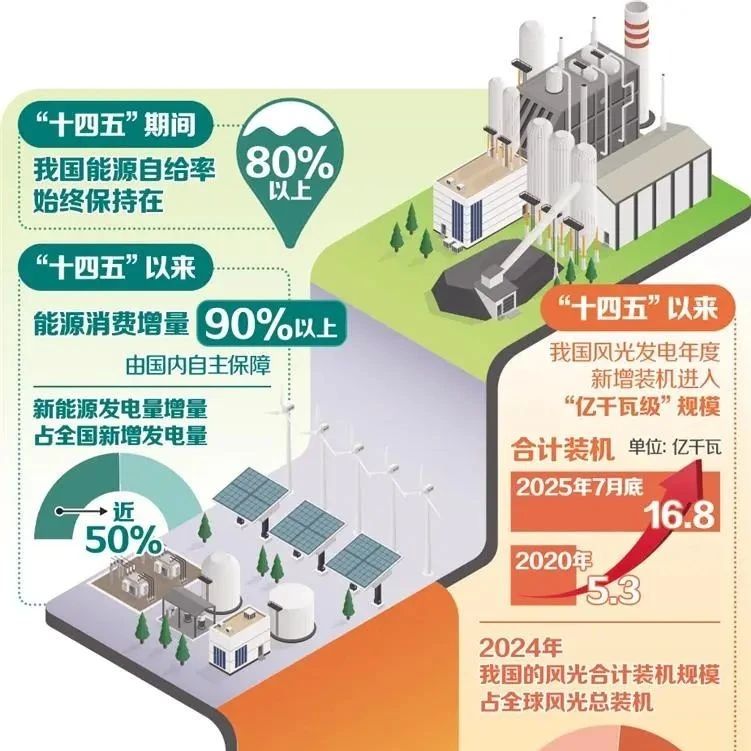
能源安全有效保障 绿色转型举世瞩目
Jing Ji Ri Bao· 2025-08-27 06:05
Core Viewpoint - China's energy sector has achieved significant breakthroughs and historical accomplishments during the "14th Five-Year Plan" period, positioning the country as a key player in global energy transition [1] Group 1: Energy Production and Supply - China's energy production accounts for over one-fifth of the global total, with the largest renewable energy system and electric vehicle charging network in the world [1] - The energy self-sufficiency rate has remained above 80% during the "14th Five-Year Plan," indicating strong domestic supply capabilities [2] - The energy consumption increased by 9.8 million tons of standard coal over the first four years of the "14th Five-Year Plan," with over 90% of this increase supported by domestic resources [2] Group 2: Renewable Energy Development - The installed capacity of wind and solar power has reached 168 million kilowatts by July 2023, with an annual growth rate of 28%, accounting for 80% of the new power installations during the "14th Five-Year Plan" [3] - The share of wind and solar power in total electricity consumption increased from 9.7% in 2020 to 18.6% in 2024, with wind and solar generation reaching 1.15 trillion kilowatt-hours in the first half of this year [3] - China's wind power capacity has ranked first globally for 15 consecutive years, and solar power capacity has held the top position for 10 years, with a combined share of 47% of global installations expected in 2024 [3] Group 3: Electricity Market Development - Significant progress has been made in establishing a unified national electricity market during the "14th Five-Year Plan," with a comprehensive set of market rules in place [4][5] - The total electricity traded in the market has increased from 10.7 trillion kilowatt-hours in the "13th Five-Year Plan" to 23.8 trillion kilowatt-hours, representing a doubling of market activity [5] - The proportion of market transactions in total electricity consumption has stabilized above 60% for four consecutive years, up from 40% in 2020 [5]
新华社丨向“绿”向“新”,数说“十四五”能源发展新突破
国家能源局· 2025-08-27 02:06
Core Viewpoint - The article highlights the significant progress and historical achievements in China's energy sector since the implementation of the "14th Five-Year Plan," emphasizing the completion of key energy production capacity and non-fossil energy targets [4]. Group 1: Energy Supply and Production - The energy supply in China is becoming more robust, with a projected national electricity generation exceeding 10 trillion kilowatt-hours by 2024, accounting for one-third of global production [5]. - The total energy production is estimated to be around 5 billion tons of standard coal, representing over one-fifth of global energy production [5]. - More than 90% of the increase in domestic energy consumption is expected to come from domestic sources [5]. Group 2: Renewable Energy Development - Nearly 50% of the new electricity generation capacity in the country is attributed to renewable energy sources [6]. - The total supply of non-fossil energy is projected to grow by nearly 50% [6]. - China has established the world's largest electric vehicle charging network, with two charging stations for every five electric vehicles [6]. - The share of renewable energy generation capacity has increased from 40% to approximately 60% [6]. Group 3: Technological Innovation and Market Growth - China holds over 40% of global renewable energy patents, with continuous improvements in solar conversion efficiency and offshore wind turbine capacity [7]. - By mid-2025, the installed capacity of new energy storage in China is expected to reach approximately 95 million kilowatts, a nearly 30-fold increase over five years [8]. - The hydrogen production and consumption scale in China is projected to exceed 36 million tons by 2024, ranking first in the world [8]. Group 4: Market Dynamics - The volume of electricity traded in the market has increased from 10.7 trillion kilowatt-hours during the "13th Five-Year Plan" to 23.8 trillion kilowatt-hours [10]. - The number of registered market participants in the electricity sector has reached 970,000, five times that of 2020 [10]. - A significant portion of photovoltaic equipment manufacturers and over 60% of wind turbine manufacturers are private enterprises [10].

能源安全有效保障 绿色转型举世瞩目 “十四五”期间我国能源自给率保持在80%以上
Jing Ji Ri Bao· 2025-08-26 21:57
能源生产总量占比超全球五分之一、构建起全球最大可再生能源体系、建成全球最大的电动汽车充电网 络、新能源专利数占全球四成以上、光伏转换效率和海上风电单机容量不断刷新世界纪录……在国务院 新闻办26日举行的"高质量完成'十四五'规划"系列主题新闻发布会上,国家能源局交出了一份我国能源 事业的亮眼成绩单。 国家能源局局长王宏志表示,"十四五"以来,我国能源事业取得了突破性进展和历史性成就,"十四 五"规划《纲要》提出的能源综合生产能力和非化石能源占比等主要指标将如期完成,14亿多人的能源 安全得到有效保障,绿色低碳发展举世瞩目,我国成为世界能源转型的重要推动者。 能源自主供应"基本盘"更稳固 今年夏季,我国电力负荷不断创新高,全国经历了大范围高温、暴雨洪涝和台风等极端天气,但电力基 本保持平稳运行。"十四五"期间我国能源自给率始终保持在80%以上,这80%意味着什么? 自主保障能力强。"十四五"前4年,受新兴产业发展等因素带动,我国能源消费量累计增长9.8亿吨标准 煤。"十四五"以来,我国强化煤炭兜底保障基础、深挖国内油气增储上产潜力、加快可再生能源替代, 实现了消费增量90%以上由国内自主保障。尤其新能源发挥了重 ...
国家能源局:能源体制改革进入快车道
Qi Huo Ri Bao Wang· 2025-08-26 20:51
Core Insights - The article highlights the significant progress made in China's energy sector since the implementation of the "14th Five-Year Plan," focusing on market-oriented reforms that enhance the vitality and dynamism of the energy market [1][2][3]. Group 1: Energy Price Mechanism - The energy price formation mechanism has been rapidly improved, with coal, new energy, and other sources entering the market, allowing most electricity prices to be determined by market competition [1]. - The pricing for all users, except residential and agricultural electricity, has become fully market-oriented, transforming electricity into a freely tradable commodity [1]. Group 2: Energy Market System - A multi-layered, multi-category, and multi-functional national unified electricity market system has been established, covering medium to long-term and ancillary service market transactions [1][3]. - The spot market is being rapidly rolled out across the country, with seven regions already operational, creating the world's largest "electricity supermarket" [1][3]. Group 3: Innovation in Energy Industry - The National Energy Administration has strengthened top-level design and increased policy supply to promote new business entities, virtual power plants, and green electricity connections [2]. - The total scale of virtual power plants has exceeded 35 million kilowatts, equivalent to the installed capacity of one and a half Three Gorges power stations [2]. Group 4: National Unified Electricity Market - The construction of a national unified electricity market has made substantial progress, establishing a diverse and functional market structure [3]. - A comprehensive "1+6" basic rule system has been developed to address previous fragmentation and regional barriers, ensuring transparency and fair competition in the market [3]. Group 5: Market Scale and Participation - The trading volume of electricity in the market has increased from 10.7 trillion kilowatt-hours during the "13th Five-Year Plan" to 23.8 trillion kilowatt-hours, more than doubling [4]. - A diverse market structure has emerged, with various stakeholders, including coal, new energy, gas, nuclear, and hydropower actively participating [4].
建成全球规模最大“电力超市”,“十五五”拓展新能源消纳空间
2 1 Shi Ji Jing Ji Bao Dao· 2025-08-26 13:19
Core Viewpoint - The article discusses the achievements and ongoing reforms in China's energy sector during the "14th Five-Year Plan" period, emphasizing the establishment of a unified national electricity market and the promotion of high-quality energy development. Group 1: Energy Market Reforms - The energy pricing mechanism has been rapidly improved, allowing coal, renewable energy, and other sources to enter the market, with most electricity prices determined by market competition [1][2] - A multi-layered, multi-category, and multi-functional national unified electricity market system has been established, with full coverage of medium and long-term trading and auxiliary service markets [2][3] - The energy industry's ecosystem is innovating rapidly, with policies supporting new business entities and virtual power plants, leading to a total scale of over 35 million kilowatts [3][4] Group 2: Market Structure and Growth - The national unified electricity market rules have been largely completed, addressing previous fragmentation and ensuring transparency and fair competition [4][5] - The market transaction volume has significantly increased from 10.7 trillion kilowatt-hours in the "13th Five-Year Plan" to 23.8 trillion kilowatt-hours, with market transactions now accounting for over 60% of total electricity consumption [4][5] - The number of market participants has surged, with various energy sources actively entering the market, creating a diverse and orderly market structure [4][5] Group 3: Future Directions for Energy Consumption - The National Energy Administration plans to enhance the adaptability of the power system to renewable energy, focusing on stabilizing wind and solar power generation [6][7] - The construction of a unified electricity market will continue, with mechanisms tailored to the characteristics of renewable energy to support higher market participation [7] - Policies will be advanced to improve the efficiency of renewable energy utilization, including the development of green hydrogen applications and expanding non-electric utilization pathways [7]