抢出口

Search documents
“抢出口”还有多少空间?(国金宏观宋雪涛)
雪涛宏观笔记· 2025-03-09 14:29
Core Viewpoint - The article discusses the current state of China's export market, particularly focusing on the "rush to export" phenomenon and its potential continuation or conclusion in light of recent trade dynamics and economic conditions [2][3][4]. Export Performance - In January-February, China's dollar-denominated exports grew by 2.3% year-on-year, a decline from 9.9% in the previous quarter, primarily due to temporary factors such as fewer working days and the early timing of the Spring Festival [2][3]. - Exports to Russia, South Korea, and Africa decreased by 10.9%, 2.6%, and 0.2% respectively, while exports to the U.S. and transshipment trade remained relatively strong [3]. "Rush to Export" Analysis - The article questions whether the "rush to export" has ended and explores its potential duration. Historical context from 2018-2019 indicates that the onset of trade tensions led to significant export activity as U.S. companies sought to stockpile goods [6][11]. - The current "rush to export" is expected to be shorter and less intense than in previous trade conflicts, with an estimated duration of around 6 months due to higher initial inventory levels and rapid implementation of tariffs [11][12]. Inventory Dynamics - The article highlights that the passive inventory replenishment observed in U.S. manufacturers and wholesalers is influenced by the current economic climate, with certain sectors like electrical and electronic products showing significant room for inventory buildup [12][13]. - The inventory-to-sales ratios for various durable goods indicate that while some sectors are experiencing high sales growth, their inventory levels are relatively low, suggesting ongoing demand for exports from China [13]. Future Outlook - The article anticipates that China's export growth may rebound after temporary factors subside, with expectations of sustained resilience in export performance through the first half of the year [4][10]. - However, potential risks such as further tariff increases or unexpected downturns in the U.S. economy could impact future export trends [11].

开年挖机销量显著上升——实体经济图谱 2025年第8期【财通宏观 陈兴团队】
陈兴宏观研究· 2025-03-09 07:44
核 心 内 容 月度商品价格预测: 黄金升、铜涨、原油震荡。 内需: 节后服务消费持续降温;商品消费分化,地产新房升,二手落;乘用车走弱。 ①地产销量增速分化。剔除春节效应,42城新房销量增速回升,一二线是主要动力;19城二手房销量增 速所有线级均有回落。 ②节后服务消费热度下降,乐园客流和酒店营收呈现磨底态势,随着天气升温,踏春潮有望带动休闲娱 乐需求回升。 外需: 2月主要经济体制造业PMI多数上升,义乌小商品出口价格抬升,考虑到抢出口和去年基数走低 等因素助力,出口或将回升。本周,特朗普对我国额外再加征10%关税。 生产: 挖机销量大幅上行,行业整体开工率不及去年。 ①用工市场供需逐渐平衡。本周制造业用工量价双双下行,全市场新增招聘帖数有所下降。 ②多数行业开工率仍不及去年。本周样本钢厂产量下行,PTA产业链负荷率下降,不过,水泥价格有所 回升,"抢出口"效应下,三大货运量增速多数上行。 ③二手挖掘机海外出口量增长,带来国内新机替代率大幅提升,1-2月挖掘机销量增速显著回升。 物价: 本周国际金、铜价格回升,原油下降。国内钢铁、煤炭价格回落,水泥续升。 ①本周美联储降息预期抬升,美元走弱共同利好大宗商品 ...

关于“抢出口”的几点思考——1-2月进出口数据点评
一瑜中的· 2025-03-08 12:33
Core Viewpoint - The significant decline in export growth in the first two months of the year is largely influenced by a high base effect from the previous year, with a year-on-year growth of only 2.3% compared to a forecast of 5.9% and a previous month of 10.7% [2][27] - The "export rush" effect is still present, potentially boosting monthly exports by an additional 0.6%-0.8% [4][19] - Future export data may experience increased volatility due to the fading "export rush" effect and the impact of new tariffs, which could lead to a decline in export growth by 3.6%-3.7% over the next ten months [4][24][26] Group 1: Export Analysis - The year-on-year decline in exports is significantly affected by a high base from the previous year, with an estimated impact of around 10% [7][14] - The "export rush" effect is estimated to have contributed an additional 3.4%-5% to the export growth, with a monthly average of 1.1%-1.7% [15][19] - The average month-on-month export growth for January-February is approximately -19%, aligning with historical averages [27] Group 2: Import Analysis - Imports have shown a year-on-year decline of 8.4%, significantly below the expected 1% growth, indicating weak domestic demand [2][5] - The month-on-month average for imports in January-February is approximately 2.5%-2.9% lower than historical averages, suggesting a potential decline in the "import rush" effect [5][27] Group 3: Regional Export Performance - Exports to the United States, ASEAN, Latin America, India, and Hong Kong have shown strong performance, contributing a total of 2.3 percentage points to overall export growth [32] - Exports to Africa and Russia have declined significantly, negatively impacting overall export performance [32] Group 4: Product-Specific Export Trends - Labor-intensive products have seen a significant decline in exports, while exports of computers and integrated circuits have remained strong [34] - The export of labor-intensive products decreased by 9.2%, while exports of automatic data processing equipment and integrated circuits increased by 10.5% and 11.9%, respectively [34][35]

“春节调整”后的出口成色?——1-2月外贸数据点评
申万宏源宏观· 2025-03-08 06:58
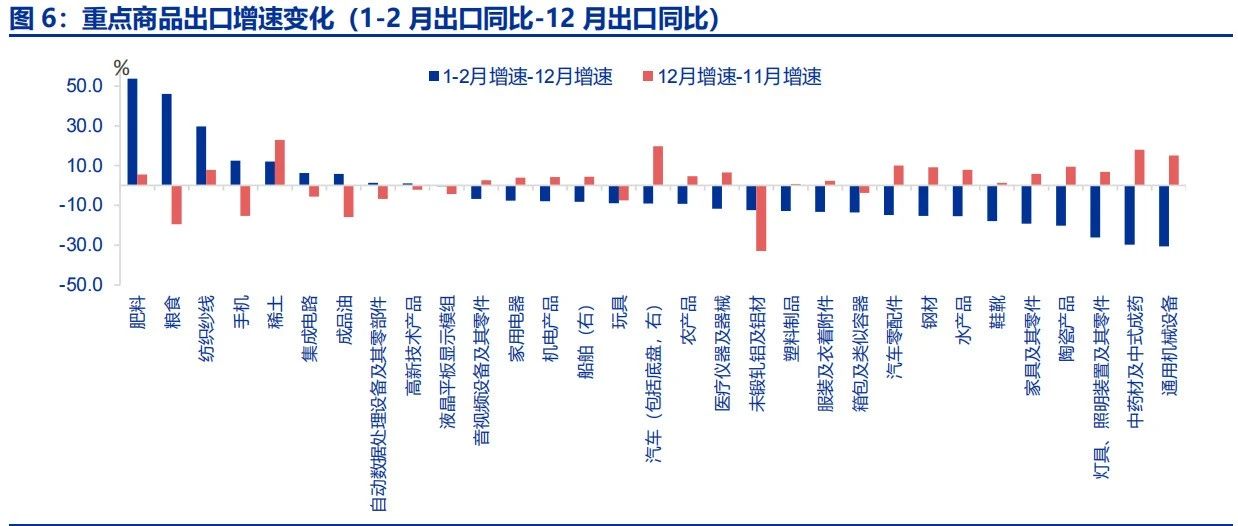
Core Viewpoint - The significant decline in exports in January-February is primarily attributed to the end of the "export rush" rather than weak external demand, with the Spring Festival misalignment having a lesser impact [2][10][11] Export Data Analysis - January-February exports decreased by 8.4 percentage points compared to December, dropping to 2.3%, partly due to the Spring Festival misalignment, which is estimated to have reduced the growth rate by approximately 1.5 percentage points [2][10][11] - The end of the "export rush" is more pronounced, particularly in exports to the U.S., which fell by 12.5 percentage points to 3.2%, and to emerging markets, indicating a slowdown in the restructuring of overseas supply chains [2][11][12] - Specific categories that experienced significant declines include high-dependence goods like footwear, which saw a drop of 18.0 percentage points to -18.7%, and general machinery, which fell by 30.6 percentage points to -1.6% [3][12][16] Import Data Analysis - Imports in January-February saw a substantial decline of 9.4 percentage points to -8.4%, primarily due to a drop in both processing trade-related electromechanical products and bulk commodities reflecting weak domestic demand [7][18] - Electromechanical product imports rebounded slightly but were still negatively impacted by integrated circuits, which fell by 7.3 percentage points to 2.3% [18] Future Outlook - The Spring Festival misalignment is expected to continue affecting year-on-year growth rates, with a potential rebound in March exports estimated to increase by 6.6 percentage points due to this effect, outweighing the negative impacts from the end of the "export rush" and tariff imposition [4][14] - However, actual exports in March may still face significant pressure when excluding the Spring Festival effect [5][14] Structural Changes in Exports - There is a noticeable divergence in export performance across different categories, with consumer electronics like mobile phones and integrated circuits showing recovery, while textiles and furniture exports have significantly declined [15][16] - Capital goods exports have generally decreased, with notable declines in general machinery and automotive parts, while some intermediate goods like fertilizers have shown a rebound [16]