绿色产业

Search documents
让民间资本有得投、投得好 一系列举措即将落地
Zhong Guo Jing Ji Wang· 2025-09-19 00:37
Group 1 - From January to August, private fixed asset investment decreased by 2.3% year-on-year, with the decline rate expanding compared to the previous seven months [1] - The decline in private investment growth is primarily due to a 16.7% drop in real estate development investment, which lowered the overall private investment growth rate by 4.5 percentage points [1] - Excluding real estate development, private project investment grew by 3% year-on-year, indicating strong investment willingness and capability in the real economy [1] Group 2 - Private investment in the manufacturing sector increased by 4.2% in the first eight months, with over half of the 31 manufacturing categories achieving double-digit growth [1] - The automotive manufacturing sector saw a remarkable investment growth rate of 22.6%, while investment in railway, shipbuilding, aerospace, and other transportation equipment manufacturing grew by 16.2% [1] - Private capital is actively aligning with industrial upgrading trends, increasing innovation investments, and integrating into the modern industrial system [1] Group 3 - Private capital participation in major infrastructure construction is expanding, with a 7.5% year-on-year increase in private investment in infrastructure [2] - The accommodation and catering industry experienced a 17% growth in private investment, while the cultural, sports, and entertainment sectors saw a 7% increase, reflecting the trend of service consumption expansion and quality improvement [2] - Despite challenges faced by some private enterprises, the long-term positive fundamentals of the economy remain unchanged, providing ample space for private investment [2] Group 4 - Future trends in private investment include a shift towards high-quality development sectors, increased capital flow into new productivity, emerging services, and new infrastructure [3] - Investment models are becoming more diversified, with improved government and social capital cooperation, and the normalization of infrastructure REITs to further stimulate private investment [3] - The investment ecosystem is evolving with large private enterprises leading innovation and small and medium-sized enterprises focusing on niche markets, creating complementary advantages [3] Group 5 - To further stimulate private investment, coordinated efforts are needed across multiple dimensions to ensure that private capital can invest effectively and efficiently [3] - The State Council's recent meeting emphasized addressing key concerns of enterprises and implementing practical measures to expand access and enhance support [3] - The National Development and Reform Commission is working on policies to promote private investment development and establish mechanisms for private participation in major national projects [3]
中经评论:进一步激发民间投资活力
Jing Ji Ri Bao· 2025-09-19 00:05
Group 1 - From January to August, private fixed asset investment decreased by 2.3% year-on-year, with the decline rate expanding compared to the previous seven months [1] - The decline in private investment growth is primarily due to a 16.7% drop in real estate development investment, which reduced the overall private investment growth rate by 4.5 percentage points [1] - Excluding real estate development investment, private project investment grew by 3% year-on-year, indicating strong investment willingness and capability in the real economy [1] Group 2 - Private investment in the manufacturing sector showed significant growth, with a 4.2% increase in the first eight months, and over half of the 31 manufacturing categories achieving double-digit growth [2] - The automotive manufacturing sector saw a remarkable investment growth rate of 22.6%, while the railway, shipbuilding, aerospace, and other transportation equipment manufacturing sectors grew by 16.2% [1][2] - Private capital is actively aligning with industrial upgrading trends, increasing innovation investments, and integrating into the modernization of the industrial system [1] Group 3 - Private capital participation in major infrastructure construction is expanding, with a 7.5% year-on-year increase in private infrastructure investment in the first eight months [2] - The accommodation and catering industry saw a 17% increase in private investment, while the cultural, sports, and entertainment sectors experienced a 7% growth, reflecting the trend of service consumption expansion and quality improvement [2] - Despite challenges faced by some private enterprises, the long-term positive fundamentals of the economy remain unchanged, providing ample space for private investment [2] Group 4 - Future trends in private investment include a shift towards high-quality development sectors, increased capital flow into new productive forces, emerging services, and new infrastructure [3] - Investment models are becoming more diversified, with improved government and social capital cooperation, and the normalization of infrastructure REITs to further stimulate private investment [3] - The investment ecosystem is evolving with large private enterprises leading innovation and small and medium-sized enterprises focusing on niche markets, creating complementary advantages [3]
进一步激发民间投资活力
Jing Ji Ri Bao· 2025-09-18 21:59
Group 1 - The core viewpoint is that China's private investment is undergoing a structural transformation towards high-quality development, with more private capital flowing into new productive forces, emerging services, and new infrastructure [1][3] - From January to August, private fixed asset investment decreased by 2.3% year-on-year, with the decline rate expanding compared to the previous seven months, indicating pressure on overall data [1][2] - Despite the overall decline, the structure of private investment shows positive changes, reflecting strong resilience and playing a crucial role in stabilizing growth, adjusting structure, and ensuring employment [1][2] Group 2 - The decline in private investment growth is primarily influenced by a 16.7% drop in real estate development investment, which reduced the overall private investment growth rate by 4.5 percentage points [2] - Excluding real estate development, private project investment grew by 3% year-on-year, indicating strong investment willingness and capability in the real economy [2] - Manufacturing sector performance is notable, with private investment in manufacturing growing by 4.2%, and over half of the 31 manufacturing categories achieving double-digit growth, particularly in the automotive manufacturing sector with a 22.6% increase [2] Group 3 - Private capital's participation in major infrastructure construction is expanding, with private investment in infrastructure growing by 7.5% year-on-year [2] - The service sector is also a hotspot for investment, with private investment in accommodation and catering growing by 17%, and cultural, sports, and entertainment sectors increasing by 7% [2] - These trends reflect the confidence of private capital in economic development and the continuous optimization of the investment environment [2] Group 4 - Despite challenges faced by some private enterprises, the long-term positive fundamentals of the economy remain unchanged, providing broad space for private investment [3] - Private enterprises are actively engaging in emerging industries such as green industries, artificial intelligence, and embodied robotics, showcasing strong innovative vitality [3] - Future trends in private investment include a shift towards high-quality development fields, diversification of investment models, and increased collaboration among investment entities [3][4] Group 5 - To further stimulate private investment, coordinated efforts are needed across multiple dimensions, ensuring that private capital can invest effectively and exit smoothly [4] - The State Council's recent meeting emphasized addressing key issues for enterprises, implementing practical measures to expand access, unblock bottlenecks, and strengthen guarantees [4] - The National Development and Reform Commission is working on policies to promote private investment development and establish mechanisms for private enterprises to participate in major national projects [4]
美新科技(301588) - 301588美新科技投资者关系管理信息20250918
2025-09-18 14:54
Group 1: Market Overview and Growth Potential - The global plastic-wood market is projected to exceed $12.598 billion by 2030, with a compound annual growth rate (CAGR) of 10.62% [2][3] - Key drivers for growth include environmental benefits, diverse application scenarios, technological advancements, and supportive policies for green industries [3] Group 2: Company Development Strategy - The company aims to leverage the rapid growth of the global plastic-wood market, focusing on overseas markets as a core growth engine [3] - Domestic market strategy involves a "dual brand matrix + full-channel penetration" approach to enhance market influence and share [4] Group 3: Product and Brand Strategy - High-end product "Meixin Chao Yue Mu" targets premium outdoor wood products, while the mid-range brand "Regreen Wei Qing Mu" focuses on cost-effective solutions for the mid-tier market [4][5] - The company is enhancing its product portfolio to cover both high-end and mid-range markets, aiming to meet diverse consumer needs [4] Group 4: Production Capacity and Automation - The company's new environmental plastic-wood profile industrialization project is in the equipment installation phase, expected to increase overall production capacity to 130,000 tons [3] - The company has established a highly automated production system, significantly improving production efficiency and product quality [5] Group 5: Market Position and Competition - China is the largest producer and exporter of plastic-wood composite materials, with significant growth potential in domestic consumption [6][7] - The company views mergers and acquisitions as a strategic means to enhance competitiveness and expand product offerings [8] Group 6: Management and Governance - The management team, led by Chairman Lin Dongrong, is stable and focused on long-term sustainable development [9] - The company has implemented a stock incentive plan to attract and retain key talent, aligning with its long-term strategic goals [10]
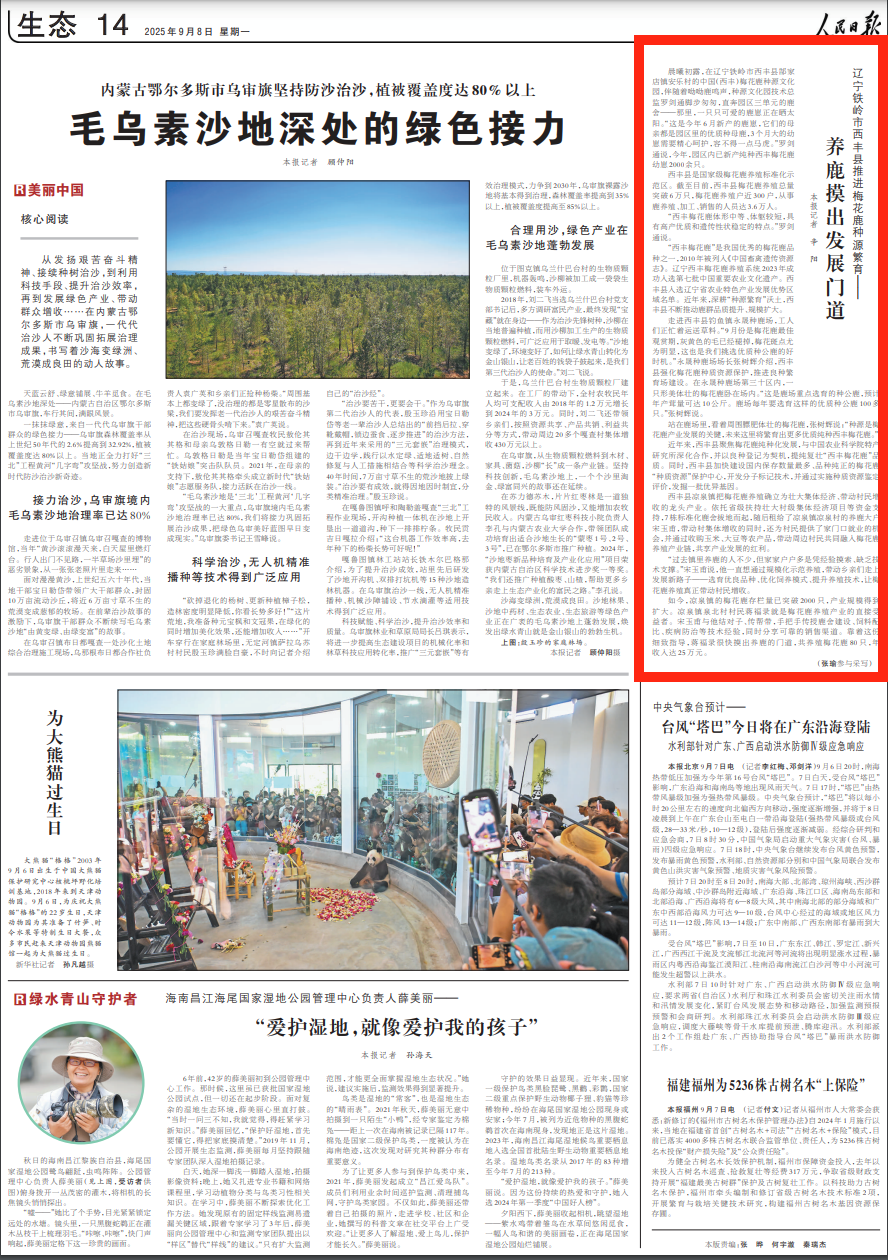
人民日报点赞辽宁铁岭市西丰县推进梅花鹿种源繁育——养鹿摸出发展门道
Ren Min Ri Bao· 2025-09-18 10:37
Group 1: Desertification Control and Ecological Restoration - Inner Mongolia's Uxin Banner has achieved over 80% vegetation coverage in the Mu Us Sandy Land through continuous afforestation and desertification control efforts [1][2] - The local government is committed to the "Three-North" project, aiming to create new achievements in desertification control in the new era [1] - Historical efforts since the 1950s have transformed nearly 60,000 acres of barren land into lush pastures, showcasing a successful narrative of turning deserts into oases [1] Group 2: Technological Innovations in Desertification Control - Advanced technologies such as drone-assisted precision seeding and various mechanized tools have been widely adopted to enhance the efficiency of desertification control [2] - The introduction of scientific methods, including the "three-dimensional" governance model, has led to significant improvements in afforestation practices [2] - The Uxin Banner Forestry and Grassland Bureau has developed 15 types of machinery to improve the mechanization rate of ecological construction projects [2] Group 3: Economic Development through Green Industries - The establishment of biomass pellet factories in the Mu Us Sandy Land has created new income opportunities for local farmers, with annual incomes rising from 12,000 yuan in 2018 to 30,000 yuan by 2024 [3] - The promotion of green industries, including ecological agriculture and tourism, is contributing to the economic upliftment of local communities [3] - The cultivation of drought-resistant crops and the development of a complete industrial chain from biomass to furniture are enhancing the economic landscape of the region [3] Group 4: Deer Farming Industry in Xifeng County - Xifeng County has established itself as a national standardization demonstration area for Sika deer farming, with a total population exceeding 60,000 deer and nearly 300 farming households [14][15] - The county's focus on purebred Sika deer has led to the successful selection of high-quality breeding stock, contributing to the local economy [15][16] - The integration of modern breeding techniques and collective economic projects has enabled local villagers to benefit from the deer farming industry, with some households reporting annual incomes of up to 250,000 yuan [16]

保险资金凸显耐心资本优势
Jing Ji Ri Bao· 2025-09-17 22:06
Core Viewpoint - The insurance industry plays a crucial role in mitigating economic risks, maintaining social stability, and enhancing livelihood security, as evidenced by the performance of listed insurance companies in their semi-annual reports [1] Group 1: Service to the Real Economy and Public Welfare - The life insurance sector is continuously enriching inclusive insurance products and services, providing essential support for healthcare, protection against loss, and elderly care [2] - China Life has engaged in over 200 major illness insurance projects and 70 long-term care insurance projects, while also launching innovative health insurance products [2] - China Pacific Insurance has increased its investment in the second pillar pension management assets to 678.3 billion yuan, a 5.1% increase from the beginning of the year [2] Group 2: Technology and Green Investments - China Pacific Insurance has increased its technology investment balance to 119.7 billion yuan, while New China Life has established a venture capital fund focused on new infrastructure and strategic emerging industries [3] - China Life has made significant investments in green sectors, including a major IPO in the renewable energy sector, while China Pacific has developed a green investment management system [3] Group 3: Market Stability through Investment - Several listed insurance companies have actively responded to calls for insurance capital to enter the market, enhancing equity allocation and investment capabilities [4] - New China Life has optimized its asset structure and participated in long-term capital market pilot reforms, establishing funds focused on high-quality listed companies [4] Group 4: A-share Market Investment Growth - China Insurance has increased its A-share investment assets by 26.1% by mid-year, with a focus on long-term investment value and stable dividend returns [5] Group 5: Investment Strategy for the Second Half of the Year - China Life remains optimistic about the A-share market, focusing on sectors such as technology innovation and advanced manufacturing for investment opportunities [6] - The company plans to maintain a flexible allocation strategy in fixed income while optimizing equity allocation towards high-dividend stocks [6] Group 6: Cost Reduction and Risk Management - The insurance industry is optimizing product structures and accelerating the development of floating yield dividend insurance products to mitigate interest rate risk [7] - New China Life has established a leadership group to promote the transformation of dividend insurance, achieving significant results in premium growth [8] Group 7: Asset-Liability Management - New China Life is enhancing its asset-liability matching capabilities by diversifying its fixed income portfolio and reducing reinvestment risks [9] - China Life has successfully narrowed the effective duration gap of its new business to 1.5 years, demonstrating effective interest rate risk management [9][10]



2025金砖国家工业创新大赛颁奖典礼在厦门举行
Zhong Guo Xin Wen Wang· 2025-09-16 09:08
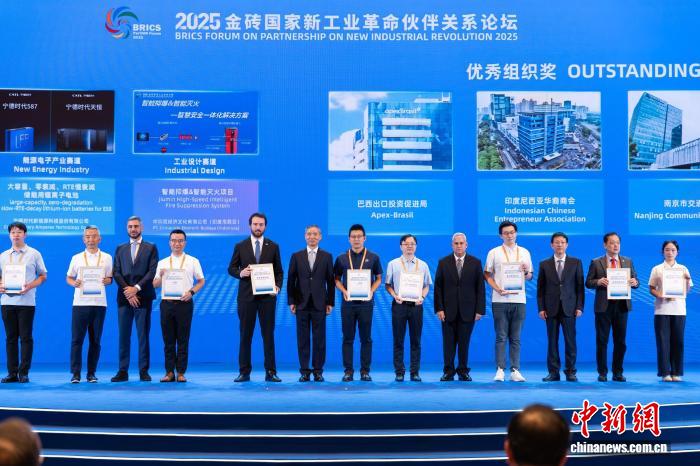
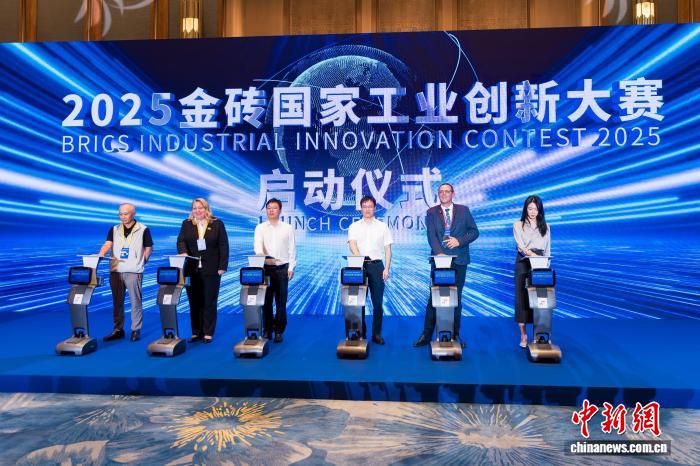
Group 1 - The 2025 BRICS Industrial Innovation Competition award ceremony was held in Xiamen, focusing on "releasing the potential of BRICS cooperation for inclusive and sustainable industrialization" [1][3] - A total of 1,396 projects participated in the competition, with 150 projects reaching the finals, and 30 projects awarded [1][3] - The awarded projects will be included in the "BRICS Industrial Innovation Cooperation Project Database" and will receive one-on-one planning services from financing institutions [1] Group 2 - The competition featured five tracks, including artificial intelligence, green industries, and low-altitude equipment industries [1] - The first prize was awarded to five projects, with ten receiving second prizes and fifteen receiving third prizes [1][3] - The event aims to accelerate the construction of the BRICS new industrial revolution partnership and strengthen talent cultivation and capacity building in the new industrial revolution field [3]
国家统计局:扣除房地产开发投资后,民间投资基本稳定
Xin Jing Bao· 2025-09-15 05:47
Core Viewpoint - The recent decline in private investment in China is primarily influenced by changes in the international environment and adjustments in the real estate market, although private project investment remains stable when excluding real estate development [1][2]. Group 1: Private Investment Trends - Private fixed asset investment has decreased by 2.3% year-on-year from January to August, with a continuous decline over the past three months [1]. - Real estate development investment, which constitutes a significant portion of private investment, has dropped by 16.7%, pulling down the overall private investment growth rate by 4.5 percentage points [1]. Group 2: Sector Performance - Excluding real estate, private investment in manufacturing and innovation sectors has shown positive growth, with manufacturing investment increasing by 4.2% year-on-year, accounting for 40.6% of total private investment [2]. - The automotive manufacturing sector has experienced a notable investment growth rate of 22.6% [2]. - In the innovation sector, private investment in information services has surged by 26.7%, while professional technical services have seen a growth of 17.6% [2]. Group 3: Infrastructure Investment - Private investment in infrastructure has increased by 7.5% year-on-year, outpacing the overall infrastructure investment growth rate of 5.5% [2]. - The energy, gas, and water production and supply sectors have witnessed a significant increase in private investment, growing by 23.5% [2]. Group 4: Future Investment Opportunities - There remains potential for growth in private investment in green industries such as new energy vehicles, photovoltaics, and lithium batteries, as well as in future industries like artificial intelligence and embodied robotics [2]. - The implementation of policies aimed at supporting the development of the private economy and promoting private investment is expected to further expand investment opportunities [2].
2025金砖国家工业创新大赛决赛在厦门开幕
Zhong Guo Xin Wen Wang· 2025-09-12 11:10
2025金砖国家工业创新大赛决赛在厦门开幕 中新社厦门9月12日电 (吴冠标)2025金砖国家工业创新大赛决赛12日在福建厦门开幕,来自中国、巴 西、印尼等国家的选手围绕参赛项目进行路演答辩。 本届大赛以"释放大金砖合作潜力 实现包容可持续工业化"为主题,聚焦"创新金砖"和"绿色金砖",设置 人工智能、绿色产业、低空装备产业等5个赛道,吸引1396个项目参赛,有150个项目入围决赛。 本文为转载内容,授权事宜请联系原著作权人 9月12日,2025金砖国家工业创新大赛决赛在厦门开幕。 中新社记者 李思源 摄 中新经纬版权所有,未经书面授权,任何单位及个人不得转载、摘编或以其它方式使用。 关注中新经纬微信公众号(微信搜索"中新经纬"或"jwview"),看更多精彩财经资讯。 居鹤伟说,目前该项目已在南京市试点,期待通过大赛平台把这一产品带到海外,让更多人享受科技的 便利。 据悉,大赛决赛将产生一等奖5名、二等奖10名、三等奖15名。获奖项目将被纳入"金砖国家工业创新合 作项目库",获得投融资机构"一对一"规划服务等支持。(完) 来源:中国新闻网 编辑:郭晋嘉 广告等商务合作,请点击这里 来自印尼的选手艾哈迈德·米 ...
中金公司2025粤港澳大湾区财富管理峰会成功举办
中金点睛· 2025-09-12 00:07
Core Viewpoint - The article emphasizes the significance of the Guangdong-Hong Kong-Macao Greater Bay Area in enhancing wealth management and financial cooperation, highlighting the opportunities for regional economic growth and the role of CICC in leading the transformation of the wealth management industry [4][6][15]. Group 1: Event Overview - The CICC 2025 Guangdong-Hong Kong-Macao Greater Bay Area Wealth Management Summit successfully gathered over 400 representatives to discuss key topics such as the achievements of the Greater Bay Area, the development of the wealth management industry, and capital market ecology [4]. - The summit featured a welcome address by CICC Chairman Chen Liang, who underscored the strategic importance of the Greater Bay Area in national development and the summit's role in promoting high-quality development in wealth management [6]. Group 2: Government and Economic Insights - Hong Kong's Financial Secretary, Paul Chan, highlighted the challenges and opportunities faced by Hong Kong as an international financial center, emphasizing the importance of the Greater Bay Area in driving wealth management development [9]. - CICC's Chief Economist, Peng Wensheng, delivered a keynote speech on the transition from scale economy to innovation economy, noting China's leading advantages in green industries and artificial intelligence [11]. Group 3: Discussions and Innovations - Nearly 30 speakers from various sectors engaged in discussions on topics such as building resilient portfolios, the transformation of China's consumer industry, and innovations in financial infrastructure [13]. - The summit integrated digitalization and green development elements, showcasing CICC's digital investment research platform "CICC Insight" to enhance the investment research experience for global institutional investors [15]. Group 4: Future Directions - The summit aimed to explore how to leverage opportunities in the wealth management sector within the Greater Bay Area, with CICC committed to contributing to the long-term development opportunities for residents and global partners [15].