绿色化转型

Search documents
酒钢宏兴股价报1.66元 炼轧厂工艺升级项目投产
Jin Rong Jie· 2025-08-29 17:32
Group 1 - The stock price of Jiugang Hongxing is reported at 1.66 yuan, down 1.78% from the previous trading day, with an opening price of 1.68 yuan, a high of 1.70 yuan, and a low of 1.66 yuan, with a trading volume of 470,276 hands and a transaction amount of 79 million yuan [1] - Jiugang Hongxing operates in the steel industry, primarily engaged in steel smelting, rolling processing, and the production and sales of related products, holding a significant influence in the regional market of Northwest China [1] - On August 28, Jiugang Group's rolling mill equipment upgrade and product structure adjustment project was officially put into production, taking 547 days to complete, with an annual production capacity of 2.3 million tons of continuous casting billets and 1.2 million tons of thick plates [1] Group 2 - The project focuses on high value-added thick and wide steel products, capable of supplying a full range of five categories of steel, including wind power steel and pressure vessel steel, marking a key step in Jiugang Group's transformation towards "high-end, intelligent, and green" steel industry [1] - On August 29, Jiugang Hongxing experienced a net outflow of main funds amounting to 11.39 million yuan, accounting for 0.11% of its circulating market value, with a cumulative net outflow of 21.4 million yuan over the past five trading days, representing 0.21% of its circulating market value [1]

珠江啤酒: 2025年半年度报告
Zheng Quan Zhi Xing· 2025-08-29 16:18
Core Viewpoint - Guangzhou Zhujiang Brewery Co., Ltd. reported a revenue increase of 7.09% year-on-year for the first half of 2025, reaching approximately CNY 3.20 billion, with a net profit attributable to shareholders of CNY 612 million, reflecting a growth of 22.51% [6][10]. Company Overview and Financial Indicators - The company operates primarily in beer production and sales, holding a leading technological advantage and strong brand recognition in South China [6][7]. - The total assets at the end of the reporting period were approximately CNY 15.92 billion, showing a slight increase of 0.10% compared to the previous year [10][12]. - The basic earnings per share increased by 22.50% to CNY 0.2766 [10]. Business Performance - The beer production volume for the first half of 2025 was 74.92 million hectoliters, a year-on-year increase of 6.71% [10]. - The company’s high-end beer product sales grew by 14.16%, indicating a shift towards premium offerings [7][9]. - The company’s sales revenue from e-commerce channels reached approximately CNY 32.63 million, with a significant year-on-year growth of 47.72% [9]. Market Trends and Strategies - The Chinese beer industry is experiencing a trend towards high-end products, with overall beer production among large enterprises declining by 0.3% year-on-year [6][7]. - The company is focusing on innovation and brand expansion, participating in various industry exhibitions and cultural events to enhance brand visibility [7][8]. - The company is also investing in green and intelligent manufacturing processes, with new production lines being established to meet market demands [7][8]. Financial Performance Analysis - The operating costs increased by 1.18% to approximately CNY 1.54 billion, while sales expenses rose by 6.37% [10][12]. - The net cash flow from operating activities showed a significant increase, reflecting improved operational efficiency [10]. - The company reported a decrease in financial expenses by 30.14%, contributing positively to the overall profit margin [10].

2025中国民营企业500强:京东、阿里、恒力分列前三
Sou Hu Cai Jing· 2025-08-29 03:27
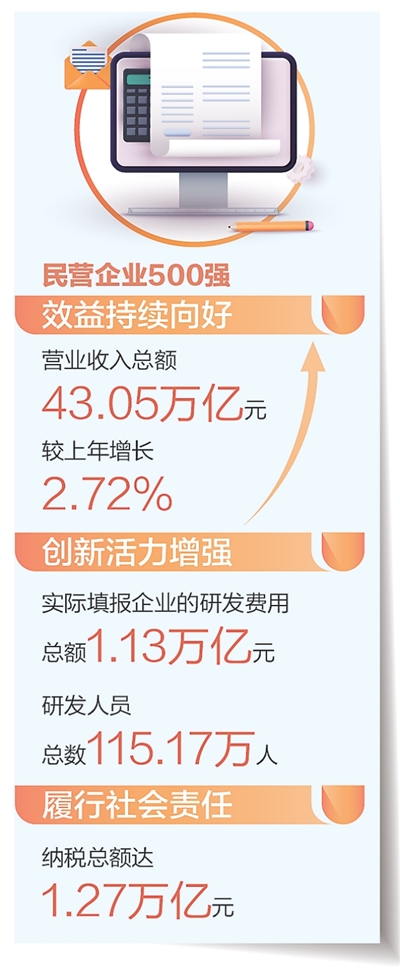
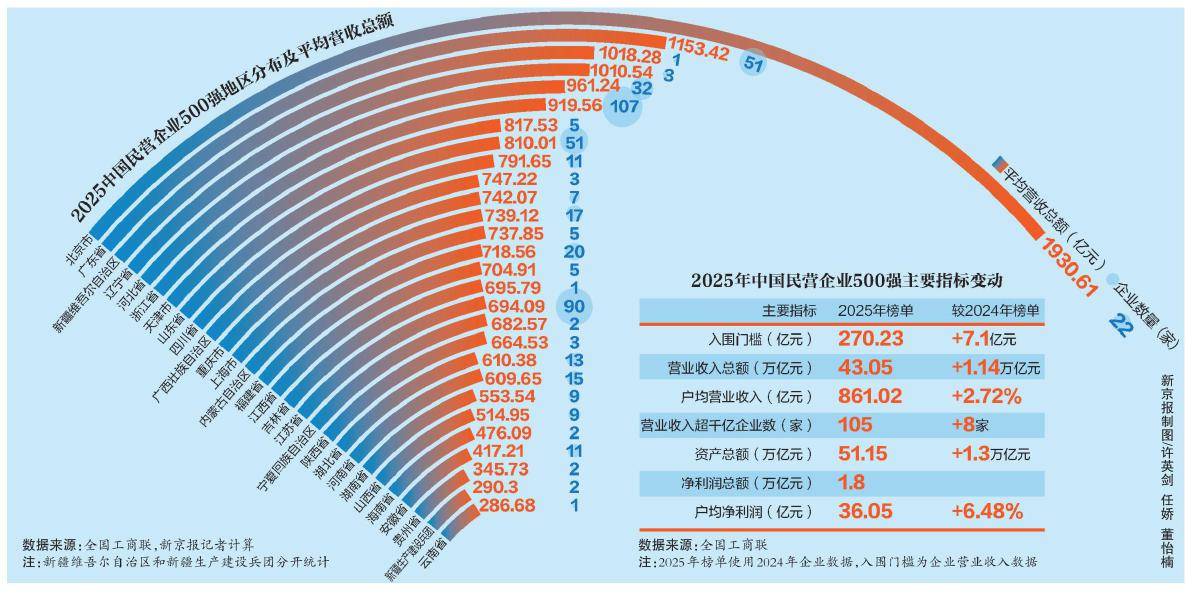
Core Insights - In 2024, the total revenue of the top 500 private enterprises in China reached 43.05 trillion yuan, with an average revenue of 861.02 billion yuan, marking a year-on-year growth of 2.72%. The total net profit amounted to 1.80 trillion yuan, with an average net profit of 36.05 billion yuan, reflecting a growth of 6.48% [2][3][4]. Revenue and Profitability - The total revenue of the top 500 private enterprises reached 43.05 trillion yuan, with an average revenue of 861.02 billion yuan, up 2.72% from the previous year. The total assets amounted to 51.15 trillion yuan, with an average asset value of 1.023 trillion yuan, increasing by 2.62%. The total net profit was 1.80 trillion yuan, with an average net profit of 36.05 billion yuan, growing by 6.48% [3][4][6]. - Among the top 500, 105 enterprises reported revenues exceeding 100 billion yuan, an increase of 8 from the previous year. There are 11 enterprises with revenues over 500 billion yuan, up by 2 [4][5]. Growth in Assets - A total of 380 enterprises saw their assets increase compared to the previous year, with 262 of them experiencing growth exceeding 5%. Among the 97 enterprises with assets over 100 billion yuan, 53 had asset growth exceeding 5% [5][6]. Digital Transformation and R&D - The top 500 private enterprises are increasingly focusing on digital and green transformations. Approximately 64.20% have developed digital transformation strategies, and 83.00% are advancing green low-carbon transitions. The total R&D expenditure reached 1.13 trillion yuan, with 171 enterprises spending over 1 billion yuan on R&D [7][8]. Employment and Social Contribution - The total employment among the top 500 private enterprises reached 11.09 million, with an average of 22,000 employees per enterprise. The total tax contribution was 1.27 trillion yuan, with 240 enterprises paying over 1 billion yuan in taxes [10][12].





海洋+AI、航运、生物医药、人才四大平行论坛将亮相2025海洋合作发展论坛
Qi Lu Wan Bao· 2025-08-29 02:19
Core Viewpoint - The 2025 Marine Cooperation Development Forum aims to strengthen and expand the marine industry in Qingdao through four parallel forums focusing on key sectors such as marine artificial intelligence, port shipping, marine biomedicine, and talent development [1][2][3] Group 1: Marine Artificial Intelligence - The first parallel forum focuses on the integration of marine and artificial intelligence, emphasizing the necessity of this integration to align with national strategies and global trends [1] - Activities include the establishment of a marine AI large model industry alliance and discussions on the development and application of marine AI models, with participation from over 150 experts and industry leaders [1] Group 2: Port Shipping - The second parallel forum addresses the transition of the global shipping market towards intelligence, digitization, and sustainability, with a theme centered on building a sustainable global shipping ecosystem [2] - It will feature over 150 authoritative guests from the maritime industry, discussing green shipping and the integration of the shipping industry into the blue economy [2] Group 3: Marine Biomedicine - The third parallel forum highlights marine biomedicine as a promising sector within emerging marine industries, linking it to national health strategies [2] - Key reports will be presented by industry leaders and experts, aiming to foster collaboration between marine biomedicine companies and local institutions to create a collaborative innovation system [2] Group 4: Marine Youth Talent - The fourth parallel forum focuses on the cooperation and innovation of young talents in the marine sector, promoting talent exchange and collaboration [3]
港股异动 | 中创智领(00564)绩后涨超6% 上半年归母净利同比增加16.36% 海外市场订货额实现高增
智通财经网· 2025-08-29 01:40
Core Viewpoint - Zhongchuang Zhiling (00564) experienced a stock price increase of over 6% following the release of its semi-annual report for 2025, indicating positive market reception to its financial performance [1] Financial Performance - The company reported a revenue of 19.97 billion RMB for the first half of 2025, representing a year-on-year increase of 5.42% [1] - The net profit attributable to shareholders was 2.515 billion RMB, showing a year-on-year growth of 16.36% [1] - Basic earnings per share stood at 1.427 RMB [1] Market Conditions - The domestic coal market in the first half of 2025 exhibited a relaxed supply-demand situation, with coal prices experiencing a downward trend [1] - There was increased pressure on the coal machinery equipment market due to declining demand [1] Strategic Initiatives - In response to the challenging market conditions, the company focused on user demand, innovation, and differentiation in technology, products, and services to enhance market competitiveness [1] - The company accelerated its international expansion efforts, achieving significant recognition in major coal-producing countries [1] Coal Machinery Segment - The coal machinery segment generated a revenue of 10.149 billion RMB, with stable profit growth year-on-year, continuing to serve as a stabilizing force for the group [1] - The order volume from overseas markets reached 775 million RMB, reflecting a year-on-year increase of 137%, indicating a trend of high-quality development [1]

中创智领绩后涨超6% 上半年归母净利同比增加16.36% 海外市场订货额实现高增
Zhi Tong Cai Jing· 2025-08-29 01:40
Core Viewpoint - Zhongchuang Zhiling (601717) reported a revenue increase of 5.42% year-on-year for the first half of 2025, despite challenges in the coal machinery market due to price declines and increased competition [1] Financial Performance - The company achieved a total revenue of 19.97 billion RMB for the first half of 2025 [1] - Net profit attributable to shareholders reached 2.515 billion RMB, reflecting a year-on-year increase of 16.36% [1] - Basic earnings per share were reported at 1.427 RMB [1] Market Conditions - The domestic coal market experienced a loose supply-demand situation, leading to a downward trend in coal prices [1] - The coal machinery equipment market faced increased pressure on demand [1] Strategic Initiatives - The company is focusing on innovation and differentiation in technology, products, and services to enhance market competitiveness [1] - There is an accelerated effort to expand into overseas markets, with significant recognition achieved in major coal-producing countries [1] Segment Performance - The coal machinery segment generated revenue of 10.149 billion RMB, with stable profit growth [1] - The overseas market order volume reached 775 million RMB, marking a year-on-year increase of 137% [1]
2025中国民营企业500强揭晓 22家北京上榜企业“科技含量”高
Sou Hu Cai Jing· 2025-08-29 01:29
Core Insights - The 2025 China Private Enterprises Top 500 list demonstrates the resilience and vitality of private enterprises in a complex domestic and international environment [1] - Overall, the private economy is showing steady progress, with improvements in quality, efficiency, and core competitiveness [1] Financial Performance - In 2024, the total revenue of the top 500 private enterprises reached 43.05 trillion yuan, with an average revenue of 861.02 million yuan, a 2.72% increase from the previous year [3] - The total assets amounted to 51.15 trillion yuan, with an average asset value of 1.023 billion yuan, reflecting a 2.62% growth [3] - The net profit of the top 500 private enterprises totaled 1.80 trillion yuan, with an average net profit of 36.05 million yuan, marking a 6.48% increase [4] Innovation and R&D - The total R&D expenditure of the top 500 private enterprises was 1.13 trillion yuan, with an average R&D intensity of 2.77% [6] - The number of valid patents held by these enterprises reached 721,600, an increase of 8.23%, with domestic patents growing by 12.42% [6] - The focus on strategic emerging industries is evident, with investments in new materials, new energy, and high-end manufacturing [4][6] Social Contribution - The top 500 private enterprises contributed a total tax amount of 1.27 trillion yuan and employed 11.09 million people, averaging 22,200 employees per enterprise [8] - A significant portion of these enterprises, 72.80%, actively participated in rural revitalization efforts [8] Regional Insights - Among the top 500 private enterprises, 22 are based in Beijing, with a strong concentration in the digital economy and high-end manufacturing sectors [9] - The supportive policies from the government, including tax incentives and a favorable business environment, have facilitated the growth of technology-driven enterprises in Beijing [9][10]



透视民企500强榜单:含“新”量不断提高
Zhong Guo Jing Ji Wang· 2025-08-29 00:36
Core Insights - The threshold for entering the 2025 China Top 500 Private Enterprises list has increased to 27.023 billion yuan, with total revenue, total assets, and net profit all showing growth compared to the previous year [1] - Private enterprises in the Top 500 have maintained a stable and positive trend through technological innovation, market expansion, and management optimization, reflecting the vitality and resilience of the Chinese economy [1] Revenue and Profit Growth - In 2024, the total revenue of the Top 500 private enterprises reached 4.305 trillion yuan, with an average revenue of 86.102 billion yuan, an increase of 2.72% year-on-year; total assets amounted to 5.115 trillion yuan, with an average asset value of 102.309 billion yuan, growing by 2.62% [2] - The total net profit of the Top 500 private enterprises was 1.8 trillion yuan, with an average net profit of 360.5 million yuan, reflecting a growth of 6.48%, and 70 companies reported net profits exceeding 5 billion yuan [2] Effective Strategies for Profitability - Private enterprises have explored three effective strategies for enhancing profitability: reducing labor costs through digitalization, minimizing procurement losses via vertical supply chain integration, and increasing the proportion of high-value-added products [3] - The resilience of overseas business is notable, with total exports amounting to 1.77 trillion yuan, a growth of 5.17%, and overseas revenue totaling 3.19 trillion yuan, increasing by 14.74% [3] Structural Optimization and Strategic Layout - Among the Top 500 private enterprises, 72% belong to the secondary industry, and 66.4% are from the manufacturing sector, with revenue, assets, and net profit in manufacturing growing by 7.66%, 7.92%, and 1.2% respectively [4] - The Top 500 are actively investing in strategic emerging industries such as new materials, new energy, and high-end equipment manufacturing, indicating a shift towards high-end sectors [4] Innovation and Governance - The total R&D expenditure of the Top 500 private enterprises reached 1.13 trillion yuan, with an average R&D intensity of 2.77%, both showing growth compared to the previous year [7] - The introduction of strategic investors has become common, with 52.24% of enterprises bringing in strategic investors, enhancing governance structures and decision-making processes [8]
民营企业攀高逐新活力迸发
Jing Ji Ri Bao· 2025-08-29 00:09
Core Insights - The threshold for entering the 2025 China Private Enterprises Top 500 has increased to 27.023 billion yuan, indicating growth in total revenue, total assets, and net profit compared to the previous year [1][2] Group 1: Revenue and Profit Growth - In 2024, the total revenue of the top 500 private enterprises reached 4.305 trillion yuan, with an average revenue of 861.02 million yuan, reflecting a growth of 2.72% [2] - The total assets amounted to 5.115 trillion yuan, with an average asset value of 1.023 billion yuan, showing a growth of 2.62% [2] - The total net profit reached 1.8 trillion yuan, with an average net profit of 360.5 million yuan, increasing by 6.48%, and 70 companies reported net profits exceeding 5 billion yuan [2] Group 2: Factors Driving Growth - Multiple positive factors contribute to the sustained growth of the top 500 private enterprises, including increased policy support, the release of domestic market vitality, and proactive changes within enterprises through technological innovation and refined management [2][3] - The resilience of overseas business is highlighted, with total export volume reaching 1.77 trillion yuan, a growth of 5.17%, and total overseas revenue at 3.19 trillion yuan, growing by 14.74% [3] Group 3: Industry Structure and Strategic Layout - Among the top 500 private enterprises, 72% belong to the secondary industry, and 66.4% are from the manufacturing sector, with manufacturing enterprises showing revenue growth of 7.66%, asset growth of 7.92%, and net profit growth of 1.2% [4] - The enterprises are actively engaging in strategic emerging industries, including new materials, new energy, and high-end equipment manufacturing, indicating a shift towards high-end sectors [4] Group 4: Innovation and Governance - The total R&D expenditure of the reporting enterprises reached 1.13 trillion yuan, with an average R&D intensity of 2.77%, reflecting a continuous increase in innovation vitality [6] - Over 90% of the enterprises have established internal control compliance institutions, balancing efficiency and risk while enhancing confidence among overseas investors [7]
民营企业500强 含“新”量越来越高(经济聚焦)
Ren Min Ri Bao· 2025-08-28 21:54
Core Insights - The "2025 China Top 500 Private Enterprises" list was released, with JD Group, Alibaba (China) Co., Ltd., and Hengli Group Co., Ltd. ranking in the top three, and the entry threshold for the list increased to 27.023 billion yuan [3][5] - Private enterprises are focusing on high-quality development despite external pressures and internal challenges, showing a steady improvement in operational efficiency and core competitiveness [3][5] Group 1: Business Performance - The total revenue of the top 500 private enterprises reached 4.305 trillion yuan in 2024, with an average revenue of 861.02 million yuan, reflecting a year-on-year growth of 2.72% [3][5] - The total assets of these enterprises amounted to 5.115 trillion yuan, with an average of 1.023 billion yuan per enterprise, marking a 2.62% increase from the previous year [3][5] - Net profit reached 180 billion yuan, with an average of 36.05 million yuan per enterprise, showing a year-on-year growth of 6.48% [3][5] Group 2: Industry Focus - 72% of the top 500 private enterprises belong to the secondary industry, with 66.4% in manufacturing [5] - The total revenue from manufacturing enterprises within the top 500 reached 2.963 trillion yuan, growing by 7.66% [5] Group 3: Innovation and Sustainability - The total R&D expenditure of the top 500 private enterprises was 1.13 trillion yuan, with an average R&D intensity of 2.77% [6][7] - 66.80% of the enterprises have achieved cost reduction and efficiency improvement through digital transformation, while 83.00% have adopted green and low-carbon technologies [7] Group 4: Social Responsibility - The total tax contribution of the top 500 private enterprises reached 1.27 trillion yuan, with 240 enterprises contributing over 1 billion yuan in taxes, accounting for 48% of the list [8] - 65.40% of the enterprises participated in the "Ten Thousand Enterprises Revitalize Ten Thousand Villages" initiative, contributing to rural revitalization and poverty alleviation efforts [8][9]