
卫星导航

Search documents
“人在家中坐,定位在玄武湖”,导航集体失灵?南京卫星协会发布说明
Xin Jing Bao· 2025-12-19 12:44
Core Viewpoint - The navigation signal anomaly in Nanjing on December 17, 2025, was caused by temporary interference affecting GNSS satellite signals, specifically targeting the civilian frequencies of Beidou and GPS, rather than a network signal interruption [2][3][4]. Group 1: Technical Analysis - Offline maps cannot resolve the navigation anomaly as the core issue is the interference of GNSS signals, which cannot be substituted by stored geographic data [2][3]. - The navigation system requires signals from at least four GNSS satellites to determine location coordinates, indicating that positioning signals and map data are independent systems [2][3]. - The interference specifically targeted the civilian frequency bands of Beidou and GPS, leading to unrecognized positioning signals, resulting in navigation failures even with offline maps [2][3]. Group 2: Strategic Significance - The simultaneous impact on both Beidou and GPS signals during the anomaly validates the strategic foresight of China's Beidou system in planning its civilian frequency bands [3][4]. - The compatibility of Beidou's civilian signal (B1C band) with GPS's civilian signal (L1C band) not only breaks the spectrum resource blockade but also creates a strategic balance where interference with Beidou also affects GPS [3][4]. - This design serves as a deterrent against malicious interference, as any disruption to Beidou's civilian signals will simultaneously impact GPS applications, thereby enhancing the security of China's civilian navigation services [3][4]. Group 3: Military Frequency Resilience - The signal anomaly only affected civilian GNSS frequencies, while Beidou's military frequencies remained unaffected due to their separation from civilian bands [4][5]. - The military system employs advanced anti-jamming technologies, ensuring robust resistance to interference and deception [4][5]. - The independence and resilience of Beidou's military frequencies provide stable and reliable time-space services for national defense and emergency support, unaffected by the civilian signal disruptions [4][5]. Group 4: Industry Response - The Nanjing Satellite Application Industry Association will continue to monitor industry developments and share professional knowledge on satellite navigation technology to enhance public understanding [4][5]. - The association encourages relevant enterprises to participate in discussions and will waive membership fees to facilitate communication between businesses and the government [5].

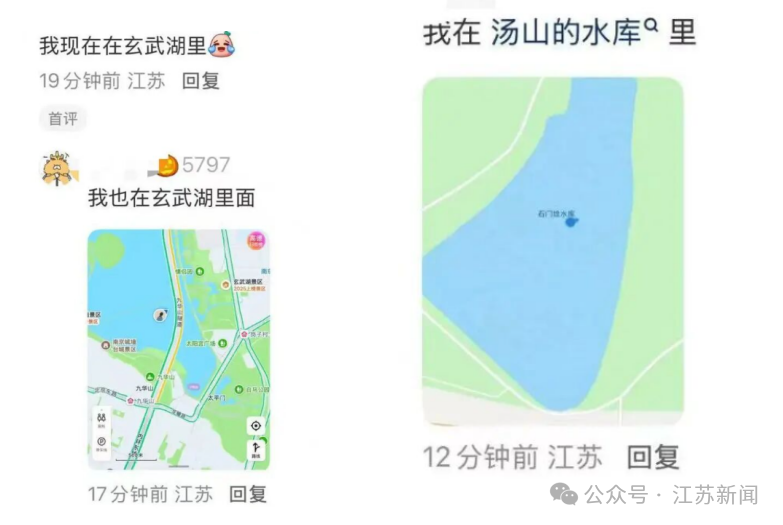
南京导航集体失灵,原因公布
证券时报· 2025-12-19 12:39
Core Viewpoint - The article discusses the navigation signal anomalies in Nanjing on December 17, 2025, clarifying the technical reasons behind the issue and emphasizing the strategic significance of the Beidou and GPS systems' compatibility [2][5]. Technical Analysis - Offline maps cannot resolve the navigation anomaly as the core issue is the temporary interference of GNSS satellite signals (including Beidou and GPS), not a network signal interruption [3]. - The core function of offline maps is to store geographic data, which only addresses the "map display" issue and cannot replace the positioning signal source [4]. - Mobile navigation relies on GNSS satellite signals (at least 4 satellites) to calculate position coordinates, and the positioning signal and map data are independent systems [4]. - The interference specifically targeted the civilian frequency bands of Beidou and GPS, preventing the positioning signal from being recognized by receivers, leading to issues like positioning drift and lack of data feedback, making effective navigation impossible [4]. Strategic Significance - The simultaneous impact on Beidou and GPS signals during the anomaly validates the forward-looking strategic vision of China's Beidou system's civilian frequency band planning [5]. - The international satellite navigation spectrum resources follow a "first come, first served" rule, with GPS having occupied core L-band resources early on, leaving limited quality spectrum for Beidou [6]. - Under the framework of the International Telecommunication Union, the compatibility of Beidou's civilian signal (B1C band) with GPS's civilian signal (L1C band) breaks the spectrum resource blockade and creates a strategic balance where interference with Beidou also affects GPS [6]. - Given the military ties of the U.S. and EU, NATO systems also rely on GPS signals, making this frequency compatibility a significant strategic deterrent against malicious interference [6]. Military Frequency Resilience - The signal anomaly only affected civilian GNSS frequency bands, while Beidou's military frequency remains unaffected [7]. - Beidou employs a military-civilian frequency separation design, with military frequencies being exclusive and confidential, physically isolated from civilian bands [7]. - The military system incorporates full digital anti-jamming technology and adaptive intelligent filtering algorithms, enabling precise identification and filtering of interference signals, thus possessing strong anti-jamming and anti-deception capabilities [7]. - The independence and anti-jamming capabilities of Beidou's military frequency provide stable and reliable time-space services for national defense security and emergency support in critical areas, unaffected by the civilian signal interference [7].

南京导航集体失灵,“本次干扰精准针对北斗、GPS民用频段”
Xin Lang Cai Jing· 2025-12-19 12:14
Core Viewpoint - The navigation signal anomaly in Nanjing on December 17, 2025, was caused by temporary interference with GNSS satellite signals, not by a network signal interruption, highlighting the limitations of offline maps in resolving such issues [1][2]. Technical Analysis - Offline maps only store geographic data and cannot replace the source of positioning signals, which rely on GNSS satellite signals from at least four satellites [2] - The interference specifically targeted the civilian frequency bands of Beidou and GPS, preventing the reception of positioning signals, leading to issues like position drift and lack of data feedback even with offline maps [2] - Offline maps are more suitable for areas with satellite positioning signals but without communication network signals, such as oceans or remote mountains [2] Strategic Significance of Beidou and GPS Compatibility - The simultaneous impact on both Beidou and GPS signals during the anomaly validates the strategic foresight of China's Beidou system in planning its civilian frequency bands [3] - The international satellite navigation spectrum follows a "first come, first served" rule, with GPS having occupied core L-band resources early on, leaving limited quality spectrum for Beidou [3] - The compatibility of Beidou's civilian signal (B1C band) with GPS's civilian signal (L1C band) breaks the spectrum resource blockade and creates a strategic balance, where interference with Beidou also affects GPS applications [3] Military Frequency Resilience - The signal anomaly only affected civilian GNSS frequency bands, while Beidou's military frequencies remained unaffected [4] - Beidou employs a military-civilian frequency separation design, with military frequencies being exclusive and physically isolated from civilian bands [4] - The military system incorporates advanced anti-jamming technologies, ensuring strong resilience against interference and deception, providing stable and reliable time-space services for national defense and emergency response [4] Industry Response - The Nanjing Satellite Application Industry Association will continue to monitor industry dynamics and share professional knowledge on satellite navigation technology to enhance public understanding [5] - The association aims to facilitate communication between enterprises and the government, encouraging participation from relevant companies without membership fees [5]
中科电气(300035.SZ):目前未涉及卫星导航领域
Ge Long Hui· 2025-12-19 11:58
Group 1 - The core business of the company includes lithium battery anode business and electromagnetic equipment business [1] - The company has not yet ventured into the satellite navigation field [1]

创耀科技(688259.SH):拟800万元增资参股旋极星源
Ge Long Hui A P P· 2025-12-19 11:29
Group 1 - The company, Chuangyao Technology (688259.SH), plans to invest RMB 8 million to acquire a 2% stake in Xuanji Xingyuan through a capital increase, which corresponds to an additional registered capital of RMB 36,735 for the target company [1] - Xuanji Xingyuan is a provider of wireless connectivity solutions based on proprietary semiconductor IP, focusing on low-power IoT and satellite navigation sectors [1] - The company offers platform-based, one-stop custom RF/analog chip services and IP licensing to its clients [1]

中科电气:公司主营业务目前未涉及卫星导航领域
Mei Ri Jing Ji Xin Wen· 2025-12-19 11:27
Group 1 - The company, Zhongke Electric (300035.SZ), has confirmed that its main business includes lithium battery anode and magnetic equipment, and it currently does not have any involvement in the satellite navigation sector [1]
由创新高个股看市场投资热点
量化藏经阁· 2025-12-19 09:11
报 告 摘 要 乘势而起:市场新高趋势追踪 触及新高的个股、行业和板块可被视为市场的风向标。越来越多的研究表明动量、趋势跟踪策略的有效性。本报告旨在定期跟踪市场中创新高的个股及其 分布,以追踪市场趋势、把握市场热点。 截至2025年12月19日,上证指数、深证成指、沪深300、中证500、中证1000、中证2000、创业板指、科创50指数250日新高距离分别为3.45%、 4.26%、3.78%、5.03%、4.16%、2.16%、6.08%、14.98%。中信一级行业指数中轻工制造、有色金属、通信、国防军工、消费者服务行业指数距离 250日新高较近,食品饮料、综合金融、房地产、医药、建筑行业指数距离250日新高较远。概念指数中,十大军工集团、卫星导航、家居用品、卫星互联 网、金属非金属、航天军工、林木等概念指数距离250日新高较近。 见微知著:利用创新高个股进行市场监测 截至2025年12月19日,共620只股票在过去20个交易日间创出250日新高。其中创新高个股数量最多的是机械、电子、基础化工行业,创新高个股数量占 比最高的是国防军工、有色金属、轻工制造行业。按照板块分布来看,本周制造、科技板块创新高股票 ...

华丰科技涨2.01%,成交额2.70亿元,主力资金净流入2452.66万元
Xin Lang Cai Jing· 2025-12-19 02:41
Core Viewpoint - Huafeng Technology's stock has shown significant growth this year, with a year-to-date increase of 139.41%, despite recent declines in the short term [1][2]. Company Overview - Huafeng Technology, established on November 21, 1994, is located in Mianyang, Sichuan Province, and was listed on June 27, 2023. The company specializes in the research, production, and sales of optical and electrical connectors and cable components, providing system solutions to customers [2]. - The revenue composition of Huafeng Technology includes components (61.65%), connectors (29.83%), system interconnection products (5.90%), and other supporting components (1.68%) [2]. Financial Performance - For the period from January to September 2025, Huafeng Technology achieved a revenue of 1.659 billion yuan, representing a year-on-year growth of 121.47%. The net profit attributable to shareholders was 223 million yuan, showing a remarkable increase of 558.51% year-on-year [2]. - Since its A-share listing, Huafeng Technology has distributed a total of 23.0496 million yuan in dividends [3]. Shareholder Structure - As of September 30, 2025, the number of shareholders of Huafeng Technology reached 30,600, an increase of 37.52% from the previous period. The average circulating shares per person decreased by 27.28% to 5,942 shares [2]. - Notable changes in institutional holdings include Hong Kong Central Clearing Limited becoming the second-largest circulating shareholder with 6.1123 million shares, and several new funds entering the top ten circulating shareholders [3].
航天环宇跌2.02%,成交额3.77亿元,主力资金净流出4032.64万元
Xin Lang Cai Jing· 2025-12-19 02:08
Group 1 - The core viewpoint of the news is that Aerospace HuanYu's stock has experienced significant fluctuations, with a year-to-date increase of 118.50% and a recent decline of 2.02% [1] - As of December 19, the stock price is reported at 43.70 yuan per share, with a total market capitalization of 17.78 billion yuan [1] - The company has seen a net outflow of 40.33 million yuan in principal funds, with large orders accounting for 23.90% of purchases and 34.02% of sales [1] Group 2 - Aerospace HuanYu, established on March 10, 2000, is located in Changsha, Hunan Province, and was listed on June 2, 2023 [2] - The company's main business includes the development and maintenance of metal and composite material forming equipment, with revenue composition as follows: aerospace and communication products 46.62%, aviation products 27.72%, aerospace equipment 25.60%, and others 0.06% [2] - As of September 30, 2025, the company reported a revenue of 304 million yuan, a year-on-year increase of 10.44%, and a net profit attributable to shareholders of 51.48 million yuan, a growth of 0.56% [2] Group 3 - Since its A-share listing, Aerospace HuanYu has distributed a total of 80.88 million yuan in dividends [3] - As of September 30, 2025, the top ten circulating shareholders include Hong Kong Central Clearing Limited, which holds 1.42 million shares, a decrease of 357,400 shares from the previous period [3] - The Southern CSI 1000 ETF is a new shareholder, holding 748,500 shares as the tenth largest circulating shareholder [3]

四川九洲:公司控股子公司积极探索基于低轨卫星星座的空管监视技术
Zheng Quan Ri Bao Wang· 2025-12-18 13:12
证券日报网讯 12月18日,四川九洲(000801)在互动平台回答投资者提问时表示,在商业航天和卫星 导航领域,公司控股子公司四川九洲空管科技有限责任公司积极探索基于低轨卫星星座的空管监视技 术,开展了关键技术研究,星基ADS-B载荷搭载"空事卫星一号"在轨验证,具有较好的技术基础。在低 空领域,九洲空管始终以行业领先技术、产品可靠质量赢得用户认可,低空业务处于稳步提升中。未来 九洲空管将持续关注行业政策,发挥自身产品和服务优势,积极跟进市场需求,开展相关方案论证、技 术研究和产品研发,推动产业发展。 ...
